Last Updated on March 10, 2026 by Becky Halls
Automated niche link exchanges can save time and boost SEO, but only when done correctly. Here’s the key takeaway: focus on relevance, quality, and compliance with search engine guidelines to avoid penalties. Tools like 3Way.Social simplify the process by automating partner matching and managing links, but you must maintain control over quality and strategy.
Key Points:
- ABC Link Exchange: A → B → C → A structure avoids direct reciprocity, reducing detection risks.
- Quality Over Quantity: Target sites with strong metrics (e.g., Domain Authority above 30) and relevant content.
- Anchor Text Diversity: Avoid repetitive patterns to prevent over-optimization penalties.
- Reciprocal Link Ratio: Keep below 20% of total links to maintain a natural profile.
- Monitoring: Use tools like Ahrefs or SEMrush to track metrics like referral traffic, link diversity, and domain authority.
Risks to Avoid:
- Overusing reciprocal links or repetitive anchor text.
- Linking to low-quality or spammy sites.
- Rapid link-building that appears unnatural.
Actionable Tips:
- Set Clear Goals: Define objectives like boosting domain authority or targeting specific keywords.
- Leverage AI Tools: Use platforms like 3Way.Social for partner matching and link management.
- Monitor Metrics: Regularly review link performance and adjust strategies to align with SEO goals.
Bottom Line: Automation can streamline link building, but success requires careful planning, ethical practices, and regular monitoring.
The Dark Reality of Link Building in iGaming, Crypto & Restricted Niches
How ABC Link Exchanges Work in Niche Markets
An ABC link exchange, or three-way exchange, involves three websites linking in a circular pattern rather than directly reciprocating links. Here’s how it works: Site A links to Site B, Site B links to Site C, and Site C links back to Site A (A → B → C → A). This setup avoids the direct “you link to me, and I’ll link to you” pattern that search engines often flag as manipulative. By breaking this obvious reciprocal structure, ABC exchanges create a more natural-looking link network.
Traditional two-way link swaps are easy for algorithms to detect because of their direct reciprocity. ABC exchanges, however, transform these into one-way links that appear independent. This is especially important because 51.6% of link builders actively use link exchanges as part of their strategy. Yet, Google’s John Mueller has warned:
A link exchange where both sides are kind of like ‘you link to me and I’ll link back to you’… that is essentially against our guidelines. Our algorithms would look at that and try to understand what is happening and try to ignore those links.
In niche markets, ABC exchanges thrive by creating relevant, interconnected ecosystems. For instance, a fitness blog might link to a nutrition site, which links to a supplement store, which then links back to the fitness blog. These connections offer value in context, making the links appear organic and useful.
One of the key benefits of this approach is reducing the “reciprocal footprint.” Instead of directly trading links, ABC exchanges distribute link equity across multiple domains. This matters because a study of 140,000 websites with at least 10,000 monthly visitors revealed that 74% have reciprocal links. ABC exchanges help diversify link profiles, aligning with Google’s guidelines while still benefiting from strategic partnerships.
“We’ve seen niche link exchange automation work best when it starts with relevance filters. The moment you automate match-making without topic fit, you scale the wrong links.” Ian Naylor, Founder of 3Way Social
Tools like 3Way.Social simplify the process by automating the matching of three relevant partners and managing the circular link placements. This eliminates the manual work while ensuring that the links remain high-quality and relevant, making these exchanges both efficient and effective.
Core Practices for Automated Niche Link Exchanges
Before diving into automated link exchanges, it’s crucial to set clear objectives. Are you aiming to boost domain authority, target specific keywords, or drive referral traffic? These goals will shape your entire strategy, from the tools you use to how you measure success. As Rayan Biswas, an SEO and digital marketing expert, emphasizes:
Automating link building effectively starts with understanding your goals. Clearly define what you aim to achieve with your automated efforts. This clarity helps in choosing the right tools and strategies.
Having clear goals also ensures efficient resource allocation. With the average high-quality backlink costing around $361 in 2026, prioritizing your efforts is essential – especially if you’re working on a tight budget. Focus on your pillar pages, which are the content pieces that drive the most traffic or conversions. And since 94–95% of all web pages receive zero backlinks, allocating resources strategically can make all the difference. Setting benchmarks for domain authority, keyword rankings, and referral traffic will help you track progress and refine your approach.
Once your objectives are in place, you can implement targeted strategies to improve your link exchange outcomes.
Set Clear Link Goals for Your Niche
Start by mapping your link equity. Identify the pages on your site that lack backlinks but hold the potential to make a significant impact. This ensures you’re not wasting time on pages that won’t deliver results. Your goals should also include specific parameters for link quality and relevance. This helps avoid spammy practices and protects your site from search engine penalties. For instance, if you run a fitness blog, your goal might be to secure 20 high-quality links per month from health, nutrition, and wellness sites with a domain authority above 30.
Use AI-Powered Tools for Domain Matching
AI-powered platforms can streamline the process of finding link partners by analyzing site content, industry relevance, and keyword alignment. These tools match you with potential partners based on factors like domain authority, audience demographics, and keyword themes. For example, 3Way.Social uses AI-driven matchmaking to identify high-quality domains for ABC link exchanges. It replaces the tedious manual tasks of cold outreach and spreadsheet tracking with a centralized dashboard. The platform also vets potential partners for issues like link toxicity, duplicate anchor text, and spam signals, ensuring you’re connecting with legitimate sites that have real organic traffic. This step is vital to avoid low-quality link directories or black-hat practices.
Apply Quality Control Filters
Even with automated tools, maintaining quality control is non-negotiable. Use platforms like Ahrefs or SEMrush to check a site’s domain authority and organic traffic levels before agreeing to an exchange. Avoid sites with thin content or obvious spam signals. Focus on securing in-content links and ensure that all links are “dofollow” to pass link equity.
Diversify your anchor text by mixing branded terms, partial match keywords, and generic phrases like “read more” to avoid over-optimization penalties. Additionally, monitor your link velocity – that is, how quickly you’re acquiring new links. A steady, natural growth pattern is key to avoiding suspicion. As Alex Tachalova, founder of Digital Olympus, advises:
Don’t build links for the sake of links. Build links for the sake of future growth. You don’t need links from sites that aren’t investing in their online visibility.
sbb-itb-88880ed
How to Avoid Penalties and Follow Google Guidelines
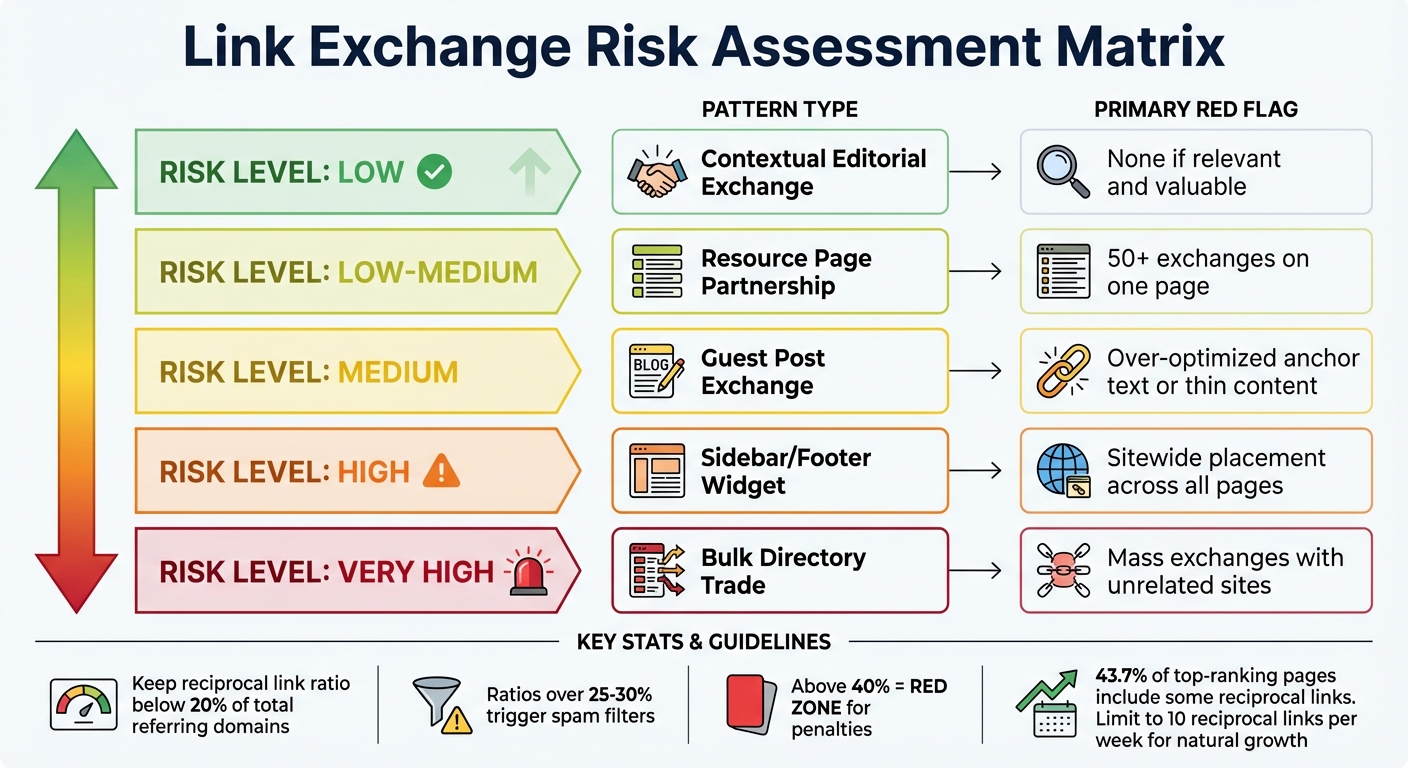
Link Exchange Risk Levels and Red Flags Guide
Google’s spam policy is straightforward: “excessive link exchanges” or creating partner pages solely for cross-linking violates their rules. But here’s the thing – link exchanges themselves aren’t inherently bad. In fact, 43.7% of top-ranking pages include some reciprocal links. The key is implementing them wisely.
To stay on the safe side, aim to keep your reciprocal link ratio below 20% of your total referring domains. For instance, Ahrefs’ blog maintains a ratio of 19.25% while ranking for over 676,000 keywords. On the flip side, ratios over 25–30% could trigger spam filters, and anything above 40% puts you in the “red zone” for penalties. Below are actionable tips to help you avoid penalties while benefiting from link exchanges.
Prevent Over-Optimization and Link Spam
Using repetitive anchor text patterns is a surefire way to attract penalties. Jin Grey, an SEO expert, shared a cautionary tale:
I had a client who lost 42% of his traffic because he exchanged 150 backlinks, using the same anchors and looks in each case.
This highlights why variation is essential.
Start by diversifying your anchor text to avoid over-optimization. Also, manage your link-building pace – limit reciprocal links to 10 per week to maintain a natural growth pattern.
“In our experience, the biggest automation mistake is repeating the same patterns – same partners, same anchor styles, same page types. The safest setups build variety in on purpose.” Ian Naylor, Founder at 3Way Social
Where you place your links matters too. Embed them within your content to make them look editorial. Avoid sitewide placements in footers or sidebars, as these are riskier.
| Pattern Type | Risk Level | Primary Red Flag |
|---|---|---|
| Contextual Editorial Exchange | Low | None if relevant and valuable |
| Resource Page Partnership | Low-Medium | 50+ exchanges on one page |
| Guest Post Exchange | Medium | Over-optimized anchor text or thin content |
| Sidebar/Footer Widget | High | Sitewide placement across all pages |
| Bulk Directory Trade | Very High | Mass exchanges with unrelated sites |
In addition to these technical precautions, focus on partnering only with high-quality, relevant sites to further protect your rankings.
Prioritize Quality Over Volume
When it comes to automated exchanges, quality trumps quantity every time. Interestingly, 73.6% of high-traffic websites effectively use reciprocal links by prioritizing relevance and authority over sheer numbers. Here’s how you can do the same:
- Focus on relevance and authority: Only exchange links with sites that are topically aligned and have a Domain Authority within 20 points of your own.
- Vet potential partners: Ensure they receive at least 2,000+ monthly organic visits and have a Domain Rating above 40. Also, their outbound link ratio should be below 2:1 to avoid connections with link farms.
One smart tactic is to “link first, ask later.” Mentioning a potential partner in your content can build goodwill and often leads to organic reciprocal links.
Finally, monitor your link profile regularly using Google Search Console. If you notice a surge in low-quality reciprocal links, use the Google Disavow tool to protect your site’s authority. Remember, a handful of high-quality links from relevant sites will always outperform a flood of low-value exchanges from unrelated domains.
How to Measure and Improve Your Automation
To keep your niche link exchanges effective, regular measurement is a must. Tracking the right metrics helps you separate productive automation from wasted effort. Without data, it’s impossible to know if your automated exchanges are boosting rankings or harming your site’s reputation.
Monitor Key SEO Metrics
Start by keeping an eye on authority metrics like Domain Authority (DA) from Moz or Domain Rating (DR) from Ahrefs. These scores help you gauge the SEO strength of each link. However, don’t stop there. Look at referral traffic to see if your links are actually bringing visitors to your site. A high-DA link that drives no traffic could signal that the partner site lacks genuine user engagement.
Another critical factor is link diversity. Track the number of unique referring domains to maintain a natural backlink profile. Also, analyze your anchor text regularly to avoid over-optimization, which could lead to penalties.
| Category | Metrics | Purpose |
|---|---|---|
| Authority | DA (Moz), DR (Ahrefs), Authority Score (SEMrush) | Measure the SEO strength of the link. |
| Traffic | Organic Traffic, Referral Traffic, Time on Site | Verify the link provides user value. |
| Profile Health | Anchor Text Ratio, Spam Score, Link Toxicity | Avoid penalties from search engines. |
| Technical | Dofollow/Nofollow status, Indexation, 404 Errors | Ensure active links passing equity. |
| Automation | Outreach Open/Response Rates, Link Placement Speed | Measure the efficiency of your automation. |
Also, confirm that your links are dofollow, properly indexed, and not leading to 404 errors. Use tools to monitor spam scores and identify toxic links that could harm your site. Keep an eye on your SERP performance by tracking changes in keyword rankings and overall organic visibility.
These metrics serve as your foundation for improving the automation process.
Adjust Your Process Based on Data
Once you’ve gathered data, use it to refine your link exchange strategy. Nebojsa Jankovic, Founder & CEO of Heroic Rankings, emphasizes:
When metrics plateau or decline, that’s your cue for change. Continuously tracking the performance of your link exchanges is crucial to identifying stagnation.
If you’re generating a high volume of links but not seeing ranking improvements, it might be time to tighten your filters. For example, you could focus on sites with a DA above 30 or DR above 60. Similarly, if certain exchanges fail to bring referral traffic, it could indicate poor niche relevance or bad placement context.
Set up real-time alerts in tools like Ahrefs or SEMrush to monitor new, lost, or broken backlinks. This way, you can recover lost links quickly or adjust your partnership strategy. If you notice sudden ranking drops, pause your automated campaigns to investigate and disavow any toxic links. A balanced link-building strategy might include 30% automated exchanges, 20% manual outreach, 20% guest posting, 15% broken link building, 10% content promotion, and 5% other methods. Use your data to find the right mix for your specific niche.
“We’ve noticed monitoring matters as much as sourcing. Automated exchanges look great on day one, but link loss and page edits creep in over time unless you track placements and follow up.” Becky Halls, Strategist at 3Way Social
For added efficiency, consider using an AI-powered platform like 3Way.Social, which offers real-time analytics and alerts in one dashboard. These tweaks ensure your automation strategy stays aligned with your SEO goals.
Conclusion
Automating niche link exchanges doesn’t mean sacrificing quality for speed. The best results come from blending ethical practices with smart technology. By using ABC structures, you can ensure link relevance while avoiding direct reciprocity. Combine this with quality filters – like targeting high Domain Ratings, strong monthly organic traffic, low reciprocal link ratios, and varied anchor text – to maintain a high standard.
Instead of chasing volume, focus on editorial value. For instance, securing five high-quality links from DR 60+ sites in your niche can deliver better results than dozens of lower-quality exchanges. This approach not only aligns with Google’s guidelines but also helps safeguard your site from penalties while building genuine authority.
Consistent monitoring is key to sustained success. If your metrics start to plateau, consider adjusting filters, refining anchor text strategies, or shifting more exchanges to three-way link structures across your properties [23, 24].
Platforms like 3Way.Social make this process easier by offering AI-powered domain matching, built-in quality filters, and real-time tracking. Their tools ensure links are topically relevant and maintain healthy link profiles, all while adhering to natural linking patterns that search engines favor. Users have reported improved rankings and higher domain authority thanks to features like advanced link diversification and a vetted network of partners [23, 24].
FAQs
Are ABC link exchanges safe with Google?
ABC link exchanges can be safe if handled with care and attention to detail. The key lies in focusing on relevance, quality, and avoiding manipulative tactics. While Google frowns upon unnatural link schemes, you can stay on the right side of their guidelines by following a few best practices:
- Partner with sites that are relevant to your niche.
- Use a mix of anchor texts to keep things natural.
- Regularly monitor the health and quality of your backlinks.
However, overdoing it or linking to spammy websites can raise red flags with Google and lead to penalties. The trick is to keep it balanced and ensure your link exchanges align with Google’s rules for a safer SEO strategy.
How do I pick good exchange partners?
To choose the right partners for niche link exchanges, focus on relevance, authority, and traffic quality. Seek out websites that have strong domain authority, publish content closely related to your niche, and attract a steady stream of quality traffic. Stay away from spammy or low-quality sites, link farms, or anything that might appear unnatural – these could result in penalties. Tools like 3Way.Social can help streamline the process by connecting you with ethical, high-quality link exchange opportunities that align with your domain.
How fast should I build exchange links?
Building exchange links requires a thoughtful, gradual approach to ensure quality and avoid penalties from search engines like Google. If you rush or engage in excessive link exchanges, it can raise red flags with search algorithms. Instead, take your time and focus on strategic link exchanges that are relevant to your content and genuinely enhance its value.
By prioritizing relevance and spreading out link exchanges over time, you’ll stay within search engine guidelines while laying a solid foundation for long-term SEO success.