Last Updated on July 24, 2026 by Becky Halls
AI is transforming link building by automating time-consuming tasks like prospecting, outreach, and follow-ups. Here’s what you need to know:
- Efficiency: AI tools can send hundreds of personalized emails in hours, compared to the 50–100 emails per week typical of manual methods.
- Scalability: AI eliminates bottlenecks, handling large-scale campaigns effortlessly while maintaining personalization. Using a link building planner further streamlines this process.
- Performance: Response rates for AI-powered outreach range from 25–40%, far surpassing the 1–2% seen with manual, templated emails.
- Cost and Time Savings: AI reduces the time spent on tasks like research and email crafting, cutting weeks of work into minutes.
- Hybrid Approach: Combining AI’s speed with human oversight ensures quality and credibility.
AI-powered platforms and link building client platforms like 3Way.Social are reshaping SEO strategies by matching verified partners, automating outreach, and delivering permanent, high-quality backlinks. To stay competitive, leveraging AI in link building is no longer optional – it’s essential for scaling efforts effectively.
Link Building Automation: Instantly Find Relevant Guest Posting Opportunities
sbb-itb-88880ed
1. Manual Link Building
Manual link building is an entirely hands-on process. It starts with exporting data from SEO tools like Ahrefs or SEMrush, then spending hours evaluating potential prospects for their relevance and authority. After that, you search for email addresses, verify contacts, and create unique outreach pitches. As campaigns grow, managing follow-ups through spreadsheets quickly becomes unmanageable.
Efficiency
On average, a link builder spends about 15 minutes crafting each personalized email, which means only 2–4 emails can be sent per hour. A typical manual campaign requires 10–15 hours just for research and outreach, and it usually takes around eight days to secure a backlink after the initial contact.
The costs add up, too. Agencies charge between $3,000 and $15,000 per month for 5–15 high-quality links. This means the cost per link can range from $200 to $3,000, primarily due to the labor involved.
"Traditional outreach is historically resource-heavy. From email crafting to prospecting and follow-ups, link-building lead generation alone is a full-time job for many SEO teams." – Rebecca Barnatt-Smith, Content Manager, Solvid
Even with efficient link building workflows, the manual process struggles to scale effectively.
Scalability
Scaling manual link building is a serious challenge. Time constraints limit most manual efforts to 50–100 emails per week. Trying to scale further often reduces the quality of personalization, which directly impacts performance. For example, response rates drop from 10–25% with fully personalized outreach to as low as 1–2% when using recycled templates.
In comparison, an AI agent can handle over 800 emails in just three hours. Manual methods also falter when it comes to follow-ups – many link builders abandon campaigns after the first email because tracking hundreds of contacts becomes overwhelming.
Personalization
One of the strengths of manual outreach is the ability to deeply personalize emails. For high-authority targets, referencing specific articles or recent social media updates can create a genuine connection that generic templates simply can’t match. Research shows personalized emails achieve 29% higher open rates, 14% more click-throughs, and calls to action tailored to the recipient convert 42% better.
That said, this level of personalization is time-intensive. With each email taking 15–30 minutes to craft, 73% of marketers using manual methods secure fewer than 10 links per month. AI-powered tools, however, can replicate this level of personalization while dramatically cutting down on time.
Performance Metrics
Manual link building does yield strong results in certain areas. Fully personalized outreach typically achieves a 10–25% response rate and a 40–60% conversion rate for secured links. However, it takes about 3.1 months to see meaningful ranking improvements. When you weigh these outcomes against the labor and time required, manual link building often becomes less appealing compared to the efficiency of AI-driven platforms.
2. AI-Powered Tools (e.g., 3Way.Social)
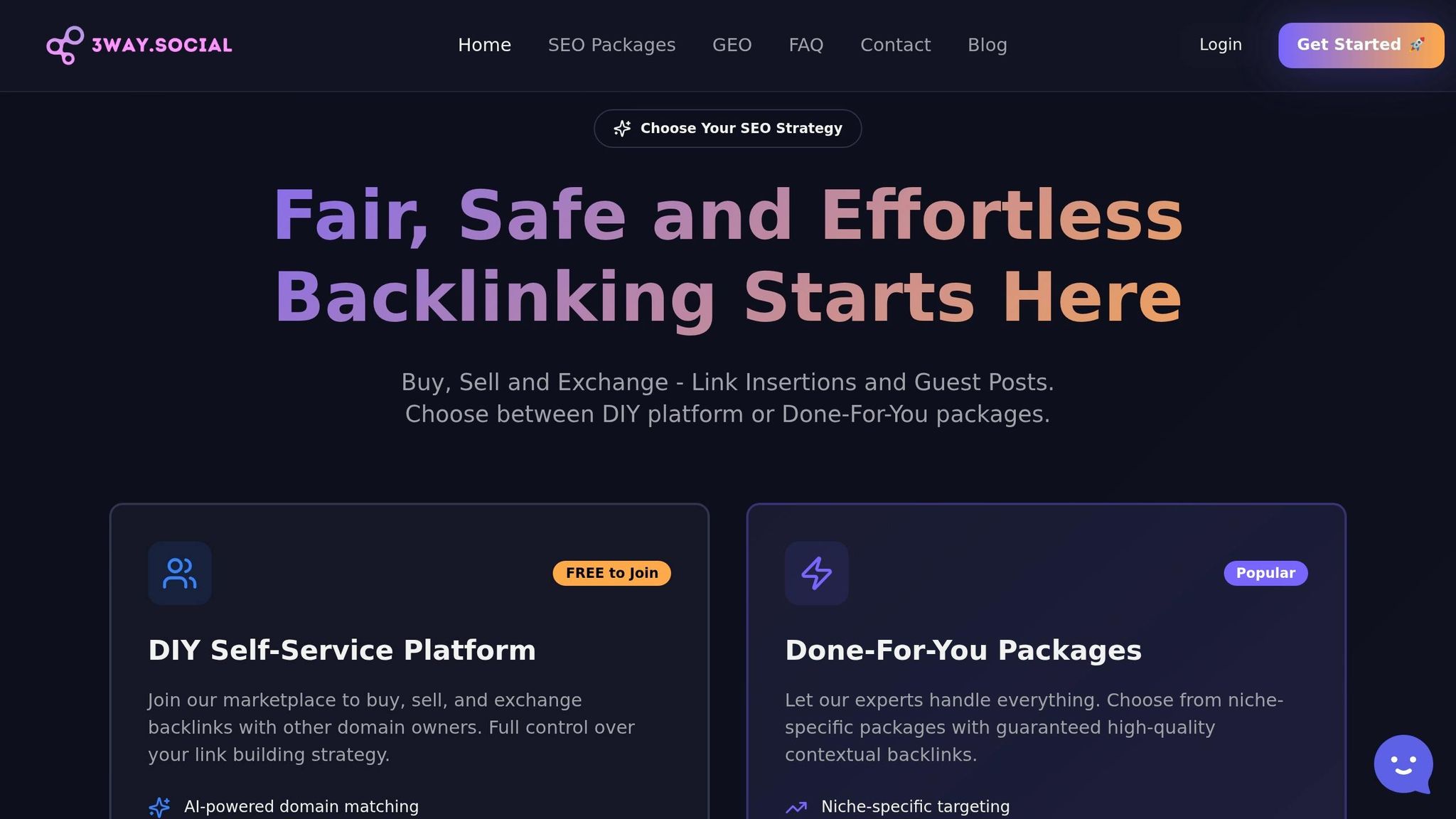
AI-powered platforms are transforming link building by automating what used to be time-consuming tasks like prospecting and outreach. Instead of manually searching for prospects and drafting individual emails, these tools use advanced algorithms to match verified brands for backlink exchanges. The setup process takes less than 10 minutes, compared to the 10–15 hours typically required for manual efforts.
Efficiency
AI tools leverage machine learning and natural language processing to handle tasks that previously demanded constant manual input. For link building, this means analyzing thousands of potential partners, verifying domain quality, and coordinating three-way link exchanges using the ABC model. Traditional agencies often provide reports loaded with links that either disappear within six months or land on irrelevant pages. AI-powered platforms, on the other hand, focus on delivering permanent, do-follow links between verified partners, cutting out unnecessary guesswork and wasted effort.
"AI automation frees organizations from manual, error-prone processes, facilitating faster decision cycles, higher accuracy, and more scalable digital operations." – Oracle
The time savings are substantial. While manual outreach typically maxes out at 50–100 personalized emails per week, AI tools can send hundreds with minimal setup. This efficiency has been linked to a reported 68% boost in SEO ROI when used effectively.
Scalability
AI tools shine when it comes to scaling link-building campaigns. Manual methods are limited by the volume of outreach one person or team can handle, but AI eliminates this bottleneck. For example, 44.2% of SEO professionals have already incorporated AI into their link-building strategies, and nearly half of SEO strategies are projected to rely on AI tools by 2026.
One standout feature is the ability to manage complex linking patterns, like the ABC link exchange model used by 3Way.Social, where Site A links to B, B links to C, and C links back to A. This triangular linking approach appears more natural to search engines. Many SEO teams (58%) now use a hybrid strategy, where AI handles repetitive tasks while humans oversee the overall strategy, allowing for greater scalability without the need for additional staff.
Personalization
AI doesn’t just automate processes – it also brings personalization to scale. Modern tools use advanced language models to analyze target sites and craft messages tailored to specific content gaps. Platforms like 3Way.Social take this a step further by matching users with vetted partners in their niche or closely related industries, ensuring that link exchanges align with relevant topics – something search engines are increasingly prioritizing. Unlike rigid, rule-based systems, AI understands context and intent, leading to smarter and more effective link placements.
"The game has changed. CMOs who win don’t buy links. They trade value with other SaaS leaders. That’s how we built 3way.Social." – Ian Naylor, SaaSAnalytics
Automated follow-ups also play a key role, increasing guest post acceptance rates by 25% and securing links within high-quality, contextually relevant content.
Performance Metrics
AI-powered platforms continuously track and analyze data to improve link-building strategies over time. For example, 3Way.Social offers automated link status verification to ensure links remain live and do-follow, while also monitoring the impact on metrics like domain authority and traffic. AI-driven outreach achieves response rates of 25–40%, a significant jump from the 1–2% typical of manual, templated outreach. Additionally, guest posts that include data-backed insights perform 38% better in SEO rankings. Companies that shifted their budgets toward AI-driven digital PR in late 2025 reported triple the ROI compared to traditional methods.
Strengths and Weaknesses
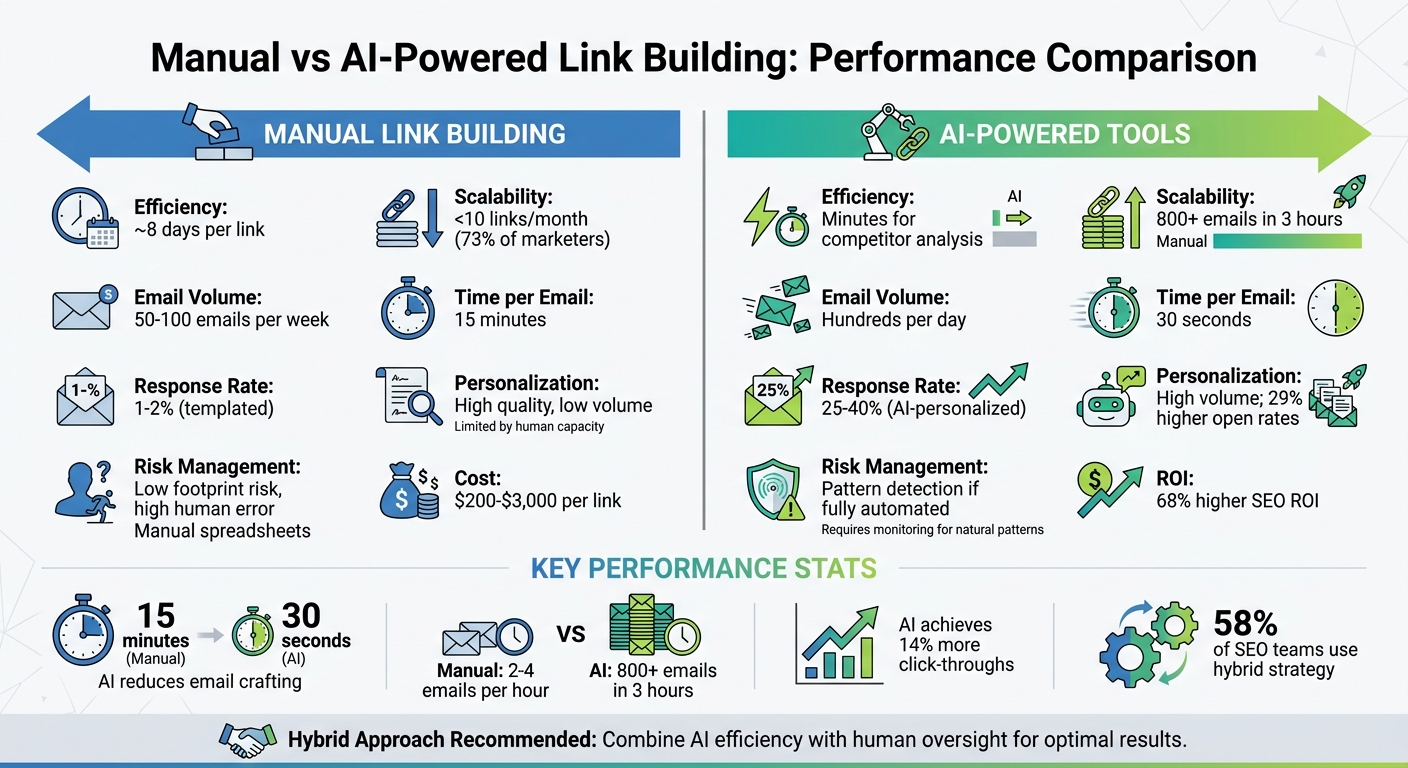
Manual vs AI-Powered Link Building: Performance Comparison
Manual link building offers a personal touch, but it’s a time-intensive process, often taking around eight days to secure just one link. On the other hand, AI-powered platforms speed things up significantly, condensing weeks of competitor analysis into just minutes while managing large-scale personalized outreach. However, fully automated systems run the risk of being detected as patterns by search engines.
The difference in efficiency is striking. While manual efforts typically cap at 50–100 emails per week, AI tools can send over 800 personalized messages in only three hours. This efficiency translates into results: AI-driven outreach achieves response rates of 25–40%, compared to the mere 1–2% seen with templated manual emails. These numbers highlight the contrasting capabilities of manual and AI-driven approaches in terms of speed, scalability, and personalization.
"Economics of links is stable and well-tested through years of SEO work. But what used to take days or weeks is now compressed into minutes, like analyzing an entire competitor backlink profile in one pass instead of clicking through 50 tabs." – Sergei Pankov, CEO of Serpzilla
Despite its speed, AI has limitations. It can match domains by topic and draft personalized pitches, but it sometimes suggests low-quality sites that demand human review. Additionally, search engines may flag repetitive or shallow content that lacks depth or originality. To address these challenges, many SEO teams now lean on a hybrid strategy – using AI for prospecting and initial outreach while relying on human expertise for filtering and building relationships.
| Feature | Manual Link Building | AI-Powered Tools |
|---|---|---|
| Efficiency | ~8 days per link | Minutes for competitor analysis |
| Scalability | <10 links/month (73% of marketers) | 800+ emails in 3 hours |
| Personalization | High quality, low volume | High volume; 29% higher open rates |
| Response Rates | 1–2% (templated) | 25–40% (AI-personalized) |
| Risk Management | Low footprint risk, high human error | Pattern detection if fully automated |
| Performance Tracking | Manual spreadsheets | Real-time dashboards |
This comparison makes one thing clear: AI has revolutionized link building by making it faster and more scalable. Yet, human oversight remains essential to ensure quality and maintain credibility. A hybrid approach – combining AI’s efficiency with human judgment – emerges as the best way to balance speed, personalization, and reliability.
Conclusion
Our analysis highlights how AI-driven automation is reshaping link-building strategies. By drastically reducing the time spent on tasks, increasing response rates, and enabling large-scale operations, AI is changing the game. For example, AI can cut email crafting time from 15 minutes to just 30 seconds, allowing teams to send over 800 personalized emails in three hours – a process that would otherwise take 16 days manually. And the results speak volumes: AI-personalized outreach achieves response rates of 25–40%, compared to just 1–2% for traditional templated emails.
These efficiencies translate into measurable SEO benefits, including a 68% higher ROI, 29% greater open rates, and 14% more click-throughs. AI also works tirelessly across time zones, managing thousands of relationships without being limited by human work hours.
For teams aiming to scale their link-building efforts without compromising quality, platforms like 3Way.Social offer a practical solution. This platform combines AI-powered domain matching with a network of vetted SEO professionals, enabling users to secure quality backlinks through fair ABC link exchanges. Features such as permanent do-follow links, advanced link diversification, and automated quality control filters ensure that high standards are upheld, even at scale.
To maximize results, consider adopting a hybrid approach: let AI handle prospecting, outreach, and verification, while human oversight focuses on securing the most valuable placements. Implement safeguards like daily send limits, follow-up schedules, and automated verification to protect rankings. With the right tools and strategies, AI-powered link building can become a powerful and sustainable advantage in your SEO efforts.
FAQs
Will AI link building get my site penalized?
AI-driven link building is generally safe from penalties when approached responsibly and aligned with established best practices. By emphasizing quality, relevance, and ensuring human oversight, it steers clear of manipulative methods that might attract penalties from search engines. The key is to focus on securing natural, high-quality links that uphold compliance and safeguard your site’s SEO performance.
How do I review and approve AI-selected link partners?
To ensure your link-building strategy stays effective and ethical, it’s crucial to carefully review and approve AI-selected link partners. Start by auditing backlinks to check their relevance and authority. This means analyzing the linking sites’ profiles and assessing their credibility.
AI tools can help monitor the quality and relevance of links, but don’t rely on them entirely. Always have a human review the links to confirm they appear on trustworthy and reputable websites.
When reaching out for backlinks, make your outreach personal and professional. Keep track of link statuses to ensure they remain active and avoid any practices that could be considered spammy. This approach not only aligns with ethical standards but also supports your long-term SEO goals.
What should I automate vs keep manual in a hybrid approach?
In a hybrid link-building strategy, use automation for repetitive tasks such as prospect research, data gathering, link scoring, and tailoring outreach – areas where AI thrives in handling large volumes efficiently. However, keep strategic responsibilities like building relationships, managing delicate negotiations, and conducting final quality checks in human hands. This approach combines AI-driven efficiency with human oversight to ensure ethical practices and high-quality outcomes.