Last Updated on January 23, 2026 by Becky Halls
Want to boost your SEO? Let’s start off by learning how to find competitor backlinks and then analyzing them. Competitor backlink analysis helps you discover where your rivals are earning links, so you can identify opportunities to strengthen your own site. Here’s how you can do it in five straightforward steps:
- Identify Competitors: Focus on sites ranking higher than you for target keywords. Use tools like Google Search, Ahrefs, or Semrush to find competitors at the domain and page levels.
- Gather Backlink Data: Use tools like Ahrefs or Moz to analyze competitors’ backlink profiles. Export data on referring domains, anchor text, and link types.
- Filter for Quality: Prioritize backlinks from domains with high authority, relevance, and low spam scores. Avoid low-quality links that could harm your SEO.
- Spot Patterns: Look for recurring strategies, such as guest posts, resource pages, or PR mentions. Identify domains linking to multiple competitors.
- Create a Backlink Strategy: Organize opportunities by priority and timeline. Focus on high-impact links, such as those from high-authority, niche-relevant sites.
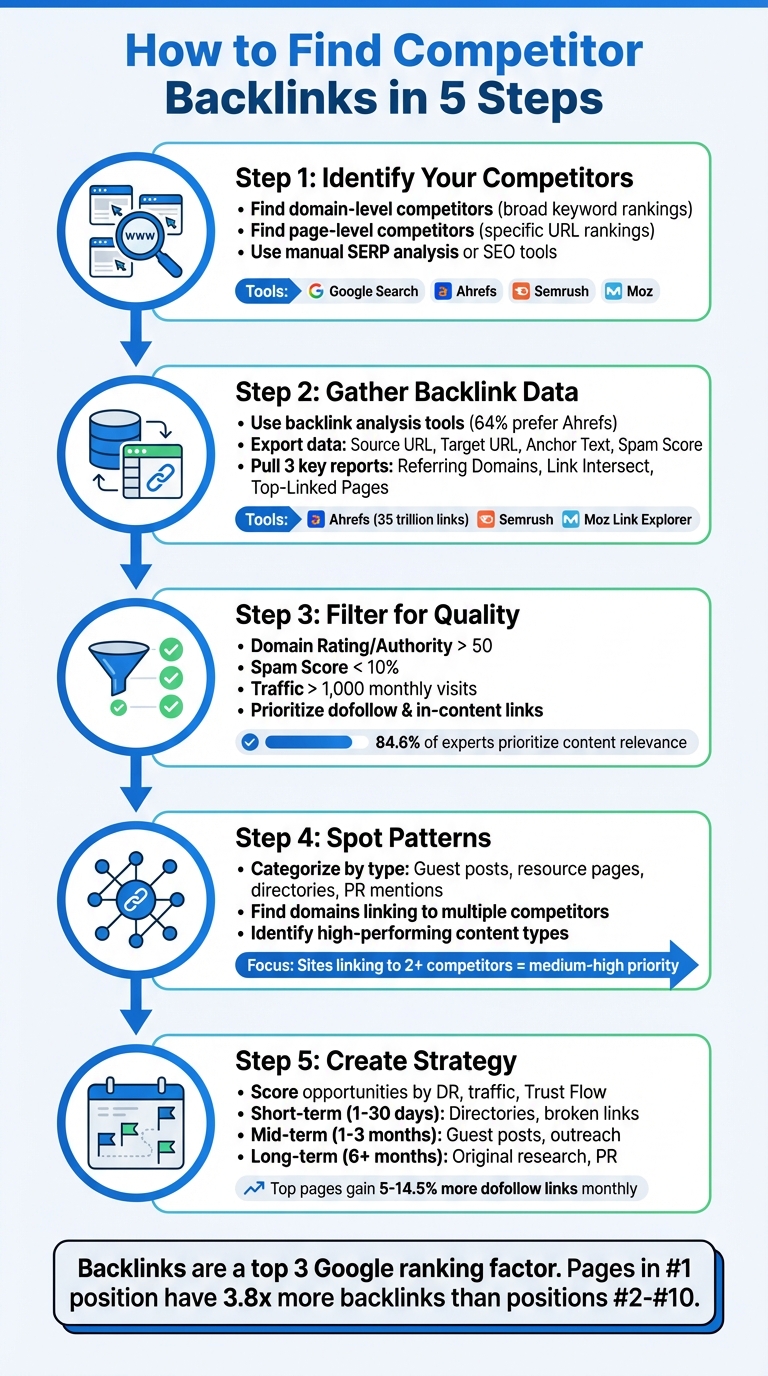
5-Step Process to Find and Analyze Competitor Backlinks for SEO
How to Check Competitor Backlinks with Ahrefs – in 1 Minute!

Step 1: Identify Your Competitors
The first step in competitor analysis is figuring out which websites you’ll be examining. Here’s the catch: your SEO competitors aren’t necessarily the same as your business competitors. Instead, they’re the sites that consistently rank higher than you for the keywords you’re targeting. As Moz explains:
“Your SEO competitors are brands that are organically ranking in the top spots for your target keywords”.
It’s also important to distinguish between domain-level competitors and page-level competitors. Domain-level competitors are brands ranking for a broad range of keywords, while page-level competitors are individual URLs that rank for specific keywords. For instance, YouTube or Amazon might rank for one of your target keywords. However, analyzing their entire domain’s backlinks wouldn’t make sense – focus on the specific page that’s ranking instead.
“We’ve seen the fastest competitor backlink wins come from copying the patterns, not the exact links. When the same type of site keeps linking to them, that’s your real clue.” Ian Naylor, Founder at 3Way Social
Find Competitors at the Domain Level
To start, separate the major players in your market from those competing for specific content.
A good first step is a manual SERP (Search Engine Results Page) analysis. Enter 3–5 of your primary keywords into Google and jot down the domains that frequently show up in the top 10 results. Export this data into a spreadsheet and look for patterns. Domains that appear consistently across multiple searches are your true domain-level competitors.
If you’d prefer a more automated method, SEO tools can help. Platforms like Moz, Semrush, and Ahrefs identify “True Competitors” by analyzing keyword overlap and shared organic visibility. These tools often assign a rivalry score based on metrics like Domain Authority (DA), keyword overlap percentage, and search volume. For example, using this method, one site pinpointed its top five competitors with ease.
If your website covers a variety of topics or product categories, take a more focused approach by analyzing specific subfolders. A March 2024 study of PetSmart revealed that petsmart.com/fish competed with niche sites like “That Pet Place” and “Live Aquaria”, while petsmart.com/bird had different rivals, such as “Tractor Supply” and “Ace Hardware”. This category-specific analysis can uncover unique competitors that a broad site-wide review might miss.
Find Competitors at the Page Level
The next step is identifying competitors at the page level. Enter your most important keywords into Google and note which URLs rank in the top 10 positions. These pages are your direct competition for content, even if their parent domains aren’t direct business rivals.
Focus on high-value pages, even if the overall domain isn’t relevant to your industry . For example, a blog post from a large authority site might rank for your keyword. Analyzing the backlinks to that page could reveal opportunities for you to replicate within your niche.
When gathering this data, ensure you only include pages with a “200-OK” status code. This ensures you’re analyzing live, successful content rather than redirects or error pages.
Organize Your Competitor Data
Once you’ve identified your competitors, it’s time to organize everything into a clear format.
A simple spreadsheet works well for this. Include columns for the competitor’s domain, primary topics or product categories, approximate monthly organic traffic (e.g., 125,000 visitors/month), and their Domain Authority or Domain Rating score.
To make analysis easier, group competitors by relevance. Separate domain-level competitors from page-level ones, and add a column for “Rivalry Score” to prioritize which competitors to analyze first. Having a structured dataset will make the next steps – like backlink analysis – much more efficient.
| Identification Method | Best For | Tools Recommended |
|---|---|---|
| Manual Search | Small keyword sets; localized niches | Google Search, MozBar |
| Domain Analysis | Identifying overall market rivals | Moz True Competitor, Semrush, Ahrefs |
| Page-Level Analysis | Specific high-value content pieces | Moz Link Explorer (Top Pages), Ahrefs Site Explorer |
Step 2: Gather Backlink Data
Once you’ve pinpointed your competitors, the next step is to dig into their backlink profiles. This means collecting data on linking domains, link types, and the overall strength of those links.
Use Backlink Analysis Tools
Backlink analysis tools make this process much easier and more efficient. Ahrefs Site Explorer is a favorite among SEO professionals, with 64% preferring it for link data. It boasts a live index of 35 trillion links, enabling real-time tracking of backlink profiles at both the domain and URL levels.
Semrush Backlink Analytics brings something extra to the table with its “Backlink Gap” tool. This feature lets you compare your domain against up to four competitors at once. It’s a quick way to uncover link opportunities you might be missing. Similarly, Moz Link Explorer offers a “Link Intersect” feature that highlights sites linking to your competitors but not to you. It also provides helpful metrics like Domain Authority and Spam Score, so you can immediately gauge the quality of potential links.
If you’re working with a tight budget, Moz offers 10 free queries per month through its community account. When selecting a tool, focus on identifying domains that link to multiple competitors but not to you. These are often your best bets because they’re already engaged in your niche. Be sure to filter for “dofollow” links and target domains with a DR or DA over 50 to avoid wasting time on low-quality data.
“In our experience, the best ‘replicable’ links are the boring ones: resource pages, niche directories that are actually curated, unlinked brand mentions, and list posts that update regularly.” Becky Halls, Strategist at 3Way Social
Export and Format Your Data
Most backlink tools allow you to export data in CSV format for manual analysis. These exports typically include details like Source URL, Target URL, Page Title, Anchor Text, and Spam Score.
One pro tip: Before combining data from multiple exports, add a “Site” column to label each competitor. This small step can save you a lot of headaches later. To simplify your analysis, use Excel’s LEFT and SEARCH functions to extract root domains from full URLs. This way, you can consolidate multiple links from the same domain into a single entry. Also, make sure to remove duplicate domain-anchor text pairs to keep your data clean and accurate.
When formatting your spreadsheet, stick to U.S. conventions for numbers and dates – use commas for thousands, periods for decimals, and the MM/DD/YYYY format for dates. This consistency will make sorting and analyzing your data much easier.
Once your data is organized, you’ll be ready to pull the reports that matter most for identifying backlink opportunities.
Pull Key Reports
There are three must-have reports to focus on for each competitor:
- Referring Domains Report: This report lists the unique websites linking to a competitor. A diverse range of referring domains often indicates a stronger backlink profile than just a high volume of links from a few sources.
- Link Intersect Report: Sometimes called the “Backlink Gap”, this report highlights domains linking to multiple competitors but not to you. These are prime targets for outreach.
- Top-Linked Pages Report: This report reveals the specific pages on a competitor’s site that are attracting the most backlinks. It’s a great way to learn what type of content is resonating in your niche.
If you want to go deeper, consider pulling reports on anchor text patterns and the ratio of dofollow to nofollow links. For those tracking competitor activity over time, the “New and Lost Backlinks” report can uncover recent successes or shifts in their link-building strategies.
Armed with these insights, you’ll be well-equipped to identify high-priority backlink opportunities and refine your outreach strategy.
Step 3: Filter Backlinks for Quality and Relevance
After gathering your backlink data, the next step is to separate the valuable links from the ones that could harm your SEO. Not all backlinks are created equal, and low-quality links can negatively impact your site’s performance.
Review Key Backlink Metrics
Start by analyzing key metrics that help determine the quality of a backlink:
- Domain Authority (DA) or Domain Rating (DR): These metrics measure a site’s overall strength. In a survey, 69% of SEO professionals reported relying on DR to assess site strength. For high-priority backlinks, aim for domains with a DR or DA above 50.
- Spam Score: This metric, provided by Moz, predicts the likelihood of a domain being penalized based on certain site features. Avoid domains with a Spam Score above 10%.
- Trust Flow and Citation Flow: Majestic‘s Trust Flow evaluates the quality and trustworthiness of a site’s link profile, while Citation Flow measures the quantity or raw power of links. A healthy backlink profile shows Trust Flow close to or higher than Citation Flow.
When assessing backlinks, prioritize in-content links over those placed in footers or sidebars. Also, check the balance between dofollow and nofollow links. While nofollow links have their uses, dofollow links are the ones that contribute to ranking improvements. Research shows that top-ranking pages typically gain 5% to 14.5% more dofollow backlinks each month.
One of the most important factors today is topical relevance. A backlink from a site within your niche is often more valuable than one from a higher-authority site in an unrelated industry. In fact, 84.6% of SEO experts consider content relevance the top priority when evaluating backlinks.
“Backlinks are the backbone of any effective SEO strategy. They act as endorsements from other websites, signaling that your content is valuable and worth noticing.”
– Hansjan Kamerling, Co-Founder, Adaptify
Once you’ve identified these quality benchmarks, it’s time to weed out the underperforming links.
“We’ve noticed teams waste time chasing a competitor’s flashiest links, when the real advantage is their mid-tier links placed on highly relevant pages. That’s usually where the movement comes from.” 3Way Social Team
Remove Low-Quality Links
After reviewing the metrics, filter out the links that don’t meet your standards. Use tools or spreadsheets to apply these filters:
- Remove domains with a DR below 50 and less than 1,000 monthly visitors.
- Flag links with over-optimized anchor text, as this can signal manipulative link-building practices. As Russ Jones from Moz explains:
“The likelihood a webmaster will give you valuable anchor text out of the goodness of their heart is very rare, so over-optimization sticks out like a sore thumb.”
Watch for authority gaps, where there’s a large difference between a site’s Domain Authority and Page Authority. This often indicates spammy links from sources like forum profiles or paginated comments. Also, avoid links from sites with excessive ads, irrelevant industries, or those operating as link farms. If multiple sites share the same IP address, it could point to a manipulative network.
Once you’ve filtered out the low-quality links, the next step is to organize and compare the remaining data.
Compare and Organize Metrics
Now that you’ve isolated quality backlinks, compare their metrics to identify the best opportunities. Use a spreadsheet to create a comparison table, making it easier to spot trends and prioritize your outreach. Tools like Excel Pivot Tables can help summarize large datasets and rank domains by authority metrics.
To refine your strategy, prioritize domains based on how many of your competitors they link to:
- High Priority: Linked by all competitors.
- Medium Priority: Linked by two or more competitors.
- Low Priority: Linked by only one competitor.
It’s worth noting that pages in the #1 search position typically have 3.8 times more backlinks than those ranked #2 through #10. By focusing on quality and relevance now, you’re setting the foundation for strategies that drive real results.
| Metric | What It Tells You | Action Threshold |
|---|---|---|
| Domain Rating (DR) | Overall site strength and ranking potential | Prioritize DR > 50 |
| Domain Traffic | Site legitimacy | Filter for > 1,000 monthly visits |
| Spam Score | Likelihood of penalty or manipulation | Avoid scores > 10% |
| Trust Flow | Quality and trustworthiness of links | Should be close to or higher than Citation Flow |
| Link Placement | SEO value transfer potential | Focus on in-content links |
sbb-itb-88880ed
Step 4: Identify Link Patterns You Can Replicate
Once you’ve filtered for quality backlinks, it’s time to dive into your competitors’ backlink strategies. By analyzing their patterns, you can uncover tactics that are already proven to work in your industry – and better yet, replicate them to boost your own results.
Categorize Your Backlinks
Start by grouping backlinks based on their source, such as guest posts, resource pages, directories, or PR mentions. Pay attention to details like anchor text, link type, and placement context. For example, links embedded within the main content of a page are far more valuable for SEO than those tucked away in sidebars or footers.
This categorization can guide your content strategy. If your competitors are consistently earning links from how-to guides or research studies, it’s a clear signal that these formats resonate with your audience. Once you’ve identified these trends, examine how these links are distributed across different competitors.
Find Patterns Across Competitors
Look for domains that link to multiple competitors. These sites have already shown an interest in your niche, making them prime candidates for your outreach efforts. Using link intersect tools, you can identify domains that link to at least two or three of your competitors – these should become medium- to high-priority targets.
Keep an eye on link velocity, too. Sudden spikes in backlinks might indicate a new campaign launch or seasonal content, while steady growth suggests a long-term strategy [1,3]. Geographic trends can also be revealing. If competitors are targeting specific regions, it might highlight new opportunities for your own outreach.
Another key step is finding high-performing pages on competitor sites that attract the most backlinks. These pages often point to content gaps in your own strategy – whether it’s original research, interactive tools, or other formats you haven’t explored yet. By mapping out these themes, you can pinpoint the topics that consistently draw backlinks across the board [1,3].
Assess Which Links You Can Replicate
Now that you’ve identified link patterns, it’s time to determine which ones are worth replicating. Not every backlink is created equal, so focus on opportunities that offer the most value for your effort. For example, submitting your site to directories is relatively simple, while guest posting requires more time and effort. On the other hand, earning PR mentions or links for original research often demands unique data or noteworthy stories, making these the most resource-intensive options.
To ensure your efforts are focused on high-impact links, prioritize dofollow links from domains with a Domain Rating (DR) of 50+ or sites with at least 1,000 monthly visitors. This way, you’re targeting backlinks that will have a meaningful impact on your SEO.
Here’s a quick breakdown of link types, their replicability, and what’s required to secure them:
| Link Type | Replicability Level | Primary Requirement |
|---|---|---|
| Business Directories | High | Basic site info & submission |
| Guest Posting | Medium | Quality content & outreach |
| Resource Pages | Medium | Useful, relevant content assets |
| Broken Link Building | Medium | Replacement content |
| Original Research | Low | Unique data, surveys, or experiments |
| PR/News Mentions | Low | Newsworthy stories & media relationships |
Step 5: Create a Prioritized Backlink Strategy
Now that you’ve analyzed competitors and filtered link opportunities, it’s time to create a focused backlink plan. The goal? Concentrate your time and resources on the opportunities that will make the biggest impact on your SEO performance.
Score and Sort Your Opportunities
Start by scoring each backlink opportunity using key metrics like Domain Rating (DR), organic traffic, Trust Flow, and Citation Flow. These metrics provide a clear picture of the value each link can bring. For example, 69% of SEO professionals rely on DR as a dependable measure of a site’s strength.
When scoring, give higher priority to sites that link to multiple competitors. These signals often indicate active engagement within your niche. Here’s how you can prioritize:
- High-priority targets: Sites linking to most of your competitors.
- Medium-priority targets: Sites linking to two or three competitors.
- Low-priority targets: Sites linking to just one competitor.
Additionally, consider the placement of links. Links embedded in the main body of content carry significantly more weight than those tucked away in footers or sidebars. And don’t overlook relevance – 84.6% of SEO experts rank content relevance as the most important factor when evaluating a backlink.
Once you’ve scored and filtered your opportunities, organize them based on the time and effort required to secure each link.
Group Opportunities by Timeline
Break your opportunities into phases to streamline execution and maintain momentum over time. Here’s a simple way to structure your efforts:
- Short-term wins (1–30 days): Focus on strategies like broken link building and directory submissions. These require minimal effort and can deliver quick results.
- Mid-term opportunities (1–3 months): Invest in guest posting, skyscraper content, and outreach to niche blogs. These tactics take more time but help build a solid backlink foundation.
- Long-term initiatives (6+ months): Concentrate on original research, earning mentions from high-authority news outlets, and nurturing relationships within your industry. These efforts establish credibility and leadership over time.
This phased approach ensures you’re continuously building links while working on larger, more complex projects. Consistency is key – top-ranking pages typically gain 5% to 14.5% more do-follow backlinks each month.
With your plan in place, the next step is to streamline your outreach process.
Use 3Way.Social for Link Building

To simplify link building, consider using 3Way.Social. This platform connects you with a network of verified SEO professionals, making it easier to secure permanent do-follow links. Its structured link exchange system helps diversify your backlink profile without the hassle of manual outreach.
This tool is particularly effective for short-term and mid-term strategies, allowing you to save your manual outreach efforts for more challenging, high-value opportunities – like forming partnerships for original research or earning mentions from authoritative news sources.
Conclusion
Competitor backlink analysis plays a key role in shaping a data-driven SEO strategy. It helps you pinpoint competitors, sift through relevant data, identify replicable trends, and focus on the most impactful opportunities.
Since Google has confirmed that backlinks are among its top three ranking factors, knowing where your competitors secure their links provides a clear path to follow. Backlinks not only validate the quality of your content but also signal to search engines that your site is worth noticing.
FAQs
How can I find the most valuable backlinks from my competitors?
To uncover your competitors’ most valuable backlinks, start by analyzing the websites that outrank you for important search terms. Use an SEO tool to extract their backlink profiles and zoom in on links coming from high-authority, relevant domains. Pay special attention to do-follow links that are naturally embedded within content, as these tend to carry more weight than those tucked away in sidebars or footers.
After gathering this data, assess the quality of these links by looking at factors like the domain’s authority, how relevant the site is to your niche, and where the link is placed. Once you’ve pinpointed the standout backlinks, you can reach out to try and secure similar ones for your own site. Tools like 3Way.Social can make this process easier with features like domain matching and AI-driven link exchange suggestions. Regularly revisiting and refining your analysis will help you stay competitive and strengthen your backlink strategy over time.
What are the best tools to analyze competitor backlinks?
To dive into competitor backlink analysis, several tools can provide you with essential insights:
- Ahrefs: This powerhouse tool delivers detailed data on referring domains, link quality, and even historical trends, making it a favorite among SEO professionals.
- SEMrush: Packed with features, it offers in-depth backlink reports and a handy “Backlink Gap” tool to directly compare your backlink profile with competitors.
- Moz Link Explorer: Known for metrics like domain authority and anchor text analysis, it also breaks down link types for a clearer picture of your link-building efforts.
- Majestic: Famous for its “Trust Flow” and “Citation Flow” metrics, this tool helps you assess the quality of links pointing to your competitors.
- 3Way.Social: An AI-driven platform designed for secure link exchanges, it connects you with a network of SEO experts to help you earn high-quality, do-follow backlinks.
Using these tools can give you the edge you need to refine your SEO strategy and boost your site’s performance. Each one brings unique strengths to the table, so choosing the right mix can make all the difference.
How can I ensure the competitor backlinks I replicate are high-quality?
To make sure the competitor backlinks you replicate are worth your time, pay attention to a few important details:
- Check the linking site’s authority and relevance: Look at metrics like domain authority and how closely the site’s content aligns with yours. A backlink from a trustworthy and relevant site carries more weight.
- Ensure the link is do-follow: Only do-follow links pass SEO value. Avoid no-follow links or those tucked away in less impactful spots like footers or sidebars.
- Examine the linking site’s traffic and content quality: A site with consistent traffic, engaging articles, and frequent updates is likely to offer better SEO value.
By focusing on these factors, you can replicate backlinks that genuinely boost your site’s authority and rankings while steering clear of potential penalties.