Signs of Low-Quality Links in Automated Exchanges
Automated link exchanges often create spammy, irrelevant backlinks—watch for keyword-stuffed anchors, sudden spikes, and risky placements that can tank SEO.

Last Updated on October 9, 2026 by Becky Halls
Low-quality links from automated exchanges can harm your SEO. They often come from spammy or irrelevant sources, use unnatural anchor text, and appear in suspicious volumes or placements. These links can lead to penalties from search engines, reducing your site’s visibility and traffic.
Key Takeaways:
- Spammy Sources: Links from unrelated or low-authority sites (e.g., casinos linking to education blogs) are a red flag.
- Unnatural Anchor Text: Overuse of keyword-rich text signals manipulation.
- Sudden Link Spikes: Large volumes of links appearing overnight indicate automation or blackhat tactics.
- Poor Placement: Links in footers, sidebars, or widgets carry less value and higher risk.
- High Outbound Link Ratios: Sites with too many outbound links may be part of link farms or automated schemes.
Protect your SEO by focusing on quality over quantity. Use tools to monitor Domain Authority, traffic, and spam scores, and avoid platforms that prioritize speed and volume over relevance and trustworthiness.
Main Signs of Low-Quality Links
Links from Spam Sites or Unrelated Sources
Backlinks from sites with low Authority Scores or Domain Authority (below 15) often indicate spam networks or abandoned websites. For example, in January 2026, a financial services company suddenly gained over 500 backlinks from low-quality directories in Eastern Europe and Asia. These links included foreign-language anchor text and exact-match commercial keywords. Within two weeks, the company saw a 40% drop in organic visibility.
Links from irrelevant niches can be just as harmful. Imagine a children’s education website receiving backlinks from casinos or adult content sites – search engines interpret this as manipulative, not legitimate. A similar case occurred in January 2026 when an ecommerce retailer experienced ranking declines after acquiring over 1,000 spammy backlinks from adult content sites, pharmaceutical forums, and link farms. Google responded with a manual penalty for unnatural links. Additionally, websites filled with ads, scraped content, or thin content are common sources of toxic backlinks, often created through automated link exchanges.
Excessive Keyword-Rich Anchor Text
Manipulation isn’t just about where links come from – it’s also about how they’re structured. Overusing exact-match keyword anchors is a red flag. A natural backlink profile includes a mix of branded links, naked URLs, and varied anchor text. Problems arise when exact-match money anchors make up more than 20% of a site’s backlink profile.
According to Yoast, “Search engines are now smarter than ever at spotting unnatural links, especially in the era of AI and semantic understanding.”
Yoast also cautions, “If multiple links all use the same focus keyphrase, Google might not know which page should rank highest for that topic, leading to competition between your own pages.”
Automated link exchanges often force keyword-rich anchors into content unnaturally, creating links that feel out of place or uninformative. This over-optimization can hurt your SEO.
Unusual Link Volume and Location
The volume and placement of backlinks can also hint at low quality. Sudden spikes in backlinks, especially without corresponding marketing efforts or viral content, are a major red flag. For instance, hundreds of links appearing overnight with identical anchor text often point to blackhat SEO tactics or negative SEO attacks. A SaaS company in January 2026 discovered hundreds of backlinks originating from compromised high-authority websites. These links were hidden in footers or spam pages injected into the sites.
Placement matters too. Backlinks buried in footers, sidebars, or sitewide widgets typically carry less value and are riskier than those embedded naturally within content. Pages overloaded with external links – 200 or more – are often designed solely to sell backlinks. Other problematic link sources include forum signatures, blog comments, and user profile pages. Additionally, multiple backlinks from domains sharing the same IP address may indicate the use of a Private Blog Network (PBN), a tactic that search engines actively penalize. These patterns can trigger penalties, significantly damaging your SEO efforts.
sbb-itb-88880ed
What To Do About Low Value, Bad, or Spam Backlinks
Metrics and Patterns That Show Automation Problems
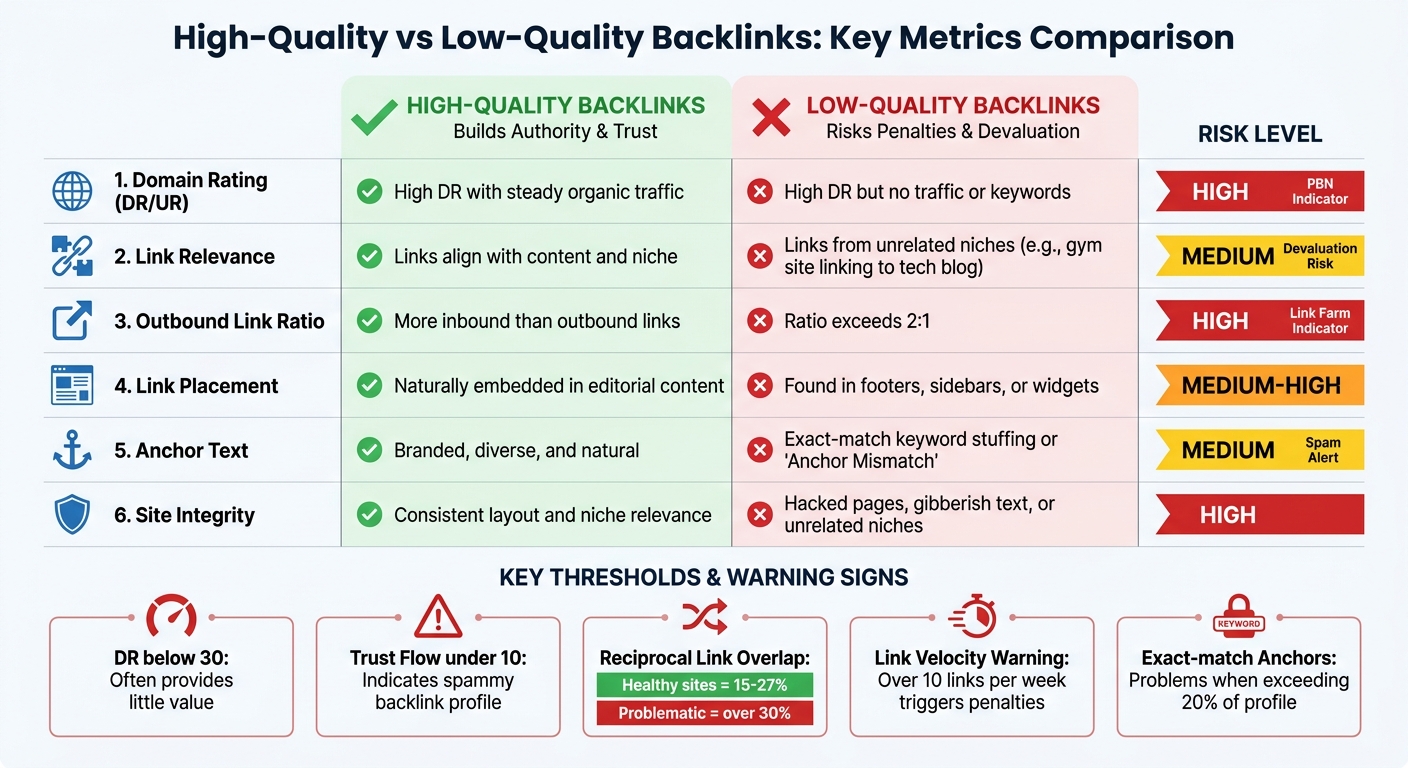
High-Quality vs Low-Quality Backlinks: Key Metrics Comparison
Checking Domain Ratings (DR/UR) and Spam Scores
A high Domain Rating (DR) doesn’t always guarantee a quality site. Automated link networks often inflate DR and Domain Authority (DA) scores while showing no organic traffic at all. For instance, a domain with a DR of 25+ but no top-ranking keywords or visitors is a clear indication of a Private Blog Network (PBN) or link farm.
Interestingly, while 68.3% of SEO professionals prioritize domain authority as a key metric, 84.6% focus more on link relevance when assessing backlink quality. This divide creates opportunities for automated systems to exploit DR-focused strategies. Always cross-check DR with organic traffic – high DR without traffic is a red flag for automation.
“An overemphasis on high authority links, especially if they are less relevant, can potentially trigger spam signals to search engines.” – Jonathan Prescott, Chief Data and AI Officer, Cavefish AI
Another telltale sign? An overuse of reciprocal links. If over 30 duplicate domains appear in a backlink profile, it’s likely part of an automated link scheme or link farm. Tools like site explorers can help uncover this by exporting referring domains and outgoing links to identify patterns of repeated domains.
These metrics help lay the groundwork for spotting outbound link patterns that often point to automation misuse.
Excessive Outbound Links and Compromised Sites
Outbound link behavior can reveal even more about automation issues. Pay attention to the outbound-to-inbound link ratio. When this ratio exceeds 2:1, it’s often a sign of a link farm or automated exchange. While reciprocal linking is common – 74% of websites have some level of it – healthy sites typically maintain a reciprocal link overlap of only 15% to 27%, reflecting natural relationships.
Automated links often hide in places like footers, sidebars, navigation menus, or widgets instead of appearing naturally in the main content. Sitewide links with exact-match commercial anchor text are a major red flag for manipulative link schemes. Compromised sites may display links buried in strange subfolders, broken layouts, or blocks of unrelated text. Automation often creates nearly identical sites with uniform layouts, “write for us” pages, and synchronized publishing schedules across unrelated niches.
“A link is ‘risky’ when it shows signals of intent to manipulate rankings, not when it merely comes from a small site.” – Makarenko Roman, SEO Specialist
Directories offering “instant approval” links often lack quality control and are prone to high spam risks.
Table: High-Quality vs. Low-Quality Link Comparison
Here’s a quick reference table to help distinguish between high- and low-quality links:
| Metric | High-Quality Example | Low-Quality Sign | Risk Level |
|---|---|---|---|
| Domain Rating (DR/UR) | High DR with steady organic traffic | High DR but no traffic or keywords | High (PBN Indicator) |
| Link Relevance | Links align with content and niche | Links from unrelated niches (e.g., a gym site linking to a tech blog) | Medium (Devaluation Risk) |
| Outbound Link Ratio | More inbound than outbound links | Ratio exceeds 2:1 (Link Farm Indicator) | High |
| Link Placement | Naturally embedded in editorial content | Found in footers, sidebars, or widgets | Medium-High |
| Anchor Text | Branded, diverse, and natural | Exact-match keyword stuffing or “Anchor Mismatch” | Medium (Spam Alert) |
| Site Integrity | Consistent layout and niche relevance | Hacked pages, gibberish text, or unrelated niches | High |
Domains with a DR below 30 often provide little value and are more likely to be tied to low-quality networks. Similarly, a Trust Flow metric under 10 can indicate a backlink profile filled with spammy or low-quality sources. Use these thresholds as a starting point when evaluating potential link opportunities.
Why Automated Platforms Increase These Risks
Automated link exchange platforms often lead to large-scale abuse that clearly violates Google’s spam policies. These platforms encourage excessive link exchanges, frequently involving partner pages designed solely for cross-linking. Search engines are quick to catch on, flagging such behavior as spam. The sheer speed and scale of these exchanges make them easy for search engines to detect and penalize almost instantly.
When link velocity exceeds 10 links per week or reciprocal link ratios climb above 25%, Google’s real-time Penguin algorithm steps in. These patterns are strong indicators of manipulation, triggering immediate penalties.
“Excessive link exchanges (‘Link to me and I’ll link to you’) or partner pages exclusively for the sake of cross-linking” are spam. – Google Spam Policies
Automated platforms often rely on sitewide placements, such as links in footers, sidebars, or widgets, and overuse keyword-rich anchor text. They also frequently include links from unrelated, foreign domains – all of which are clear red flags for manipulation. Not only do these tactics invite penalties, but they also weaken your website’s long-term SEO performance.
While high-traffic websites may naturally include some reciprocal links, bulk automated linking is a different story. Google’s AI can easily distinguish between organic and spammy links, devaluing the latter and damaging your site’s credibility.
How 3Way.Social Reduces Low-Quality Link Risks
3Way.Social stands out from high-risk automated platforms by combining AI-powered quality controls with human oversight to ensure backlinks are placed on relevant, authoritative domains. This dual approach eliminates the issue of irrelevant link placements often caused by traditional automated exchanges.
Every backlink is carefully evaluated using a system that analyzes Domain Authority (DA), traffic levels, and spam scores. This unique valuation method ensures that only high-quality partners are allowed into your network. Additionally, 3Way.Social relies on a vetted network of SEO professionals who adhere to strict editorial standards, keeping out sites with thin content or spammy profiles – sites that could harm your rankings. This rigorous vetting process is the foundation of its standout ABC link exchange model.
The ABC Link Exchange Model
One of the platform’s key features is its ABC link exchange structure, which avoids the pitfalls of direct reciprocal linking (where Site A links to Site B and vice versa). Instead, it creates a triangular pattern: Site A links to Site B, Site B links to Site C, and Site C links back to Site A. This design mimics natural linking behavior, steering clear of manipulative schemes often associated with bulk automation. Plus, all links are permanent, do-follow, and not marked as “sponsored”, ensuring they retain their full SEO value.
Ongoing Monitoring and Partner Control
Beyond just placing links, 3Way.Social actively works to maintain their quality and longevity. The platform continuously monitors each link deal and promptly addresses broken links to protect your backlink profile. Users also have access to advanced tools that let them filter potential partners by topic, Domain Authority, traffic, and relevance – giving you complete control over who links to your site.
“3Way.Social revolutionized our SEO approach. Our site’s rankings have significantly improved thanks to its innovative ABC link exchange system.”
– Sophia Martinez, SEO Manager
Whether you prefer the DIY marketplace for hands-on control or the Done-For-You packages with delivery guaranteed in 7–14 days, 3Way.Social’s dedication to quality ensures your SEO strategy remains strong and secure.
Conclusion: Protect Your Backlink Strategy
Spotting and addressing low-quality links is crucial to safeguarding your business from serious risks. Nicholas Rubright from Rankomedia sums it up perfectly: “The consequences of a penalty can be devastating… It can be an existential threat for businesses heavily reliant on search engine visibility.” A search penalty can result in major drops in both organic traffic and revenue, especially for companies that depend heavily on search visibility.
The price of dealing with low-quality links in the long run far outweighs any short-term benefits. Penalty recovery is no small task – it involves costly link audits, manual removal efforts, and submitting disavow files. And the damage doesn’t stop there. Your brand reputation takes a hit when it’s tied to spammy websites, and overly aggressive automated outreach can even lead to email providers like Gmail and Outlook flagging or blocking your legitimate communications.
Denis Dementienko, CEO of Natural Links, offers a key piece of advice: “Automate the operations – yet keep the editorial judgment human.” This strikes the right balance between leveraging technology and maintaining human oversight. Automation is great for tasks like research and monitoring, but when it comes to link placements, a human touch is indispensable.
To stay ahead of these risks, adopting a proactive strategy is essential. Regularly track metrics like link velocity and anchor text diversity to catch signs of automation misuse early. Tools like 3Way.Social show how combining AI-powered quality controls with human oversight can make automation efficient without exposing your business to the dangers of unsupervised practices. This blend of technology and human judgment is your best defense against the pitfalls of low-quality links.
FAQs
How can I tell if a sudden backlink spike is negative SEO or my own campaign?
A sudden surge in backlinks can sometimes signal negative SEO, especially if the links are from spammy or low-quality sources. Be on the lookout for red flags such as over-optimized anchor text or links coming from irrelevant websites or domains that have been penalized. To stay on top of this, tools like Google Search Console can help you review your backlink profile and pinpoint harmful links that might damage your site’s SEO.
Which metrics matter most when a site has high DR/DA but little or no traffic?
When a website has a high Domain Rating (DR) or Domain Authority (DA) but shows minimal or no traffic, it’s important to prioritize metrics that matter. Pay attention to the relevance of the linked site, ensure the domain authority or rating is above 50, and check its organic traffic levels. These elements can help you assess the link’s ability to improve SEO, build credibility, and align with your overall objectives.
What’s the safest way to remove or neutralize toxic links without hurting rankings?
To manage harmful links without jeopardizing your rankings, start by spotting them with tools like Google Search Console. Next, reach out to the webmasters of the sites hosting these links and ask for their removal. If that doesn’t work, carefully use Google’s disavow tool to disregard the problematic links. Performing regular backlink audits and sticking to ethical link-building methods will help you maintain a clean link profile and safeguard your rankings.