Top 7 Metrics To Assess Link Credibility
Evaluate backlinks with DA, Trust/Citation Flow, spam signals, topical relevance, organic traffic, placement, and profile diversity.

Last Updated on October 9, 2026 by Becky Halls
When it comes to evaluating backlinks, quality outweighs quantity. Google prioritizes trustworthy and relevant links over sheer numbers. Here are the 7 key metrics you need to assess link credibility effectively:
- Domain Authority (DA): Measures a site’s ranking potential (0-100). Higher scores are better but must align with organic traffic and niche relevance.
- Trust Flow (TF) & Citation Flow (CF): TF evaluates link trustworthiness, while CF measures link volume. A balanced ratio between the two is crucial.
- Spam Score: Flags risky or manipulative links. Lower scores are safer, but always manually review flagged links.
- Topical Relevance: Links from sites and content aligned with your niche deliver more SEO value than unrelated high-authority links.
- Organic Traffic: A site’s actual search traffic reflects its quality. Consistent traffic growth is a positive signal.
- Link Placement & Anchor Text: Links embedded in relevant content with varied anchor text are more impactful than those in sidebars or footers.
- Link Profile Diversity: A natural mix of link sources and anchor text indicates a healthy, trustworthy backlink profile.
These metrics work best when analyzed together, not in isolation. For example, a high DA site with no organic traffic or high spam signals may not be worth pursuing. Focus on links that are relevant, well-placed, and from domains with strong, diverse profiles.
Quick Tip: Avoid over-relying on any single metric like DA or Spam Score. Instead, combine these insights to build a safer, more effective backlink strategy.
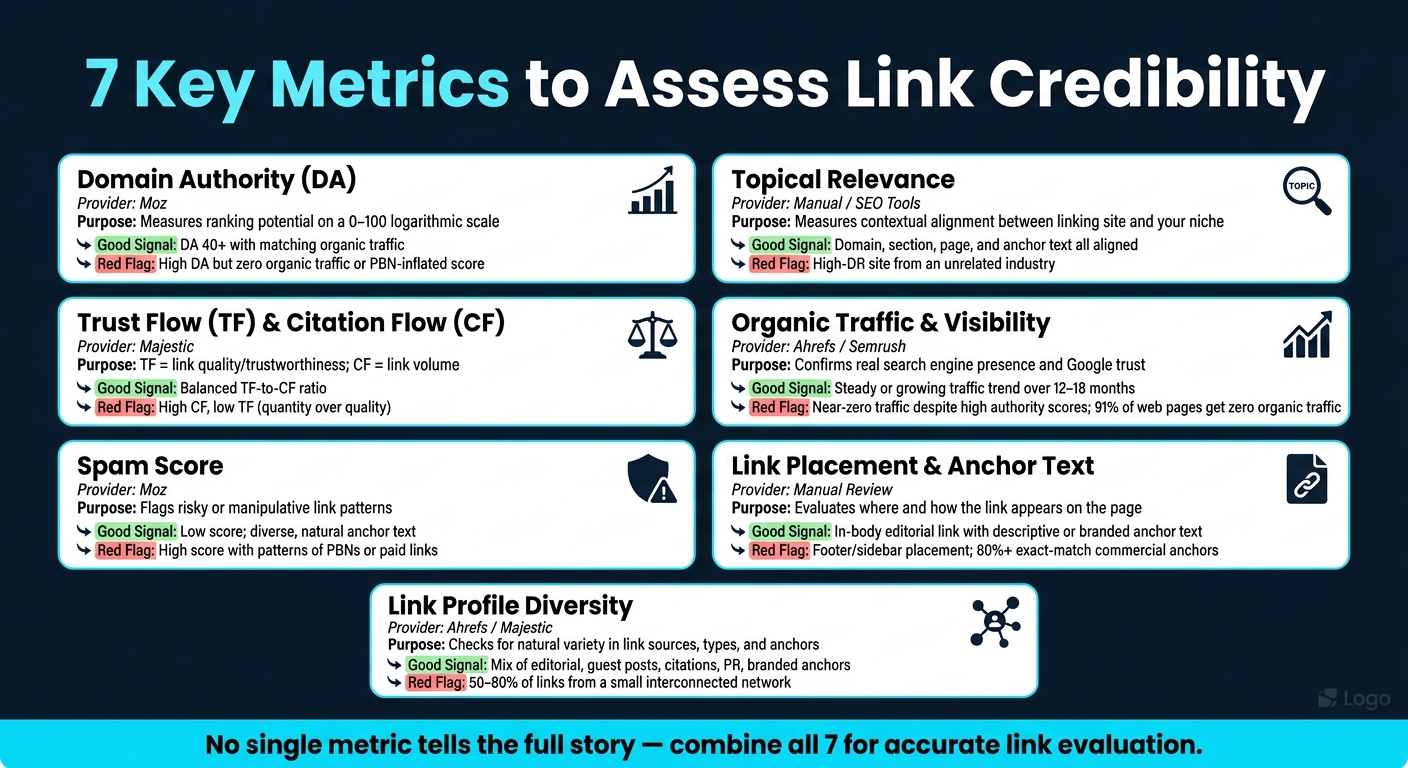
7 Key Metrics to Assess Link Credibility at a Glance
How to Tell If a Backlink Is Good for SEO
sbb-itb-88880ed
1. Domain Authority (DA) and Similar Metrics
Understanding the strength of a website’s domain is the first step in evaluating link credibility.
Domain Authority (DA), created by Moz, is a predictive score that estimates how likely a website is to rank in search engine results. It operates on a logarithmic scale from 0 to 100, where each step up becomes increasingly harder to achieve. For instance, moving from a DA of 10 to 20 is relatively easy, but climbing from 70 to 80 requires significantly more effort and resources.
It’s important to note that DA isn’t an official Google metric. Instead, it’s a third-party estimate based on Moz’s link index. Factors like the number of linking root domains, total backlinks, and proprietary metrics such as MozRank and MozTrust all contribute to the score, helping to identify backlinks with high PR. Other tools have similar metrics: Ahrefs uses Domain Rating (DR), Semrush offers Authority Score (AS), and Majestic employs Trust Flow (TF). Each metric evaluates domain strength differently, so no single score provides the full picture.
| Metric | Provider | Focus Area |
|---|---|---|
| Domain Authority (DA) | Moz | Ranking potential |
| Domain Rating (DR) | Ahrefs | Backlink profile strength |
| Authority Score (AS) | Semrush | Overall domain quality |
| Trust Flow (TF) | Majestic | Link trust and quality |
DA works best as a comparative tool rather than a standalone measure. For example, compare a potential link source’s DA to similar sites in your niche. If it scores significantly lower without an obvious reason, it may warrant further investigation. As a general guideline, sites with a DA of 20+ are considered entry-level, 40+ is a solid target, and 60+ is considered high-quality.
However, relying solely on a high DA score can be misleading. Scores can be artificially boosted through tactics like private blog networks (PBNs) or redirects from expired domains. Martín Miño, Founder of Contenido Patrocinado, highlights this risk:
“A DR of 60 on a site with no real organic traffic and hundreds of outbound links on internal pages says very little about the value that link will transfer. Metrics are initial filtering tools, not final verdicts.”
To avoid pitfalls, always pair DA with organic traffic data. A site with a high DA but no search traffic is often a warning sign.
Beyond DA, metrics like Trust Flow and Spam Score can help assess the context and quality of links. These additional tools provide a more comprehensive view of a site’s credibility.
2. Trust Flow (TF) and Citation Flow (CF)
While Domain Authority gauges a site’s overall ranking potential, Trust Flow (TF) and Citation Flow (CF) – metrics created by Majestic – zoom in on the quality and quantity of backlinks. These tools add an extra layer of insight by distinguishing between the trustworthiness and sheer volume of links pointing to a site.
Trust Flow evaluates a site’s backlinks on a scale from 0 to 100, focusing on how trustworthy those links are. It does this by assessing the proximity of a webpage to a set of verified authoritative websites. The closer the connection to these trusted “seed sites”, the higher the Trust Flow score. On the other hand, Citation Flow measures the total number of backlinks, offering a straightforward count of link volume.
“While Quality inspires Trust Flow, Citation Flow is driven by Quantity.” – Majestic
The real value lies in comparing these two scores. A site with a high Citation Flow but a low Trust Flow often has a weak link profile, likely filled with low-quality backlinks like spammy forum posts or irrelevant guestbook links. A well-rounded, credible site usually demonstrates a balanced ratio between the two metrics, where both scores align closely.
It’s worth noting that improving Trust Flow is not a linear process. For instance, moving from a score of 15 to 25 is substantially harder than going from 5 to 15. This makes it more practical to benchmark your Trust Flow against competitors in your niche rather than striving for an unrealistically high score.
For example, Majestic reported in June 2026 that the professional community site “Women in Tech SEO” had a Trust Flow in the 20s. While this might seem modest compared to global platforms, it’s a strong score for a niche-focused site.
3. Spam Score and Toxicity Indicators
When evaluating a website’s link profile, it’s not just about authority and trust – it’s also about identifying potential risks.
Metrics like Spam Score (from Moz) and toxicity scores (from Semrush) are designed to flag links that might be risky or manipulative. These tools assess factors like low domain authority, unusual anchor text, and connections to penalized sites. While SEO tools often refer to “toxic backlinks”, Google uses terms like “link spam” or “unnatural links.” However, since the release of Penguin 4.0, Google has shifted its approach, simply devaluing spammy links rather than penalizing entire websites for them.
“Penguin now devalues spam by adjusting ranking based on spam signals, rather than affecting ranking of the whole site.” – Google
The real issue arises when there’s a pattern of suspicious links, rather than an isolated case. A backlink profile filled with paid guest posts, private blog networks (PBNs), or repetitive, overly optimized anchor text is a clear indicator of manipulation. This is why many SEOs are turning to safer alternatives like ABC link exchanges to build authority without triggering spam signals. A healthy anchor text profile is diverse, including branded terms, bare URLs, and generic phrases. If 80% of your backlinks rely on the same keyword-rich anchor text, it’s a glaring warning sign.
But relying entirely on toxicity scores can be risky. For example, disavowing links flagged as toxic by these tools once caused a website to lose 60% of its traffic, even though those links were providing value. Sam McRoberts, CEO of VUVU Marketing, offers this perspective:
“The links marked as toxic by most SEO tools are very often neutral at worst, not toxic.”
The takeaway? Conduct thorough audits before taking action. Only disavow links if Google Search Console reports a manual penalty for unnatural links. Instead of obsessing over individual links, focus on patterns such as sudden surges in link acquisition, clusters of backlinks from unrelated industries, or notable traffic drops – these are often better indicators of quality issues.
Next, let’s explore how topical relevance plays a role in evaluating link sources.
4. Topical Relevance and Content Alignment
Metrics like Domain Authority (DA) and Domain Rating (DR) are great for assessing a site’s overall strength, but they don’t tell the whole story when it comes to niche relevance. While these metrics measure authority, the true SEO value comes from links that are contextually relevant. For instance, a link from a DR 85 lifestyle magazine to a B2B cybersecurity tool might provide far less SEO value than links from DR 40–50 blogs focused on cybersecurity or IT administration. Why? Because relevance is the foundation that gives authority its weight.
Google uses natural language processing and entity understanding to prioritize links that make sense contextually rather than just looking at domain power. As Google’s John Mueller explained, links from related sites are “more relevant and useful” compared to unrelated high-DA links. A 2020 Semrush study backs this up, showing that over 65% of links pointing to top-20 ranking pages came from thematically relevant domains.
To fully assess topical relevance, you need to look at four specific layers: domain, section/category, page, and anchor text with its surrounding context. When all these layers align, the link sends a strong, clear signal to search engines. If only one or two layers match, the SEO impact is much weaker.
| Relevance Layer | What to Check |
|---|---|
| Domain level | Does the site consistently cover your industry or a closely related niche? |
| Section/category level | Is the section linking to you focused on a relevant topic? |
| Page level | Does the article naturally connect to your content as a deeper resource? |
| Anchor text and nearby context | Does the anchor text and surrounding content align with your page’s topic? |
Whether you’re building links through guest posts, digital PR, or link exchanges, treating topical relevance as a must-have filter is critical. Once relevance is ensured, you can then focus on authority within that relevant set. Tools like 3Way.Social are designed with this principle in mind, matching domains by niche and content category. This ensures that link exchanges stay within a logical, topic-focused framework, avoiding unnatural cross-niche connections that could raise red flags for users and search engines alike.
After establishing topical relevance, the next step is to analyze how credible links contribute to measurable improvements in site performance.
5. Organic Traffic and Visibility Metrics
Organic traffic is one of the most reliable indicators of how search engines perceive a website. While authority scores like Domain Authority vs Page Authority or DR (Domain Rating) can hint at potential, actual organic traffic shows how well a site performs in search engines, making it a more trustworthy measure of link credibility. A site that ranks for thousands of keywords and attracts consistent monthly visitors demonstrates it meets Google’s quality standards. On the flip side, a site with little to no organic traffic is a red flag, no matter how high its authority scores might appear. This makes organic traffic a practical metric for evaluating link sources beyond just authority scores.
Although organic traffic estimates aren’t perfectly precise, tools like Ahrefs combine data from ranking positions, search volumes, and expected click-through rates (CTR) to provide useful comparisons. As Anna from Ahrefs explains:
“While these estimates don’t, and can’t, show you exactly how much organic traffic a website gets, they work incredibly well for comparison.”
These estimates are especially helpful when ranking potential link sources and filtering out weaker sites.
A traffic trend graph is one of the easiest ways to assess a site’s performance over time. A steady or growing trend over the last 12–18 months is a good sign of stability, while a sharp decline might indicate a Google penalty or technical issues. As Traffic Think Tank highlights, “Sudden drops in traffic might indicate broken links, incorrect redirects, or crawl errors.” Links from penalized domains can harm your SEO efforts, so it’s essential to be cautious. Following a comprehensive SEO link building checklist can help you avoid these pitfalls. Additionally, understanding where a site’s traffic originates helps determine its relevance to your niche.
Beyond just looking at total traffic numbers, the Top Pages report is valuable for identifying where that traffic is coming from. For example, a site might boast 50,000 monthly visitors, but if most of that traffic is going to unrelated content – like celebrity gossip on a site that also hosts a tech section – then the link’s relevance to your niche is minimal. You want traffic-heavy pages that align with your industry or topic for the link to carry weight.
| Metric | What It Tells You | Why It Matters for Link Assessment |
|---|---|---|
| Estimated Organic Traffic | Number of monthly visitors from search engines | Confirms the site is indexed and valued by Google |
| Ranking Keywords | Range of topics the site ranks for | Shows search visibility and content breadth |
| Traffic Value | Cost to replicate the traffic via paid ads | Indicates the site’s audience has commercial value |
| Traffic Trend | Historical growth or decline in traffic | Highlights potential penalties or algorithm issues |
| Top Pages | Pages driving the most traffic | Ensures the site’s core content is relevant to your niche |
Here’s a critical stat to consider: 91% of all web content gets zero organic traffic from Google. This means the majority of pages contribute no SEO value. If a potential link source falls into this category, it’s unlikely to benefit your efforts, no matter how polished the site appears.
6. Link Placement, Anchor Text, and Link Context
Once you’ve assessed domain authority and traffic metrics, it’s time to dive into on-page factors. Not all backlinks are created equal – where the link appears, the anchor text used, and the surrounding content all play a big role in determining its value. These elements add another layer to understanding a link’s overall effectiveness.
Placement is key. Links placed in the main body of an article – particularly in the first half – are far more impactful than those tucked away in footers, sidebars, or other template sections. Google’s algorithm prioritizes links that are naturally embedded in relevant, visible content. For example, a link seamlessly integrated into a paragraph discussing a related topic is much more valuable than one buried in a footer that repeats across multiple pages.
Anchor text and context matter just as much. Using descriptive and relevant anchor text, like “B2B email marketing guide” or “local SEO case study”, significantly boosts a link’s SEO value compared to generic phrases like “click here.” However, overusing exact-match anchors (more than 10–20% of your total anchors) can lead to penalties. To keep your link profile natural, aim for a mix of branded, partial-match, and generic anchor texts. Search engines also analyze the surrounding sentences, the paragraph’s overall theme, and the page’s topic to determine the link’s relevance. For instance, a link to an SEO tool within a paragraph about improving Google Maps rankings sends a strong relevance signal. On the other hand, the same link in a generic “resources” list with no context won’t carry nearly as much weight.
This is why platforms like 3Way.Social focus on creating in-content, permanent do-follow links placed within relevant narratives. These links naturally fit into the flow of the content, avoiding the less effective placements like sidebars or footers.
Here’s a quick breakdown to evaluate link opportunities:
| Factor | Strong Signal | Weak Signal |
|---|---|---|
| Placement | In the main article body, near relevant text | Footer, sidebar, or a sitewide template area |
| Anchor Text | Descriptive, branded, or partial-match | Repeated exact-match commercial keywords |
| Surrounding Context | Paragraph clearly related to your topic | Unrelated content or a mixed list of outbound links |
| Editorial Control | Added by an editor as part of the narrative | Automated, user-generated, or paid without disclosure |
When assessing a link opportunity, think about its placement, whether the anchor text flows naturally, and if the surrounding content aligns with your niche. A link that checks all these boxes will have a much stronger impact on your SEO efforts.
7. Link Profile Diversity and Network Quality
A diverse backlink profile is a strong indicator of genuine credibility. When a site earns links naturally, it tends to collect them from a variety of sources – editorial mentions, guest posts, resource pages, citations, and branded references across different industries and IP ranges. On the other hand, when 50–80% of backlinks come from a small, interconnected group of sites, it often signals a manufactured link scheme rather than authentic editorial endorsements.
A strong link profile might include a marketing blog cited by industry publications, supported by relevant guest posts, academic references, and podcast mentions with diverse branded anchor text. In contrast, a weak profile might feature hundreds of backlinks from unrelated blogs, repetitive keyword-stuffed anchors, and links from pages created solely to push outbound links. These linking patterns significantly affect how much trust a domain’s links convey. This highlights the importance of focusing on both the quantity and the quality of inbound links.
The credibility of a domain’s own inbound links also plays a critical role in evaluating the value of the links it provides. A site backed by reputable, contextually relevant sources is far more likely to pass meaningful authority. On the flip side, a domain with a questionable backlink network may offer little SEO value in the long run. This is why relying only on headline authority metrics can be misleading.
Here’s a breakdown of the key differences between a strong link profile and a risky one:
| Aspect | Healthy Profile | Risky Profile |
|---|---|---|
| Referring domains | Numerous unique domains from different IPs and industries | High concentration from a small, interconnected group |
| Anchor text | Branded, URL-based, and generic with varied partial matches | Heavy reliance on exact-match commercial keywords |
| Link types | A mix of editorial links, guest posts, citations, PR, and resources | Overuse of a single tactic (e.g., only guest posts or directories) |
| Network signals | Minimal reciprocal linking; diverse sources | Clear link rings or reciprocal exchange patterns |
| Update resilience | Stable performance through link-spam updates | Higher risk of devaluation or manual penalties |
Structured link exchanges can also help improve link diversity when done correctly. Platforms like 3Way.Social use AI to facilitate domain matching and ABC-style exchanges, avoiding direct reciprocal linking – a common red flag in link schemes. These platforms connect users with a vetted network of SEO professionals, focusing on topically relevant and permanent do-follow links. This approach supports link diversity that withstands algorithm updates. However, it’s essential to ensure that linked sites maintain clean, varied profiles instead of relying solely on authority metrics.
Comparison Table
Evaluating link credibility isn’t about focusing on a single metric. Instead, it’s about looking at multiple signals together. Here’s a quick reference table that summarizes the seven metrics discussed earlier, along with tips on how to interpret them.
| Metric | Purpose | Interpreting Its Values |
|---|---|---|
| Domain Authority (DA) | Gauges a domain’s ranking potential on a 1–100 scale | Higher scores are better, but always compare within your niche |
| Trust Flow (TF) | Reflects the quality and trustworthiness of links to a site | Higher values suggest stronger trust; review alongside Citation Flow for a balanced view |
| Citation Flow (CF) | Measures the volume and strength of inbound links | High CF without matching TF may indicate quantity over quality; a large gap between CF and TF can be a red flag |
| Spam Score | Identifies patterns linked to risky or manipulative domains | Lower values are better; high scores call for a manual review instead of outright dismissal |
| Topical Relevance | Examines how well the source site aligns with your content’s subject | Better alignment indicates a more credible and contextually valuable link |
| Organic Traffic & Visibility | Shows if a site attracts genuine search interest | Stable, consistent traffic is a good sign; extremely low traffic may signal a problem |
| Link Placement & Context | Assesses whether a link is naturally embedded in relevant content | Editorial links within content are stronger; links in footers, sidebars, or templates carry less weight |
This table serves as a practical checklist for assessing link sources. For example, a site with a high DA but a high Spam Score and minimal organic traffic should raise questions. Each weak metric should prompt a closer look before pursuing a link.
Conclusion
No single metric can fully capture a link’s credibility. Domain Authority provides a starting point, while Trust Flow and Citation Flow help distinguish between genuine authority and artificially inflated metrics. Meanwhile, Spam Score acts as a safeguard, identifying domains that could pose hidden risks. By combining these metrics, you create a solid defense against algorithm changes. Adding factors like topical relevance, organic traffic patterns, link placement, and profile diversity further strengthens your strategy and minimizes manipulation risks.
Focusing on high-quality links delivers real SEO value. As Google’s John Mueller has said, “one really good link from one good website can be more relevant than millions of low-quality links.” This underscores the need to prioritize quality over sheer numbers, shifting the focus to fewer but more impactful links.
These principles don’t just shape individual link decisions – they also guide scalable link-building strategies. For teams handling link acquisition on a larger scale, platforms like 3Way.Social make it easier to follow these standards. They match domains based on authority, relevance, and network quality, while ensuring permanent do-follow and nofollow links and diverse link patterns.
Think of these metrics as a filter for decision-making, not a competition for scores. A site that checks the right boxes – strong authority, balanced trust ratios, low spam signals, steady organic traffic, and natural in-content link placement – is better equipped to handle algorithm updates and build lasting authority. When the metrics align, go for the link. If they don’t, it’s best to move on.
FAQs
What’s a “good” DA, TF, and CF for my niche?
When building a natural link profile, aim to collaborate with partners whose Domain Authority (DA) is within 20 points of your own score. Starting with a DA of 30 or higher is a solid benchmark. However, if you’re operating in a highly competitive niche, you may need to target domains with a DA between 50 and 69.
For Trust Flow (TF) and Citation Flow (CF), focus on maintaining a healthy ratio between the two. A ratio ranging from 0.5 to 2.0 is typically considered balanced. Ideally, look for a TF of at least 10, with a ratio around 0.75, as this often signals high-quality backlinks.
When should I disavow links flagged as toxic or spammy?
If you’re considering disavowing links, do so only when there’s a strong chance of a manual penalty or clear signs that certain links are harming your site. Be cautious with automated tools – they can sometimes misidentify harmless links as problematic. Instead, take the time to manually review flagged links, especially those coming from link farms or irrelevant, low-quality websites.
In cases where Google imposes a manual penalty, focus on cleaning up your backlink profile. Make sure to document your efforts to remove harmful links, as this will be important when you submit a reconsideration request to Google.
How can I tell if a high-DA site is actually valuable?
High Domain Authority (DA) might look impressive, but it doesn’t automatically mean the site holds value. Always cross-check DA with consistent organic traffic. A site boasting high DA but attracting few visitors could be a red flag – it might even be a penalized link farm.
Focus on topical relevance when assessing potential links. Links from sites closely aligned with your niche usually deliver better results. Additionally, take a close look at the site’s editorial standards. Are there named authors? Clear contact details? High-quality outbound links? These are signs the site is built for real users, not just to game the system.