Checklist For ABC Link Quality Control
Checklist for vetting ABC link exchanges: prioritize topical relevance, technical checks, anchor diversity, and ongoing monitoring.

Last Updated on October 9, 2026 by Becky Halls
ABC link building can boost your SEO rankings, but only if quality remains the focus. One poor-quality link can harm your site’s reputation or lead to penalties. Here’s what you need to know:
- Relevance matters more than authority. A niche-relevant link from a lower-DA site often outperforms a high-DA link from irrelevant sources.
- Metrics aren’t everything. Look beyond Domain Authority (DA) or Domain Rating (DR) to evaluate organic traffic, editorial quality, and link placement.
- Avoid link farms. Sites with too many outbound links or unrelated content are red flags.
- Technical checks are crucial. Ensure links are dofollow, live, and indexed for at least 30 days.
Using tools like 3Way.Social simplifies this process by automating partner matching and link monitoring. Stick to a structured link building checklist to avoid penalties and build sustainable SEO performance.
How To Set A Link Building Criteria / Quality Threshold And Why It Matters
sbb-itb-88880ed
Planning Your ABC Link Building Campaign
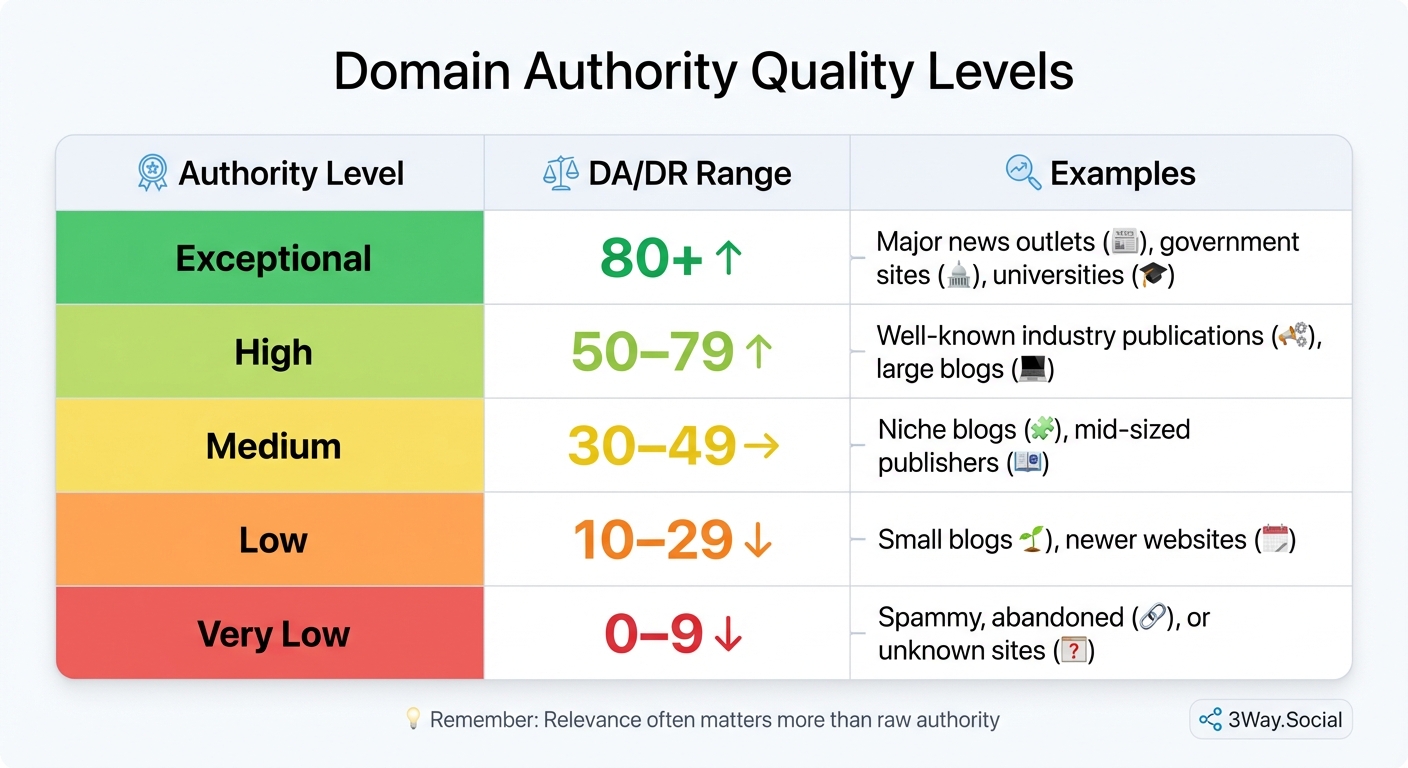
Domain Authority Quality Levels for ABC Link Building
When planning your ABC link building campaign, it’s crucial to define what qualifies as a quality link before reaching out. Without clear standards, you risk wasting time on poor prospects or even damaging your rankings by accepting links that could hurt your site’s reputation.
Setting Quality Metrics
Start by setting minimum quality benchmarks. Metrics like Domain Authority (DA) or Domain Rating (DR) can provide a solid starting point. For example, exceptional sites typically score 80 or higher, while high-quality sites fall in the 50–79 range. That said, a relevant link from a DA 40 site can often carry more weight than an irrelevant link from a DA 60 site.
Next, check for consistent or increasing organic traffic. A high-DA site with little to no traffic is a red flag. Also, ensure that linking pages return a “200 OK” status and aren’t blocked by robots.txt or “noindex” tags. For a link to truly add value, it should stay indexed for at least 30 days.
Take a close look at the link neighborhood. If a page links to unrelated industries or has too many outbound links, it might be a link farm. The most effective links are editorial ones placed in the main body of the content. Links in sidebars, footers, or author bios tend to hold much less value.
| Authority Level | DA/DR Range | Examples |
|---|---|---|
| Exceptional | 80+ | Major news outlets, government sites, universities |
| High | 50–79 | Well-known industry publications, large blogs |
| Medium | 30–49 | Niche blogs, mid-sized publishers |
| Low | 10–29 | Small blogs, newer websites |
| Very Low | 0–9 | Spammy, abandoned, or unknown sites |
Finding Relevant Niches
Relevance is more important than raw authority. As OutreachFrog puts it:
“Authority helps. Relevance multiplies authority”.
Focus on websites that align closely with your niche or industry. For instance, a health blog might work well with a fitness equipment site. To gauge a site’s relevance, visit its homepage and skim the titles of the last 10 posts. If the topics are all over the place, it’s likely a link warehouse rather than a legitimate publication.
Also, look for signs of credibility. Named authors with consistent publishing histories and active social media profiles signal that the site is built for real readers, not just SEO purposes. Advanced search operators like inurl:blog paired with your target keywords can help you uncover active content creators. You can also explore professional communities on Slack or LinkedIn to find potential partners – 51.6% of link builders report using link exchanges as part of their strategy.
Once you’ve identified quality prospects, set clear goals to guide your outreach strategy.
Establishing Campaign Goals
Having clear objectives is key to making smart decisions throughout your campaign. Whether you’re aiming to boost domain authority, drive referral traffic, or diversify your backlink profile, each goal will influence how you choose your partners.
To streamline your efforts, consider using a 100-point quality scorecard to evaluate potential partners. For instance:
- Topical Relevance: 25 points
- Editorial Fit: 20 points
- Indexation Stability: 20 points
Accept sites scoring between 80 and 100 (“Scale Safe”) and reject those scoring below 65. This scoring system ensures consistency, especially as your campaign scales, and minimizes the impact of small errors across multiple partnerships.
Finally, monitor link longevity. Check to see if links remain live and indexed two weeks and one month after publication. This tracking helps you identify campaigns that provide lasting value versus those with temporary results.
The ABC Link Quality Control Checklist
Once your campaign planning is done, this checklist can help you maintain high standards throughout every stage of your ABC link-building campaign. A structured approach ensures you catch problems before they impact your rankings.
Evaluating Link Prospects
Start by reviewing domain metrics as a foundation, but don’t stop there. Look at trust indicators like Domain Rating (DR), Domain Authority (DA), and Authority Score (AS) for initial screening. Pay close attention to the Trust Flow (TF) to Citation Flow (CF) ratio – a healthy range is between 0.5 and 2.0, signaling a reliable site rather than a spammy network.
Traffic levels are another key factor. A domain with high DA but almost no organic traffic could be a red flag for an expired or penalized site. Always manually check for critical site elements like an About page, Contact information, and author details. Review posts to ensure the site has a relevant, high-quality link neighborhood. If you notice links to unrelated commercial industries (like gambling or pharmaceuticals) or excessive outbound links on a single page, it’s best to steer clear.
Immediately reject domains that lack a clear editorial focus, have too many ads, or offer a submission funnel that looks like a price list for links.
Verifying Technical Link Requirements
Make sure the page where your link appears returns a “200 OK” status, isn’t blocked by robots.txt, and isn’t tagged “noindex.” Links should use the “dofollow” attribute to pass ranking power unless they’re marked as “sponsored”, in line with Google’s guidelines.
Check the anchor text to ensure a balanced mix of branded terms, natural phrases, and partial matches. Avoid over-optimized exact-match keywords, as they can cause “anchor drift”. Also, confirm the placement page isn’t canonicalized to another URL, and inspect the surrounding content to ensure it isn’t overcrowded with links. Beyond technical factors, the content’s relevance to your niche is equally important.
Reviewing Content and Placement
The content surrounding your link should be original, valuable, and free from thin or AI-generated material. Aim to have your link placed naturally within the main body of the article, ideally in the first 1–2 paragraphs and above the fold. Links in sidebars, footers, or author bios generally carry less SEO value.
Ensure the guest post matches both your niche and the host site’s typical content. A strong endorsement comes from relevant context, not just high authority metrics. Avoid keyword stuffing and stick to a natural writing style to reduce the risk of penalties. Lastly, evaluate the quality of the surrounding content – if parts of the article are poorly written or include off-topic promotional links, it compromises the overall placement.
Monitoring Links After Implementation
Quality control doesn’t stop once the link is live. Use tools like Screaming Frog or Ahrefs to track your links and set up alerts for lost links or changes in their status codes.
Focus on “Net Growth” (new links minus lost links) instead of just the total number of links to measure your progress. Losing about 5–10% of links annually is normal; anything higher may require investigation. Keep an eye on link velocity – sudden spikes in keyword-rich placements could signal manipulation. To maintain quality, use a two-person review process and a scorecard to evaluate every new domain before approving placements. These ongoing checks help ensure your link-building efforts continue to strengthen your site’s authority over time.
Using 3Way.Social for Quality Control
Keeping up with ABC link exchanges can feel like a juggling act, but 3Way.Social simplifies the process with its AI-powered tools and built-in quality filters. This platform ensures that your link-building efforts remain effective and stress-free by automating key parts of the process.
One of its biggest advantages is its vetted network. Instead of connecting with random website owners, you’ll collaborate with SEO professionals, significantly reducing the risk of linking to low-quality or spammy domains that could harm your rankings. The platform uses AI to match domains based on relevance, authority, and niche alignment. This means you can skip the tedious task of manually reviewing metrics, allowing you to focus on strategy instead.
Key Features of 3Way.Social
The platform’s domain matching feature is a game-changer. It pairs your site with partners that align with your niche, authority level, and traffic patterns. Plus, the links you gain are permanent do-follow links, which help transfer ranking power effectively.
Another standout feature is the advanced link diversification tools. These tools help you maintain a balanced backlink profile by spreading placements across various domains over time, creating a natural and sustainable link structure. You can also set minimum quality standards with the quality control filters, ensuring that only prospects meeting your criteria are considered. And with a user-friendly dashboard, you’ll have a clear view of your entire link network, making it easy to identify and address any issues early on.
Selecting Your Plan
Once you’re familiar with the platform’s features, it’s time to choose a plan that fits your needs:
- Free Plan: Perfect for beginners or those managing one or two sites. This plan lets you add your domain, find potential partners, and earn credits through successful exchanges. While it’s limited to basic features, it’s a great way to get started with ABC link building.
- Premium Plan: Designed for SEO professionals running larger campaigns. This plan includes advanced filters for precise partner selection, guest posting vs link exchanges for more diverse link placements, and priority support to ensure your campaigns stay on track. Pricing is customized based on your usage.
- Enterprise Plan: Tailored for agencies or in-house teams handling large-scale SEO operations. Building on the Premium Plan, it offers custom integrations and dedicated account management. Pricing is personalized, so you’ll need to contact 3Way.Social for a quote.
Whether you’re just starting out or managing complex SEO strategies, 3Way.Social offers tools and plans to suit your goals. It’s all about making quality control easier and more efficient.
Conclusion
Quality control is the backbone of successful ABC link-building campaigns. It’s the difference between boosting your rankings and risking penalties. The focus should always be on topical relevance and partner vetting rather than sheer volume. Links need to flow naturally within content, originate from sites with real organic traffic, and avoid patterns that could raise red flags with search engines. Interestingly, research highlights that 60% of quality issues can be avoided simply by using proper inspections and checklists.
Using diverse anchor text is key to avoiding over-optimization, while the ABC structure (Site A to B, B to C, C to A) helps steer clear of reciprocity signals that algorithms might target. Regularly tracking links ensures they remain live and indexed, tying back to the core checklist principles: evaluating prospects, confirming technical compliance, and reviewing content. This structured approach is crucial for maintaining sustainable SEO performance and effective campaign management, especially when using tools like 3Way.Social.
3Way.Social simplifies the process by automating link monitoring and partner verification. Its vetted network takes the uncertainty out of finding reliable collaborators, while automated checks confirm links go live as dofollow placements. Plus, real-time alerts notify you if links drop or change, keeping your backlink profile strong.
With built-in quality control features and real-time monitoring, 3Way.Social transforms the checklist into action. Whether you’re managing a small number of exchanges on the Free Plan or scaling up to enterprise-level campaigns, the platform takes care of the heavy lifting. This allows you to focus on strategy and achieve long-term SEO success with confidence.
FAQs
What is an ABC link exchange?
An ABC link exchange, also called a three-way link exchange, is an SEO tactic involving three websites – let’s call them A, B, and C. Here’s how it works: Website A links to Website B, Website B links to Website C, and Website C links back to Website A.
The idea behind this method is to avoid direct reciprocal linking (where two sites simply link to each other), which can be flagged by search engines. By creating this circular linking pattern, it becomes more difficult for search engines to identify the connection, reducing the chances of penalties. At the same time, this strategy helps distribute link equity across the sites, potentially boosting their SEO authority.
How can I quickly identify a link farm?
To spot a link farm quickly, keep an eye out for certain telltale signs. These include a large number of backlinks coming from low-quality, spammy, or unrelated websites that exist purely to trade links. Some common warning signals are an overload of sponsored content, links from irrelevant foreign-language sites, and unnatural link patterns that don’t make sense.
It’s also helpful to review metrics like domain authority, website traffic, and how relevant the content is to your topic. Toxic links often go hand-in-hand with link farms. Additionally, watch for poor editorial standards or content stuffed with excessive, low-value links – these are major red flags.
How long should I monitor new links?
Monitoring new links regularly is crucial, especially in the initial months after acquisition. Keeping an eye on links allows you to spot valuable ones while identifying any that could harm your site’s performance. Many SEO professionals emphasize the importance of consistent tracking to ensure link quality and address potential problems before they escalate.