Last Updated on February 17, 2026 by Becky Halls
Unsure about unnatural links vs ethical links? Unnatural links are backlinks created to manipulate search rankings, while ethical links are earned naturally through quality content and genuine relationships. The key difference lies in intent: unnatural links aim to trick algorithms, often violating Google’s guidelines, while ethical links prioritize user value and adhere to search engine rules.
Unnatural Links:
- Tactics: Paid links, private blog networks (PBNs), link farms.
- Risks: Penalties, traffic drops, and damaged credibility.
- Indicators: Over-optimized anchor text, low-quality sources, irrelevant placements.
Ethical Links:
- Tactics: Editorial mentions, guest posts, broken link building, digital PR.
- Benefits: Long-term SEO stability, improved domain authority, and better user trust.
- Indicators: Contextual relevance, varied anchor text, transparency.
Quick Comparison
| Factor | Unnatural Links | Ethical Links |
|---|---|---|
| Intent | Manipulate rankings | Provide user value |
| Acquisition | Paid, automated, or incentivized | Earned through quality content and outreach |
| Source Quality | Low-quality, irrelevant sites | High-authority, niche-specific domains |
| Anchor Text | Over-optimized, keyword-stuffed | Natural, varied, branded |
| Penalty Risk | High | Low |
| Long-Term Impact | Harmful to rankings and reputation | Builds trust and improves visibility |
Bottom Line: Avoid shortcuts like unnatural links – they may deliver temporary gains but come with high risks. Ethical link-building requires effort but ensures stable growth, better rankings, and lasting credibility.
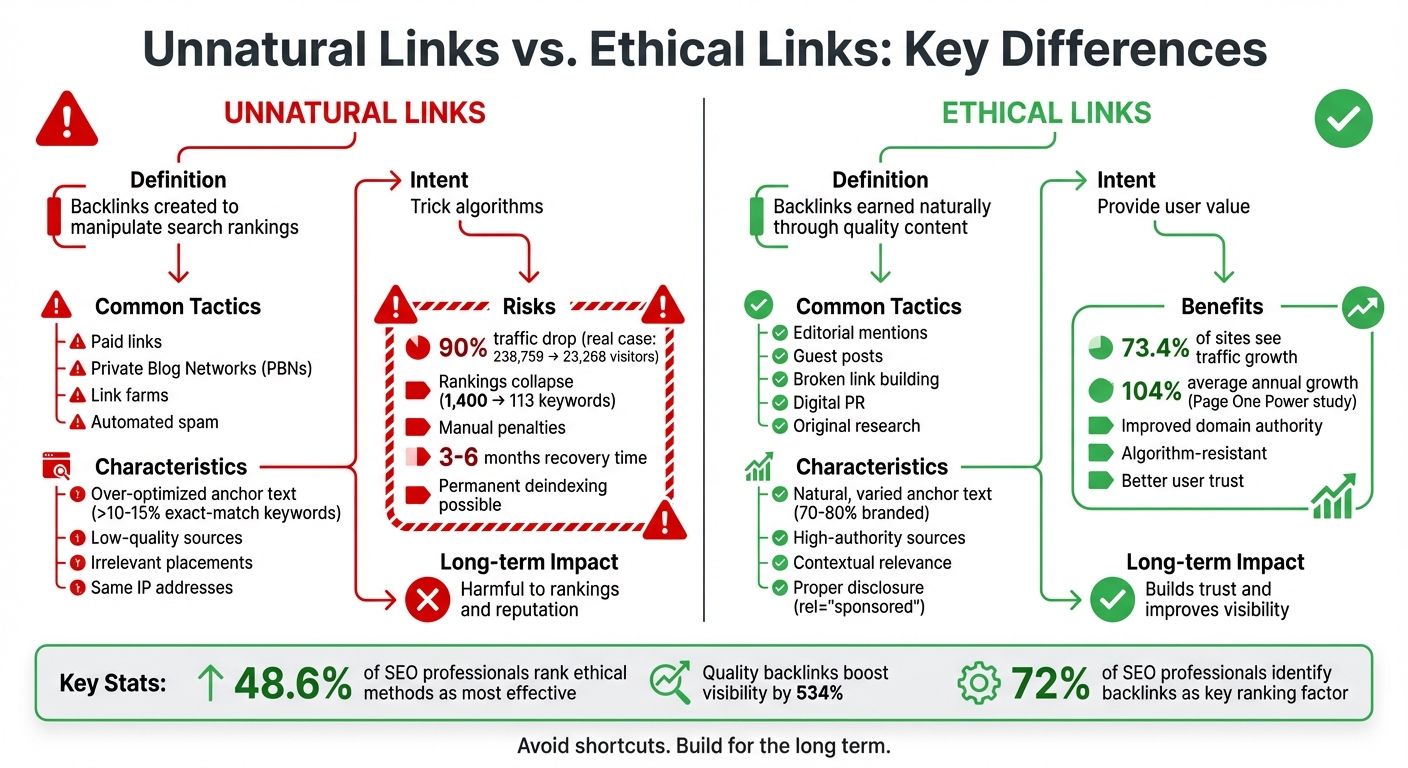
Unnatural vs Ethical Links: SEO Impact Comparison
What Are Unnatural Links?
Definition of Unnatural Links
Unnatural links are backlinks created with the sole purpose of manipulating search engine rankings, rather than being naturally or editorially placed by website owners. Think of them as “deceptive endorsements” designed to trick Google’s algorithm into perceiving a site as more authoritative than it actually is. As outlined in Google’s Quality Guidelines:
“Creating links that weren’t editorially placed or vouched for by the site’s owner on a page, otherwise known as unnatural links, can be considered a violation of our guidelines”.
Unlike genuine backlinks that are earned through quality content or relationships, these links are artificially constructed – often bought, automated, or otherwise engineered – to game the system. Let’s dive into some common examples of these tactics.
“We’ve seen ‘unnatural’ links usually give themselves away by the context. If the link looks like it was added for SEO rather than for the reader, it rarely ages well.” 3Way Social Team
Examples of Unnatural Links
- Private Blog Networks (PBNs): These are collections of websites under one entity’s control, created solely to boost the authority of a target site. They’re often recognizable by shared hosting setups, thin or recycled content, and little to no organic traffic.
- Paid link schemes: This involves exchanging money, goods, or services for followed backlinks without proper disclosure. Examples include paying for placement on low-quality sites or sending free products to bloggers in return for links.
- Link farms: These are groups of interconnected websites that exist purely to link to one another, unlike ABC link exchanges, creating an artificial link web. Tools like Google’s SpamBrain are designed to detect such patterns.
Other examples include automated programs that spam forums or comment sections with links, keyword-stuffed anchor text in widgets or footers, and submissions to low-quality directories that lack real user engagement.
Common Characteristics
Manipulative links often share telltale signs that separate them from naturally earned backlinks. One major red flag is over-optimized anchor text. For instance, if hundreds of backlinks use identical keyword-rich phrases like “buy cheap sneakers”, it’s a clear sign of manipulation. A natural link profile tends to include a mix of brand names, plain URLs, and varied anchor text. When more than 10% to 15% of a site’s anchor text consists of exact-match commercial keywords, it can trigger spam filters.
Another indicator is links originating from low-quality sources, such as sites with minimal authority, no organic traffic, or irrelevant content. For example, a tractor repair website linking to a cosmetics blog is a glaring mismatch. Unnatural links also tend to appear in non-editorial areas like footers, sidebars, or unrelated text blocks.
Other warning signs include multiple backlinks from the same IP address, sudden spikes in link acquisition, and links from pages that also reference many unrelated spammy sites. As Tania Voronchuk from Links‑Stream puts it:
“If a link is created primarily for a search engine bot rather than for a human, it is most likely unnatural”.
sbb-itb-88880ed
What Are Ethical Links?
Definition of Ethical Links
Ethical, or “white hat”, links are those earned when another website chooses to reference your content because it provides genuine value. As Google puts it, “A natural link is an editorial choice”. These links follow search engine guidelines by focusing on user experience and transparency. Unlike links created solely to manipulate search rankings, ethical links serve as authentic endorsements.
“In our experience, ethical links are boring in the best way. They sit on relevant pages, use natural anchors, and make sense even if Google didn’t exist.” Ian Naylor, Founder of 3Way Social
Examples of Ethical Links
Ethical links come from quality content that stands out and earns recognition. For instance:
- Editorial Mentions: When journalists or bloggers cite your site as a reliable source for news or industry insights.
- Guest Posts: Published articles on reputable sites that genuinely address the host site’s audience rather than being written just to gain a backlink.
- Resource Pages: Pages that curate valuable tools or guides relevant to an industry.
- Broken Link Building: Replacing a dead link on a site with your high-quality, relevant content.
- Digital PR: Gaining links by offering expert commentary on trending topics.
- Original Research: Studies or data-driven content that naturally attracts citations.
Common Characteristics
Ethical links share a few standout traits. First, they are contextually relevant – links typically come from websites within your niche or a closely related field and are placed in content where they make sense. Second, they use natural and varied anchor text, avoiding keyword stuffing. Lastly, transparency is key. If a link is sponsored, it should use proper attributes like rel="sponsored" or rel="nofollow" to disclose its nature. These qualities ensure ethical links maintain their integrity, setting them apart from manipulative practices – a distinction further explored in the next section.
Key Differences Between Unnatural and Ethical Links
Unnatural links are created with the sole purpose of manipulating search engine rankings, while ethical links are earned based on genuine merit and value. As one expert puts it, “If a link is created primarily for a search engine bot rather than for a human, it is most likely unnatural”.
Ethical links are built on editorial discretion – websites link to your content because it genuinely serves their audience’s needs. In contrast, unnatural links are often obtained through questionable practices like direct payments, bartering, or automated link-building schemes. While ethical links stem from honest relationships and quality content, unnatural ones rely on deceptive methods such as cloaking or private blog networks (PBNs). The key difference lies in the approach: ethical links are earned, while unnatural links are artificially constructed.
The consequences of using these links differ dramatically. For example, one website hit with an unnatural links penalty in April 2023 experienced a catastrophic drop in organic traffic – from 238,759 visitors to just 23,268 in a single month, a 90% decline. Their top three keyword rankings also collapsed from over 1,400 to just 113. On the other hand, a study of 847 websites revealed that 73.4% of domains employing ethical, user-focused SEO strategies experienced growth in organic traffic.
Anchor text patterns also reveal stark differences. Natural link profiles typically consist of 70–80% branded anchors, while unnatural profiles often include over 10% keyword-stuffed or “toxic” anchor text. Sites with a toxic link ratio exceeding 10% are flagged as “highly toxic” by auditing tools, significantly increasing the likelihood of penalties.
Comparison Table: Unnatural vs. Ethical Links
Here’s a side-by-side breakdown of the differences:
| Factor | Unnatural Links | Ethical Links |
|---|---|---|
| Primary Intent | Manipulate PageRank and search rankings | Provide value to users and cite useful resources |
| Acquisition Method | Purchased, automated, or incentivized (quid pro quo) | Earned through merit, outreach, and high-quality content |
| Source Quality | Low-quality directories, PBNs, or irrelevant sites | Authoritative, niche-relevant, and reputable domains |
| Anchor Text | Over-optimized with exact-match commercial keywords | Diverse (branded, URLs, generic, or long-tail) |
| Compliance | Violates Google Spam Policies/Webmaster Guidelines | Aligns with search engine guidelines and E-E-A-T |
| Long-term Viability | High risk of manual actions or algorithmic devaluation | Sustainable growth and resilience to algorithm updates |
Risks of Unnatural Links
Engaging in unnatural link practices can lead to immediate ranking penalties and long-term damage to your site’s reputation.
SEO Penalties and Traffic Drops
Google takes unnatural link practices seriously, enforcing its policies through manual actions and algorithmic demotions. Manual actions are penalties applied by human reviewers when a site violates Google’s Search Essentials. These penalties result in explicit warnings in Google Search Console and often cause sharp ranking declines. On the other hand, algorithmic demotions – like those triggered by SpamBrain, Google’s AI-driven spam detection system – subtly reduce visibility by ignoring unnatural links or suppressing a site’s rankings.
“We’ve noticed patterns are what get people into trouble, not one link. Repeating the same anchor styles, placements, and partner sites over and over is where risk builds.” Ian Naylor, 3Way Social
The financial consequences can be devastating. Websites penalized for unnatural links often see traffic plummet, with some losing over 90% of their monthly visits. Keyword rankings can collapse, as seen in one example where rankings dropped from over 1,400 to just 113. A notable case occurred in March 2024 when HouseFresh.com, a product review site, suffered a massive visibility loss after a Google algorithm update, causing significant operational challenges.
Recovery is neither quick nor guaranteed. For manual actions, recovery involves cleaning up links and submitting a reconsideration request to Google. Algorithmic penalties require improving site quality and waiting for Google to recrawl the affected pages. This process can take anywhere from three to six months – if recovery happens at all. In severe cases involving spam networks, recovery may never occur, with sites facing permanent removal from Google’s index. Beyond rankings, these penalties can severely harm a brand’s credibility and trustworthiness.
Brand and Reputation Damage
Unnatural links don’t just harm your rankings – they can tarnish your brand’s reputation. When your site is linked to spammy, irrelevant, or low-quality domains, both search engines and users start to view your content as unreliable. Google’s algorithms may even apply a “Trust Reduction” signal, meaning future legitimate links from your domain carry less weight due to past manipulative practices.
“The presence of unnatural links also damages your site’s reputation. Google (and visitors) may perceive your site as unreliable or untrustworthy if they see it associated with spammy or irrelevant websites.” – Dan Shaffer, Sr. Director SEO, SEO.com
Public exposure of manipulative tactics can make matters worse. In February 2011, J.C. Penney faced a manual penalty from Google after a New York Times investigation revealed their use of a massive paid link network. The penalty dropped their top rankings for thousands of keywords, pushing them to the bottom of search results for months. Similarly, in 2013, Rap Genius suffered a significant traffic loss after Google penalized their ABC link exchange scheme, which involved asking bloggers to embed links in exchange for social media promotion. These high-profile cases highlight how unnatural link practices can escalate into public relations nightmares, eroding consumer trust and damaging brand reputation for years.
Benefits of Ethical Links
Using ethical link-building practices leads to growth that lasts and builds upon itself over time. Instead of relying on shortcuts for quick ranking improvements – which can be undone by search engine penalties – ethical links provide enduring value. They help you maintain authority while staying aligned with search engine guidelines, even as algorithms evolve.
Long-Term SEO Stability
Ethical links lay a strong foundation that holds up against algorithm changes. Since these links follow search engine rules, they’re less likely to be impacted by updates designed to target manipulative practices. Once your site achieves a strong ranking, it’s easier to maintain its position.
A study of 847 websites found that 73.4% of domains saw organic traffic growth after adopting ethical SEO strategies, including proper link-building techniques. High-quality links built ethically act as long-term assets, continually enhancing your site’s authority and value without the need for constant replacement.
Improved Domain Authority and Traffic
Ethical links not only keep your site safe from penalties but also enhance your reputation and visibility. When credible websites link to your content, it’s like a public endorsement of your expertise. These endorsements boost your domain authority score, signaling to search engines that your content is worth ranking higher. This trust not only helps with rankings but also attracts highly targeted referral traffic.
The results speak for themselves. Between 2019 and 2024, the agency Page One Power achieved an average annual organic traffic growth of 104% for their clients by focusing on authoritative links rather than quick, risky tactics. Ethical links bring in visitors from relevant, high-traffic websites, which often leads to better conversion rates since these visitors are coming through trusted recommendations.
“Links represent a vote of confidence from other authoritative brands and sites to your own… We succeeded by pointing out the long-term trends, not the quick wins.” – Nick Katseanes, Page One Power
SEO Impact Comparison: Unnatural vs. Ethical Links
Let’s take a closer look at how unnatural and ethical link-building strategies stack up when it comes to SEO. Unnatural links are a gamble – they might deliver short-term results, but they come with a high risk of penalties that can wipe out progress in an instant. Ethical links, on the other hand, offer stability and long-term growth, adapting seamlessly to algorithm updates.
“Any links intended to manipulate PageRank or a site’s ranking in Google search results may be considered part of a link scheme and a violation of Google’s Webmaster Guidelines.” – Google Webmaster Guidelines
Here’s a side-by-side comparison to break it down further:
| Impact Category | Unnatural Links | Ethical Links |
|---|---|---|
| Penalty Risk | High (manual actions and algorithmic filtering) | Minimal (resilient to updates) |
| Traffic Pattern | Sudden spikes, then sharp declines | Steady growth with compounding benefits |
| User Experience | Misleading, irrelevant, or intrusive | Relevant, helpful, and contextual |
| Recovery Time | 3–6 months with multiple reconsideration requests | No recovery needed; consistent stability |
| Brand Impact | Harms credibility and trustworthiness | Boosts authority and E-E-A-T signals |
| Cost Efficiency | Wasteful when links are devalued | High ROI through enduring authority |
With tools like Google’s SpamBrain now catching unnatural link patterns in real-time, any short-lived gains from these tactics are quickly neutralized. On the flip side, ethical strategies like digital PR and earned editorial coverage are proving their worth. In fact, 48.6% of SEO professionals rank these methods as the most effective for link building – because they align with search engines’ focus on quality.
How 3Way.Social Supports Ethical Link Building
Building ethical links is all about ensuring long-term SEO stability without constantly worrying about penalties or spending hours vetting partners. Platforms like 3Way.Social simplify this process by using AI-powered tools to create natural, high-quality backlinks. Its ABC link exchange structure avoids reciprocal linking patterns that search engines often flag, while its carefully vetted network connects you with authoritative, niche-specific domains.
What sets 3Way.Social apart is its alignment with Google’s SpamBrain AI – an anti-spam system developed in 2018 to combat manipulative link-building practices. By focusing on contextual relevance and sustainable authority, the platform helps create links that act as genuine endorsements. Its AI-driven contextual matching ensures your links support PageRank and build long-term domain trust, blending ethical practices with efficient execution.
Key Features of 3Way.Social
- AI-Powered Domain Matching: Ensures links are contextually relevant, avoiding mismatched industries.
- Guest Posting Opportunities: Promotes high-quality content that genuinely benefits readers, steering clear of low-value schemes.
- Permanent Do-Follow Links & Advanced Diversification: Provides lasting link equity while avoiding patterns like IP clustering or over-optimized anchor text that search engines might flag.
- Automated Tracking: Monitors your links to ensure they remain live and maintain their do-follow status, protecting against bait-and-switch tactics.
| Feature | Benefit for Ethical Link Building | Risk Mitigated |
|---|---|---|
| ABC Structure | Eliminates direct reciprocal link patterns | Prevents detection of manipulative link trading |
| Vetted Partners | Connects to high-authority, niche-specific domains | Avoids associations with low-quality PBNs |
| Automated Tracking | Confirms link longevity and do-follow status | Guards against loss of link equity |
| Contextual Placement | Places links in relevant guest posts | Avoids penalties for non-contextual link placements |
Benefits for SEO Professionals
3Way.Social offers a streamlined solution for ethical link building, cutting down the time spent on manual outreach and partner evaluations. Its automated outreach and quality control filters ensure you’re building domain authority strategically rather than relying on risky tactics. Unlike Private Blog Networks (PBNs), which may provide temporary boosts but are often penalized, this platform prioritizes stability.
Conclusion
The choice between unethical and ethical link-building has a direct and lasting impact on your website’s success. Unethical practices might deliver quick results, but they come with serious risks, like steep traffic losses and long recovery periods. This article has highlighted real-world cases that show the dangers of such approaches.
On the other hand, ethical link-building takes more effort upfront but provides sustainable, long-term benefits. For instance, quality backlinks have been shown to boost search visibility by as much as 534%. Unlike gains from shortcuts, these results remain stable even when algorithms change. With 72% of SEO professionals identifying backlinks as a key ranking factor, the real question isn’t whether to build links – it’s about doing it the right way.
Ethical strategies protect your domain authority and shield you from algorithm penalties. Paying for undisclosed placements, engaging in obvious link exchanges, or relying on automated networks puts your site’s credibility at risk. Google’s SpamBrain AI now targets manipulative link practices on both ends – buyers and sellers – making it harder than ever to exploit the system.
Platforms like 3Way.Social show that ethical link-building can be efficient. By leveraging AI to match domains and working with a vetted network of SEO experts, you can create relevant, high-quality links without the hassle of manual outreach. The platform’s ABC structure avoids reciprocal link patterns that raise red flags, while automated tracking ensures your links maintain their value over time.
Focus on relevance, transparency, and long-term authority rather than chasing quick wins. These principles not only help secure your rankings today but also protect your reputation for the future.
FAQs
How can I identify unnatural links vs ethical links on my site?
Unnatural backlinks are links that don’t occur naturally and often go against search engine rules. These might come from unrelated websites, spammy directories, or be deliberately placed just to manipulate rankings. Google and other search engines are pretty good at spotting these and can penalize your site for them. To stay on the safe side, stick to ethical link-building practices that align with search engine guidelines.
What should I do if Google flags my site for unnatural links?
If Google flags your site for unnatural links, the first step is to tackle the issue head-on. Start by conducting a thorough link audit to identify any harmful or suspicious backlinks. Once you’ve pinpointed these problematic links, either remove them by contacting the site owners or use Google’s disavow tool to signal that you don’t want those links associated with your site.
The goal here is to ensure your backlink profile looks natural and organic. Taking these measures not only helps you recover from penalties but also protects your site’s SEO health in the long run.
How can I earn ethical links without using keyword-stuffed anchor text?
To build links ethically, prioritize creating content that offers real value and naturally draws backlinks. Focus on developing resources like in-depth guides, helpful tools, or well-researched studies that people find useful and worth sharing. Strengthen your efforts by fostering authentic relationships through tailored outreach that feels personal and genuine.
When it comes to anchor text, make sure it’s descriptive and relevant, steering clear of keyword stuffing. This method not only stays in line with search engine guidelines but also protects you from penalties. The goal is to earn links based on trust and the merit of your content, not through manipulative strategies.