Last Updated on April 2, 2026 by Ian Naylor
Directories can help your website gain do-follow links, which are crucial for improving search rankings and building authority. These links pass SEO value from one site to another, helping boost your Domain Rating (DR) and visibility in search engines like Google. By submitting your site to high-quality directories, you can achieve:
- Faster indexing by search engines (sometimes within days).
- A Domain Rating increase of 15–25 within 45–60 days for new sites.
- Improved local search rankings (businesses with 40+ directory listings rank 53% higher).
- Referral traffic from users actively searching for services.
To get the most out of directory submissions:
- Focus on high-DR directories (40+), especially niche or local ones.
- Ensure your business information (NAP: Name, Address, Phone) is consistent across all listings.
- Write unique descriptions and diversify anchor text to avoid penalties.
- Spread your submissions over 3–6 months to maintain a natural link profile.
Directories like Google Business Profile, Bing Places, and industry-specific platforms (e.g., Clutch, G2) are excellent starting points. Paid directories can also deliver faster approvals and higher-quality links, but only invest in those with DR 70+.
Key Tip: Regularly audit and update your listings to ensure accuracy and maintain SEO value.
Do-Follow Links and Directory Benefits Explained
What Do-Follow Links Are
A do-follow link is a hyperlink that allows search engines to pass authority from one website to another. In HTML, links are naturally do-follow unless specific attributes like rel="nofollow", rel="sponsored", or rel="ugc" are added. When a trustworthy site links to yours with a do-follow link, it’s essentially endorsing your content’s quality and relevance.
These links play a direct role in improving search rankings. Google views them as "votes of confidence", which can help boost your website’s visibility. Additionally, they assist search engine crawlers in discovering, indexing, and ranking your content more efficiently. In fact, pages that rank at the top of Google results typically have about 3.8 times more backlinks than those in positions two through ten. Beyond rankings, do-follow links enhance metrics like Domain Authority and Domain Rating, while also driving referral traffic from the linking site.
Interestingly, only 10.6% of all backlinks on the top 110,000 websites are no-follow, meaning the majority are do-follow. Yet, only 5% of all websites have any backlinks at all. This makes acquiring quality do-follow links an edge in the competitive SEO landscape. With these advantages in mind, it’s easier to see why directories are a smart resource for obtaining do-follow links.
Why Directories Work for Do-Follow Links
Directories offer an effective and straightforward way to build authority, particularly for newer websites. Unlike strategies like guest posting or digital PR, high-authority directories – like Google Business Profile, Bing Places, and Product Hunt – provide free do-follow links through simple submissions. This ease of use makes directories a practical starting point for building your backlink profile.
One of the key strengths of directories is their ability to provide both topical and geographic relevance. Niche directories, in particular, send stronger relevance signals compared to general ones. For example, a link from an industry-specific directory with a DR (Domain Rating) of 55 can often outperform a link from a general directory with a DR of 70 because of the contextual alignment. Directory links also account for 31% of Google’s local ranking factors, turning technical SEO benefits into tangible ranking improvements.
sbb-itb-88880ed
How To Create HIgh Authority Business Directory Dofollow Backlinks – Instant Approval
How to Find Quality Directories for Do-Follow Links
In 2026, over 4,500 active web directories existed, but SEO experts focus on fewer than 50 that meet high-quality standards. The key is to differentiate worthwhile directories from those that offer little value before investing your time and resources.
Checking Domain Authority, Trust Flow, and Spam Score
Start by evaluating a directory’s Domain Rating (DR) or Domain Authority (DA). Directories with a DR of 40 or higher are worth considering, while those with DR 70+ provide the most link equity. As one analysis pointed out:
"A listing on a DR 90 site usually outperforms ten listings on DR 30 sites".
Directories with DA scores above 50 often deliver noticeable ranking improvements within 30–45 days.
To assess Trust Flow, use tools like Majestic. Scores above 20 indicate the directory is authoritative and editorially maintained. Avoid directories with more than 50 outbound links on a single page, as exceeding 100 links often signals a link farm.
High-quality directories enforce manual reviews, requiring detailed submission guidelines rather than allowing instant auto-approval. James Mitchell, Technical SEO Lead at Backlynk, emphasizes:
"The problem was never directories themselves – it was low-quality, auto-approve directories being used as link farms".
Manual review times of 2–4 weeks are a good sign of quality.
Finally, analyze the directory’s backlink profile and organic traffic trends using tools like Ahrefs or Semrush. A steady or increasing organic traffic pattern is a green flag, while declining numbers should raise concerns. Additionally, review the directory’s existing listings to ensure it doesn’t link to questionable niches like gambling or adult content, as these can harm your SEO efforts.
Once these metrics are verified, focus on confirming the directory’s do-follow status and indexing by search engines.
Confirming Do-Follow Status and Search Engine Indexing
Before submitting your site, check if the directory offers do-follow links. Use browser extensions like MozBar or inspect the page’s source code; if you don’t see rel="nofollow", the link is do-follow.
Next, confirm that the directory is indexed by search engines. Use the "site:" operator (e.g., site:example-directory.com) to see if Google is crawling its pages. A low result count – especially when many backlinks remain unindexed – can be a red flag.
A quality directory should also rank on the first page of search results for its name or relevant category keywords. Additionally, check the Google cache of a directory page to see how recently it’s been crawled. Frequent crawling suggests the site is active and trusted. For local directories, remember that directory links influence about 31% of Google’s local ranking factors, making proper indexing even more critical for businesses targeting local audiences.
To simplify your evaluation process, you can use tools like 3Way.Social. This platform offers advanced domain matching and performance tracking, helping you quickly identify directories that meet these quality benchmarks.
Directory Submission Process
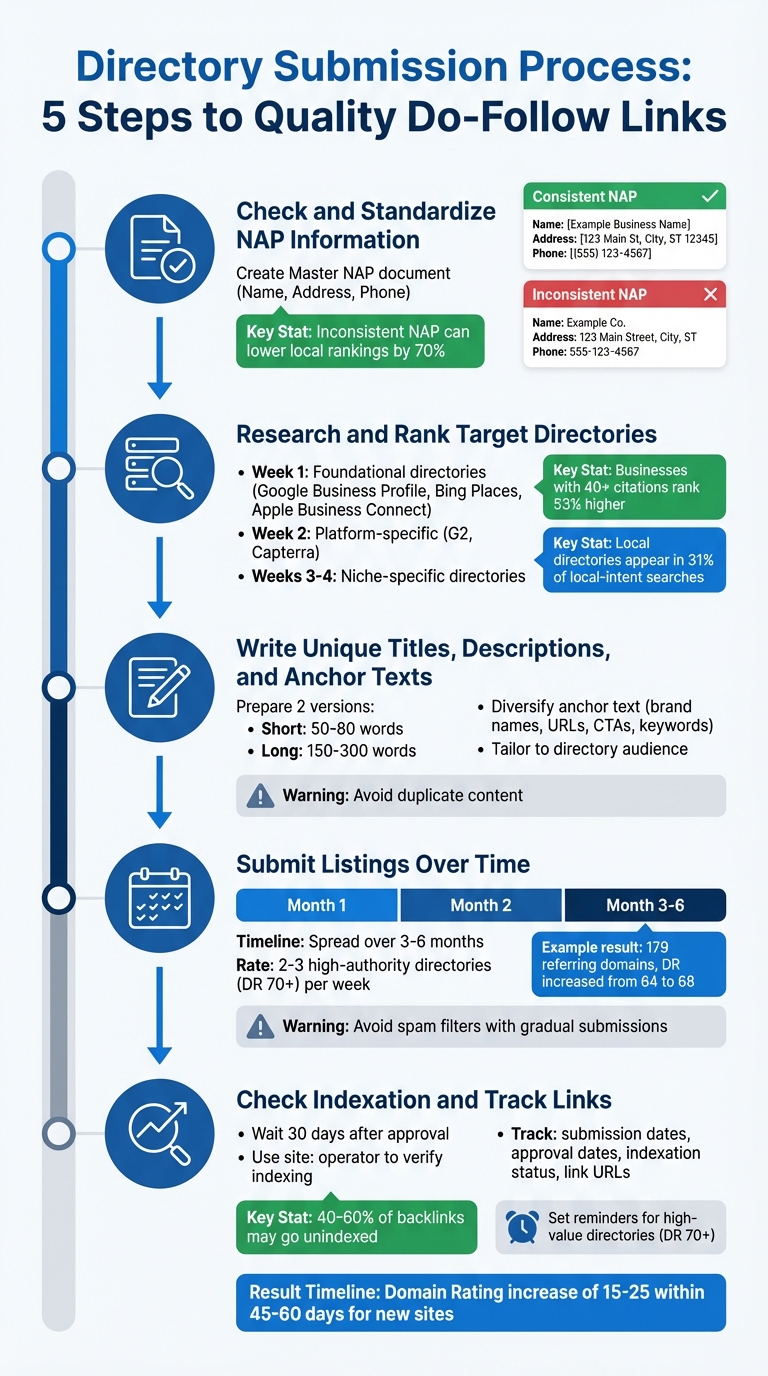
5-Step Directory Submission Process for Do-Follow Links
Once you’ve selected and verified quality directories, it’s time to move on to the submission process. Taking your time and avoiding duplicate content is key here – rushed submissions can hurt your SEO efforts.
Step 1: Check and Standardize NAP Information
Start by creating a Master NAP document – a single reference for your business’s name, address, and phone number. This ensures consistency across all directories, which is critical for local SEO. Inconsistent NAP data can lower local search rankings by as much as 70%. Even small differences, like "Street" vs. "St." or "Suite 100" vs. "#100", can confuse search engines. Gombos Atila Robert, CEO of Jasmine Business Directory, explains:
"Pick one format and stick with it everywhere. If your legal business name is ‘Johnson’s Auto Repair LLC,’ don’t get creative and use ‘Johnson Auto Repair’ on some directories… Search engines treat these as completely different businesses."
Make sure your NAP is in text format (not an image) on your website’s footer or header so search engines can easily read it. Use a local phone number rather than a toll-free one to boost local SEO signals. Finally, track your submissions in a spreadsheet, noting details like the format used, submission dates, and approval statuses.
Step 2: Research and Rank Target Directories
Not all directories are created equal. Focus on those with high authority, relevance to your industry, and a suitable audience. Here’s a good starting point:
- Foundational directories: Google Business Profile, Bing Places, Apple Business Connect (Week 1)
- Platform-specific directories: G2, Capterra (Week 2)
- Niche-specific directories: Relevant to your industry (Weeks 3–4)
Sometimes, niche directories with lower Domain Ratings (DR) can outperform general ones with higher DRs because of their topical relevance. For example, a directory with a DR of 55 might offer more value than one with a DR of 80 if it directly aligns with your business. This is especially important for local businesses, as local directories show up in 31% of local-intent organic search results. Plus, businesses with 40 or more accurate citations rank 53% higher in local search results.
Before submitting, gather assets like logos, screenshots, and URLs for your homepage, category tags, and social media profiles. This preparation can improve your approval chances with human editors.
Step 3: Write Unique Titles, Descriptions, and Anchor Texts
Each directory listing should be unique. Avoid copying and pasting the same description across directories, as duplicate content can dilute your SEO efforts. Prepare two versions of your description:
- Short version: 50–80 words
- Long version: 150–300 words
Tailor your descriptions to the directory’s audience. For example, developer-focused directories might need technical details like APIs, while SaaS review platforms might focus on ROI or time savings. Krzysztof, Founder of LaunchDirectories, emphasizes:
"The distinction is between submitting thoughtful, unique listings to platforms with real audiences versus blasting identical descriptions to hundreds of no-name link farms. The former builds lasting SEO authority. The latter gets you nowhere."
Diversify your anchor text by mixing brand names, raw URLs, and natural keyword variations. Stick to your exact business name in titles to avoid keyword stuffing and potential editorial rejections.
Step 4: Submit Listings Over Time
Patience is essential for building a natural link profile. Spread out your submissions over 3–6 months. Submitting too many listings in a short period can trigger spam filters and hurt your SEO. A good rule of thumb is to submit to 2–3 high-authority directories (DR 70 or higher) per week.
One example of this gradual approach saw a business gain 179 referring domains and increase its Domain Rating from 64 to 68 over several months. Be patient with the review process – resubmitting too quickly can lead to rejection.
Step 5: Check Indexation and Track Links
Once your listings are approved, confirm that search engines have indexed them. Since 40–60% of backlinks may go unindexed, this step is crucial. Use the "site:" operator (e.g., site:example-directory.com "your business name") to check indexing. Wait about 30 days after approval before verifying through Google’s cache.
Keep updating your submission tracker with details like submission and approval dates, indexation status, and link URLs. For high-value directories (DR 70+), set calendar reminders to recheck indexation.
Tools like 3Way.Social can simplify tracking indexation and evaluating the impact of directory submissions on your SEO. Regular audits will help you identify which listings need updates or removal to maintain their value.
Best Practices for Getting More Value from Do-Follow Links
Building on the submission steps, these tips can help you maximize the benefits of your do-follow links.
Target Niche, Industry, and Local Directories
Focus on directories that are specific to your industry or niche. These often provide stronger relevance signals compared to broader, high-authority platforms. Search engines place a premium on contextually relevant links, making niche directories more impactful than general ones. Similarly, local directories can improve your map rankings by ensuring consistent NAP (Name, Address, Phone) data across platforms. Instead of spreading yourself thin, aim to submit to 20–30 high-quality, industry-specific directories rather than hundreds of lower-quality options.
When to Pay for Directory Listings
Paid directory listings can be worth the investment, but only if the platform has a Domain Rating (DR) of 70 or higher. Considering the average cost of a high-quality backlink is $508.95, it’s crucial to ensure you’re getting real value. Industry-specific directories like Clutch (for agencies), Avvo (for lawyers), or Healthgrades (for medical professionals) often justify their cost by delivering targeted, verified traffic.
Statistics back this up: paid listings on high-authority directories see conversion rates of 4.7%, compared to 1.9% for free listings. They also achieve a 42% higher click-through rate. James Mitchell, Technical SEO Lead at Backlynk, emphasizes the importance of directory quality:
"The difference in link equity between a DR 90 directory and a DR 20 directory isn’t marginal. It’s astronomical".
Premium directories typically charge between $65 and $260 annually, with some, like the Better Business Bureau, ranging from $400 to $500 per year. Before committing to a paid listing, confirm that the directory employs human editors for manual review rather than automated bots. This ensures your listing contributes to a credible and trustworthy link profile.
Vary Anchor Text and Keep Link Profiles Natural
To maintain a natural link profile and avoid over-optimization, use a mix of anchor text types. Combine brand names, plain URLs, and descriptive phrases like "visit website" to diversify your approach. This not only prevents penalties but also strengthens the trustworthiness of your do-follow links.
Incorporate long-tail keywords that reflect how real users search. For instance, instead of generic terms, opt for phrases like "Chicago wedding photographer specializing in intimate ceremonies." A balanced link profile should also include a mix of do-follow and no-follow links, signaling reliability to search engines. Customize each submission’s title and description to align with the directory’s audience. Highlight technical details or benefits – such as ROI or time savings – to resonate with potential customers and stand out.
Common Mistakes and How to Avoid Them
After implementing best practices for directory submissions, it’s equally important to steer clear of common missteps. This section outlines the pitfalls that can undermine your SEO efforts and how to sidestep them effectively.
Using Low-Quality or Spam Directories
Submitting your site to low-quality or spammy directories can do more harm than good. These directories often attract penalties and tarnish your site’s reputation by associating it with unreliable or shady online platforms. Google’s Penguin update was designed to combat manipulative link schemes, making these directories a risky choice.
Here are some red flags to watch out for:
- Instant or Automated Approval: Reputable directories typically rely on human editors to review submissions, a process that usually takes 24 to 72 hours.
- Unprofessional Design: Outdated layouts, cluttered pages, excessive banner ads, and irrelevant links are telltale signs of a poor directory.
- Lack of SSL Certificates: Directories without HTTPS security ("Not Secure" warnings) should raise concerns.
- Poor Technical Health: Directories with slow loading speeds, broken internal links, or poor mobile responsiveness are best avoided.
To evaluate a directory, use Google’s ‘site:’ operator (e.g., "site:example.com"). If the directory isn’t indexed, it likely offers little to no SEO value and might even be penalized.
"The company you keep online matters tremendously. Just as you wouldn’t want your physical storefront in a run-down area… you don’t want your online presence in digital spaces that lack credibility."
- Gombos Atila Robert, PhD, CEO of Jasmine Business Directory
Real-world examples highlight the importance of quality over quantity. For instance, in 2025, a small bakery audited its directory listings and removed entries from low-quality sites. By focusing on five high-quality, SSL-secured directories with user-friendly designs, the bakery saw a 40% boost in local search visibility within six months. Similarly, a regional healthcare provider improved its directory-referred appointments by 47% in one year after systematically removing low-authority listings.
| Feature | Quality Directory | Low-Quality/Spam Directory |
|---|---|---|
| Approval Process | Manual review (24–72 hours) | Instant or automated approval |
| Design | Professional, mobile-responsive | Outdated, cluttered with ads |
| Security | SSL Certificate (HTTPS) | No SSL (HTTP/Not Secure) |
| Outbound Links | Limited, relevant links | Hundreds of irrelevant links |
Not Monitoring or Updating Listings
Submitting your business to directories is not a one-time task. Failing to monitor and update your listings can lead to broken links and outdated information, which confuses both search engines and users. This is especially problematic as directories may change their policies, shut down, or experience technical issues.
Accurate and consistent business information is crucial. Businesses with 40 or more accurate directory citations can see a 53% improvement in local search rankings. Regular audits are essential to maintain this accuracy.
Here’s how to stay on top of your listings:
- Conduct Quarterly Reviews: Schedule regular audits to ensure that your business details are up-to-date, links are functional, and directories still meet quality standards.
- Use Google Analytics: Track referral traffic from directories. If a directory sends little to no traffic and shows signs of declining quality – like a higher spam score or dropping domain authority – consider removing your listing.
Free vs. Paid Directory Listings Compared
When it comes to refining your backlink strategy, the choice between free and paid directory listings depends on your budget, timeline, and SEO goals. For startups and small businesses, free directories can be a great way to establish visibility without financial investment. For example, curated startup directory lists can provide up to 42 do-follow links at no cost, with an estimated SEO value of over $2,500. High-authority free directories such as AlternativeTo and SourceForge offer strong Domain Authority scores of 86 and 87, respectively.
Paid directories, on the other hand, bring faster approvals, better placement, and consistent link quality. While free listings often involve lengthy manual reviews that can take anywhere from days to months, paid submissions are typically approved within 48 hours. A real-world example from 2024 shows how a Manchester-based accounting firm achieved 2.3 times more clicks and 4.1 times more qualified leads with a premium directory listing compared to five free listings. This translated to a 340% ROI on their annual subscription.
"If you need fewer than 2-3 qualified leads per year to break even, paid listings often deliver positive ROI." – Gombos Atila Robert, CEO of Jasmine Business Directory
The best results often come from combining both approaches. Start with high-authority free directories (DA 50+) to lay a solid foundation, then strategically invest in paid directories like Clutch or G2, where the referral traffic and credibility justify annual costs ranging from $20 to $500 or a one-time fee. For instance, Foursquare offers instant verification for $20, while LaunchDirectories provides lifetime access for $149.
Here’s a side-by-side comparison to help you decide which option aligns with your SEO goals:
| Feature | Free Directory Listings | Paid Directory Listings |
|---|---|---|
| Cost | $0 | $20–$500/year or one-time fee |
| Link Type | Mix of do-follow and no-follow | Do-follow |
| Effort Required | High (manual research, 15+ mins per entry) | Low (fast-tracked or instant approval) |
| SEO Value | Foundational; builds authority over time | High; 15–25% ranking boost within 3–6 months |
| Risks | Quality varies; slow approval (up to 6 months) | Financial investment; potential penalties if overused |
To get the most out of either option, maintain consistent NAP (Name, Address, Phone) information across all directories. Spread your submissions over several months to avoid unnatural backlink spikes, which can trigger spam filters.
Conclusion
Directory submission has shifted gears, transforming into a methodical SEO practice focused on building trust and authority. Instead of chasing sheer numbers, the emphasis is now on targeting 20–30 high-quality directories rather than hundreds of low-value options. And the results speak for themselves: websites with just 30–35 solid backlinks can drive over 10,500 visits per month, proving that quality links can significantly boost traffic.
As Gombos Atila Robert, PhD, puts it:
"Directory link building isn’t dead – it’s just evolved."
To succeed, consistency and attention to detail are critical. Keep your NAP (Name, Address, Phone) details uniform across all listings, write unique descriptions for each entry, and space out your submissions over several months (3–6 months is ideal) to simulate organic growth. For new websites, aim for 5 to 10 high-quality submissions per month to maintain a steady pace.
Think of directory submission as an ongoing effort. Regularly auditing your listings ensures accuracy and eliminates harmful entries. Without intervention, 40–60% of backlinks may remain unindexed, but using indexing tools can increase that rate to over 85%.
As Total Info Hub explains:
"Directory submission is no longer spam – it’s about trust and relevance."
To maximize your results, focus on directories with a Domain Authority of 40 to 70, target niche and local platforms for added relevance, and diversify your anchor text to maintain a natural link profile. Whether you choose free or paid listings, the ultimate goal is to build a trustworthy and authoritative foundation that search engines reward with higher rankings and better visibility.
For more tips and tools to refine your strategy, visit 3Way.Social.
FAQs
How many directory links should I build each month?
The number of directory links you should aim for each month hinges on the quality and domain authority of the directories you’re targeting. It’s better to prioritize fewer, high-authority directories (think Domain Rating 70+) since they deliver stronger SEO benefits. Many SEO experts suggest aiming for 10–50 high-quality directory links monthly, ensuring the directories are not only authoritative but also relevant to your niche. Quality always trumps quantity when it comes to SEO.
How can I tell if a directory link will actually be indexed?
To find out if a directory link is indexed by Google, you can use Google Search Console‘s URL Inspection tool. This feature lets you check if the URL is currently indexed or eligible for indexing.
Another option is to perform a simple Google search using the "site:" operator. For example, search for site:exampledirectory.com in Google. If the page shows up in the results, it’s indexed.
Keep in mind that indexing can take some time, so these steps are helpful for confirming the status of your link.
What should I do if my NAP is inconsistent across directories?
If your NAP (Name, Address, Phone number) details vary across directories, it’s time to take action. Start by auditing all your listings to pinpoint any inconsistencies. Once you’ve identified discrepancies, update them to ensure everything matches perfectly.
Keeping your NAP consistent not only boosts your local SEO rankings but also strengthens trust with potential customers. To make this process easier, look into synchronization tools that can automate updates and help prevent outdated information from creeping back in. Prioritize high-authority directories to maximize your local search visibility.