Last Updated on March 19, 2026 by Becky Halls
Toxic backlinks are links from low-quality or spammy websites that violate search engine rules. They aim to manipulate rankings instead of providing real value. These links can harm your website by:
- Lowering search rankings and reducing organic traffic.
- Triggering Google penalties, including manual actions.
- Damaging your site’s trust and authority over time.
To identify toxic backlinks, look for patterns like over-optimized anchor text, links from irrelevant or penalized domains, and sudden spikes in backlinks. Tools like Google Search Console and Semrush can help flag issues.
If toxic links are found, try removing them by contacting webmasters. If that fails, use Google’s disavow tool cautiously. Regular audits and ethical link-building practices are key to maintaining a clean backlink profile and avoiding penalties.
“We’ve seen toxic backlinks cause the most damage when nobody notices them. They creep in quietly from old campaigns, spam scrapes, and low-quality directories.” Becky Halls, Strategist at 3Way Social
Toxic Backlinks: How to Find Them & Disavow Them [2024]
sbb-itb-88880ed
What Are Toxic Backlinks?
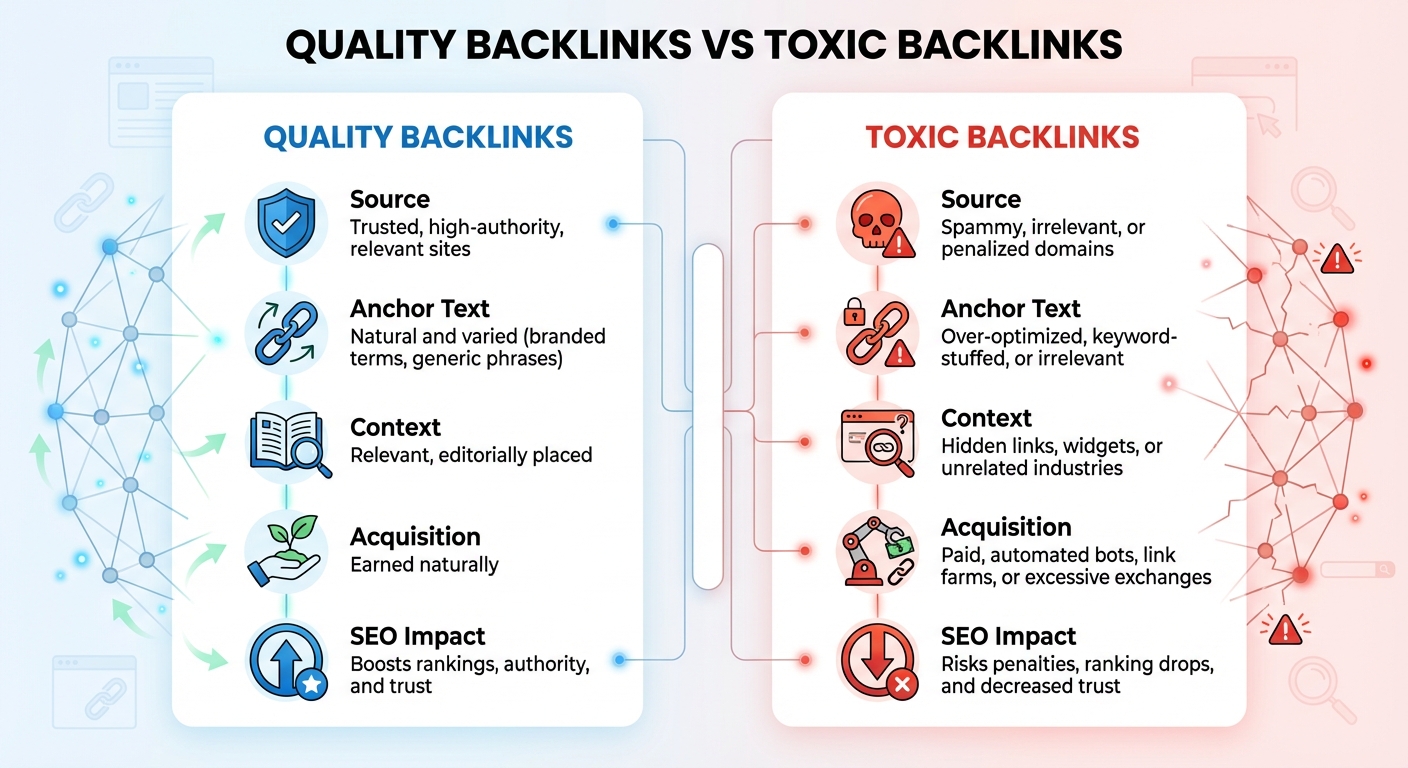
Quality vs Toxic Backlinks Comparison Chart
Toxic backlinks are low-quality, unnatural links that go against search engine rules by trying to manipulate rankings instead of offering genuine value to users. Google refers to these as “link spam” – links created to game the system rather than to benefit readers.
These harmful links often come from spammy, irrelevant, or even malicious sites, such as link farms, private blog networks (PBNs), or compromised websites. Violations occur when links are bought, involved in excessive link exchanges, or generated using bots. As Google explains:
“A natural link is an editorial choice”.
Search engines have two ways of handling these violations: they either ignore the links by devaluing them algorithmically or issue manual penalties that can push your pages down or even remove them from search results entirely. Tools like Semrush measure toxicity levels, with scores of 60–100 labeled as “Toxic” and 45–59 as “Potentially Toxic”.
Definition and Key Characteristics
Toxic backlinks are easy to spot because they share a few clear traits. These include manipulative anchor text, such as keyword-stuffed phrases like “best cheap loans”, links from unrelated industries (e.g., a casino site linking to a children’s school), and those originating from penalized or low-authority domains.
“In our experience, the biggest giveaway is context. If the linking site has thin content and links out to every industry, it’s rarely a safe signal.” Becky Halls, Strategist at 3Way Social
Other red flags include links from sites with a Domain Authority (DA) under 20, hidden links or widgets, foreign-language anchor text on English-language sites, or an unusually large number of new backlinks appearing overnight. For instance, in January 2026, a financial services company discovered over 500 backlinks from low-quality directories in Eastern Europe and Asia – all featuring exact-match commercial keywords in foreign languages and appearing within a single weekend.
Danny Richman, Founder of Richman SEO Training, offers an insightful perspective:
“I don’t believe in toxic links. I do believe in toxic link profiles”.
Context matters, too. A gambling site link might be toxic for a children’s education website but perfectly fine for a casino review platform.
This is where toxic backlinks stand in stark contrast to quality backlinks.
Toxic Backlinks vs. Quality Backlinks
The key difference between toxic and quality backlinks lies in intent and editorial choice. Quality backlinks come from trusted, authoritative, and relevant sites that choose to reference your content naturally. Toxic links, however, exist purely to manipulate rankings and add no real value.
Here’s a quick comparison:
| Feature | Quality Backlinks | Toxic Backlinks |
|---|---|---|
| Source | Trusted, high-authority, relevant sites | Spammy, irrelevant, or penalized domains |
| Anchor Text | Natural and varied (e.g., branded terms, generic phrases) | Over-optimized, keyword-stuffed, or irrelevant |
| Context | Relevant, editorially placed | Hidden links, widgets, or unrelated industries |
| Acquisition | Earned naturally | Paid, automated bots, link farms, or excessive exchanges |
| SEO Impact | Boosts rankings, authority, and trust | Risks penalties, ranking drops, and decreased trust |
Quality backlinks are earned through strong content and genuine relationships, while toxic links can actively harm your site. Greg Heilers and Morgan Taylor from Jolly SEO explain:
“Bad backlinks are a problem not just because they can lead to penalties by Google. Backlinks with a negative traffic trajectory also provide a decreasing ROI as they age”.
How Toxic Backlinks Harm Your Website
Toxic backlinks can seriously damage your SEO efforts. Understanding their impact highlights why maintaining a clean backlink profile is so important.
Lower Rankings and Reduced Traffic
Google’s algorithms, like SpamBrain and Penguin, are always on the lookout for unnatural link patterns. When these manipulative links are detected, Google might devalue them, which can lead to a drop in rankings. Take the Easy Branches website as an example – it had over 2.6 million backlinks but saw its monthly traffic plummet from 36,000 to zero in just two years. In another case, aggressively disavowing links caused a staggering 60% drop in organic traffic.
Toxic links can also waste your crawl budget, diverting Google’s resources away from indexing your high-quality content. And while algorithmic impacts can be severe, they might escalate to something even worse: manual penalties.
Google Penalties and Manual Actions
Algorithmic demotions happen quietly, but manual actions from Google can have a much harsher impact. These penalties, triggered by manual reviews, can sink your rankings or even remove pages entirely. John Mueller, Google’s Search Advocate, explains:
“If we see a very strong pattern [of spammy links] there, then it can happen that our algorithms say well, we really have kind of lost trust with this website… and then you can see kind of a drop in the visibility there.”
While minor penalties might resolve within 2–4 months, more severe cases can take anywhere from 6 to 12 months – or longer – to recover. Regularly reviewing the “Security & Manual Actions” report in Google Search Console and using a backlinks monitor tool is one way to stay ahead of these issues.
But the damage doesn’t stop at penalties. Toxic backlinks can also erode your site’s credibility over time.
Reduced Trust and Authority
Toxic backlinks – by their manipulative nature – gradually chip away at your site’s credibility and domain authority. A backlink profile overloaded with spammy links signals to search engines that your site can’t be trusted, a process known as authority dilution. This can have broader implications, such as being excluded from AI-generated summaries or other search engine features.
Search engines also categorize websites into “neighborhoods”, so if your site is linked to low-quality domains, it may be grouped with toxic websites, further damaging your authority. Greg Heilers and Morgan Taylor from Jolly SEO explain it well:
“Backlinks with a negative traffic trajectory also provide a decreasing ROI as they age.”
This slow erosion of trust makes it harder for your site to compete, even if you’re consistently producing high-quality content. Toxic backlinks don’t just harm your rankings – they undermine your entire online reputation.
How to Identify Toxic Backlinks
Spotting toxic backlinks requires a link building planner, automated tools, and manual review to get a full picture of your backlink profile. This process is crucial to avoid ranking penalties and maintain trust, as discussed earlier.
SEO Tools for Backlink Analysis
Start with Google Search Console – it’s the best place to check for any manual actions from Google, which might already highlight unnatural links to your site. After that, dive into a full audit using tools like Semrush’s Backlink Audit Tool. This tool assigns a Toxicity Score (ranging from 0 to 100) and uses over 45 toxic markers, such as link networks, mirror pages, and spammy TLDs, to evaluate links. To minimize errors and get a clearer picture, combine data from Google Search Console, Ahrefs, and Semrush.
Once you’ve gathered data from these tools, the next step is to review each flagged link manually, focusing on its source, context, and placement.
Criteria for Evaluating Link Quality
While automated tools are great for identifying risks, manual evaluation is essential for understanding the context. For instance, a gambling-related link might harm a school website’s credibility but could be fine for a casino review site. To separate good links from bad ones, consider the following:
- Anchor Text Patterns: Look for “money” anchors (exact-match keywords) or “compound” anchors (a mix of brand and keyword). These often indicate manipulative SEO rather than genuine editorial links.
- Placement: High-quality links are usually embedded editorially within the main content, while toxic ones are often tucked away in footers, sidebars, or widgets.
- Link Density: Be cautious of pages with too many external links or paragraphs overloaded with links.
Here’s a quick comparison to help you evaluate link quality:
| Criteria | High-Quality Backlink | Toxic Backlink |
|---|---|---|
| Source Authority | High DA/DR; established authority | Low authority; de-indexed or newly created |
| Relevance | Related to your niche | Unrelated or spammy niches like gambling or adult content |
| Anchor Text | Natural, branded, or descriptive | Over-optimized, keyword-stuffed, or irrelevant |
| Placement | Embedded within body content editorially | Found in footers, sidebars, widgets, or hidden areas |
| Site Content | Unique, valuable, and well-written | Scraped, thin, or spun content from AI |
Common Patterns of Spammy Links
Be on the lookout for sudden spikes in backlinks, as these can indicate spam campaigns or negative SEO attacks. A site becomes highly toxic if over 50% of its backlinks share identical anchor text. Other red flags include links from hacked websites (often hidden in footers), high-spam-score domains, or backlinks from irrelevant foreign-language sites.
Typical sources of spammy links include:
- Comment spam
- Forum profile links
- Low-quality directories
- Private blog networks (PBNs)
Additionally, technical markers like mirror pages (identical pages across multiple domains) or multiple linking sites sharing the same Google Analytics or AdSense IDs are strong indicators of toxicity. These patterns can undermine your backlink profile, so addressing them is critical.
How to Remove and Disavow Toxic Backlinks
Once you’ve identified toxic backlinks, the next step is to remove or neutralize them. Start by attempting manual removal before resorting to Google’s disavow tool. Here’s how to tackle each step effectively.
Removing Toxic Links: The Manual Approach
Begin by finding the webmaster’s contact information. You can check the “Contact Us” page, author profiles, WHOIS data, or use tools like Hunter.io to locate their details. When reaching out, use your domain’s email address to establish credibility. Your message should include:
- The specific URL on your site affected by the backlink.
- A clear explanation that the link was added without your consent or violates Google’s link spam policies.
- A polite request to either remove the link or apply a
rel="nofollow",rel="sponsored", orrel="ugc"attribute.
If you don’t get a response within 7–10 days, follow up with a second request. Keep a record of all outreach attempts in a spreadsheet, which can be helpful if you need to submit documentation to Google later.
For example, a travel blog in 2026 lost 60% of its traffic after receiving a manual penalty for unnatural links. Through diligent outreach, the owner managed to remove 120 out of 200 toxic links and disavowed the remaining 80. Within 45 days, the penalty was lifted, and the blog’s rankings fully recovered in three months. This case shows that persistence and professionalism can lead to success. If complete removal isn’t an option, requesting a nofollow attribute is a practical alternative to stop the link from passing PageRank.
“We’ve noticed cleanup works best when it’s selective. Trying to disavow everything ‘low DA’ creates busywork. Focus on obvious spam, irrelevant clusters, and unnatural patterns.” Ian Naylor, Founder of 3Way Social
Using the Google Disavow Tool
The disavow tool is a powerful option, but it should only be used when absolutely necessary – such as when a large number of spammy links have caused or may cause a manual action. Google’s Gary Illyes has cautioned:
“We said multiple times that the disavow tool is a very heavy gun. And if you don’t know what you are doing, you can shoot yourself in the foot with it”.
Before using the tool, check Google Search Console’s “Security & Manual Actions” section. If it says “No issues detected”, disavowing may not be needed, as Google’s algorithms might already be ignoring the spammy links.
To use the tool, prepare a plain text (.txt) file in UTF-8 or 7-bit ASCII format. Use domain:example.com to disavow an entire domain or specify individual pages like https://example.com/page. Add comments with the # symbol to document why each link was included or when removal attempts were made. Keep in mind:
- The file cannot exceed 2MB or 100,000 lines.
- Each upload replaces the previous file, so maintain a master list of disavowed links.
Once submitted, it can take weeks or months for Google to process the file as it recrawls the web.
In one case, an ecommerce site faced a manual penalty after a negative SEO attack involving over 1,000 spammy links. By submitting a well-documented disavow file and a reconsideration request, the site’s rankings recovered within 45 days. This example highlights how the disavow tool, when used correctly, can counteract large-scale spam attacks.
Preventing Toxic Backlinks in the Future
To keep your backlink profile clean, regular monitoring is essential. Perform backlink audits every 3–6 months, or monthly if your site operates in a competitive or spam-prone niche. Track new referring domains and watch for unusual spikes that might indicate spam campaigns or negative SEO attacks using tools like Google Search Console or Semrush.
Avoid risky practices like using Private Blog Networks (PBNs), link-building bots, or purchasing “follow” links – PBNs, in particular, are a common cause of manual penalties. Ensure all non-editorial links, including paid, sponsored, or user-generated ones, are tagged correctly with rel="nofollow", rel="sponsored", or rel="ugc".
Diversify your anchor text by including brand mentions and naked URLs instead of relying solely on exact-match commercial keywords. Finally, educate your marketing team on ethical link-building practices to avoid falling into manipulative tactics. Regular vigilance and adherence to best practices can help you maintain a healthy backlink profile.
Building a Healthy Backlink Strategy
Why Quality Backlinks Matter
Think of high-quality backlinks as endorsements for your site. Google’s John Mueller has stressed the importance of earning natural, trustworthy links rather than chasing sheer quantity.
But backlinks aren’t just about traditional search rankings anymore. Their quality now plays a role in whether your site gets highlighted in AI-driven tools like Google’s AI Overviews, ChatGPT, and Perplexity.
To secure these valuable links, focus on creating “linkable assets.” This could mean publishing original studies, running polls, offering ebooks, or crafting expert guides that journalists and bloggers naturally want to reference. Another effective approach is broken link building – find outdated or dead links on competitor sites, then pitch your own relevant content as a replacement to the referring domains.
Once you’ve nailed the concept of earning natural links, the next step is to leverage trustworthy platforms for building links safely.
Using Platforms for Safe Link Building
When it comes to ethical link building, transparency and vetted networks are key. A platform like 3Way.Social (https://3way.social) offers an AI-powered solution for secure ABC link exchanges. Its domain-matching technology ensures your site is paired with relevant, authoritative partners. The platform also provides permanent do-follow links and advanced features for link diversification, helping you maintain a natural-looking backlink profile.
Quality control filters and flexible exchange options ensure you’re building links that align with Google’s guidelines. Keep in mind that any paid links, advertisements, or sponsored content must include the rel=”nofollow” or rel=”sponsored” attribute to avoid violating Google’s spam policies.
Alongside using reliable platforms, diversifying your backlink profile is another critical step.
Diversifying Your Link Profile
A diverse backlink profile is like a safety net – it protects your site from algorithmic penalties and builds long-term credibility. Google’s algorithms look for patterns of unnatural linking behavior, so maintaining diversity helps avoid raising red flags. Securing links from trusted, authoritative sources can also act as a safeguard, buffering your site’s reputation even if a few lower-quality links slip through.
To keep things natural, vary your anchor text. Use a mix of branded mentions, plain URLs, and descriptive phrases instead of overloading on keyword-heavy anchors. Balance your profile with both dofollow and nofollow links to make it appear more organic to search engines. Additionally, aim to get links from a wide range of unique domains and IP addresses to avoid looking like part of a Private Blog Network.
Finally, focus on steady, organic growth. A sudden influx of links can trigger search engine suspicion, so aim for a gradual, consistent build-up.
Conclusion
So what are toxic backlinks and how do they affect your site? Toxic backlinks can harm your site’s SEO performance, but they’re not insurmountable. By conducting regular audits – monthly or quarterly – you can identify and address harmful links before they cause lasting damage. To do this effectively, you must first find backlinks Google has indexed for your domain. On average, about 15% of backlinks may fall into the toxic category, but there’s a silver lining: websites that take the right steps to clean up typically see a 90% recovery rate.
When you find toxic links, start by manually removing them. Reach out to webmasters and request removal. If that doesn’t work, use Google’s disavow tool as a backup. Thankfully, Google’s systems are designed to ignore isolated spammy links. John Mueller from Google explains:
“If you’re seeing individual links that pop up… I would completely ignore those… they happen to every website and Google’s system has seen them so many times over the years, and we’re very good at just ignoring.”
Once you’ve dealt with toxic links, shift your attention to building a strong, sustainable backlink strategy. Focus on earning editorial links and properly attributing any paid partnerships. A solid base of high-quality backlinks not only boosts your SEO but also helps shield your site from occasional toxic links or negative SEO attacks.
Recovery isn’t instant – it typically starts within 30 days but may take 3–6 months for full results. Ethical link-building, paired with consistent monitoring, is essential for long-term success. Stay patient and vigilant to maintain a healthy backlink profile and avoid penalties.
For AI-powered tools to strengthen and secure your backlink strategy, check out 3Way.Social.
What Are Toxic Backlinks – FAQs
Do toxic backlinks always hurt my rankings?
Toxic backlinks don’t always hurt your rankings because Google often ignores low-quality links. However, backlinks that are spammy or manipulative can trigger penalties, which could harm your SEO efforts. To safeguard your site’s rankings, it’s crucial to keep an eye on your backlink profile and deal with harmful links promptly.
How can I tell if a backlink is toxic or just irrelevant?
When deciding if a backlink is harmful or just unrelated, take a close look at its source. Watch out for signs of spam or poor quality, such as link farms, private blog networks (PBNs), or links from websites in completely unrelated industries. These are red flags that could indicate a toxic backlink.
To spot these issues, tools like Google Search Console or specialized backlink audit platforms can be incredibly helpful. They can identify suspicious patterns or spam signals that might otherwise go unnoticed.
Why does this matter? Toxic backlinks can hurt your SEO performance, potentially dragging down your rankings. That’s why it’s so important to keep an eye on your link profile regularly. Staying proactive about monitoring ensures your backlinks support – not harm – your site’s visibility.
When should I use Google’s disavow tool?
If you come across toxic backlinks that are dragging down your SEO and can’t be removed manually, it’s time to turn to Google’s disavow tool. This tool is especially useful for dealing with links from spammy or low-quality websites that could lead to penalties or a drop in rankings. Be cautious, though – only disavow links that are genuinely harmful to avoid any unintended effects on your site’s performance.