Last Updated on January 5, 2026 by Becky Halls
Contextual relevance in backlinks means the link is placed within content that matches the topic of the page it’s linking to. This alignment helps search engines understand the connection between the source and destination, improving rankings and user experience.
Key Points:
- Backlinks are links from one website to another, signaling credibility to search engines.
- Contextual relevance ensures the link is embedded in related content, making it more valuable.
- Search engines analyze the surrounding text, anchor text, and linked page to determine relevance.
- Links in the main content perform better than those in sidebars or footers.
- Contextual links reduce the risk of penalties from search engines and improve user engagement.
Why It Matters:
- Google prioritizes context over domain authority.
- Relevant links build topical authority, improve SEO rankings, and enhance user experience.
- Poorly placed or unrelated links can harm rankings and trigger penalties.
To build better backlinks, focus on relevance, natural placement, and meaningful anchor text. Use tools like 3Way.Social to simplify finding and securing high-quality, contextually relevant links.
“We’ve seen one properly placed contextual link in a genuinely relevant paragraph outperform 10-20 ‘good metric’ links sitting in sidebars, author boxes, or random resource pages.” 3Way Social Team
Contextual Link Building: How I Increased My SEO Traffic By 195% In 1 Month
How Contextual Relevance Affects SEO Rankings
Contextually relevant backlinks play a crucial role in improving rankings and showcasing expertise. Here’s a breakdown of how they directly influence your SEO performance.
Building Topical Authority
Backlinks from content that aligns with your niche signal to search engines that your site is a trusted resource for specific topics. The anchor text and surrounding content further reinforce your expertise. Google’s Topic-Sensitive PageRank prioritizes authority from trusted pages within a niche. Simply put, a link from a high-ranking, relevant page carries far more weight than one from an unrelated site.
“A good hub is a page that points to many good authorities; a good authority is a page that is pointed to by many good hubs.”
– Jon Kleinberg, Professor, Cornell University
Ahrefs research highlights that key factors for visibility in AI-driven search – such as branded web mentions, branded anchors, and branded search volume – are significantly influenced by contextual backlinks.
Search Engine Land’s guide on quality backlinks emphasizes relevance and notes links in body copy carry more weight than templated areas like footers/sidebars. Search Engine Land
Better User Experience
Once topical authority is established, contextual links enhance user engagement by fitting naturally into the content. Readers are more likely to click on links embedded within the main body of an article than those placed in sidebars or footers. This type of placement boosts engagement metrics. Google’s “Reasonable Surfer” model reflects this by assigning more weight to links that are both prominent and relevant to the surrounding content. Before pursuing a link, consider this:
“Will this link bring engaged, highly qualified visitors to my website?”
– Cyrus Shepard, Founder, Zyppy SEO
On the other hand, links that feel out of place can confuse readers and may even signal manipulative link-building tactics to search engines.
Lower Risk of Penalties
Contextual backlinks not only enhance authority and user experience but also reduce the risk of penalties. Search engines view these links as natural endorsements rather than manipulative strategies, which helps avoid penalties. Since Google’s 2012 Penguin Update, there has been a crackdown on manipulative link-building practices. Context-rich links provide search engines with a clear understanding of the link’s destination, reducing reliance on risky, over-optimized anchor text that could trigger penalties. For example, links that are off-topic – like a gambling link on a cooking blog – are often flagged as spam. Both manual and algorithmic reviews are quick to identify such out-of-context placements.
“Contextual relevance remains the #1 most important visibility factor on AI search.”
– Authority Builders
Modern search engines and AI models evaluate link context by analyzing co-citation patterns and the specific paragraph where the link appears. By focusing on contextual relevance, you align with Google’s evolving algorithms, which prioritize semantic relationships and user intent.
How to Evaluate Contextual Relevance
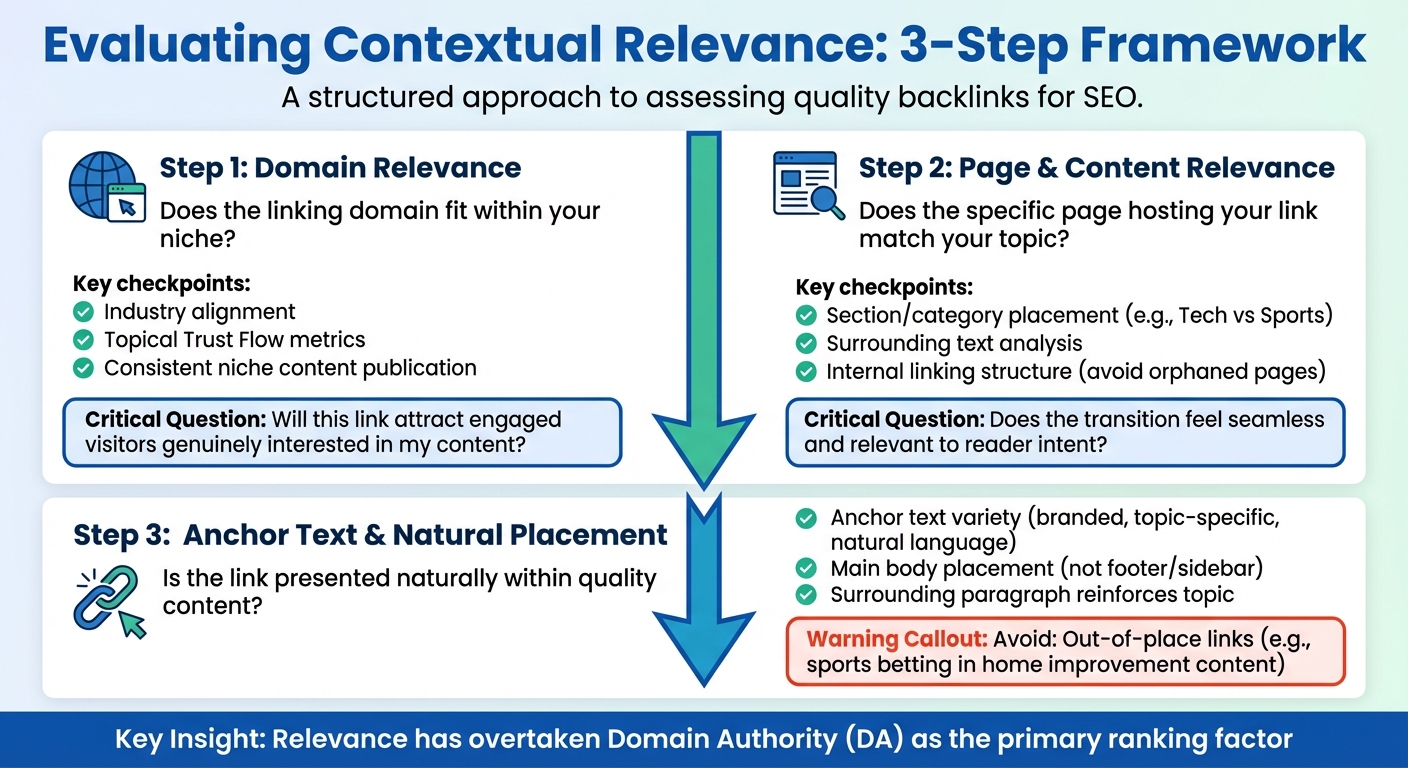
How to Evaluate Contextual Relevance in Backlinks: 3-Step Assessment Framework
Before chasing any backlink, it’s important to determine how much it will actually benefit your SEO efforts. This means taking a close look at the linking domain, the specific page, and the placement of the link. In today’s SEO landscape, relevance has overtaken Domain Authority (DA) as a key ranking factor. To ensure alignment with your goals, assess three main elements: the domain, the page content, and the anchor text.
Domain Relevance
The first thing to check is whether the linking domain fits within your niche. Does the website operate in your industry or cover topics that are closely related? A link from a smaller site with an audience that aligns with your niche can often be more impactful than one from a high-authority site that’s unrelated.
SEO tools can help here – look at metrics like Topical Trust Flow to see how search engines rank the domain’s influence in specific subject areas. Also, consider whether the site consistently publishes content relevant to your niche or if it only touches on your industry occasionally.
Ask yourself: “Will this link attract engaged visitors who are genuinely interested in my content?”.
Page and Content Relevance
Even if the domain is a good match, the specific page hosting your link matters just as much. For instance, on a multi-topic site like a news outlet, the section or category where your link appears is crucial. A link from the Technology section of a newspaper holds different weight than one from its Sports section.
Look closely at the text surrounding your link. Search engines analyze related terms in the surrounding content to determine if the link fits naturally. Also, check whether the linking page is well-connected within its own site. Pages with few or no internal links – so-called “orphaned” pages – may signal content created solely for link-building purposes.
The link should feel like a natural next step for readers. If someone clicks on it, the transition should feel seamless and relevant to their original intent.
Anchor Text and Natural Placement
Once you’ve confirmed the page’s relevance, it’s time to focus on how the link is presented. The anchor text acts as a label, giving search engines context about the linked page. Even when generic terms like “click here” or bare URLs are used, the surrounding text plays a big role in establishing relevance.
Links placed within the main body of content carry more weight than those tucked into footers, sidebars, or author bios. Google’s Reasonable Surfer model prioritizes links that are prominently placed in the HTML and are relevant to both the source and destination pages. To avoid penalties for over-optimization, use a variety of anchor text types, including branded terms, topic-specific phrases, and natural language.
Pay attention to the surrounding paragraph as well. The content around your link should reinforce the topic of your destination page. If the anchor text feels out of place – like a sports betting link in an article about home improvement – it could trigger penalties.
“In our experience, the links that actually move rankings usually look boring – they’re surrounded by the same concepts the target page covers, not forced in with a keyword-stuffed anchor.” 3Way Social Team
sbb-itb-88880ed
How to Build Contextually Relevant Backlinks with 3Way.Social

Now that you’ve grasped how to evaluate contextual relevance, it’s time to apply that knowledge. 3Way.Social simplifies the process of securing contextually relevant backlinks by combining AI-driven tools with a network of SEO professionals. This platform builds on your earlier evaluation methods, making it easier to establish backlinks that truly boost your SEO efforts. It’s all about ensuring each link adds genuine value to your overall strategy.
“When we’ve cleaned up a backlink profile, the biggest wins often come from replacing a handful of irrelevant links with a smaller number of niche-relevant ones.” 3Way Social Team
Use AI-Powered Domain Matching
3Way.Social’s AI takes the guesswork out of finding the right domains. By analyzing your website’s niche, it identifies domains that share a natural connection to your content. This isn’t just about matching keywords – the platform uses advanced deep learning to understand how topics relate to each other, similar to how modern search engines assess links. The result? A curated list of websites that not only align with your audience but also enhance your contextual relevance.
Create Guest Posts
Guest posting is a tried-and-true way to secure backlinks, and 3Way.Social makes it seamless. Start by personalizing your outreach – connect with potential sites on social media or engage with their content before pitching a guest post idea. When crafting your post, pay close attention to the text surrounding your backlinks. The context around your anchor text should clearly relate to the destination page, helping search engines understand the connection.
Get Permanent Do-Follow Links
Temporary links that vanish after a few months can hurt your SEO strategy. That’s why 3Way.Social prioritizes permanent do-follow links, which offer lasting value. These links act as genuine endorsements from the source site, passing authority directly to your pages. The platform ensures these links are embedded within the content itself – not buried in footers or sidebars – so they carry maximum weight in search engine rankings. Plus, their permanence means you won’t have to worry about losing SEO authority over time.
Diversify Your Link Profile
A well-rounded backlink profile is essential for authenticity. Use 3Way.Social’s filters to secure links from a variety of sources and experiment with different anchor text types. A balanced profile includes branded terms, topic-specific phrases, and natural language anchors, all spread across diverse domains and content formats. This approach avoids manipulative linking patterns and signals to search engines that your backlinks are organic.
Track Your Progress
With the 3Way.Social dashboard, you can monitor how your backlinks are impacting your SEO performance. Keep an eye on key metrics like rankings, domain authority, and the overall health of your link profile. Regular audits ensure that the links you’ve built remain active and effective. By tracking your progress, you can identify which types of contextually relevant links work best for your niche and fine-tune your strategy for even better results over time.
Contextual Relevance in Backlinks – Conclusion
Contextual relevance isn’t just a fancy term – it’s the backbone of a strong backlink strategy. When your links come from content that aligns closely with your niche, it signals to search engines that your site deserves to rank higher. As Madelyn Gardner from Brafton explains, “Google sees contextual backlinks as a sign that your site is trustworthy and valuable for readers. These links act like digital recommendations, giving your site more legitimacy in the eyes of search engines”.
The focus has shifted from sheer domain authority to relevance, and for good reason. A link from a blog that shares your topic can now outperform a high-authority link from an unrelated site. This trend is particularly important as AI-driven search engines increasingly lean on contextual signals to establish entity associations. It’s no surprise that these signals play a major role in shaping AI-powered search results.
This relevance-first mindset not only sharpens search intent but also lays the groundwork for smarter, more effective link-building strategies.
While building these links takes effort, the payoff is clear: stronger topical authority, better user engagement, and a healthier, penalty-resistant backlink profile. The secret lies in securing quality placements within relevant content, optimizing the surrounding anchor text, and keeping a close eye on your backlink health through regular audits.
Tools like 3Way.Social make this process easier by using AI to match your site with contextually relevant domains. Whether you’re just getting started or refining your approach, prioritizing contextual relevance is the key to boosting your search rankings and driving sustainable organic traffic growth.
Contextual Relevance in Backlinks – FAQs
What is contextual relevance in backlinks, and how does it help improve SEO rankings?
Contextual backlinks are links embedded within relevant, high-quality content that closely matches the topic of the linked page. These links act as a signal to search engines, showing that your site holds authority and credibility within a particular niche or subject area.
When placed thoughtfully within meaningful content, these backlinks transfer link equity more efficiently, which can improve your site’s position in search engine results. Additionally, they encourage higher click-through rates by appealing to users who are genuinely interested in the topic. This combination can lead to better rankings and a steady boost in organic traffic.
What are the risks of using backlinks that lack contextual relevance?
Using backlinks that don’t fit contextually with your content can actually hurt your website’s SEO. Search engines might flag these links as spammy or manipulative, which could lead to Google penalties. The consequences? Lower rankings, less traffic, and even harm to your online reputation.
To keep your SEO strong, prioritize creating relevant, high-quality backlinks that naturally align with your site’s content and genuinely benefit your audience.
How do I make sure my backlinks are contextually relevant?
To make your backlinks work effectively, ensure they are placed within content that directly aligns with the subject of your webpage. Use anchor text that feels natural and descriptive, making it a seamless part of the content rather than something forced. Prioritize backlinks from trusted, high-authority websites in your niche – this could mean writing guest posts or collaborating with reputable sources. When your backlinks are contextually relevant, search engines recognize their value and connection to your content, giving your SEO efforts a meaningful boost.