Last Updated on July 20, 2025 by Becky Halls
Evaluating backlink relevance is critical for improving your SEO performance. Here’s how you can ensure your backlinks contribute to higher rankings and targeted traffic:
- Relevance Matters: Backlinks from sites closely related to your niche are more impactful than those from unrelated domains. For example, a link from a fitness blog to another fitness-related site carries more weight than one from a fashion blog.
- Key Benefits: Relevant backlinks improve your rankings, drive engaged traffic, and enhance your site’s credibility. A SaaS company targeting industry-specific links saw a 38% increase in organic traffic.
- Evaluation Steps:
- Gather Backlinks: Use tools like Google Search Console, Ahrefs, or SEMrush to collect data.
- Check Alignment: Ensure the linking site’s content aligns with your niche.
- Review Placement: Links within the main content are more valuable than those in footers or sidebars.
- Analyze Audience: Verify that the linking site’s audience matches your target market.
- Examine Page Content: Ensure the linking page is relevant, up-to-date, and valuable.
Key Takeaway
Relevance is more important than sheer authority. A well-placed link from a related site can outperform multiple irrelevant links, even from high-authority domains. Use tools like Ahrefs, Moz, or SEMrush to streamline your analysis and continuously monitor your backlink profile for sustained success.
Step-by-Step Guide to Evaluating Backlink Relevance in SEO
Find Your Backlinks
Start by gathering a detailed list of websites linking to your content. Google Search Console is a good starting point, offering basic data like linking sites, anchor texts, and link counts. To get a more comprehensive view, consider using specialized SEO tools with their own crawlers – these tools often provide varying backlink counts and additional insights. Bing Webmaster Tools is another free option that not only shows your backlinks but also allows you to compare your profile with up to two competitors. While using these tools, focus on metrics such as Authority Score, referring domains, and network graphs that reveal the relationships between linking sites. Keep in mind, Google Search Console gives an overview but doesn’t include detailed quality metrics for linking domains. Once you’ve compiled your backlink list, you can move on to evaluating their relevance.
Verify Indexation and HTTP Status of Linking Pages
Before you assess topical fit, confirm the linking page can actually pass value. Check that the URL returns HTTP 200, not a 4xx or 5xx status. Make sure it’s not blocked in robots.txt and doesn’t use a meta robots or X‑Robots‑Tag “noindex”.
- Indexation check: Search the exact URL in Google, and try a site: query with a title snippet. This is directional, not a guarantee, but it helps spot obvious indexation gaps.
- Canonical review: If the linking page points a rel=”canonical” to a different URL, signals are consolidated to the canonical target.
- Redirects: If the linking page or link target redirects, ensure it resolves cleanly without a long chain.
Check Topic Alignment
With your backlink list in hand, the next step is to assess whether the linking sites align with your niche. Look for websites whose industry or services are closely related to yours. A backlink from a site within your field signals to search engines that your content is relevant and valuable. Take a closer look at how your link is integrated into the content. Links that are naturally embedded within high-quality, related text carry more weight than those that feel out of place or forced.
Review Link Placement
Where your backlink appears on the linking page can significantly influence its value. Links placed naturally within the main body of content tend to have more SEO impact than those buried in footers, sidebars, or author bios. Check if the surrounding text is relevant to your content and whether the anchor text accurately describes your page or contains appropriate keywords. Be cautious with over-optimized anchor texts, as they can diminish the link’s value. After this, turn your attention to whether the linking site’s audience aligns with your target market.
When your backlink is an image, the image’s alt attribute acts like anchor text. Favor descriptive, non-spammy alt text that reflects the destination topic, and avoid repeating exact-match phrases across many domains.
Confirm the backlink is a standard HTML <a href="..."> link visible in the rendered DOM. Links created only via onclick handlers or elements that require user interaction may not be discovered reliably. If JavaScript injects the link, verify it renders without scrolling, clicks, or login, and that crawlable resources are not blocked.
Check Audience Match
Beyond content relevance and placement, it’s important to confirm that the linking site’s audience overlaps with your target market. Use tools like SimilarWeb to estimate traffic, user engagement, and the geographical distribution of the site’s audience. A niche website with moderate traffic but high engagement often provides more value than a high-traffic site with low interaction. Additionally, examine traffic trends over time; a steady or upward trend indicates that the site remains relevant and trusted.
Language and Geo Relevance
Topical alignment is stronger when language and region match your audience. Look for consistent language usage, regional cues, and international signals on the linking site.
- Hreflang: Sites with correct
hreflangannotations indicate intended audiences by language and region, which supports context for your link. - ccTLDs and geo signals: Country-code domains like .de or .fr, local addresses, and locally focused content point to a specific market.
- Audience fit: If you target en‑GB users, backlinks from reputable UK sites in English often align better than links from unrelated regions or languages.
Examine Page Content
Finally, dig deeper into the specific page hosting your backlink. Even if the overall site is relevant, the individual page may not be. Check whether the page content is up-to-date and offers value, as outdated or thin content can weaken the link’s quality. Consider the page’s purpose – whether it’s a guide, a news article, or a product review – and evaluate whether it aligns with its current authority.
"Content and Links going into your site, are the two most important ranking factors followed by RankBrain" – Andrey Lipattsev, Search Quality Senior Strategist
What is Link Relevance? How to Get Relevant Backlinks for Your Website
Key Metrics and Tools for Backlink Analysis
After evaluating backlink placement and relevance, you’ll want to dive deeper into the numbers. Here are the key metrics and tools to help you measure backlink quality effectively.
Important Metrics for Backlink Evaluation
To separate the good backlinks from the bad, focus on these critical metrics:
- Domain strength: This reflects a website’s overall authority. Websites typically have a Domain Authority (DA) score between 20 and 70, but aim for backlinks from sites with a DA over 50.
- Page strength: Even if the domain has a solid DA, the specific page linking to you might not. Assess the quality of the linking page separately.
- Anchor text diversity: A natural backlink profile includes a mix of branded, exact match, partial match, and generic anchor texts. This variety helps avoid over-optimization penalties.
- Dofollow vs. nofollow ratio: Ideally, 70–80% of your backlinks should be dofollow, as these pass link equity, while nofollow links do not.
- Link attributes: Google treats
rel="nofollow",rel="sponsored", andrel="ugc"as hints, not strict directives. There is no “dofollow” attribute, links without these values can pass signals. Paid placements should userel="sponsored", and user-generated links should userel="ugc". Aim for a natural mix rather than a fixed ratio. - Outbound links: Pages with fewer outbound links pass more link equity. Look for pages that aren’t overcrowded with external links.
- Referring domains: For a growing site, having more than 100 referring domains is a healthy benchmark. A steady monthly growth rate of 5–10% in backlinks is ideal.
"The quality of backlinks matters more than the number of links acquired." – SEOptimer
Another crucial factor is page relevance, which measures how closely the linking page’s content aligns with your topic or industry. Kimberley McConnery, Director of Link Building Operations at Sure Oak, explains:
"A linking site that’s from the same or similar industry as yours will hold more value than a link from an unrelated industry. Relevant niche shows contextual relevancy and trustworthiness."
Top SEO Tools
To streamline backlink analysis, professional SEO tools can provide in-depth insights. Here’s a look at some of the best in the game:
- Ahrefs: Known for its vast keyword database (28.7 billion keywords) and an impressive 35 trillion backlinks in its index. Ahrefs is also the second most active web crawler globally, offering plans from $29 to $1,499 per month.
- Moz: With the largest backlink database (44.8 trillion backlinks), Moz is a budget-friendly option. Plans range from $49 to $299 per month, and its Link Explorer tool is excellent for tracking new and lost links.
- SEMrush: This all-in-one digital marketing platform offers extensive PPC data, historical insights, and traffic estimates. Its plans range from $140 to $500 per month, and its Link Building Tool is particularly helpful for managing outreach campaigns.
| Tool | Backlink Database | Keyword Database | Monthly Price Range | Key Strength |
|---|---|---|---|---|
| Ahrefs | 35 trillion | 28.7 billion | $29 – $1,499 | Largest keyword database |
| Moz | 44.8 trillion | 1.25 billion | $49 – $299 | Largest backlink database |
| SEMrush | 43 trillion | 26.6 billion | $140 – $500 | Most comprehensive suite |
Using 3Way.Social for Backlink Evaluation
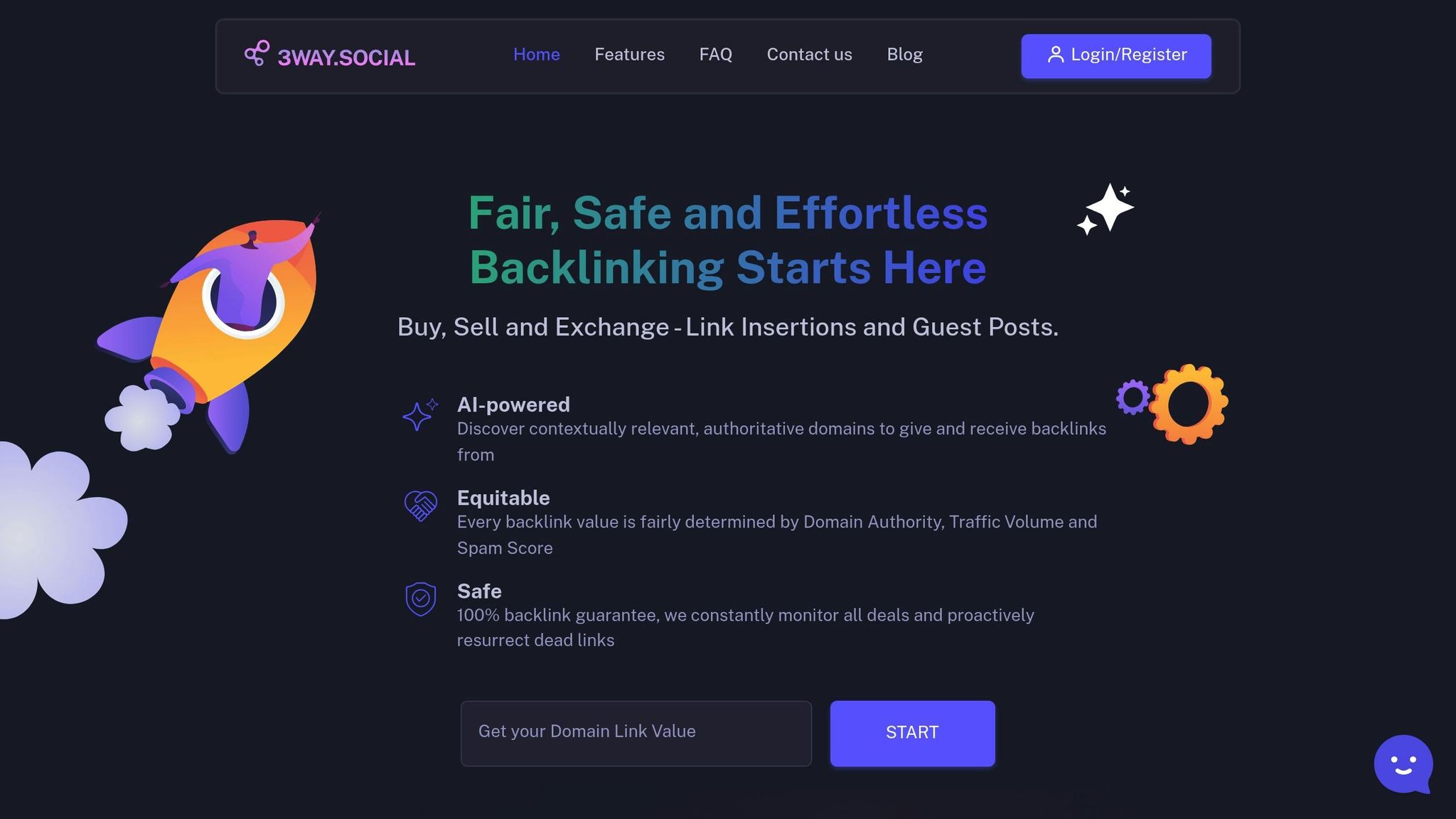
For a fresh approach to backlink analysis, 3Way.Social offers AI-driven tools that go beyond traditional methods. It evaluates domain authority, traffic volume, and spam scores using advanced algorithms. This platform also provides quality control filters to identify contextually relevant and authoritative domains.
What sets 3Way.Social apart is its unified SEO score, which integrates multiple ranking factors to assess potential link partners. Every link is validated as dofollow and unsponsored, ensuring compliance with SEO best practices. The platform also supports three-way (ABC) link exchanges, avoiding direct reciprocal linking patterns that search engines might penalize.
Another standout feature is continuous monitoring, which tracks your backlinks and guarantees reinstatement or refunds if links are lost or become problematic. This feature can save you hours of manual work.
"3Way.Social revolutionized our SEO approach. Our site’s rankings have significantly improved thanks to its innovative ABC link exchange system. The platform’s high-quality partner network is unmatched." – Sophia Martinez, SEO Manager
The platform operates on a credit system, ensuring fair pricing and transparency. Businesses using 3Way.Social report a 3x faster improvement in rankings and a 30% average increase in domain authority compared to traditional methods. Best of all, it’s free to join, with no subscription fees, making it accessible for businesses of all sizes.
sbb-itb-88880ed
Making Decisions Based on Backlink Analysis
Once you’ve gathered data from your backlink analysis using the tools and metrics discussed earlier, it’s time to put that information to work. The insights you’ve collected are only as useful as the actions you take to refine and strengthen your backlink strategy.
Focus on High-Quality Backlinks
The best backlinks come from websites that are both credible and relevant to your niche. Aim to build a diverse profile with anchor texts that appear natural. It’s equally important that the linking site’s content aligns with your website’s focus and avoids being overly monetized. Instead, the content should prioritize user value. Keep in mind that backlink quality isn’t a simple yes-or-no assessment – it falls on a spectrum.
Stay clear of practices Google defines as link schemes. These tactics can lead to ranking issues, regardless of short-term gains.
- Buying or selling links that pass PageRank without proper
rel="sponsored". - Excessive link exchanges, including large-scale reciprocal or three-way patterns intended to manipulate rankings.
- Mass guest posts with keyword-rich anchors across many sites.
- Automated link creation via software or services.
But what about links that don’t meet these standards? That’s where cleanup comes in.
Handle Poor or Irrelevant Backlinks
Start by identifying toxic backlinks. In many cases, Google’s algorithms are capable of ignoring low-quality links, so using the disavow tool isn’t always necessary. However, some situations demand direct action. Tools like SEMrush and Google Search Console can help you spot unnatural anchor text patterns or sudden spikes in link volume. Once you’ve identified harmful links, your first step should be reaching out to the site owners to request removal before resorting to disavowing.
If removal efforts don’t work, the disavow tool becomes your backup plan. But proceed carefully – Google has made it clear this feature is not to be used lightly:
Google: "This is an advanced feature and should only be used with caution. If used incorrectly, this feature can potentially harm your site’s performance in Google’s search results."
Google further advises:
Google: "You should disavow backlinks only if you believe that there are a considerable number of spammy, artificial, or low-quality links pointing to your site, and if you are confident that the links are causing issues for you."
The disavow tool is most appropriate when your site has received – or is at risk of receiving – a manual penalty for unnatural links. When preparing your disavow file, list one URL or domain per line (use "domain:" to block entire domains), then submit it through Google Search Console. Be patient, as it may take a few weeks for Google to process your file and reflect the changes.
When you prepare a disavow file, follow Google’s required format so it can be processed correctly. Use plain text encoded in UTF‑8 or 7‑bit ASCII, with a maximum size of 2 MB and up to 100,000 lines.
- One entry per line, either a full URL or
domain:example.comto cover the entire domain, including subdomains. - Comments begin with
#and are ignored. - Processing time can span several weeks before effects appear in search.
Monitor and Improve Your Backlink Strategy
After cleaning up your backlink profile, regular monitoring is key to staying competitive in SEO. With Google rolling out thousands of algorithm updates each year, what works today might not work tomorrow. For instance, 76.92% of SEO experts focus on tracking new backlinks, while 72.31% prioritize monitoring link quality.
- Consolidate signals: Identify backlinks pointing at outdated URLs and confirm they 301 to the current page. Shorten or remove chains to reduce crawl waste.
- Ask for updates: When possible, have partners link directly to the canonical URL, which reduces reliance on redirects and improves clarity.
Track how new links affect performance so you can focus on what works. In Google Search Console, monitor impressions, clicks, and average position for pages that received recent backlinks, and review query-level shifts.
- Referral quality: In GA4, review referral traffic by source and landing page to see which domains send engaged users.
- UTMs and canonicals: If you use UTM parameters for campaigns, ensure canonicals point to the clean URL so equity consolidates correctly.
- Page health: Recheck that linking pages remain HTTP 200 and indexed, and have not switched to noindex or paywalls.
- Outbound dilution: Watch for pages that later add many external links, which can weaken the value of your placement.
- Template shifts: Flag design changes that move contextual links into footers or sidebars and request restoration when possible.
Conclusion and Best Practices for Maintaining Backlink Relevance
Key Points Summary
Evaluating backlink relevance isn’t a one-and-done task – it’s an ongoing process that underpins successful SEO. As discussed, relevance outweighs authority when it comes to the impact of backlinks. Google Search Advocate John Mueller has emphasized that link relevance is the most crucial factor in determining a backlink’s ranking power.
Did you know the top-ranking page typically has 3.8x more backlinks than those ranked lower?. However, quantity alone doesn’t cut it – one well-placed, relevant backlink can outperform hundreds of irrelevant ones, even if they come from high-authority domains. This highlights the importance of prioritizing contextual alignment over simply chasing domain authority scores.
To evaluate backlinks effectively, focus on factors like topic alignment, link placement, audience overlap, and the surrounding content’s relevance. Tools ranging from Google Search Console to advanced platforms like 3Way.Social can provide detailed insights to help refine your backlink profile. These insights are your key to building a sustainable SEO strategy.
Best Practices for Long-Term Success
To maintain and improve backlink relevance, consider these strategies as part of your ongoing efforts:
- Focus on quality and relevance: Consistently prioritize backlinks that align with your niche. Invest in creating evergreen content, such as guides, checklists, and case studies. These types of resources naturally attract valuable, relevant backlinks over time.
- Conduct regular audits: Schedule monthly reviews of your backlink profile to identify links that may have lost their relevance or quality. Look for broken links, shifts in linking sites’ focus, or changes in your own business direction. Ensure the surrounding content provides meaningful context to maximize the impact of each link.
- Diversify your link sources: Build relationships with reputable websites in your industry rather than pursuing high-quantity, low-relevance links. This approach creates more sustainable opportunities and reduces reliance on any single traffic source.
- Optimize anchor text naturally: Use anchor text that’s relevant and varied, reflecting how real users would link to your content. Avoid over-optimization, which could lead to algorithmic penalties. Strive for a balance that feels organic.
- Leverage automation tools: Platforms like 3Way.Social can track backlink changes, flag potential issues, and adapt to algorithm updates. These tools help you maintain technical oversight while focusing on strategic relationship building.
FAQs
How do I check if a backlink is relevant to my website’s niche?
To determine how relevant a backlink is, start by examining the content and focus of the website providing the link. Does it fall within your industry or niche? Does its audience overlap with your target demographic? These are key indicators of relevance.
Then, take a closer look at the specific page linking to your site. Does its content naturally align with your website’s subject? Backlinks from well-regarded, niche-specific websites send a strong signal to search engines about the link’s credibility and contextual value.
To streamline this process, you can leverage SEO tools to evaluate factors like domain authority and content alignment. This approach helps you focus on building high-quality links instead of just chasing numbers.
What are the best tools for evaluating the relevance of backlinks to your website?
To assess the relevance of backlinks effectively, tools such as Ahrefs, Semrush, Moz Link Explorer, and Google Search Console are excellent choices. These platforms let you dive into backlink quality, determine how well they align with your niche, and track their influence on your SEO performance.
For a more efficient process, you might want to explore AI-driven tools like 3Way.Social. These solutions simplify backlink building and management while prioritizing quality and niche relevance. The result? Improved rankings, increased traffic, and stronger domain authority for your site.
Does the location of a backlink on a webpage impact its SEO value?
Yes, where a backlink appears on a webpage can have a big impact on its SEO value. Links placed higher on the page – like in the main content or header – tend to be more effective. They’re more visible to users and search engines, which makes them carry more weight. On the other hand, links tucked away in footers or sidebars often hold less influence.
The quality of the linking page matters too. Backlinks from sites with strong domain authority or those closely related to your niche are viewed as more trustworthy by search engines. This can give your site a bigger boost in rankings. The takeaway? Focus on building fewer, high-quality backlinks rather than chasing large numbers of low-value ones.