Last Updated on March 10, 2026 by Becky Halls
Reciprocal links can boost SEO if evaluated carefully. But not all links are worth it. Here’s how to assess them:
- Domain Authority (DA): Partner with sites within 20 points of your DA. Aim for DA 30+; higher is better for competitive niches. Check for at least 1,000 monthly organic visitors to verify legitimacy.
- Domain Relevance: Links should align with your niche or audience. Avoid unrelated or spammy connections.
- Anchor Text Quality: Use natural, descriptive anchor text. Avoid keyword stuffing or repetitive patterns.
- Link Placement: Prioritize links in the main content. Avoid footers, sidebars, or sitewide placements.
- Traffic Quality: Ensure the partner’s audience matches your target market. Check engagement metrics like bounce rate and session duration.
- Backlink Profile: Look for diverse, high-quality backlinks. Avoid sites with inflated metrics or spammy links.
- Content Freshness: Partner with sites that regularly update their content. Stale or outdated pages pass less value.
- Spam Score: Keep spam scores below 3%. High scores signal risky partnerships.
- Link Reciprocity Ratio: Maintain a ratio below 20%. Excessive mutual links can trigger search engine penalties.
- User Engagement Metrics: Links should drive engaged traffic. High bounce rates or low time-on-site may indicate poor link quality.
Key takeaway: Focus on relevance, quality, and natural patterns to ensure reciprocal links benefit your SEO efforts. Avoid shortcuts or manipulative tactics – they can harm rankings.
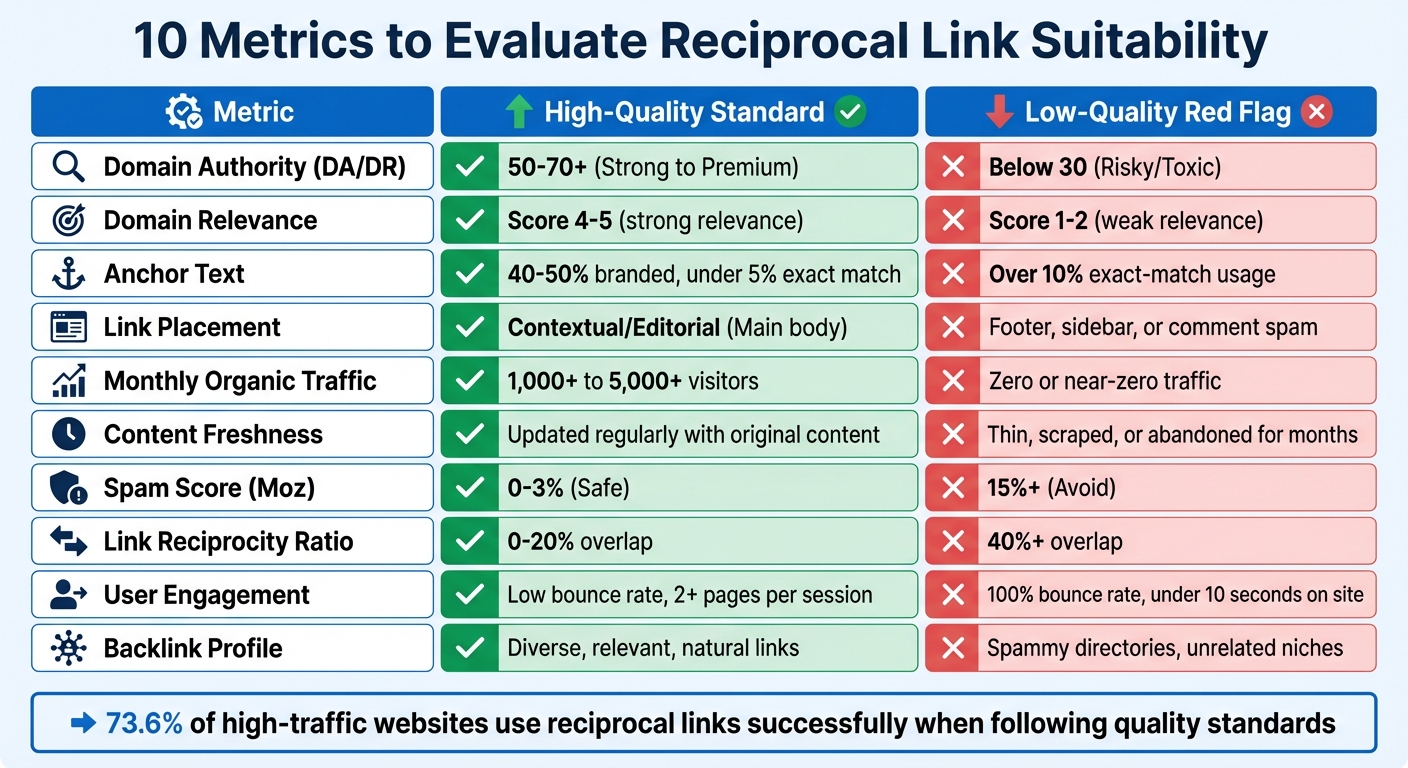
10 Key Metrics for Evaluating Reciprocal Link Quality in SEO
How I Spot Bullsh*t Reciprocal Links in Less Than 3 Minutes (and Avoid Google Penalties)
sbb-itb-88880ed
1. Domain Authority
Domain Authority (DA) is a ranking metric that estimates how likely a website is to perform well in search engine results. It’s measured on a 1–100 logarithmic scale, meaning the higher the score, the harder it is to climb. For example, moving from 20 to 30 is much easier than going from 70 to 80. This metric is often used to assess the value of potential link partners – sites with higher authority pass more link equity, making their links more impactful.
Metrics like Moz’s Domain Authority (DA), Ahrefs’ Domain Rating (DR), and Semrush’s Authority Score (AS) all aim to measure a website’s strength. They factor in elements like backlink quality, content strength, and historical performance.
When considering reciprocal link opportunities, focus on websites with scores within 20 points of your own DA. This ensures a balanced and natural exchange. For most SEO strategies, aim for partners with a DA of 30 or higher. However, for competitive niches, a DR range of 50–69 is often considered “Strong”. Here’s a breakdown of DR ranges:
| DR Range | Quality Level | When to Prioritize |
|---|---|---|
| 70+ | Premium | Best for high-competition niches |
| 50–69 | Strong | Ideal for most SEO campaigns |
| 30–49 | Moderate | Use only if highly relevant to your topic |
| Below 30 | Risky | Consider only for niche sites with verified traffic |
It’s also essential to verify a site’s authority score against its organic traffic. Some websites inflate their metrics but lack actual search traffic. A reliable benchmark is at least 1,000 monthly organic visitors. Use tools like Semrush or Ahrefs to cross-check DA with traffic data. This ensures you’re partnering with sites that have real search visibility, not just artificially boosted scores.
Once authority is confirmed, evaluate the relevance of the link placement to ensure it aligns with your strategy.
2. Domain Relevance
Domain relevance measures how well a backlink supports a website’s rankings. Modern SEO uses vector embeddings to evaluate the topical connection between sites. A close connection – like a plumbing supplier linking to a plumber – indicates natural relevance. On the other hand, a distant connection – such as a tech gadget site linking to a plumber – creates “semantic noise”, which Google’s algorithms are likely to ignore.
“Relevant backlinks are not ‘better links’ because they come from higher metrics. They are better because they reinforce what your site represents in Google’s entity graph and intent clusters.” – Stellar SEO
This highlights the importance of ensuring topical alignment when exchanging links. Using a link building planner and other practical methods can help confirm this alignment. For example, as of January 2026, Ahrefs maintains a reciprocal link ratio of 19.25% while ranking for over 676,000 keywords. This shows that relevant reciprocal links don’t harm high-authority domains – as long as they align with the site’s topic. To check relevance, you can use the search operator site:domain.com [your topic] to see if a potential partner has consistently covered your niche over time. If your guest post would be the only content on that topic across their site, it’s likely a “semantic outlier” that search engines might devalue.
Also, examine the partner’s recent outbound links. If they frequently link to unrelated or low-quality sites – like casinos or essay services – their relevance is compromised. For local businesses, geographic relevance can sometimes replace topical alignment. For instance, a local bakery linking to a nearby auto shop can still boost local search signals, even if their topics don’t overlap directly.
The table below outlines the different tiers of relevance to help evaluate potential link partners:
| Relevance Tier | Description | SEO Impact |
|---|---|---|
| Tier A: High-Confidence | Directly aligned with your primary topic or audience; industry leader. | High; boosts rankings quickly. |
| Tier B: Solid Supporting | Clearly related but with a broader focus (e.g., niche blog). | Moderate; improves long-tail visibility. |
| Tier C: Contextual/Limited | Partially aligned or relevant at a category level. | Low; adds link diversity. |
| Tier F: Avoid | No logical connection; unrelated industry or spammy patterns. | Negative; risks penalty or devaluation. |
To confirm relevance, tools like Ahrefs or SEMrush can analyze keyword overlap between your site and potential partners. This helps determine whether you’re both targeting the same search intent, which is a strong indicator of true relevance. Always prioritize strong topical alignment – a pet store linking to a veterinary blog makes sense, but linking to a car dealership doesn’t. Securing backlinks with tight alignment ensures they genuinely contribute to your SEO efforts.
3. Anchor Text Quality
Anchor text – the clickable part of a hyperlink – plays a crucial role in how anchor text impacts organic traffic. It’s not just about including keywords; the goal is to use descriptive, natural-sounding text that feels conversational. For instance, instead of forcing exact-match keywords like “best SEO tools”, you might reference your brand name or describe your platform, such as “comprehensive SEO platform.”
One thing to watch out for is over-optimization. Search engines like Google are smart enough to detect patterns of overused or keyword-stuffed anchor text. If your anchor text looks unnatural or repetitive, modern algorithms may penalize your site, leading to stagnant rankings. A good rule of thumb is to keep exact-match “money” keywords to less than 5% of your total anchor text profile.
A well-balanced anchor text profile typically includes:
- 30–50% branded anchors, such as “3Way.Social”
- 20–30% naked URLs, like “https://3way.social”
If more than 30% of your anchors use the same wording, search engines might flag your site for manipulative behavior.
“The distinction search engines care about is pattern density, not existence.” – Stellar SEO
To stay on track, it’s a good idea to audit your anchor text quarterly using tools like Ahrefs or SEMrush. Ensure no single keyword exceeds a 10% threshold. When working on reciprocal links, aim for natural, descriptive anchors rather than insisting on specific high-volume keywords. Also, prioritize placing links within the main body of your content, as these links carry more authority than those in footers or sidebars. And here’s a simple test: if your anchor text sounds awkward when read aloud, it’s time to revise it for a more natural flow.
4. Link Placement
After considering authority, relevance, and anchor text quality, the placement of a link becomes a crucial factor in assessing reciprocal links. Where a link appears on a page can signal its importance. Links embedded within the main body of content are seen as genuine endorsements, while those tucked away in footers or sidebars often raise red flags for search engines, as they may indicate manipulative practices. This reinforces the earlier discussion about link quality.
One major red flag is sitewide placements – these are links that appear in footers or sidebars across every page of a website. Such placements can create an unnatural link density, which spam filters are designed to catch. Studies reveal that 67% of penalty-free backlinks are located within the middle third of a page’s content. This highlights that links placed contextually within editorial content are far less likely to trigger penalties.
“Sitewide placements are high-risk territory. When you put a link in your footer or sidebar, it appears on every single page of your site… Google specifically targets these patterns because they don’t make sense for users.” – BuildingBacklinks.io
User behavior also plays a role in link value. Links placed in the main content tend to get more visibility and higher click-through rates. Google’s algorithms favor links that are likely to be clicked by real users. If a link is buried in a location where it’s unlikely to draw attention, its SEO value may be effectively nullified.
For ABC link exchange strategies, focus on placing links within blog posts, resource pages, or detailed guides. Avoid navigation elements like footers or sidebars, as these often result in low-quality connections that could lead to penalties. It’s also essential to regularly review your link partnerships to ensure links remain in strong, contextually relevant positions. Keeping links in prominent, meaningful locations is key to maintaining a healthy and effective reciprocity strategy.
5. Traffic Quality
When evaluating potential reciprocal link partners, traffic quality is far more important than just the number of visitors. A site boasting 10,000 monthly visitors may seem attractive, but if those users have no interest in your niche, the link won’t provide much value. The key is finding partners whose audience naturally aligns with your target market. This way, reciprocal links—or more advanced ABC link exchanges—bring in traffic that’s not only targeted but also engaged.
Start by conducting a keyword overlap analysis. SEO tools can help you determine if the linking site ranks for topics relevant to your industry. A strong overlap suggests their audience is already searching for content similar to yours. Geographic traffic distribution is another critical factor. For example, if your business operates in the U.S., but the potential partner’s audience is mostly from another continent, that’s a clear mismatch. It’s also crucial to ensure their traffic sources are primarily organic search rather than paid ads or social media campaigns.
Next, look at engagement signals to gauge whether their visitors are genuinely interested in the content. Metrics like a bounce rate higher than 70% can signal that the site isn’t delivering what users expect. Other indicators, such as session duration and pages per visit, provide additional context. Ideally, a good partnership should lead to a 10-25% increase in engaged sessions within six weeks of implementation. Don’t forget to check their social media activity as well – accounts with large follower counts but no likes or comments often indicate fake engagement rather than a real, active audience.
As a general rule, potential partners should have at least 1,000 monthly organic visitors. But don’t stop at just the numbers. Use tools like UTM parameters and Google Analytics to track referral traffic, conversion rates, and pages per session. Additionally, manually review the partner’s “About” page and top-performing articles to ensure their audience aligns with your ideal customer profile.
Focusing on traffic quality turns a reciprocal link into more than just a backlink – it becomes a pathway to engaged, conversion-ready visitors.
6. Backlink Profile
When evaluating a partner’s backlink profile, you’re essentially performing a background check on their site’s authority. Even if a domain boasts impressive authority metrics, a toxic backlink profile can reveal underlying issues – like a house with a shiny exterior but hidden structural flaws.
Start by looking for inconsistencies between domain authority and organic traffic. For example, if a site has a Domain Rating of 70 but reports zero organic traffic, that’s a red flag. This often signals artificial metric inflation through practices like private blog networks (PBNs) or leveraging expired domains. A trustworthy partner typically has at least 1,000 monthly organic visitors with stable or growing traffic trends. Make sure their traffic and backlink data align with these benchmarks.
Once traffic looks legitimate, dive into their anchor text distribution. Healthy profiles show diverse anchor text patterns without over-reliance on exact-match keywords. If you notice an overuse of phrases like “best insurance rates” or “cheap loans”, it’s a sign of manipulative behavior.
Pay attention to the reciprocity ratio, which should stay below 20% to avoid raising suspicions. For instance, in January 2026, a financial services company faced a major issue when 500+ backlinks suddenly appeared from low-quality directories in Eastern Europe and Asia. These links, with foreign-language anchor text, caused a 40% drop in organic visibility within two weeks. The team had to use Google’s Disavow Tool to recover.
Use tools like Moz or Semrush to check the spam score. A score above 15% indicates potential risk, while a range between 0% and 3% is considered safe. Also, ensure backlinks come from relevant niches. Links from unrelated industries – like a gambling site linking to a children’s education site – are risky and often devalued by search engines.
Finally, examine link placement. Links embedded naturally within content are 3 to 5 times more effective than those in footers or sidebars. If most backlinks are from footers, blogrolls, or sitewide placements, this could indicate participation in link farms. While 73.6% of high-traffic websites naturally have reciprocal links, the key difference lies in maintaining a clean and high-quality backlink profile. This careful analysis helps you choose partners who can genuinely enhance your site’s authority.
7. Content Freshness
Keeping content fresh is a key factor when assessing a partner’s quality and relevance. A site that regularly updates its content demonstrates active management and reliability – qualities that search engines value. When evaluating a reciprocal link, content freshness plays a big role in determining how much SEO value that link can pass to your site. Google doesn’t just rely on visible publication dates; it digs deeper into technical signals, content changes, and user behavior to decide if a page deserves a strong ranking. That’s why it’s important to examine freshness beyond surface-level cues.
Start by focusing on technical indicators instead of just visible dates. Check the last-modified HTTP header and XML sitemap lastmod tags. These reveal when changes were actually made at the code level. Keep in mind that search engines are smart enough to distinguish meaningful updates from minor tweaks.
A consistent publishing schedule is another sign of active site management. For instance, sites that post 2–3 times a month show they’re staying engaged, while sites that haven’t updated in over a year often signal neglect – especially in fast-changing industries. In dynamic niches, content older than 3–6 months can quickly lose its ranking power.
Fresh updates don’t just help with rankings – they also improve user engagement. Search engines now consider behavioral signals like click-through rates and time-on-page to judge whether a “fresh” update added real value. A reciprocal link on a recently updated page with strong user interaction will pass more link equity than one buried on a stagnant page that search engines rarely crawl. Also, check if the site links to other high-quality, recently updated sources. This shows they’re actively part of a thriving content network.
Be cautious about partners with AI-generated or thin content under 500 words. Search engines can tell the difference between real updates and superficial changes. Sites that stop updating risk having their outbound links devalued, which can hurt your rankings even without a direct penalty. Before agreeing to any reciprocal link, make sure your partner’s content is fresh, substantial, and aligned with the latest in your industry.
8. Spam Score
When evaluating a potential partner’s domain, checking its spam score is crucial. This metric, created by Moz, helps predict the likelihood of a website being penalized or banned by Google. It does so by analyzing 27 common traits found in penalized sites. Think of it as an early warning system, helping you decide if further investigation is needed. It works hand-in-hand with backlink profile analysis to uncover hidden risks.
Moz divides spam scores into three risk levels: 1%–30% (low risk), 31%–60% (medium risk), and 61%–100% (high risk). Domains with low scores are generally safe for partnerships, while high-risk domains should be avoided to protect your backlink profile. For medium-risk sites, take the time to manually review factors like content quality, contact details, and technical health before making a decision.
“A high Spam Score for your site, or a site you’re looking at, doesn’t mean this site is necessarily spammy. It’s a sign that you should do some more investigation into the quality and relevance of this site.” – Moz Help Hub
It’s important to note that a spam score highlights patterns commonly found in penalized sites – it doesn’t definitively label a site as spam. Some red flags include overly long domain names with numbers, certain top-level domains like .loan or .men, missing SSL certificates, thin content, and an uneven ratio of followed to nofollowed links. Sites with 14–16 spam flags are almost guaranteed to be flagged as spam by search engines. You can use Moz Link Explorer to check spam scores, which allows 10 free queries per month with a free account.
Regularly monitoring your own site’s spam score is equally important. Look out for warning signs like thin content or questionable link patterns. Also, avoid placing reciprocal links in footers or sidebars, as these sitewide placements are easily flagged by Google’s AI systems. Links from sites with manipulative patterns are often nullified by Google, which can stall your rankings.
9. Link Reciprocity Ratio
The link reciprocity ratio shows how many of your referring domains also receive a link back from your site. To calculate it, divide the number of reciprocal domains by the total number of referring domains, then multiply by 100. For example, if 50 out of 250 referring domains are mutual, your ratio would be 20%.
Search engines use this ratio to distinguish between natural link-building and engineered patterns. A moderate number of reciprocal links is normal – research indicates that about 73.6% of high-traffic websites have some mutual links. However, an excessively high ratio can signal manipulation. When search engines detect such patterns, they might devalue those links, which could stall your rankings, even if you’re actively building more links. Like domain authority and relevance, this metric is a key indicator of a natural link profile.
Data from the industry supports this perspective. For example, Ahrefs’ blog has a reciprocal ratio of around 19.25% while ranking for over 676,000 keywords. Ratios exceeding 25% might activate algorithmic filters, so staying within the 0–20% range is widely regarded as safe.
“Excessive link exchanges (‘Link to me and I’ll link to you’) or partner pages exclusively for the sake of cross-linking” – Google Spam Policies
To check your ratio, export your dofollow referring domains and outbound links into a spreadsheet and find the overlap. If your ratio is above 25–30%, prioritize earning one-way editorial links to balance things out.
For a more advanced approach, consider using ABC link exchanges through tools like 3Way.Social (https://3way.social). These setups create three-way loops (e.g., Site A → Site B → Site C → Site A), which help maintain a more natural-looking citation flow.
10. User Engagement Metrics
Once you’ve evaluated technical factors and link placement, user engagement metrics provide the final piece of the puzzle for determining a link’s true worth. These metrics build on earlier assessments, offering a crucial perspective on how valuable a reciprocal link really is.
Engagement metrics highlight whether a linking domain attracts an active audience. Data like time on site, bounce rate, and pages per session show if users are actually interacting with the content. When referral visitors from a reciprocal link spend time exploring the site, it’s a good sign that the link is both relevant and useful.
Search engines tend to reward links that deliver genuine value. High engagement signals that a link is more of an editorial endorsement rather than a manipulative tactic. On the other hand, if users bounce immediately (within 10 seconds), it could mean the link is poorly placed or misleading.
“Some backlinks don’t help rankings much but still drive qualified traffic. If a niche blog or community forum is sending buyers my way, I’ll take that link every time.” – Adrian K, Link Building Expert
To analyze referral behavior, tools like Google Analytics are indispensable. By filtering metrics specifically for referral traffic, you can compare how these visitors perform compared to your organic audience. Tools such as SimilarWeb can also estimate a partner site’s traffic and engagement levels. Additionally, checking their social media activity – likes, shares, and comments – can confirm whether their audience is actively engaged.
Research shows that successful link partnerships can increase engaged sessions by 10–25% within six weeks. However, if a reciprocal link drives no traffic or results in a 100% bounce rate, it’s likely that search engines have already devalued it.
Comparison Table
This table brings together the key metrics for evaluating the quality of reciprocal links, making it easier to distinguish between links that boost SEO and those that could harm rankings. It’s a quick-reference guide to help you assess potential link partners effectively.
| Metric | High-Quality Standard | Low-Quality Red Flag |
|---|---|---|
| Domain Authority (DA/DR) | 50–70+ (Strong to Premium) | Below 30 (Risky/Toxic) |
| Domain Relevance | Score 4–5 (strong relevance) | Score 1–2 (weak relevance) |
| Anchor Text | 40–50% branded, under 5% exact match | Excessive exact-match usage (over 10%) |
| Link Placement | Contextual/Editorial (Main body) | Footer, sidebar, or comment spam |
| Monthly Organic Traffic | 1,000+ to 5,000+ visitors | Zero or near-zero traffic |
| Content Freshness | Updated regularly with original content | Thin, scraped, or abandoned for months |
| Spam Score (Moz) | 0–3% (Safe) | 15%+ (Avoid) |
| Link Reciprocity Ratio | 0–20% overlap | 40%+ overlap |
| User Engagement | Low bounce rate, 2+ pages per session | 100% bounce rate, under 10 seconds on site |
This table complements earlier discussions by summarizing the most critical metrics for outreach and link validation. If a potential partner fails on two or more key metrics, especially traffic quality or spam score, it’s a strong signal to avoid the link.
For maximum impact, prioritize contextual in-content links – these are estimated to be 3–5x stronger than links placed in footers or author bios. Keep this guide handy to ensure your link-building efforts stay focused and effective.
Conclusion
Reciprocal links can be highly effective when approached with care and precision. According to data, 73.6% of high-traffic websites incorporate reciprocal links without facing penalties, and 43.7% of top-ranking pages on Google include some form of mutual linking. The key to success lies in carefully evaluating potential partners using the metrics outlined earlier.
Failing to follow these standards can lead to penalties. Google’s spam policies specifically target excessive or low-quality link exchanges. Ignoring quality signals could result in manual penalties, algorithmic downgrades, or wasted time on links that provide no authority. Keeping your reciprocity ratio within 15-20% and focusing on relevant, contextual placements ensures you stay in safe territory.
Using the right tools can streamline the process. Manually analyzing metrics can be time-consuming, but automated platforms like 3Way.Social simplify ABC link exchanges. These tools help minimize direct reciprocity signals and maintain compliance with Google’s guidelines, saving both time and effort.
Looking ahead, the future of link building points toward AI-driven matching systems and triangular linking strategies. Quality, relevance, and natural linking patterns now outweigh the sheer number of links. Use the comparison table and thresholds provided in this guide as a foundation, regularly audit your ratios, and prioritize links that fit naturally within your content.
When executed with discipline and supported by the right tools, reciprocal links remain an essential part of a well-rounded backlink strategy. Each exchange should be treated as a deliberate, strategic choice rather than a numbers game.
FAQs
How can I tell if a site’s DA is inflated?
A site’s Domain Authority (DA) score might look impressive at first glance, but it can sometimes be misleading. The key is to dig deeper into the quality and relevance of its backlinks.
If the DA score is inflated due to spammy or low-quality links, it’s a red flag. To uncover this, closely examine the site’s backlink profile. Look for warning signs like:
- Spammy or irrelevant links
- Unnatural link-building patterns
- Links from unrelated or questionable sources
By comparing the backlink quality to the DA score, you can determine if the score has been artificially inflated. This extra step ensures you’re evaluating the site based on genuine authority rather than manipulated metrics.
What’s the safest way to keep reciprocity under 20%?
To keep reciprocal link ratios below 20%, aim for genuine, relevant, and balanced exchanges. Steer clear of manipulative tactics or overusing links, as Google frowns upon unnatural link schemes. Focus on placing links naturally and ensuring they align with your site’s content to stay within SEO guidelines and minimize risks.
Which analytics metrics show a reciprocal link is effective?
Key factors to consider when evaluating a reciprocal link’s impact are referral traffic, bounce rate, and click-through rate (CTR). When referral traffic is high and bounce rates are low, it’s a good sign that users find the linked content valuable and engaging.
On top of that, it’s important to analyze the linking site’s domain authority, content relevance, and organic traffic trends. These elements help confirm that the link comes from a credible source, which not only boosts SEO but also helps avoid any penalties tied to manipulative linking practices.