Last Updated on December 1, 2025 by Becky Halls
White-hat link building is still one of the most effective ways to improve SEO in 2025. Here’s what you need to know:
- Quality over quantity: Top-ranking pages have 3.8x more backlinks than lower-ranking ones, but the focus is on trusted, relevant links, not just numbers.
- 91% of content doesn’t rank without high-quality backlinks, showing how essential ethical link-building strategies are for visibility.
- AI-driven search relies on backlinks: With 73.2% of SEO experts agreeing backlinks influence AI search results, building a strong profile is key for staying competitive.
- Best practices: Use diverse methods like guest posting, digital PR, HARO, and link-worthy content creation. Avoid over-reliance on a single tactic to maintain a natural profile.
- Tools can help: Platforms like 3Way.Social simplify finding and securing ethical backlinks while tracking tools like Ahrefs and SEMrush measure success.
White-hat link building requires effort, but it delivers long-term results, boosts domain authority, and ensures rankings survive algorithm updates. Stick to ethical methods to build trust and visibility across search engines and AI platforms.
The Ultimate Guide To Link Building (White Hat!)
Main Findings from the 2025 Study
The 2025 research took a deep dive into real-world data to uncover what truly works in white-hat link building. The findings reveal a clear shift: the race for sheer link numbers has given way to prioritizing quality backlinks.
Quality Over Quantity in Backlinks
The data paints a striking picture: most content struggles to rank without quality backlinks. In fact, 91% of content lacks critical links, and 94% fails to secure any external links at all. While top-ranking pages boast 3.8 times more backlinks than lower-ranking ones, this doesn’t mean chasing an endless number of links. Instead, these high-performing pages earn links from trusted, relevant sources that search engines deem credible.
Search engines now scrutinize the source of your backlinks, how they’re integrated into the content, and whether they genuinely add value for users. A single backlink from a respected industry site can outweigh dozens of links from low-quality directories or irrelevant blogs. Links embedded in meaningful, relevant content carry more weight because they directly benefit readers.
The study also confirms that white-hat backlinks from reputable sites not only boost domain authority but also drive real referral traffic – bringing in visitors who are genuinely interested in your content. This makes focusing on quality links far more impactful than simply accumulating a high volume of weak links.
| Link Building Approach | Time Investment | Risk Level | Long-term Results | Penalty Risk |
|---|---|---|---|---|
| White-Hat | High | Low | Sustainable rankings and authority growth | None |
| Gray-Hat | Moderate | Moderate | Variable, algorithm-dependent | Moderate |
| Black-Hat | Low | High | Quick gains, then severe penalties | Severe |
This emphasis on quality naturally ties into improving domain authority and maintaining a diverse link profile.
Domain Authority and Link Diversity
One standout finding from the study is that websites with steady link growth achieve 2.3 times higher domain authority compared to those without an active link-building strategy. This reinforces the idea that quality, not quantity, drives lasting SEO success. Higher domain authority leads to benefits like better rankings across your content, stronger trust signals for search engines, and a more competitive position within your niche. As your authority grows, it creates a positive feedback loop – helping you earn even more authoritative links.
Diversity in link sources also plays a key role in sustaining this growth. The study highlights that no single link-building tactic should dominate more than 30–40% of your overall link profile. A diverse profile not only appears more natural to search engines but also shields your site from algorithm updates that could devalue specific link types.
Websites that use multiple white-hat strategies build stronger and more resilient SEO foundations than those relying on just one approach. A well-rounded link profile might include:
- Guest posts on relevant industry blogs
- Mentions in digital PR campaigns
- Links from resource pages
- Coverage through HARO (Help A Reporter Out) opportunities
Tracking metrics like Moz Domain Authority or Ahrefs Domain Rating can help you monitor the growth of your site’s authority through quality backlinks. Consistently acquiring diverse links lays the groundwork for sustainable SEO success.
Beyond diversity, the placement and wording of links significantly influence their SEO power.
Contextual Links and Anchor Text
The study underscores that context matters – where and how links are placed can be just as important as the links themselves. Search engines now evaluate whether a link fits naturally within the surrounding content. For example, linking to a marketing automation guide in an article about sales efficiency makes sense contextually, while placing the same link in unrelated content could raise red flags.
Anchor text usage has also evolved. The research suggests using anchor text that feels natural and blends seamlessly into the content. Over-optimized, exact-match keywords are no longer effective – and could even lead to penalties. Instead, a varied and descriptive approach works best. For example, instead of repeatedly using “best CRM software”, you might opt for phrases like “customer relationship management tools”, “this CRM platform”, or even the brand name. This signals to search engines that the links are editorially placed and genuinely valuable to readers.
Two real-world examples highlight these principles. HelpScout’s customer service statistics post has earned 3,800 referring domains while ranking for its target keyword. Similarly, Salesforce’s “What is CRM” post has gained 1,900 referring domains and achieved top rankings. Both examples demonstrate how contextually relevant, data-driven content naturally attracts high-quality backlinks.
White-Hat Link Building Strategies That Work in 2025
A 2025 study highlights several ethical link-building strategies that deliver consistent results while steering clear of penalties. Although these methods demand more effort, they help establish long-term authority that holds up against algorithm changes. The trick? Use a mix of approaches rather than putting all your eggs in one basket.
Guest Posting and Outreach
Guest posting continues to be a dependable white-hat tactic – when done right. Gone are the days of mass outreach and generic pitches. Success now hinges on personalized, relationship-driven campaigns that show a deep understanding of the target site’s content and audience. Start by pinpointing authoritative websites in your industry that have strict editorial standards and where your expertise genuinely adds value to their readers. Every outreach email should clearly explain the benefit you bring, ensuring that guest posts deliver meaningful, contextually embedded links.
Backlinks work best when they’re naturally woven into the content, not tucked away in author bios, footers, or sidebars. Use varied, descriptive anchor text instead of stuffing in exact-match keywords. To maintain a balanced link profile, guest posts should make up about 20–25% of your total backlinks. This approach complements other methods by diversifying your link portfolio.
Tools like 3Way.Social make this process easier. Using AI, they match you with relevant and authoritative domains for guest posting. Their filters – based on topic, Domain Authority, traffic, and relevance – ensure you’re targeting the right websites, with links that are permanent, do-follow, and free of sponsored labels.
Digital PR and HARO
Digital PR and HARO (Help A Reporter Out) offer excellent opportunities to earn backlinks from trusted news and media outlets – without creating guest posts. These methods focus on sharing your expertise or insights with journalists and bloggers who need reliable sources. When a journalist cites your site, that backlink carries real editorial weight. Digital PR involves reaching out proactively with newsworthy updates, research, or industry insights.
When paired with other strategies, digital PR and HARO can contribute about 20–25% of your total link profile. Together with content creation, these channels add depth to your overall strategy.
Creating Content That Attracts Links
Beyond outreach and PR, creating high-quality content is essential for building a strong backlink portfolio. One of the most effective white-hat methods is producing content so valuable that others naturally want to reference it. The study highlights several formats that reliably earn backlinks: original research, comprehensive guides, infographics, and interactive tools.
Original research stands out as particularly impactful. When journalists or bloggers cite your data, they’re required to link back to your site as the source (AI-generated content doesn’t qualify for this role). Some research-based articles have accumulated thousands of backlinks over time.
Comprehensive guides also attract attention by addressing topics in detail and solving real problems. These often earn links from resource pages and educational sites. Meanwhile, infographics and interactive tools offer visually engaging content that gets widely shared.
Publishing valuable content consistently is a proven way to earn backlinks. According to First Page Sage‘s Q1 2025 algorithm analysis, high-quality content remains the top ranking factor. Content creation should account for about 20–25% of your link-building efforts, providing lasting benefits long after publication.
The most effective link-building strategies in 2025 share a few common traits: they focus on delivering genuine value to users, come from relevant and credible sources, and fit seamlessly into existing content. By combining guest posting, digital PR, HARO, and high-value content creation – and ensuring no single tactic dominates more than 30–40% of your profile – you can build a strong, sustainable backlink portfolio that supports long-term SEO success.
sbb-itb-88880ed
Tools and Platforms for White-Hat Link Building
White-hat link building thrives on ethical strategies and measurable results. While creating high-quality content and building genuine relationships are the backbone of this approach, specialized tools and platforms can make scaling these efforts easier and more efficient.
How 3Way.Social Simplifies Ethical Link Building
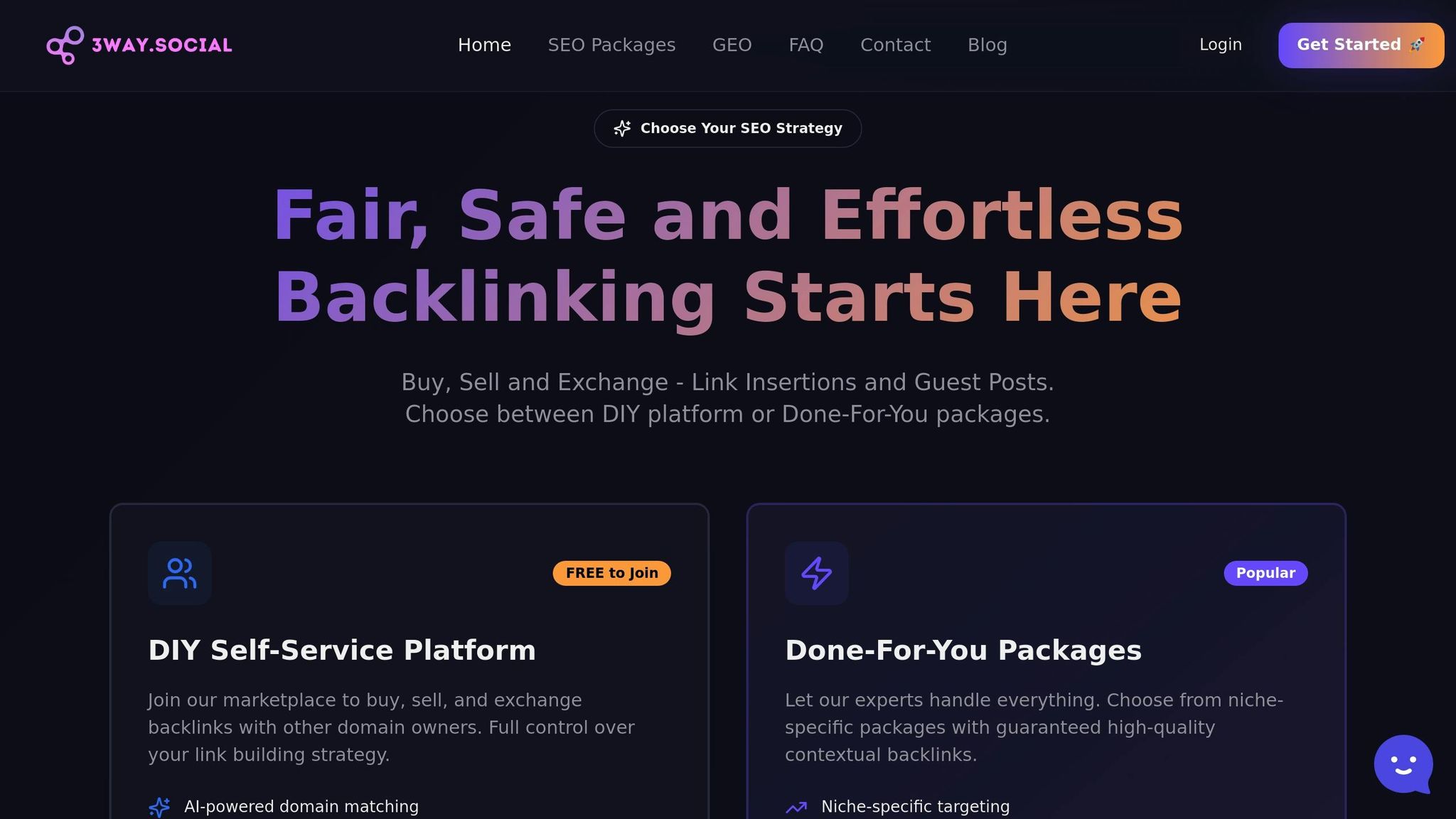
3Way.Social addresses one of the toughest parts of white-hat link building: finding reliable, high-quality link partners at scale while sticking to ethical practices. By using AI-powered domain matching, the platform connects websites with relevant, authoritative domains, removing much of the guesswork from the process.
What sets 3Way.Social apart is its fair and transparent approach. Instead of using arbitrary pricing models, the platform bases link values on factors like Domain Authority (DA), traffic volume, and spam score. This ensures that exchanges are proportional, with both sides benefiting fairly. Plus, this transparency makes budgeting and evaluating potential partners much simpler, all while focusing on permanent, high-quality backlinks.
The platform guarantees all links are permanent do-follow links that aren’t marked as sponsored, giving them full SEO value. On top of that, it actively monitors links to ensure they remain live and restores any that disappear. This 100% backlink guarantee eliminates the frustration of losing carefully built links without warning.
With precision filters, you can narrow down potential partners by topic, DA, traffic, and relevance, ensuring that every link aligns with your content’s context. Freelance SEO consultant Alex Chen praises this feature:
“This platform has been a lifesaver for my link-building campaigns. The user-friendly dashboard and smart exchange options save me countless hours, and the precise partner selection is a major plus.”
3Way.Social also supports a variety of link-building methods, including ABC link exchanges, guest posting, and niche edits. All these options are available within a vetted network of SEO professionals, helping you maintain a well-balanced link profile – one where no single tactic dominates more than 30–40% of your backlinks.
For flexibility, the platform offers both DIY and Done-For-You options. If you prefer hands-on control, the self-service marketplace lets you manage every step of your campaigns. For those with limited time, the Done-For-You packages deliver niche-specific, high-quality backlinks in just 7–14 days, handled entirely by experts. The intuitive dashboard also allows you to track your entire link portfolio and monitor SEO progress in one place, making it easy to adjust strategies as needed.
Digital marketing director Jordan Rivera highlights the platform’s value:
“The strategic advantage 3WAY.SOCIAL offers is phenomenal. It’s not just a link exchange platform; it’s a comprehensive SEO enhancer, thanks to its diverse, quality-assured network.”
In addition to simplifying partner selection, 3Way.Social integrates performance analytics, ensuring your SEO strategy is both effective and measurable. But securing quality links is only half the battle – tracking their impact is just as critical. That’s where performance tools come in.
Tools for Tracking Link Building Performance
Once you’ve secured quality backlinks, it’s essential to measure their impact. The right tracking tools can help you evaluate how well your white-hat campaigns are performing by analyzing key metrics like search visibility and traffic improvements.
Google Search Console is an excellent starting point. This free tool provides direct insights from Google, showing which search queries drive traffic to your site. It helps you identify whether your backlinks are improving keyword rankings and which pages are seeing the most benefit. While it doesn’t offer the detailed backlink analysis of paid tools, it provides a reliable foundation for understanding your progress.
For more in-depth analysis, SEMrush and Ahrefs are invaluable. These platforms track metrics like Domain Authority (DA) or Domain Rating (DR), showing how your site’s authority grows as you acquire quality backlinks. They also monitor keyword rankings across thousands of search terms, allowing you to see how specific links contribute to ranking improvements. Additionally, both tools provide detailed backlink profiles, showing which sites link to you, the anchor text used, and whether those links remain active.
When analyzing your link-building performance, focus on these key metrics:
- Domain Authority Growth: Indicates whether your site’s authority is improving. Research shows that websites with consistent link-building efforts experience 2.3x higher domain authority growth compared to those without active campaigns.
- Keyword Ranking Progress: Tracks how your target keywords climb the search rankings as you gain relevant backlinks. Tools like Google Search Console, SEMrush, or Ahrefs are great for monitoring these changes.
- Organic Traffic Analysis: Measures whether your backlink strategy is driving more visitors from search engines, offering insights beyond vanity metrics.
- Referral Traffic Analysis: Tracks visitors arriving directly through your backlinks. High-quality, relevant links should bring engaged users who explore your site further.
- Link Quality Assessment: Evaluates the relevance, authority, and topical alignment of acquired links.
Backlinks account for 13% of ranking factors, according to First Page Sage’s Q1 2025 algorithm analysis, and experts rank link building as the third most important SEO factor after content and keywords. By combining free tools like Google Search Console with premium platforms, you can gain a comprehensive view of your efforts while staying within budget.
Challenges in White-Hat Link Building
White-hat link building is a reliable way to achieve long-term SEO results, but it comes with its fair share of challenges. This ethical approach requires more time, effort, and strategy compared to quick-fix methods. To succeed, it’s crucial to understand these hurdles and find ways to overcome them.
Scaling White-Hat Link Building
One of the toughest parts of white-hat link building is scaling without losing quality. Unlike black-hat tactics that promise quick results, ethical link building involves time-consuming tasks like manual outreach, creating valuable content, and building authentic relationships. These efforts can’t be easily automated without compromising on standards.
In competitive industries, the challenge grows even bigger. Many websites are vying for the same high-quality backlinks, which means you’re constantly racing against the clock. Writing personalized outreach emails, producing content that earns links, and forming genuine connections with industry players takes time – and there’s only so much of it.
Managing multiple strategies such as guest blogging, digital PR, HARO outreach, and resource page building adds another layer of complexity. Finding the right link partners at scale is particularly tricky. It requires manually identifying authoritative and relevant sites based on metrics like Domain Authority, traffic, and spam scores, followed by negotiating terms for link placements.
Thankfully, advanced tools can help lighten the load. Platforms designed for ethical link building can automate parts of the process while maintaining quality. For example, AI-powered tools can identify potential link partners based on criteria like topic relevance and traffic, saving time on research.
A platform like 3Way.Social tackles these challenges with its network of vetted SEO professionals and automated matching system. Its filters make it easier to find partners that align with your strategy. Plus, it offers flexible options – whether you prefer managing campaigns yourself or opting for Done-For-You packages that deliver niche-specific backlinks in just 7–14 days. This makes scaling possible without the need to expand your team.
Maintaining a Balanced Link Profile
Another challenge is ensuring your link profile stays balanced and natural. Search engines are quick to spot manipulative patterns, so over-relying on one tactic can raise red flags. For instance, if most of your backlinks come from guest posts, even high-quality ones, it might appear suspicious. A diverse mix of link-building strategies not only protects you from algorithm updates but also mimics the way links naturally accumulate over time.
Anchor text variation is another piece of the puzzle. Overusing exact-match keywords can look manipulative. Instead, mix things up with brand mentions, descriptive phrases, or generic terms to keep your profile looking organic. And don’t forget the importance of context – links embedded within relevant, high-quality content carry more weight than those tucked away in footers or sidebars.
Regular monitoring is key to staying on track. Tools like Google Search Console, SEMrush, and Ahrefs can help you identify and fix imbalances before they become issues. Platforms such as 3Way.Social make this process even easier with a centralized dashboard that gives you a clear view of your link portfolio, helping you spot and adjust any over-reliance on specific tactics.
Avoiding Low-Quality Links
Not all backlinks are beneficial. In fact, poor-quality links can harm your SEO efforts and even lead to penalties. Research shows that 91% of content fails to rank without quality backlinks. Low-quality links can derail even the most well-thought-out strategies.
Spotting bad links isn’t always straightforward. A site might have decent Domain Authority but lack editorial standards, accept irrelevant content, or function as a link farm. Some websites even sell links, which violates search engine guidelines and puts your site at risk.
To avoid these pitfalls, carefully evaluate each link opportunity. Look at the linking site’s content quality, audience engagement, and link profile. Warning signs include excessive unrelated outbound links, thin or poorly written content, and a history of linking to spammy sites. Always prioritize relevance, authority, and editorial quality to ensure that your backlinks genuinely add value.
Once you’ve secured backlinks, ongoing monitoring is essential. Tools like Ahrefs, SEMrush, or Moz can help you track your link profile and flag any suspicious links. If you identify harmful links, Google Search Console’s disavow tool allows you to instruct search engines to ignore them.
Platforms like 3Way.Social also help maintain quality by using a transparent valuation system based on metrics like Domain Authority and spam scores. Their vetted network ensures that every link meets strict standards, and their 100% backlink guarantee ensures any lost links are restored, so your SEO efforts continue to pay off.
While it may be tempting to cut corners with black-hat methods, the risks far outweigh the rewards. Buying links or participating in link farms can lead to severe penalties that damage your site’s visibility and reputation. Recovery from such setbacks can take months – or even years. Sticking to ethical, value-driven practices is the only way to build a strong and sustainable link profile.
Conclusion: What the 2025 Study Tells Us
White-hat link building remains a cornerstone of SEO in 2025. Even with the rise of AI-driven search and evolving algorithms, the basics haven’t changed. High-quality backlinks still play a key role in improving rankings, building authority, and earning trust in ways that shortcuts simply can’t replicate.
Why White-Hat Link Building Still Matters
There’s a reason white-hat link building continues to hold its ground. In Q1 2025, backlinks accounted for 13% of Google’s ranking factors, proving their ongoing significance even as other elements shift.
Websites that consistently focus on ethical link-building practices experience 2.3x higher domain authority growth, providing a competitive edge that grows over time. And with over 71% of Americans now using AI to search for information, along with 73.2% of SEO experts agreeing that backlinks influence AI-driven search results, the need for ethical strategies is more pressing than ever. Platforms like ChatGPT and Claude rely on these authoritative signals, making white-hat methods crucial for visibility across both traditional and emerging search tools.
Unlike black-hat tactics that offer fleeting results, white-hat strategies deliver rankings that hold up against algorithm updates. They help position your brand as a trusted source, bring in authentic referral traffic, and create long-lasting relationships with other sites.
These findings underline the need for SEO professionals to take proactive steps toward refining their link-building strategies.
Next Steps for SEO Professionals
The insights from the 2025 study highlight the importance of acting now. Start by auditing your existing content to find assets worth promoting. Then, focus on creating new resources – like in-depth guides, original research, or infographics – that deliver real value. It’s worth noting that weak content rarely earns high-quality backlinks, no matter how much outreach you do.
Diversifying your link-building methods is another critical step. Research shows that no single tactic should dominate more than 30–40% of your total link profile. To maintain a balanced, natural profile, combine strategies like guest posting, digital PR, HARO outreach, resource page link building, and data-driven studies. This approach not only strengthens your link profile but also helps shield your site from potential algorithm changes.
It’s also essential to track your progress. Use tools like Google Search Console, SEMrush, or Ahrefs to monitor domain authority, keyword rankings, and organic traffic. These metrics will help you identify which strategies are delivering the best ROI.
For added efficiency, consider platforms like 3Way.Social. These tools use AI to match domains, filter by topic and traffic volume, and even guarantee backlinks, saving time while maintaining the high standards required for white-hat success.
Lastly, review your backlink profile regularly to identify and disavow any low-quality or manipulative links that might lead to penalties. Cleaning up your link portfolio is crucial to avoid future issues. At the same time, stick to a content calendar that prioritizes creating link-worthy assets, drawing in editorial links from trusted sources.
The 2025 study reinforces what experienced SEO professionals have always known: there are no shortcuts to lasting success. White-hat link building demands patience, strategic planning, and consistent effort, but the payoff is worth it. With 38.43% of SEO professionals investing between $1,000–$5,000 monthly on link building – and ranking it as the 3rd most important SEO factor overall – the real question is not if you should invest in ethical practices, but how soon you can implement them to stay ahead in an ever-evolving search landscape.
FAQs
What is the impact of white-hat link building on SEO and AI-driven search rankings in 2025?
White-hat link building continues to play a crucial role in improving SEO performance, even as AI reshapes search algorithms in 2025. By sticking to ethical strategies – like earning backlinks from reputable websites – businesses can strengthen their rankings, attract more organic traffic, and build domain authority.
AI-driven search engines now emphasize relevance, trustworthiness, and user experience more than ever. This makes high-quality backlinks from reliable sources incredibly valuable. Tools powered by AI can simplify the process by helping businesses find secure and diverse link opportunities, ensuring these efforts deliver meaningful, long-term benefits.
What are the risks of focusing too much on one link-building strategy?
Relying too much on one link-building method can put your website’s SEO at risk. Search engines prefer backlink profiles that look natural and diverse. If most of your backlinks come from just one source – like guest posts or a single type of website – it might seem unnatural to search algorithms, potentially leading to penalties or lower rankings.
Another issue with sticking to one strategy is how vulnerable it makes you to changes in search engine algorithms or policies. To build a stronger, more adaptable SEO foundation, mix up your link-building efforts. Use a variety of approaches, like guest posts, directory submissions, and collaborative partnerships. This not only makes your backlink profile look more natural but also helps safeguard your rankings against future algorithm updates.
Why is having a diverse link profile crucial for improving SEO rankings?
A well-rounded link profile plays a key role in achieving SEO success. Search engines favor websites that have a mix of high-quality backlinks from a variety of sources. This diversity signals trustworthiness and authority, which can positively impact your rankings.
When you diversify your backlinks, you also minimize the risk of being penalized for depending too heavily on one type of link. Plus, it enhances your chances of climbing higher in search results. The result? Increased traffic and a stronger overall domain authority for your site.