Ethical ABC Link Building: Best Practices for 2025
Ethical ABC (three-way) link building under Google’s 2025 rules: pick relevant partners, place in-content links, diversify anchors, and monitor link health.

Last Updated on October 9, 2026 by Becky Halls
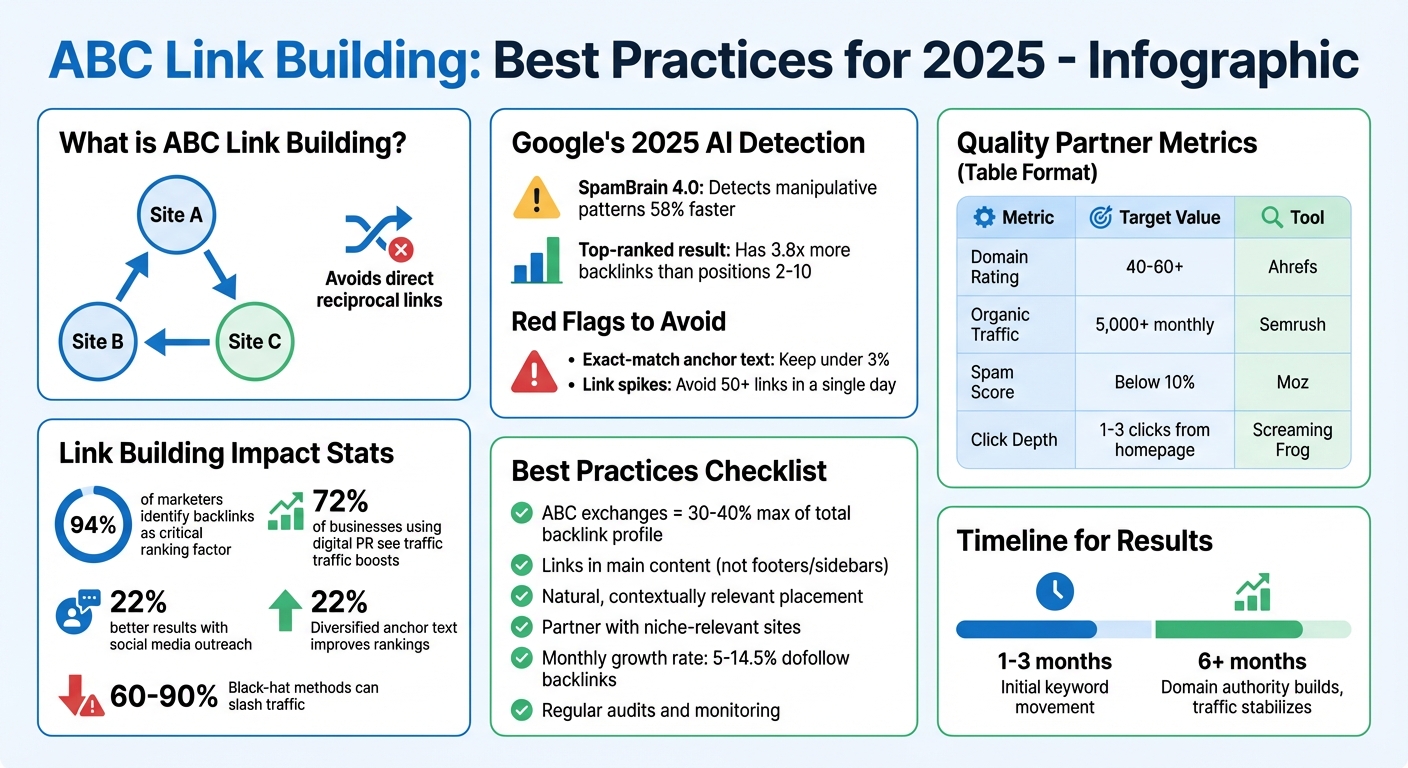
ABC link building is a triangular link exchange strategy where Site A links to Site B, Site B links to Site C, and Site C links back to Site A. This method avoids direct reciprocal links, making it harder for search engines to detect as manipulative. However, Google’s 2025 guidelines explicitly warn against manipulative link practices, emphasizing relevance, quality, and user benefit. Done right, ABC link building can boost SEO and improve domain authority without violating rules.
Here’s what you need to know:
- Google’s Focus in 2025:
- AI like SpamBrain 4.0 detects manipulative patterns 58% faster.
- Quality over quantity is key: fewer, high-authority, contextually relevant links matter most.
- Avoid over-optimized anchor text (keep exact-match keywords under 3%) and sudden link spikes (over 50 in a day).
- Best Practices:
- Partner with sites in your niche with strong metrics (e.g., Domain Rating 40–60+, organic traffic 5,000+ monthly).
- Place links naturally in main content, not in footers or sidebars.
- Diversify your link-building strategies – ABC exchanges should be part of a broader plan.
- Risks to Avoid:
- Excessive link exchanges or partnerships with low-quality sites.
- Sudden backlink surges or overuse of exact-match anchor text.
- Links from “bad neighborhoods” (e.g., spammy or irrelevant sites).
Tools like 3Way.Social automate compliant ABC link exchanges, ensuring high-quality partnerships and natural linking patterns. Regular audits and monitoring are crucial to maintaining a healthy backlink profile and avoiding penalties. We’ve seen ABC link building work best when it’s treated like a relevance swap, not a loophole. If the three sites don’t genuinely fit together, the links don’t hold up.
To succeed in 2025, focus on ethical, user-first link-building strategies that align with Google’s evolving standards.
ABC Link Building Best Practices and Key Metrics for 2025
The Harsh Truth About Link Building (Most SEOs Don’t Want You To Know)
sbb-itb-88880ed
Google’s 2025 Link Building Guidelines
Google’s approach to link building has taken a more refined turn in 2025. With the introduction of SpamBrain 4.0, their AI-powered system now identifies manipulative link patterns 58% faster than its earlier versions. This means shortcuts and shady tactics are detected and addressed more swiftly than ever.
The focus has shifted from sheer volume to quality over quantity. As Gary Illyes from Google succinctly put it:
We need very few links to rank pages….
Interestingly, the top-ranked Google result still boasts 3.8 times more backlinks than the pages ranking in positions two through ten. However, these links are sourced from high-authority, contextually relevant websites.
How Google’s AI Evaluates Links in 2025
Google’s AI now evaluates links using three key signals:
- Entity Recognition: Does the link support a recognized brand or concept?
- Contextual Relevance: Is the link naturally placed within a related discussion?
- Trust Indicators: Does the link come from a reputable and well-maintained source?
Links placed naturally within the main content of a page carry far more value than those tucked into footers or sidebars. This reinforces the importance of integrating links where they genuinely enhance the user experience.
Ethical ABC Link Building Practices
Google’s guidelines also shape what is considered ethical in link building. For example, natural, contextually relevant link exchanges – commonly referred to as ABC link building – can comply with Google’s standards if done correctly. While direct reciprocal link exchanges are easily flagged, three-way link patterns remain acceptable when all participating sites share a topical connection and the links provide real value to readers.
“We’ve seen the cleanest ABC exchanges come from content-first thinking: upgrade the target page, place the link naturally, then build around that topic with supporting pages and internal links.” 3Way Social Team
However, there are red flags to watch out for. If your anchor text includes more than 3% exact-match keywords or your site suddenly gains over 50 new links in a single day, you might trigger a manual review.
The Role of Digital PR in Link Building
John Mueller from Google has highlighted the importance of quality-driven approaches, saying:
I love some of the things I see from digital PR. It’s a shame it often gets bucketed with the spammy kind of link building. It’s just as critical as tech SEO, probably more so in many cases.
This underscores the value of links that genuinely serve users’ interests rather than simply gaming the system. By following these updated guidelines, you can create link-building strategies that align with Google’s expectations and deliver meaningful results.
Best Practices for Ethical ABC Link Building
ABC link building is all about building authentic relationships while adhering to Google’s 2025 guidelines. Here’s how to do it effectively.
Selecting Quality Link Partners
The first step is identifying partners whose content aligns with your niche. A link from a site within your industry – or a closely related one – not only signals expertise to search engines but also adds real value for readers. To assess potential partners, rely on third-party tools and metrics. Look for sites with a Domain Rating (DR) of 40–60+ and monthly organic traffic of 5,000 to 10,000+.
Take a close look at their link profiles. Avoid sites with abrupt traffic spikes, pages overloaded with over 100 outbound links, or links pointing to irrelevant niches.
Also, ensure the site is technically sound. Check that it’s indexed by Google and free of intrusive ads that obscure content. For link placement, aim for pages that are no more than 2–3 clicks away from the homepage to ensure frequent crawling by search engines.
| Metric | Target Value | Tool Example |
|---|---|---|
| Domain Rating | 40–60+ | Ahrefs |
| Organic Traffic | 5,000+ monthly visits | Semrush / Ahrefs |
| Spam Score | Below 10% | Moz |
| Click Depth | 1–3 clicks from homepage | Screaming Frog |
Once you’ve identified potential partners, focus on personalized outreach to build meaningful connections.
Creating Personalized Outreach Messages
Generic emails don’t cut it. In fact, link builders who leverage social media for outreach see 22% better results than those who don’t. Start by engaging with potential partners on platforms like LinkedIn or Twitter. This gradual approach helps establish familiarity and boosts your chances of a response.
When crafting your email, make it personal. Address the recipient by name, reference their recent work, and highlight how your brand can complement their content. Offering something unique – like exclusive data, expert insights, or a fresh perspective – can make your pitch stand out. Deborah Norton, Founder of Bravo! Interactive Media, sums it up perfectly:
“The best links to acquire are organic in nature and are such a good fit that they are a Win-Win for both parties.”
Keep your email concise and include a clear call to action. After your initial message, wait 5–7 days before following up, and make sure each follow-up email adds new value rather than just checking in.
Placing Links Naturally in Content
Where you place your links matters. Links embedded in the main content are far more impactful than those buried in footers, sidebars, or comments. According to Google’s Reasonable Surfer Model, links positioned prominently – especially early in the main content – are more likely to be clicked and carry more weight.
Use anchor text that feels natural and descriptive, giving readers a clear idea of what to expect on the linked page. Mix it up with branded anchors, partial-match keywords, and descriptive phrases to maintain a diverse anchor text profile. Over-optimized, keyword-stuffed anchors can backfire, triggering spam penalties.
Brian Dean, Founder of Backlinko, emphasizes the importance of context in link placement:
“In today’s search landscape – especially with large language models (LLMs) like ChatGPT and AI Mode – context beats the <href> tag.”
Using 3Way.Social for ABC Link Building
3Way.Social takes the hassle out of ethical link building by automating compliant ABC link exchanges. Designed with Google’s 2025 guidelines in mind, the platform uses AI to facilitate three-way exchanges that avoid the pitfalls of traditional reciprocal linking.
What sets 3Way.Social apart is its focus on organic linking patterns. Instead of the easily detected reciprocal links that search engines may flag, the platform arranges triangular exchanges. This method mirrors natural linking behavior while still delivering SEO benefits to all participants. It’s a smart way to balance quality control with strategic SEO goals.
One standout feature is its automated quality control system, powered by AI. It ensures that only high-quality, contextually relevant sites are included, filtering out low-value partners like link farms or poor-quality domains. This rigorous screening helps maintain a clean, organic link profile.
A great example of its effectiveness comes from 2024, when a user improved their Domain Authority from 28 to 45 in just six months. By leveraging automated ABC link exchanges, they eliminated the need for time-consuming manual outreach. This case highlights how 3Way.Social can deliver measurable results while sticking to ethical practices.
Key Features of 3Way.Social
3Way.Social is packed with tools to make ethical link building easier and more effective. Here’s what you can expect:
- Permanent Do-Follow Links: Links placed through the platform are permanent, so you don’t have to worry about partners removing them later. This provides peace of mind and ensures long-term SEO value.
- Anchor Text Monitoring: Built-in tools alert you if your anchor text profile becomes over-optimized. This helps you avoid penalties from keyword stuffing and keeps your backlink profile looking natural.
- Real-Time Reporting Dashboard: The platform offers transparent reporting, showing you link performance and grading in real time. This way, you can track every exchange, monitor link health, and adapt your strategy based on actual data rather than guesswork.
- Guest Posting Opportunities: Beyond link exchanges, the platform also connects you with guest posting options, letting you secure contextual links while contributing valuable content.
| Feature | Benefit for Ethical ABC Link Building |
|---|---|
| Partner Screening | Filters out low-quality sites, link farms, and PBNs |
| Anchor Text Monitoring | Prevents over-optimization and maintains a natural link profile |
3Way.Social Pricing Plans
3Way.Social offers pricing options to suit a variety of needs, from small businesses to large-scale operations. Here’s a breakdown:
- Free Plan: Perfect for testing the waters. You can explore basic features, add your domain, find link partners, and use credits to see how the platform matches you with others.
- Premium Plan: Ideal for growing websites. This plan includes advanced filters, guest posting opportunities, and priority support, making it easier to scale your link-building efforts.
- Enterprise Plan: Designed for agencies and larger businesses. It offers high-volume link management, custom integrations, and dedicated account management. Pricing is tailored to your specific needs, so you only pay for the features you use.
Whether you’re just starting out or managing dozens of domains, 3Way.Social provides the tools and flexibility to make ethical link building efficient and effective.
Avoiding Risks in ABC Link Building
ABC link building isn’t without its dangers. Google’s link spam guidelines clearly warn against “excessive link exchanges”, which include three-way link patterns. The potential fallout? Links could be rendered useless, organic traffic could plummet by 60%–90% due to manual penalties, and in worst-case scenarios, your site might even be deindexed entirely.
Another hazard is the “bad neighborhood” issue. A site that seems reputable today could later tarnish your reputation if it starts hosting spammy content like gambling or crypto ads. Aaron Anderson, Founder of Linkpitch.io, puts it bluntly:
I would be nervous as a site owner if I ever saw my site on a list for anything… I would not want to be part of like networks or lists where you could bank on me always to get a link.
This underscores the importance of ongoing vetting – it’s not a one-and-done task.
Link rot is another challenge to watch out for. Backlinks you’ve worked hard to earn may vanish if partner sites go offline or remove links without notice. Additionally, over-optimization – like using exact-match anchors more than 3% of the time – or sudden surges in backlinks (50+ links in a single day) can raise red flags and trigger manual reviews. With Google’s SpamBrain 4.0 AI now identifying manipulative links 58% faster, the risk of detection is higher than ever.
To reduce these risks, diversification is key. ABC link exchanges should make up no more than 30–40% of your total backlink profile. Balance them out with strategies like digital PR, guest posting, and content-driven outreach. Vet potential partners carefully to ensure they meet high standards. Tools like Copyleaks can help you avoid sites that churn out low-quality, AI-generated content. While diversification helps, staying vigilant is equally important.
Regular monitoring is another essential safeguard. Conduct routine audits to protect your backlink profile and ensure compliance with ethical practices. Tools like Ahrefs and Google Search Console can help you identify harmful links before they cause problems. Check the “Manual Actions” section in Search Console frequently to catch penalties early. If a partner site starts showing a high spam score or experiences a steep traffic drop, disavow those links immediately. The June Link Spam update showed how serious Google is about penalizing sites heavily involved in link exchanges. Proactive monitoring is your best defense against these risks, helping you maintain SEO value and avoid penalties.
Tracking ABC Link Building Performance
Once your ABC link exchanges are up and running, keeping tabs on their impact is crucial. The most obvious indicator of success? Organic traffic growth. If your backlinks are doing their job, you’ll notice a steady increase in visitors. Google Analytics 4 makes this easy – head to Reports > Acquisition > Traffic acquisition to pinpoint which referring domains are driving traffic to your site. This data helps you fine-tune your SEO strategy based on what’s working.
But traffic is only part of the story. To get the full picture, you’ll also want to monitor keyword performance and overall domain health. Are your target pages climbing closer to the first page of search results? Tools like SEMrush, Ahrefs, and SERPWatcher can track keyword rankings for the pages tied to your ABC links. Be patient – while you might see some movement in 1–3 months, the real payoff often takes 6+ months, as domain authority builds and traffic stabilizes. As Vibhav Gaur, Business Head at Outreach Crayon, puts it:
The real power of link building lies not just in the execution but in the measurement. This is where most campaigns fall short.
Another key metric to watch is referring domains and link velocity. Focus on acquiring links from unique, authoritative domains rather than chasing sheer volume. A healthy growth rate for top-ranking pages typically falls between 5% and 14.5% more dofollow backlinks each month. Sudden spikes in backlinks can raise red flags with search engines, so aim for consistent, natural growth. Also, diversify your anchor text – a mix of branded, generic, and exact-match anchors can improve rankings by 22% and boost relevance by roughly 5%. These metrics reinforce the importance of ethical link-building practices.
Don’t forget to use Google Search Console to ensure that pages with your ABC links are indexed – unindexed pages bring no value. Check the “Indexing Status” section, and compare link acquisition dates with organic performance changes to confirm attribution. While third-party metrics like Domain Rating (DR) from Ahrefs or Domain Authority (DA) from Moz aren’t direct Google ranking factors, they can give you a sense of your site’s growing trustworthiness.
To tie your link-building efforts to tangible business results, track conversions, sign-ups, or sales generated by organic and referral traffic. A 2024 study revealed that 72% of businesses leveraging digital PR and off-page strategies experienced noticeable traffic boosts. Regular audits with tools like Semrush Backlink Audit can help you identify and address toxic links before they cause harm. Set up monthly recrawls to monitor new, lost, or broken backlinks, ensuring your ABC link network remains healthy and aligned with best practices.
Ethical Link Building Conclusion
ABC link building continues to stand out as a leading strategy for 2025, with 94% of marketers identifying backlinks as a critical ranking factor. The formula for success? Prioritize quality over quantity while adhering to ethical practices that align with Google’s ever-changing guidelines. Cutting corners with black-hat vs. white-hat methods might seem tempting, but the risks are steep – these tactics can slash organic traffic by as much as 60% to 90%. As Josh Brown, Digital Marketing & SEO Consultant at Helpjuice, wisely points out:
Ethical link building helps create a solid foundation for your website that helps minimize the risks of getting your site hit with a penalty.
This underscores the importance of a well-thought-out, ethical approach. As detailed in this guide, the key lies in building a sustainable backlink profile by carefully selecting partners, placing links naturally, and diversifying your tactics. To keep things balanced, ensure no single strategy accounts for more than 30–40% of your total backlinks. Focus on fostering authentic relationships and consider using AI-powered tools to streamline the process. For instance, platforms like 3Way.Social (https://3way.social) use AI to match domains and connect you with a vetted network of SEO professionals, making ABC link exchanges more efficient.
Given that 58.4% of SEO experts rank backlinks as highly influential, an ethical and strategic approach to link building is essential. By following these best practices, you can create a resilient backlink profile that not only weathers algorithm updates but also drives sustainable growth well into 2025 and beyond.
Ethical ABC Link Building – FAQs
How can I create an ethical ABC link-building strategy that follows Google’s 2025 guidelines?
To make sure your ABC link-building strategy stays on track with Google’s 2025 guidelines, focus on earning backlinks that genuinely add value and build trust. Steer clear of shortcuts like paid link farms, mass outreach emails, or undisclosed sponsorships. Google’s advanced AI tools are sharper than ever at spotting these tactics, and they can lead to penalties that hurt your site.
Instead, aim for backlinks from reputable, relevant websites. Use natural anchor text by blending branded terms, generic phrases, and partial-match keywords. Build your links gradually – sudden spikes can raise red flags and might prompt manual reviews. Also, diversify your link profile by including a mix of do-follow, no-follow, and contextual links to align with Google’s quality expectations.
Platforms like 3Way.Social can make this process easier. They connect you with vetted professionals for secure and transparent ABC link exchanges, helping you maintain an ethical and effective strategy that adapts to Google’s ever-evolving algorithms.
What are the potential risks of over-optimizing anchor text in ethical ABC link building?
Google’s spam-detection algorithms are quick to spot over-optimized anchor text, especially when exact-match keywords are overused. This can trigger penalties – whether manual or algorithmic – that harm your site’s search rankings and weaken its credibility.
To steer clear of these pitfalls, focus on creating a natural mix of anchor text. Incorporate a variety of phrases, such as branded terms, generic text, and partial-match keywords, to keep your profile balanced and authentic.
How does 3Way.Social simplify ethical ABC link building?
3Way.Social takes the hassle out of ethical ABC link building by automating the entire process. Using AI, it evaluates your website’s niche, authority metrics, and target keywords to recommend the most relevant partner sites. After you approve the suggested matches, the platform sets up a secure three-way link structure (Site A → Site B → Site C → Site A) and handles the publishing of permanent, do-follow backlinks – no manual coding required.
To maintain quality, 3Way.Social filters out irrelevant or low-quality links and keeps an eye out for issues like over-optimized anchor text. Plus, with real-time reporting on link performance and compliance, it enables marketers to scale their link-building efforts while adhering to Google’s guidelines.