Predictive Analytics in Link Building
Predictive analytics lets link builders forecast which backlinks will move rankings, anticipate link decay, and automate targeted outreach for measurable SEO gains.

Last Updated on October 9, 2026 by Becky Halls
Predictive analytics is transforming link building by using historical data, machine learning, and algorithms to forecast link value, ROI, and link decay. This approach helps SEO professionals prioritize high-quality backlinks, streamline outreach, and stay ahead of competitors. Key benefits include:
- Forecasting Link Value: Predict which backlinks will boost rankings most effectively.
- Identifying Trends Early: Spot emerging topics and authoritative sites before they become oversaturated.
- Reducing Risks: Anticipate link decay and replace links before they lose value.
- Optimizing Outreach: Use AI tools to score link prospects and automate personalized outreach.
For tools, platforms like Ahrefs, BuzzSumo, and 3Way.Social enhance link-building efforts by analyzing domain authority, relevance, and user engagement. Predictive analytics ensures smarter, data-driven strategies, helping marketers achieve better results faster.
Core Concepts in Predictive Link Building
Domain Matching Algorithms
Domain matching algorithms leverage machine learning to map content into a multi-dimensional vector space, measuring how closely potential linking sites align with target pages. By using advanced models like BERT, these systems analyze over 340 data points, employing vector mapping and tensor calculations to identify contextual relationships. To ensure quality, cascading neural networks filter out problematic sources like Private Blog Networks (PBNs) and link farms by analyzing network structures and content patterns.
“The algorithm now evaluates links based on three critical factors: the specific page providing the link, user engagement metrics, and semantic relevance between content.”
Interestingly, backlinks from high Domain Authority (DA > 70) sites might have little effect on rankings if they lack semantic alignment with the target content. These refined algorithms allow SEO strategies to measure and predict a link’s potential impact more precisely than ever before.
Predicting Link Value
Once domain matching is complete, the next step is evaluating the value of potential backlinks. Predictive analytics uses semantic data and historical trends to forecast which links will have the greatest effect on search rankings. This method gives link builders a competitive edge by identifying impactful opportunities early. By considering factors like semantic alignment, user engagement, and past performance, this approach ensures a more targeted investment in link-building efforts.
Another advantage is the ability to anticipate link decay – predicting when a backlink might lose its value due to shifts in the source site’s authority or relevance. This foresight allows SEO teams to act quickly and replace declining links before they negatively affect rankings.
| Link Value Tier | Characteristics | SEO Impact |
|---|---|---|
| Tier 1: Premium | Major publications (e.g., BBC, Forbes), DA 70+, Editorial placement | Exceptionally High |
| Tier 2: Quality | Authoritative industry blogs, DA 40–70, Strong relevance | High |
| Tier 3: Acceptable | Smaller niche blogs, DA 20–40, Real audience | Moderate |
| Tier 4: Low-Value | Marginal relevance, DA under 20, Limited audience | Minimal |
| Tier 5: Toxic | Spam sites, PBNs, link farms | Negative (Risk) |
Using vector mapping to pair linking opportunities with specific target pages ensures the most effective authority signals. Additionally, monitoring link velocity – the rate at which new backlinks are acquired – helps maintain a natural and consistent growth pattern. Regular quarterly audits of link profiles with predictive tools can also identify declining link quality, allowing for timely adjustments to prevent ranking losses.
sbb-itb-88880ed
Tools and Platforms for Predictive Link Building
Predictive Analytics Tools for SEO
The right tools can turn link building into a precise, data-driven strategy. Ahrefs leads the way with its Site Explorer, which helps uncover competitor backlinks and filter them by Domain Rating (DR 50+), making it easier to pinpoint top-tier prospects. Its Content Explorer is another standout feature, showcasing topics with the highest number of referring domains based on historical trends. For example, Backlinko’s analysis of 11.8 million search results generated over 5,000 backlinks from major sites like Semrush and Moz, underlining how exclusive data can drive link-building success.
BuzzSumo and Sprout Social are excellent for identifying trending topics. These tools use social listening to spot content gaining traction before it becomes oversaturated. Meanwhile, Google Custom Search Engine (CSE), when paired with Ahrefs data, can create a custom database of past linking sites. This approach is powerful because websites that have linked to similar content in the past are often more likely to link again.
Advanced Web Ranking rounds out the toolkit by evaluating domain authority, organic traffic, and relevance. It prioritizes high-value links, shifting the focus from sheer volume to measurable metrics. These tools make link-building efforts smarter and more strategic, moving away from manual guesswork to rely on actionable data.
On top of these tools, platforms like 3Way.Social offer even more specialized features for predictive link building.
Using 3Way.Social for Predictive Link Building
3Way.Social uses AI to streamline link exchanges, focusing on secure and balanced ABC link-building strategies while avoiding the risks tied to direct reciprocal linking. The platform evaluates site content, industry focus, and keyword relevance to ensure mutually beneficial exchanges that deliver lasting SEO benefits through permanent do-follow links.
Unlike manual methods, 3Way.Social predicts link quality and security before you commit. It connects users with a network of vetted SEO professionals and ensures semantic relevance, solving the problem of high-authority links (DA > 70) that fail to improve rankings due to a lack of topical alignment. With features like link diversification and advanced quality filters, the platform not only predicts which links you can acquire but also determines which ones will genuinely enhance your domain authority, organic traffic, and search rankings.
How to Implement Predictive Link-Building Strategies
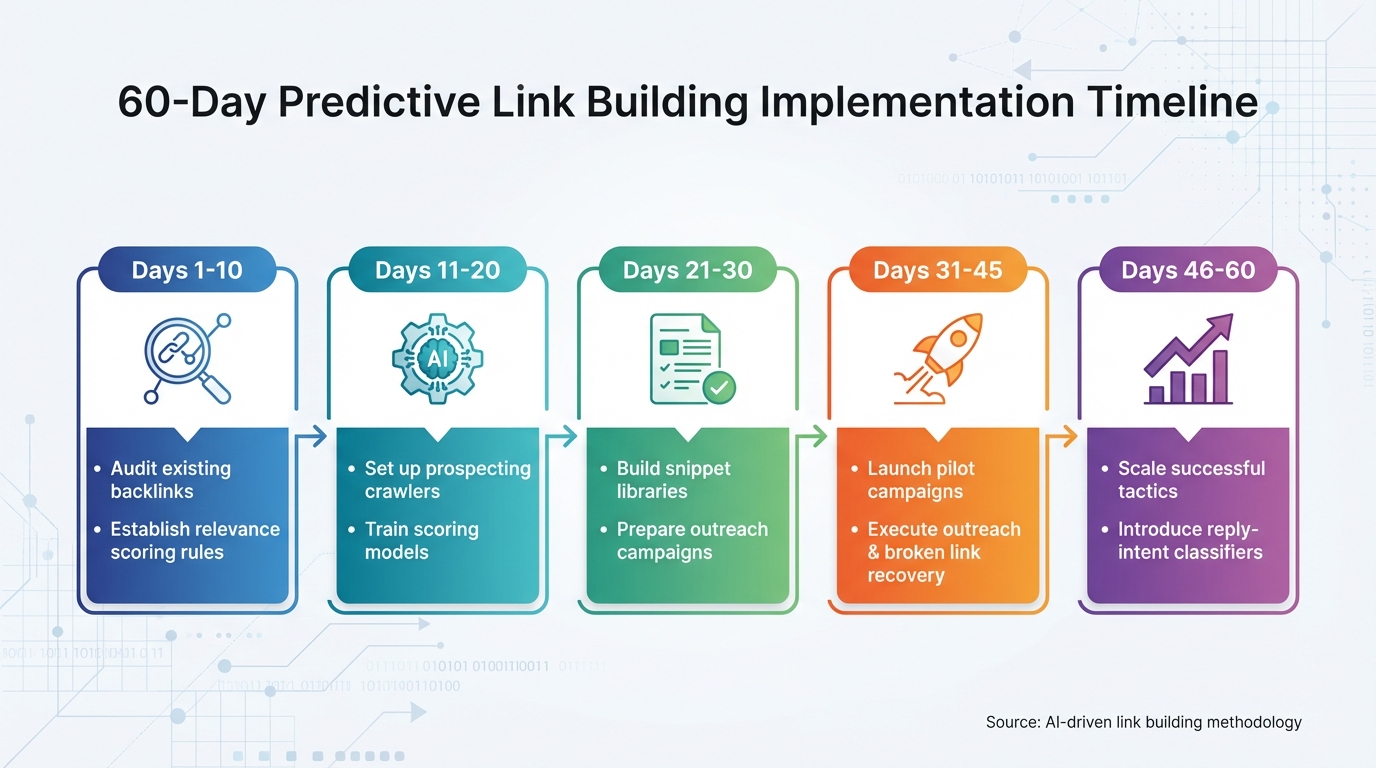
60-Day Predictive Link Building Implementation Timeline
Step-by-Step Process for Predictive Link Building
To refine your link-building efforts, consider this structured approach based on advanced domain matching and link value forecasting.
Start by setting clear objectives and KPIs. These might include identifying high-potential keywords, estimating the likelihood of link acceptance, or predicting link decay trends.
Next, gather and clean 18–24 months of historical data. This could include metrics like domain authority, anchor text usage, and ranking changes. Tools like Google Search Console, Ahrefs, or Semrush can help you compile this information.
Apply regression or time-series analysis to the data. Using Python or R, you can correlate backlink metrics and predict link decay. For example, Ahrefs’ Traffic Forecast Notebooks offer a practical way to model these predictions.
Use AI-driven models to score link prospects. These models can rank potential link partners based on their likelihood to respond and their editorial fit. Don’t forget to include competitors’ linking domains in your analysis.
Create link-worthy content assets. AI tools can help you identify content gaps or update outdated stats and references, ensuring your material is both relevant and appealing.
Automate your outreach with AI-generated, personalized messages, but always keep a human eye on the process. Generic, overly automated tactics can be counterproductive.
Finally, monitor the performance of acquired links. Metrics like conversions or branded search volume can help you refine your models. Some users have reported achieving rankings 58% faster with this data-driven approach.
Here’s a suggested 60-day timeline to implement these strategies systematically:
- Days 1–10: Audit your existing backlinks and establish relevance scoring rules.
- Days 11–20: Set up prospecting crawlers and train your scoring models.
- Days 21–30: Build snippet libraries for outreach campaigns.
- Days 31–45: Launch pilot campaigns – this could include outreach or broken link recovery efforts.
- Days 46–60: Scale up successful tactics and introduce reply-intent classifiers to enhance your outreach.
Best Practices for Using Predictive Data
Once your predictive strategy is underway, these practices can help you get the most out of your data.
- Focus on data quality. Predictive models need clean, consistent datasets to avoid errors and deliver meaningful insights.
- Maintain a balanced anchor text mix. Use predictive tools to determine the right blend of branded, exact-match, and generic anchors. This approach helps avoid penalties for over-optimization.
- Convert unlinked mentions into backlinks. Tools like 3Way.Social can help you track brand mentions that lack links, and predictive templates can streamline your outreach for these opportunities.
- Prioritize contextual relevance. Links embedded naturally within relevant content carry far more weight than those placed in unrelated or boilerplate sections.
- Gradually warm up your email systems. When automating outreach, start with a low email volume and increase it over the first 10 days to maintain your domain’s deliverability.
- Continuously refine your models. Search engine algorithms change over time, so set up alerts to flag when your predictions deviate from actual outcomes. Regularly retrain your models with updated data.
“Link building in 2026 is about earning the right to be cited. Do the work that deserves the link, and use AI link building to aim that work where it will be welcomed.” – Priya Kashyap
Currently, only 29% of marketing teams report success in their link-building efforts. The difference often lies in whether teams rely on predictive analytics or outdated manual methods. While predictive data isn’t a magic bullet, it replaces guesswork with a more evidence-based, strategic approach, giving you a far better shot at success.
Measuring and Evaluating Predicted Link Performance
Key Metrics for Link Performance
To gauge how well your predictions align with actual outcomes, focus on five main categories: authority, traffic, risk, financial return, and visibility.
Start by monitoring Domain Authority (DA) and estimating future authority growth. Miguel Salcido, CEO & Founder of Organic Media Group, highlights:
“The most important metrics in determining the authority of a given link are the number of keyword rankings that the domain you are getting the link from has, as well as the amount of estimated organic traffic the domain gets from those rankings”.
Aim for links from domains with a DA or Domain Rating (DR) of 50 or higher to ensure a meaningful boost in link equity.
For traffic, track your current organic numbers alongside projected traffic impacts. A simple formula helps estimate potential visits: Search Volume × Average CTR = Projected Monthly Visits. On average, the top Google result garners a 27.6% click-through rate (CTR), with each move up in ranking adding roughly 2.8% in CTR.
Risk metrics include tracking link decay, which measures when a backlink might lose its value due to de-indexing or changes to the content. On the financial side, compare link acquisition costs (typically ranging from $300 to $1,000) to expected ROI and lead generation potential. Lastly, visibility metrics involve comparing current rankings to predicted improvements. Interestingly, pages ranking #1 tend to have 3.8 times more backlinks than those in positions 2–10.
These metrics provide a roadmap for connecting your current performance with predictive insights.
Standard vs. Predictive Metrics Comparison
The main difference between standard and predictive metrics lies in their perspective: standard metrics focus on current or past performance, while predictive metrics look ahead. Angela Jackson explains:
“Traditional analytics look at what happened yesterday. SEO forecasting predicts what will happen next”.
Here’s a breakdown of how these two approaches differ across key categories:
| Metric Category | Standard Metric (Historical/Current) | Predictive Metric (Forecasted) |
|---|---|---|
| Authority | Domain Authority (DA) / Domain Rating (DR) | Predicted Authority Growth / Forecasted Link Value |
| Traffic | Current traffic levels | Predicted traffic growth |
| Risk | Spam Score | Predicted Link Decay / Forecasted Deindexation Risk |
| Financial | Cost per Link | Estimated ROI / Projected Lead and Revenue Impact |
| Visibility | Current Keyword Rankings | Predicted Ranking Improvement / CTR Forecast |
Incorporating predictive metrics into your strategy allows you to align your efforts with anticipated outcomes, making your link-building campaigns more forward-thinking.
When assessing the accuracy of predictive models, a variance of 10–30% is generally considered a success. Kristavja Caci, SEO Content Marketer at Surfer, advises:
“The best SEO forecasts acknowledge their limitations. I tell website owners we’re building educated predictions, not guarantees. When we forecast with 10–30% variance ranges rather than exact numbers, we actually hit our targets 90% of the time”.
Because SEO results often take 3 to 6 months to materialize, it’s wise to track performance for at least 2–3 months before drawing any conclusions.
Future Trends in Predictive Link Building
AI and Machine Learning in SEO
AI has transformed link-building strategies, shifting the focus from simply accumulating backlinks to earning mentions in Search Generative Experience (SGE) citations and building credibility through entity-based co-citation patterns by 2026. This evolution means that predictive analytics now measures how often your brand appears alongside trusted sources in AI-generated responses, rather than just traditional search results.
Tools powered by Natural Language Processing (NLP) are matching topic clusters with publishers by identifying shared entities and synonyms, creating more meaningful link opportunities. At the same time, sentiment analysis – now boasting an accuracy rate of around 90% – enables outreach customization based on how recipients are likely to react emotionally to your pitch. AI also predicts backlink decay, allowing you to proactively replace weakening links before they negatively impact your rankings.
The financial benefits of AI in SEO are clear: 30% of companies using AI report a 6–10% revenue boost, and 70% of industry leaders plan to increase their automation investments by 2025. Priya Kashyap from Serplux encapsulates the shift:
“Link building in 2026 is about earning the right to be cited. Do the work that deserves the link, and use AI link building to aim that work where it will be welcomed”.
To get started, automate discovery and scoring processes before standardizing your outreach efforts. For niche edits, AI tools can identify pages with outdated citations or statistics, prioritizing them for updates with fresh, relevant data.
These advancements set the stage for tackling ethical concerns in predictive link building.
The Role of Ethical and Secure Link Building
As AI enhances link predictions, ethical practices and secure methods become increasingly important. The quality of training data directly impacts model accuracy. If your data includes manipulative tactics from the past, AI will replicate those issues, leading to flawed predictions and potential penalties. With the predictive analytics market expected to grow from $10.2 billion in 2022 to $67.86 billion by 2032, establishing ethical foundations is more critical than ever.
Google’s SpamBrain and stricter policies on site reputation abuse are cracking down on low-quality guest posts and parasitic SEO practices. Predictive risk management is now essential – platforms must filter out “fake DR” (Domain Rating) and bot-driven traffic that distort traditional metrics. Currently, only 30% of organizations working with external link builders feel fully confident in their results, while 56% of SEO professionals anticipate increased link-building budgets in 2025.
Platforms like 3Way.Social address these challenges by offering vetted environments that validate domain authority and relevance. The platform uses AI to facilitate ABC link exchanges (A links to B, B links to C, C links to A), creating a natural backlink ecosystem that avoids the pitfalls of traditional reciprocal linking. Links provided are permanent, do-follow, and free of “sponsored” labels, ensuring they appear genuine. Features like automated link health monitoring and a unified SEO score ensure fair value in every exchange.
To stay ahead, focus on creating citable elements like first-party data, original research, and expert insights, as these are more likely to be referenced by AI models. A study revealed that one query generated only 25 clicks from an AI Overview compared to over 200,000 visits from standard search results, highlighting the importance of earning quality citations. Use tools to audit for manipulated metrics, such as bot traffic or inflated authority scores. As Vince Nero from BuzzStream puts it:
“I think the best link building teams strive to find a balance between scalable processes and flexibility”.
Conclusion
Key Takeaways
In 2026, predictive analytics has reshaped link-building strategies by leveraging AI to pinpoint high-value links before outreach even begins. Data shows that websites ranking first on Google boast 3.8 times more backlinks than those in positions 2 through 10. With predictive tools, the focus shifts from sheer volume to prioritizing quality – identifying high-authority sites with organic traffic and relevant topics.
Managing risks proactively is now more achievable, especially when forecasting link decay. A notable statistic reveals that 7% of backlinks vanish within their first year. Tools like 3Way.Social streamline the process with AI-powered ABC link exchanges, ensuring permanent do-follow links from vetted domains without leaving a traceable reciprocal linking pattern.
The financial benefits are hard to ignore. Companies adopting AI in sales and marketing report 6–10% revenue growth, and by 2025, 70% of marketing leaders plan to increase automation investments. The key to success lies in blending automation with strategic insights – such as targeting unlinked brand mentions, which boast a conversion rate of 15–20%, or publishing original research that attracts 200% more links than standard content.
These advancements provide a clear roadmap for refining your link-building efforts.
Next Steps for Your Link-Building Strategy
To put these insights into action, consider starting with a 7-day sprint to experiment with predictive methods. Begin by selecting a revenue-focused topic, publishing an original data point (even a small study with 300–500 respondents can work), creating a glossary page, and using AI tools to compile a list of 25 prospects for outreach. Develop linkable assets like first-party research, interactive tools, or industry benchmarks – content that editors naturally want to reference. For example, in 2025, a SaaS company released an industry trends report based on over 10,000 responses, earning 127 backlinks from domains with DR 40+ in just six months.
Leverage predictive analytics to perform a gap analysis, identifying websites linking to your competitors but not to you. Convert unlinked brand mentions into active links and use broken link building to replace dead links on authoritative sites with your updated content. Platforms like 3Way.Social can help by matching you with relevant domains and automating the link exchange process.
Whether you’re starting with free tools or investing in advanced platforms, focus on traffic metrics over vanity indicators like Domain Rating. Let data guide your decisions. For a head start, explore 3Way.Social to tap into AI-powered link exchanges and build a forward-thinking backlink strategy today.
FAQs
What data do I need to start predictive link building?
To get started with predictive link building, the first step is gathering the right data. You’ll need information like historical backlink data, domain authority metrics, engagement signals, competitor backlink profiles, and trend analysis.
By analyzing these elements, predictive tools can pinpoint backlinks that are likely to boost your rankings and drive more traffic. This data-driven approach makes your link-building strategy not just smarter, but also more efficient.
How can I predict which backlinks will actually improve rankings?
Predicting which backlinks will improve rankings relies on data-driven strategies and predictive analytics. By digging into historical data and leveraging machine learning, you can estimate how backlinks will influence SEO performance. Prioritize links from relevant and high-authority websites, as these tend to have the greatest impact. AI tools can also help evaluate link quality and forecast their potential SEO value. This approach ensures your efforts are focused on securing backlinks that are most likely to enhance both rankings and traffic.
How can I detect and prevent link decay before it impacts SEO?
Keeping tabs on your backlinks is crucial for maintaining a healthy SEO profile. Use automated tools to regularly scan for broken or outdated links. Alongside this, take the time to manually review critical pages, external references, and call-to-action buttons to ensure everything is functioning as intended.
When issues arise, address them promptly by updating outdated links, removing broken ones, or setting up proper redirects. For a more forward-looking approach, consider using predictive analytics to anticipate potential link decay trends. This allows you to take action before problems impact your site’s performance.
Frequent backlink audits are a key part of sustaining strong SEO results. They help you stay ahead of potential issues and ensure your site remains optimized for search engines.