Last Updated on May 6, 2026 by Becky Halls
APIs make link building faster and more efficient by automating tasks like prospecting, outreach, and backlink monitoring. Instead of manually handling these processes, APIs connect tools like SERP checkers, email platforms, and domain databases, saving time and reducing costs. For example:
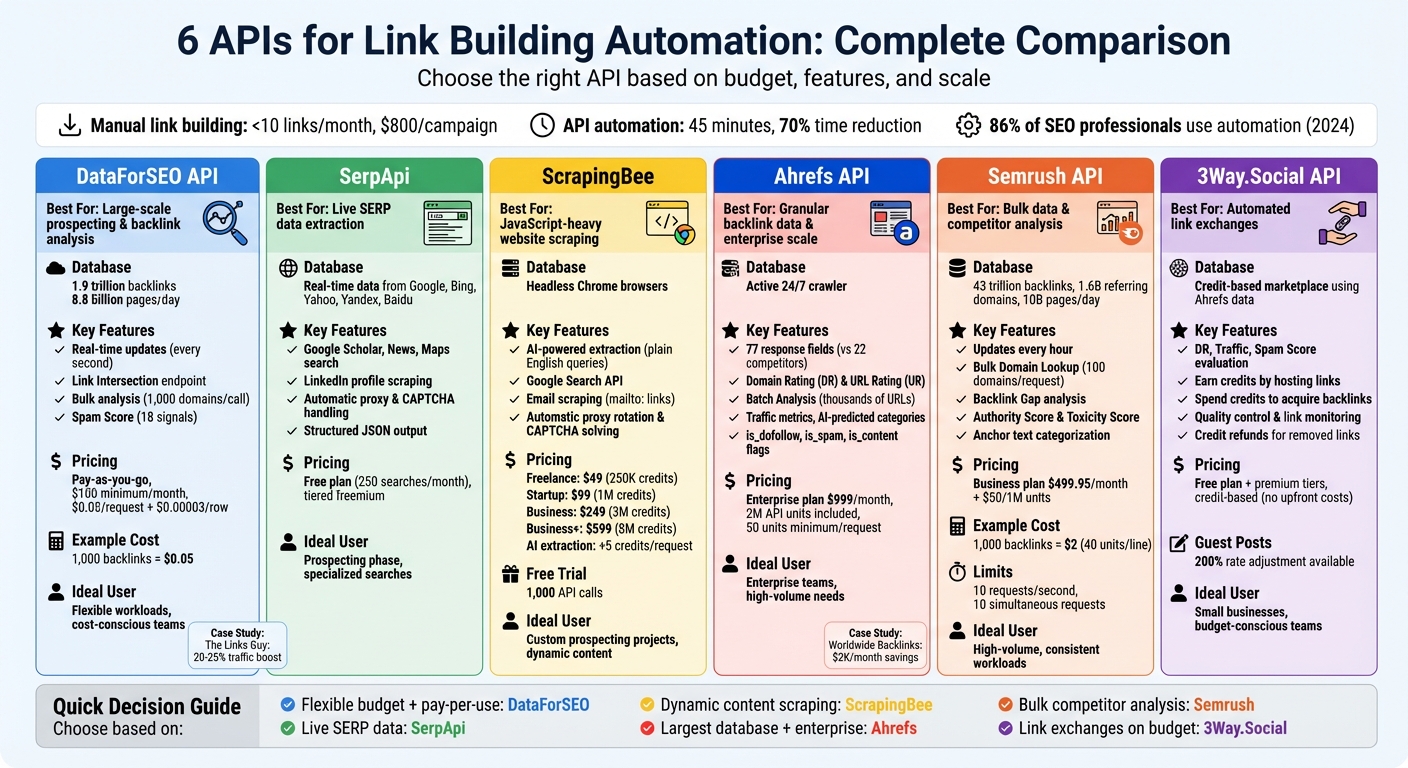
- Manual link building typically secures fewer than 10 links per month and costs around $800 per campaign.
- Automation cuts this to just 45 minutes and can reduce outreach time by 70%.
- By 2024, 86% of SEO professionals had integrated automation into their strategies.
Key APIs for link building include:
- DataForSEO API: Real-time backlink data, prospecting tools, and pay-as-you-go pricing.
- SerpApi: Live SERP data extraction for platforms like Google and Bing.
- ScrapingBee: Focused on web scraping, especially for JavaScript-heavy sites.
- Ahrefs API: Granular backlink data with 77 response fields.
- Semrush API: Bulk data retrieval and competitor analysis.
- 3Way.Social API: A marketplace for automated link exchanges.
Each API has unique strengths. Choose based on your budget, technical skills, and campaign goals. For example, DataForSEO offers flexibility with its pricing, while Ahrefs and Semrush are ideal for large-scale operations. Smaller businesses may benefit from 3Way.Social for cost-effective link exchanges.
APIs save time and labor but require human oversight to maintain quality. Balancing automation with manual input ensures better results.
API Comparison for Link Building Automation: Features, Pricing & Best Use Cases
Automating link building with Claude
sbb-itb-88880ed
1. DataForSEO API
The DataForSEO API is built for large-scale link prospecting and backlink analysis. It crawls over 8.8 billion pages daily and maintains a live index of more than 1.9 trillion backlinks. Unlike tools that depend on cached data, DataForSEO updates its index every second, providing the most current information.
Data Accuracy
This API simulates specific devices, locations, and search engines to deliver search results that reflect real-time conditions. It removes personalization factors like search history to ensure objective data. Users can even request raw HTML to verify results. The platform’s “Rank” metric is modeled after Google’s original PageRank algorithm, assessing authority based on how nodes are ranked within a linked database. This level of precision supports its robust link prospecting capabilities.
Link Prospecting Features
With its accurate data, the API excels at spotting valuable linking opportunities. The Link Intersection endpoint identifies domains linking to your competitors but not to your site, making it easy to uncover quick wins. Bulk endpoints, such as Bulk Ranks and Bulk Backlinks, allow users to analyze up to 1,000 domains in a single API call. Advanced filters help refine results by TLD (e.g., .gov or .edu), link type (dofollow/nofollow), anchor text, and semantic location – giving preference to links within article content over less impactful ones like footer links.
In 2024, The Links Guy Agency, led by Amit Raj, used the DataForSEO SERP API to export 50,000+ keywords and scrape the top 11 organic results for each. By calculating a “link gap” based on authority metrics and backlink counts, the agency achieved a 20% to 25% boost in their client’s organic traffic over several months.
Backlink Quality Metrics
Each backlink record includes details like the surrounding text, semantic location (e.g., “article” or “main”), and whether the link is broken (is_broken status), making it easier to assess link value. The API also calculates a Spam Score based on 18 different signals, including protocol usage and the ratio of external to internal links. Users can track new and lost backlinks over time, offering insights into competitors’ successful strategies.
Pricing
DataForSEO operates on a pay-as-you-go model with a $100 minimum monthly commitment, which can be applied across any of its APIs. Each request costs $0.02, plus $0.00003 per row of data. For instance, retrieving 1,000 backlinks costs about $0.05. This pricing structure makes it highly cost-effective for scaling automation through a link building client platform.
In late 2022, Worldwide Backlinks, co-founded by Callum Sherwood, transitioned from a competitor’s API to DataForSEO. By automating domain scanning for spam detection, they cut monthly API expenses by around $2,000.
“Most of the SEO tools out there are significantly overpriced; API credit costs really add up quickly… We saved roughly $2,000 per month, which is awesome!” – Callum Sherwood, Co-founder, Worldwide Backlinks
2. SerpApi
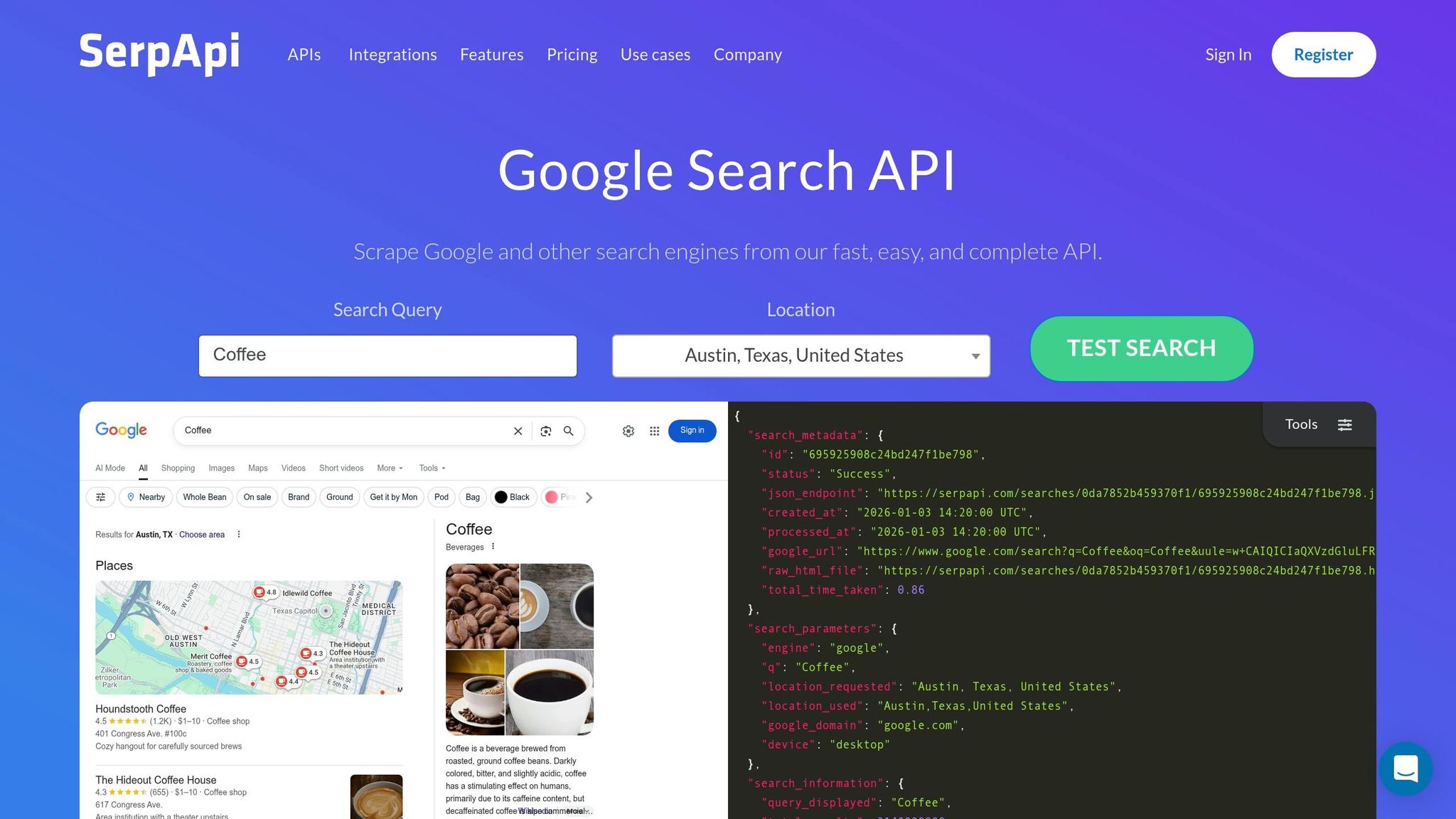
SerpApi brings a unique angle to the table by focusing on live SERP data extraction. It pulls real-time search results from platforms like Google, Bing, Baidu, Yahoo, and Yandex, delivering structured JSON data. This includes organic results, featured snippets, People Also Ask boxes, and local packs. By providing up-to-the-minute data, SerpApi supports automation and makes it easier to identify top-ranking pages. Let’s dive into the features that make it a valuable tool for direct link prospecting.
Link Prospecting Features
SerpApi excels in specialized searches, offering tools tailored for specific needs:
- Google Scholar: Perfect for finding academic citation opportunities.
- Google News: Helps with timely PR outreach.
- Google Maps: Aids in uncovering local link-building prospects.
Additionally, its LinkedIn Public Search Results Scraper can extract public profile data, making it easier to identify and target outreach prospects.
Another standout feature is its ability to handle proxies and solve captchas automatically. This ensures smooth operation during large-scale campaigns without the risk of IP bans. As Justin O’Hara from SerpApi explains:
“SerpApi is a real-time data-scraper that picks up real time results to all our API’s.”
Pricing
SerpApi offers a free plan that includes 250 searches per month. For higher search volumes and faster speeds, tiered freemium pricing options are available.
While SerpApi doesn’t provide backlink quality metrics like Domain Rating or Authority Score, it shines in delivering raw SERP data. This data is invaluable for identifying potential link-building opportunities, such as blogs, directories, and journals, particularly during the prospecting phase. This makes it a strong addition to an integrated SEO toolkit, especially for those prioritizing automation in their workflow.
3. ScrapingBee
ScrapingBee prioritizes web scraping infrastructure rather than focusing on SEO-specific metrics. It operates a fleet of headless browsers running the latest version of Chrome, allowing it to render web pages exactly as users see them. This makes it particularly effective for extracting data from JavaScript-heavy websites, where traditional scrapers often struggle.
Link Prospecting Features
ScrapingBee offers a specialized Google Search API designed to streamline the discovery of guest posting opportunities, directories, and niche blogs without triggering blocks. By enabling the render_js parameter, users can extract contact details and link opportunities from sites that rely on dynamic scripts to hide data. This feature is especially handy for tackling modern, script-heavy websites.
One standout feature is ScrapingBee’s AI-powered extraction. Instead of crafting complex CSS selectors, you can simply describe the data you need in plain English. Using parameters like ai_extract_rules and ai_query, the tool interprets the page structure and delivers structured data automatically. Arvid Kahl, Founder of Podscan, highlights this capability:
“Scraping is 50% dealing with ever-changing HTML files and 50% formatting data efficiently. ScrapingBee’s incredible AI feature can do both much better than I ever could.”
The API also simplifies email scraping by targeting mailto: links through CSS selectors like a[href^='mailto']. This makes outreach campaigns much easier to manage. Additionally, features like automatic proxy rotation and CAPTCHA solving ensure high success rates, even during large-scale data extraction efforts.
Pricing
ScrapingBee’s pricing is designed to accommodate campaigns of varying sizes. There are four monthly plans available:
- Freelance: $49 for 250,000 API credits with 10 concurrent requests.
- Startup: $99 for 1,000,000 credits and 50 concurrent requests.
- Business: $249 for 3,000,000 credits and 100 concurrent requests.
- Business+: $599 for 8,000,000 credits and 200 concurrent requests.
For users interested in AI-powered extraction, there’s an additional cost of 5 credits per request. New users can also take advantage of 1,000 free API calls to test the platform.
Although ScrapingBee doesn’t offer backlink metrics like Domain Authority or Domain Rating, its ability to extract raw data with precision makes it an excellent choice for custom link prospecting projects.
4. Ahrefs API
Ahrefs operates one of the most active web crawlers, running non-stop to uncover backlinks and website data. This constant crawling ensures that link-building automation tools have access to fresh, dependable data for prospecting and analysis. To enhance data quality, Ahrefs implemented a specialized spam filter across all backlink endpoints, delivering cleaner results for automation workflows and AI integrations.
Data Accuracy
Ahrefs API is known for its highly detailed data. Its Backlinks endpoint provides 77 response fields – more than triple the 22 fields offered by competing tools like Semrush. As Despina Gavoyannis, Senior SEO Specialist at Ahrefs, puts it:
“Our data is way more granular than the competition. For example, there are 77 response fields returned by our Backlinks endpoint vs. only 22 response fields in Semrush’s endpoint.”
This level of granularity allows developers to filter and analyze backlinks with precision. The API also delivers contextual details, such as snippet_left and snippet_right, which show the text surrounding each link. Additionally, AI-predicted category paths (e.g., “/Article/How_to”) help identify relevant outreach targets, while the is_content flag indicates whether a link appears within the main content of a page.
Link Prospecting Features
Ahrefs simplifies large-scale prospecting with its robust data capabilities. The Batch Analysis feature, for instance, can extract metrics like Domain Rating (DR) for thousands of URLs at once, far exceeding the 200-website limit found in its web interface. The API also includes traffic-based qualification metrics, such as estimated monthly organic traffic for both the referring page (traffic) and the referring domain (traffic_domain). These insights make it easier to prioritize high-value prospects and assess opportunities based on business size and budget [42,46].
Backlink Quality Metrics
The API provides essential metrics for evaluating link opportunities. Key indicators like Domain Rating (DR) and URL Rating (UR) assess the strength of a domain’s or page’s backlink profile on a 100-point scale [42,44]. The is_dofollow attribute confirms whether a link passes authority signals, while the is_spam flag helps identify spammy domains. Another useful metric, linked_domains_source_domain, shows how many unique domains a source links to, which can help detect link farms. Combined with the is_content flag, these features enable you to focus on valuable editorial links that appear in primary content. This detailed data makes it easier to implement a cost-effective and scalable link-building strategy.
Pricing
Ahrefs uses a unit-based pricing system, where costs depend on the number of rows returned and fields requested. Each API request has a minimum cost of 50 units. To manage costs, you can use the select parameter to request only the fields you need and the limit parameter to control the number of rows. Accessing the production API typically requires an Enterprise plan, which starts at $999 per month and includes 2 million API units. Developers can also send free test queries to API v3 endpoints while their app remains in “Inactive” status during development. Additionally, the limits-and-usage endpoint allows real-time monitoring of remaining monthly allowances.
5. Semrush API
Semrush operates a proprietary crawler that processes an impressive 10 billion pages daily, supported by a database of over 43 trillion backlinks from 1.6 billion referring domains. This massive dataset updates as often as every hour, ensuring automation tools have access to fresh link intelligence. With such a robust infrastructure, Semrush plays a vital role in automating link-building tasks. Its API turns this wealth of data into actionable insights through two primary tools: the Analytics API, designed for backlink and competitor research, and the Projects API, which manages Site Audit and Position Tracking data.
Data Accuracy
The API excels in delivering fast, bulk data retrieval, a significant improvement over manual processes. For example, a script can pull data for 10 domains in just 1.3 seconds and export thousands of rows in 6 seconds. Luke Harsel from Semrush highlights the efficiency of this approach:
“Pulling data via an API can be automated, so it is an excellent solution for gathering vast sets of data efficiently”.
The Bulk Domain Lookup feature further streamlines workflows, processing 100 domains per request. For the most accurate backlink audits, Semrush allows users to connect their Google Search Console accounts, ensuring comprehensive data coverage. These capabilities make link prospecting faster and more efficient.
Link Prospecting Features
The Semrush API simplifies prospect identification with features like incremental syncing, which ensures systems fetch only updated data since the last sync. This avoids redundant pulls and keeps workflows efficient. Developers can use programming languages like Python or Perl to integrate Semrush data into custom dashboards, CRM platforms, or automated reporting tools. Additionally, the Backlink Gap metric identifies domains linking to competitors but not your site, pinpointing high-priority link opportunities. The API also provides First/Last Seen dates for links, allowing users to monitor the freshness and stability of backlink profiles.
Backlink Quality Metrics
The API evaluates backlink quality using an Authority Score (AS) based on Link Power and Organic Traffic, while also flagging risky domains with a Toxicity Score. Anchor text is categorized into groups like “Money” (keywords), “Branded”, “Naked URL”, and “Generic”, helping users avoid over-optimization that could lead to search engine penalties. It also analyzes link types (e.g., follow vs. nofollow) and TLD distributions (.gov, .edu, .com), enabling strategic diversification of backlink profiles.
Pricing
Semrush’s pricing reflects its ability to handle rapid, bulk data needs. Accessing the Analytics and Projects API requires a Business plan subscription at $499.95 per month. API units are sold as a recurring monthly add-on, costing approximately $50 per 1 million units. For example, retrieving 1,000 backlinks with related data costs about $2 (40 units per line of data). Calls for live domain organic reports cost 10 units per line, while historical data calls cost 50 units per line. Unused API units expire at the end of each billing cycle, and the API enforces limits of 10 requests per second and 10 simultaneous requests per user account.
6. 3Way.Social API
3Way.Social takes a distinct approach to link building with its credit-based marketplace, leveraging Ahrefs API data to set pricing based on objective SEO metrics. The platform evaluates domains using three key factors: Domain Rating (DR), Organic Monthly Traffic Volume, and a proprietary Spam Score. As Ian from 3Way.Social explains:
“Pricing is based on objective, data-driven factors (DR, Traffic, Spam Score)”.
Here’s how 3Way.Social ensures accuracy, evaluates backlink quality, and structures its pricing for seamless SEO automation.
Data Accuracy
To maintain fair pricing and precise link valuation, 3Way.Social applies a standardized model across all domains. For instance, a domain with a DR of 74 and 38,000 monthly organic visitors is valued at approximately 133 credits. By pulling authority and traffic metrics directly from the Ahrefs API, the platform ensures its data aligns with industry benchmarks. Additionally, it keeps track of link longevity and offers credit refunds if purchased backlinks are removed.
Backlink Quality Metrics
The platform uses a combination of Domain Rating, organic reach, and its proprietary Spam Score to filter out risky domains before they enter the marketplace. Automated quality control ensures that backlinks are live and dofollow. If a link goes offline, users can access restoration services or request refunds, keeping the process smooth and reliable.
Pricing Structure
3Way.Social operates on a credit-based model designed for flexibility and accessibility. Users earn credits by hosting link insertions on their own sites and spend those credits to acquire backlinks from others. For guest posts, sellers can adjust rates using a dashboard slider, allowing prices to increase up to 200% of the base credit value to account for custom content creation. Ian highlights this transparency:
“Whether you are buying or selling, you know the price reflects true SEO value”.
This system makes it easier for smaller businesses to participate in link exchanges without incurring upfront costs.
Advantages and Disadvantages
APIs make link building more efficient but come with their own set of challenges. For instance, DataForSEO stands out for its pay-as-you-go pricing and consistent JSON responses. This makes it a good option for workloads that fluctuate, but if you’re dealing with high volumes, costs can unexpectedly rise. Plus, integrating it demands a certain level of technical know-how.
Ahrefs API boasts the largest historical database in the industry. This makes it a powerful tool for competitor backlink analysis. However, its enterprise-level pricing and complex setup can make it tough for smaller teams to adopt.
Semrush API integrates seamlessly with its full SEO toolkit, offering a comprehensive solution for high-volume users. That said, it has a major limitation: it doesn’t allow live backlink data retrieval through its API. This feature is only accessible via its web interface, which can be a drawback for teams with sporadic or flexible needs.
ScrapingBee focuses on real-time SERP scraping and includes automatic proxy rotation to avoid IP blocks. However, its narrow focus on scraping limits its utility compared to APIs that offer broader SEO insights. Similarly, SerpApi excels at tackling technical hurdles like CAPTCHAs during live search result scraping. Yet, its specialized focus can restrict its application in wider SEO strategies.
On the other hand, 3Way.Social API takes a different route by automating secure and fair link exchanges. With a free plan and premium tiers, it’s especially appealing to smaller businesses, offering cost-effective access to quality link exchanges. This approach sets it apart from traditional data-gathering APIs.
While these APIs save significant time, they still require human oversight to avoid potential issues, such as over-automation. One of their biggest advantages is the labor savings they offer. For example, manually prospecting for 40 quality leads can take up to eight hours and cost around $800 in labor. With API-driven tools, that same task can be completed in just 45–60 minutes. In one case, an agency boosted their weekly prospecting from 150 to 500 leads using automation in 2024. However, fully automated emails had a downside: response rates dropped to about 2%, compared to 15–20% when human review was involved.
These tools can deliver impressive efficiency, but striking the right balance between automation and human input remains essential.
Conclusion
Choose an API that fits your specific needs: DataForSEO is a great option for detailed keyword, SERP, and backlink data, offering flexible pay-as-you-go pricing. On the other hand, ScrapingBee focuses on real-time SERP data and handles dynamic content efficiently. These differences can help you decide which API best complements your workflow.
Each API has its strengths. For comprehensive competitive insights and access to one of the largest backlink databases, Ahrefs API stands out. However, it requires a significant financial commitment, making it ideal for enterprise-level use. If you’re looking for scalable keyword and competitor analytics, Semrush API is a strong choice.
For those on a tighter budget, Google’s free APIs, like Search Console and PageSpeed Insights, offer excellent tools for performance tracking and technical SEO site audits, with up to 25,000 free requests per day. Combining these free tools with premium APIs can be a smart strategy for cost-conscious projects. Meanwhile, if you’re exploring automated link-building, 3Way.Social API provides a unique solution with both free and paid tiers, making it accessible to smaller businesses.
When it comes to pricing models, consider your workload. Pay-per-request models work well for fluctuating needs, while subscriptions are better for high, consistent volumes. Always test free tiers or sandbox modes to ensure the data meets your expectations before committing to a plan.
FAQs
Which API should I start with for link building automation?
The Moz API offers a solid foundation for automating link-building efforts. Designed specifically for SEO tasks, it simplifies processes like backlink analysis, allowing you to save time and better manage your SEO strategy.
How do I keep automated outreach from hurting response rates?
To keep automated outreach from negatively impacting response rates, focus on making your messages relevant and personal. Leverage AI tools to track open and reply rates, allowing you to fine-tune campaigns in real time. Craft tailored messages using personalized templates and thoughtful follow-ups to maintain a genuine tone. Additionally, AI-driven prospect qualification can help you avoid sending irrelevant or excessive messages. Regularly review response data to adjust your approach and ensure your outreach stays effective without overwhelming your audience.
How can I estimate monthly API costs before scaling?
To get a handle on API costs, start by exploring different pricing models, such as pay-as-you-go or subscription-based plans. Running a small-scale test can help you track usage patterns and estimate potential expenses more accurately. It’s also a good idea to compare features and pricing across various providers to find the option that offers the best value for your specific needs. Taking the time to evaluate thoroughly will help you budget effectively and ensure you’re prepared to scale as needed.