Last Updated on May 22, 2026 by Becky Halls
Transparency in link building is essential for SEO success. It ensures that backlinks are earned through ethical, open, and traceable practices, aligning with search engine guidelines and building trust with users and partners. Here’s what you need to know:
- Transparent link building involves creating links with clear origins, legitimate purposes, and value to real audiences. It avoids manipulative tactics like buying links or using private blog networks (PBNs).
- Search engines favor transparency. Modern AI systems like Google’s SpamBrain and tools like ChatGPT assess link quality holistically, rewarding genuine, contextually relevant backlinks.
- Risks of non-transparent methods: Opaque tactics can lead to penalties, ranking drops, and wasted resources. Recovery from penalties often takes months.
- Key principles of transparency: Disclosure, documentation, editorial discretion, and vetting are essential for ethical link-building practices.
- Benefits of transparency: It strengthens E-E-A-T (Experience, Expertise, Authoritativeness, Trustworthiness), improves rankings, minimizes penalty risks, and fosters lasting partnerships.
To succeed with your SEO, focus on earning links through honest, high-quality practices that stand up to scrutiny.
Core Principles of Transparent Link Building
How Transparent Practices Align with Search Engine Guidelines
Google’s Webmaster Guidelines make one thing clear: any links created to manipulate rankings fall under “link schemes” and can lead to penalties. Transparent link-building avoids these pitfalls by ensuring every link serves a legitimate purpose – whether it’s based on editorial value, a genuine business connection, or an openly disclosed content partnership.
Using the correct link attributes, like rel="sponsored" or rel="nofollow", is a crucial part of this process. These technical markers show search engines that you’re playing by the rules and help protect your site from penalties during manual or algorithmic reviews. These attributes align perfectly with the core principles of disclosure, documentation, editorial discretion, and vetting, which we’ll explore in more detail below.
“Transparency is no longer optional – it is the foundation of any sustainable SEO strategy.” – SEOAuto Blog
Now, let’s break down the elements that make transparent link-building a reliable and ethical practice.
Key Elements of Transparency in Link Building
Transparent link-building relies on four main pillars:
- Disclosure: Always be upfront about the nature of a link arrangement. Whether it’s a paid placement, a content swap, or a business collaboration, transparency is key.
- Documentation: Maintain records of outreach emails, agreements, and live links. A clear paper trail can save you if your site ever faces a manual review.
- Editorial discretion: Links should be added because they genuinely enhance the content, not because of undisclosed financial incentives.
- Vetting: Carefully evaluate every linking partner to ensure they are legitimate, credible websites – not anonymous link farms or private blog networks (PBNs).
Amit Raj, Founder of TheLinksGuy, emphasizes the importance of openness in link-building:
“Transparency in link building is all about consistently communicating with your clients without hiding any essential information.”
These principles set ethical link-building apart from manipulative strategies.
Transparent vs. Opaque Link-Building Practices
The key question to ask is: would this link hold up under scrutiny? Transparent practices include disclosed guest posts on trusted industry sites, peer-to-peer collaborations between verified businesses, or citations earned through original research. These stand in stark contrast to opaque tactics.
| Feature | Transparent Practice | Opaque Practice |
|---|---|---|
| Source | Traceable, verified partners | Anonymous or hidden networks |
| Disclosure | Full (rel="sponsored" where required) |
Hidden arrangements |
| Quality | Unique, high-quality placements | Spun, duplicate, or irrelevant |
| Anchor text | Natural and descriptive | Keyword-stuffed or misleading |
| Long-term SEO impact | Sustainable authority and E-E-A-T signals | Short-term spikes, high penalty risk |
The gap between these two approaches has grown wider over time. Google’s advanced machine learning tools are now highly effective at identifying PBNs and automated link schemes. Transparent methods, on the other hand, focus on building contextual credibility and entity relationships – the kind of signals that AI-driven search engines actively reward.
sbb-itb-88880ed
How Transparency Improves SEO Performance
How Quality Backlinks Support Better Rankings
Transparent link-building practices lead to higher-quality backlinks, which play a crucial role in boosting rankings. By being upfront about your strategies and adhering to ethical guidelines, you naturally target links from reputable, editorially independent websites. These are precisely the types of links that search engines prioritize.
Google’s E-E-A-T framework emphasizes the importance of backlinks from credible, niche-specific sources to establish your site’s authority. A Semrush study analyzing 1,000 domains underscores this point: sites with higher Authority Scores, driven by strong backlink profiles, are more likely to appear in AI-generated search results. As tools like Perplexity and ChatGPT assess link quality to gauge content credibility, the value of high-quality backlinks is increasing.
Adopting transparent methods not only improves your rankings but also helps safeguard against algorithmic penalties.
How Transparency Lowers the Risk of Penalties
Using opaque link-building tactics can leave a trail that modern algorithms are quick to detect and penalize.
“Google’s link spam updates and machine learning systems now identify purchased links, reciprocal schemes, and guest post networks with accuracy, penalizing sites that appear to use them.” – Jolissa Skow, Freelance Writer and Content Strategist, Search Engine Land
Transparent practices, on the other hand, mitigate these risks. Carefully vetting partners, following a checklist for effective backlink placement, and maintaining detailed records create a clear audit trail. This allows you to respond quickly if any questionable links surface. Regular backlink audits – conducted quarterly or even monthly for active campaigns – help identify and disavow harmful links before they lead to penalties.
“Using ethical, transparent tactics helps avoid penalties such as search engine blacklisting. It ensures your website’s longevity and continuing online visibility.” – DashClicks Team
By combining transparency with proactive monitoring, you can protect your site and maintain steady performance.
Tracking Performance Through Honest Reporting
Honest reporting strengthens transparent link-building efforts by tying link quality directly to measurable results. Without this clarity, stakeholders may lose trust in the strategy.
Transparent reporting focuses on connecting link-building efforts to tangible outcomes, such as increased organic traffic, improved lead quality, and revenue growth – not just raw link counts. Tools like Google Search Console, GA4, and live dashboards provide visibility into target URLs, active links, and rejected placements. This level of transparency allows stakeholders to independently verify results.
When decision-makers clearly see the value of your efforts, they’re more likely to support the time and investment needed for strategies to succeed.
“In the long run, clear SEO always outperforms clever SEO.” – Moinul Alam, SEO Specialist, SEO For Today
10 Years of Link Building Advice in 10 Minutes
Transparency in Link Exchange Agreements
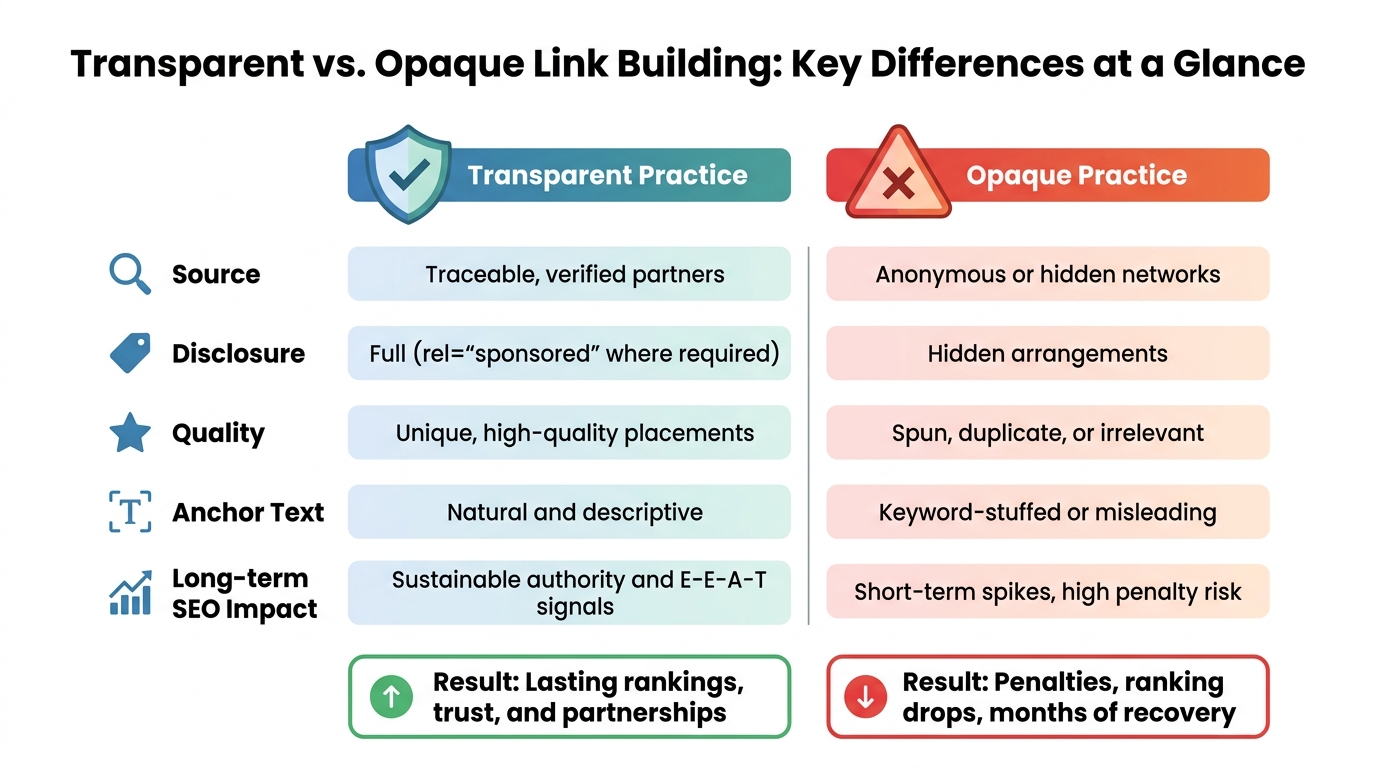
Transparent vs. Opaque Link Building: Key Differences at a Glance
What Makes a Link Exchange Ethical
For a link exchange to be ethical, it needs to be built on clear intentions, open communication, and genuine value for all parties involved.
An ethical exchange happens between verified and reputable websites that complement each other. The links should be seamlessly integrated into relevant content, signaling to search engines that they result from editorial judgment rather than a paid deal.
“Modern link building is about relationships, not transactions.” – Jolissa Skow, Content Strategist, Search Engine Land
These exchanges often go beyond simple link swaps. The most effective partnerships involve collaborative efforts like joint whitepapers, co-authored guides, or interviews. In these cases, the links naturally emerge as part of the shared content, rather than being the primary goal.
By adhering to these ethical practices, you can establish a solid foundation for creating clear and transparent link exchange agreements.
How to Structure a Clear Link Exchange Agreement
A clear link exchange agreement ensures that both parties are on the same page, reducing misunderstandings and protecting everyone involved. Before entering into an agreement, it’s essential to evaluate each partner’s domain authority, organic traffic trends, and audience relevance. Once vetted, the agreement should address key details like anchor text accuracy, link attributes, and financial disclosures. For instance, if financial compensation is involved, the link must include the rel="sponsored" attribute to comply with Google’s guidelines.
“Transparency in link building is all about communication… it can help explain, or shed light on the process so that parties agree regarding industry standards and expectations.” – Amit Raj, Founder, TheLinksGuy
Keeping detailed records of the agreement is equally important. This documentation not only supports audits but also ensures that links remain active and aligned with the original terms. Including provisions for regular backlink audits can help maintain a clean and reliable link profile over time.
Using Platforms to Support Transparent Exchanges
Even with structured agreements, managing link exchanges manually can be overwhelming, especially on a larger scale. This is where specialized platforms come in handy, simplifying the process while maintaining transparency.
For example, 3Way.Social focuses on ABC (three-way) link exchanges, where Site A links to Site B, and Site C links back to Site A. This approach avoids the pitfalls of direct reciprocal linking while ensuring every connection remains clear and traceable. The platform uses AI-powered domain matching to pair websites based on niche relevance and domain authority, ensuring that all exchanges begin with genuine compatibility.
The platform also vets every participant, guarantees permanent do-follow links, and provides a user-friendly dashboard. This dashboard offers full visibility into link statuses, anchor texts, and target URLs, making it easier to manage and verify agreements effectively. Platforms like 3Way.Social demonstrate how technology can streamline and uphold transparency in link exchange practices.
Best Practices for Transparent Link-Building Workflows
Building Internal Processes for Transparency
Transparent link building thrives on well-structured and ethical workflows. It all begins with clear vetting criteria. Before reaching out to potential sites, establish minimum benchmarks for metrics like Domain Rating (DR), organic traffic, and niche relevance. For instance, many professionals require sites to have 1,000–5,000 monthly organic visitors, verified through tools like Ahrefs or SEMrush, instead of solely relying on Domain Authority.
Once a partner meets these standards, document every step of the process. This includes outreach efforts, editorial discussions, agreed anchor texts, and any financial agreements. Keeping an audit trail ensures accountability. Additionally, all submitted content should be original and human-written, verified using tools such as Copyscape or Originality.ai. This reduces the risk of penalties from low-quality or plagiarized content. As Abhishek Chauhan from Justwords Digital highlights:
“The agencies that get their clients penalized are almost always the ones that accepted bulk link delivery with a spreadsheet of URLs and a ‘trust our process’ from the vendor. No pre-approval. No documentation.”
After building these internal workflows, the next step is ensuring transparent communication with stakeholders.
Reporting Link-Building Progress to Stakeholders
Transparent reporting sets ethical link-building practices apart. Incorporate live dashboards into your workflow to keep stakeholders informed in real time. Every report should include detailed link data, such as the linking URL, target URL, anchor text, the linking domain’s organic traffic, and whether the link is dofollow or nofollow. This level of detail allows stakeholders to independently verify placements.
It’s also important to show rejected outreach efforts. Doing so demonstrates the genuine effort behind the process and helps set realistic expectations. Claire Aldridge, a Digital Marketing Specialist at Victory Digital, emphasizes this:
“We’ll never bend the truth or cover up a mistake – we’re human, after all – and we’ll work twice as hard to get the results we promised.”
Focusing on business outcomes, like organic conversions, lead quality, and revenue impact, helps stakeholders grasp the long-term value of link-building efforts.
Using Technology to Maintain Transparency in Link Building at Scale
To maintain transparency as your efforts grow, the right tools are essential. For outreach, platforms like Hunter.io and RocketReach help find and verify contact information for legitimate site owners. For link monitoring, tools such as BacklinkManager.io and Monitor Backlinks automatically track whether your acquired links remain live, alerting you if any are removed.
For teams managing multiple partnerships, 3Way.Social offers an AI-powered solution. It matches sites based on niche relevance and authority while providing a dashboard that tracks link statuses, anchor texts, and target URLs. Its vetted network and permanent dofollow links ensure every connection aligns with search engine expectations for a clean backlink profile.
Here’s a quick overview of tools that can enhance transparency at various stages of your workflow:
| Workflow Stage | Recommended Tools | Transparency Benefit |
|---|---|---|
| Prospecting & Vetting | Ahrefs, SEMrush, Majestic | Objectively validates traffic, DR, and niche fit |
| Outreach & Discovery | Hunter.io, RocketReach | Tracks who is contacted and why |
| Content Verification | Copyscape, Originality.ai | Ensures content is original and human-written |
| Monitoring | BacklinkManager.io, Monitor Backlinks | Tracks live/lost link status automatically |
| Reporting | AgencyAnalytics, Google Sheets, GA4 | Offers real-time visibility to stakeholders |
Conclusion
Key Benefits of Transparent Link Building
Transparency in link building isn’t just about playing fair; it’s a smarter, long-term approach. Shady link schemes might offer quick gains, but they also come with massive risks, like harsh ranking penalties and drawn-out recovery periods. On the other hand, transparent strategies lead to lasting SEO growth. Every authentic link you earn builds your authority, which naturally attracts more mentions, citations, and partnerships over time.
This approach is even more critical as AI-driven search platforms like Google SGE, Perplexity, and ChatGPT increasingly evaluate link profiles in a more comprehensive way. Research has shown that websites with stronger authority scores – earned through high-quality, relevant backlinks – are more likely to rank well in AI-generated search results. In short, being transparent today sets the stage for better visibility in the future.
Beyond boosting rankings, transparent link building enhances E-E-A-T signals (experience, expertise, authority, and trustworthiness), fosters real industry relationships, and safeguards your brand’s reputation. As Andy Hill, Managing Director at Distribute Digital, explains:
“Backlinks remain the best indicator to Google and other search engines that a webpage is considered important… The more relevance and authority a website has, the more weight the vote gets.”
These combined advantages highlight the importance of using reliable tools to support transparency in link building.
How Platforms Like 3Way.Social Support Ethical Link Building
Scaling a transparent link-building strategy isn’t easy without the right tools. That’s where platforms like 3Way.Social step in. Their AI-powered solution connects verified websites based on niche relevance and domain authority. Every exchange is peer-verified, ensuring all parties contribute real value – no anonymous link farms or hidden tactics.
With features like permanent do-follow links, precise domain matching, and a user-friendly dashboard, 3Way.Social provides SEO professionals with the tools they need to maintain accountability. It simplifies the process of building ethical, durable backlink profiles while ensuring compliance with search engine guidelines.
Transparency in Link Building FAQs
How can I tell if a backlink is truly “transparent”?
A transparent backlink is one where its origin, purpose, and any financial agreements are clear and easy to verify. Key aspects to watch for include:
- Editorial intent: The link offers genuine value and isn’t placed solely for manipulation.
- Full disclosure: Any payments or exchanges are openly acknowledged, often marked with attributes like rel=sponsored.
- Contextual relevance: The link fits naturally within content that aligns with its subject matter.
- Traceability: You can confirm where the link comes from and its authenticity.
Platforms such as 3Way.Social are designed to help maintain these standards.
When should I use rel=”sponsored” vs rel=”nofollow”?
When dealing with links tied to advertising, sponsorships, or financial compensation, it’s recommended to use rel=”sponsored” to comply with search engine guidelines. On the other hand, rel=”nofollow” is suitable when you want to avoid passing ranking credit, such as for untrusted or non-editorial links. While rel=”sponsored” is specifically designed for paid links, using rel=”nofollow is still acceptable if your primary aim is to prevent passing any ranking signals.
What documentation should I keep for a link-building audit?
To maintain accountability and transparency in link building, it’s crucial to keep thorough records of your link-building activities. This includes tracking outreach efforts, link agreements, guest post placements, and any partnership disclosures. Your records should detail key information such as the linking URL, target URL, anchor text, domain metrics, go-live date, and confirmation of do-follow status.
When evaluating potential link opportunities, document the vetting criteria you use – such as domain authority, traffic levels, and relevance to your niche. Consistently monitoring your backlink profile with analytics tools ensures it remains clean and compliant. Tools like 3Way.Social can make secure and vetted link exchanges more manageable.