Guest Posts and Link Longevity: What to Know
Why guest post links fade, what breaks them, and clear steps to choose, monitor, and preserve backlink value over time.
Last Updated on October 9, 2026 by Ian Naylor
Most guest post links lose strength with time, and many disappear sooner than people expect.
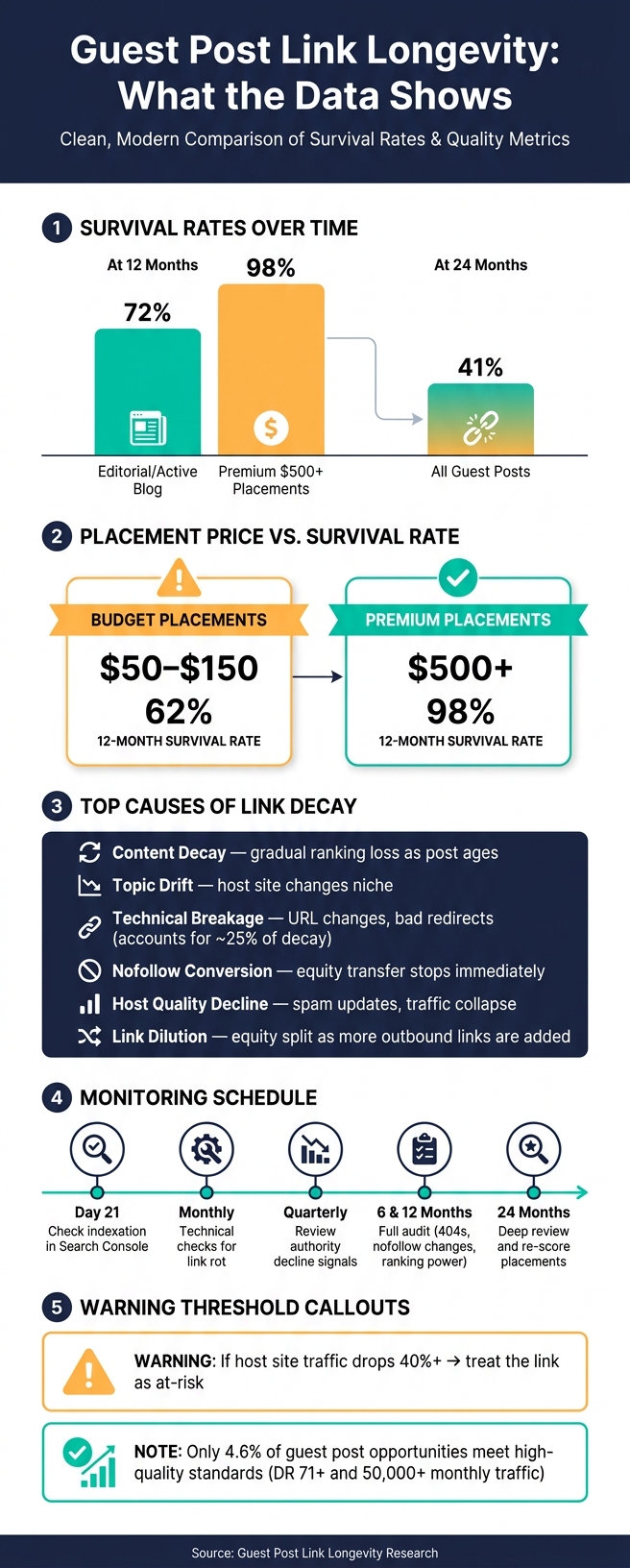
If I had to sum up the full article in a few lines, I’d say this: a guest post link keeps helping only while the page stays live, indexed, relevant, dofollow, and on a healthy site. The biggest lift often comes in the first 1 to 6 months, then the effect tends to level off. After 12 months, about 72% of guest posts on active blogs are still live, and by year two that drops to 41%.
Here’s the short version:
- Links die in two main ways: the page breaks or disappears, or the page stays up but loses SEO strength.
- Common causes: old content, topic drift, URL changes, bad redirects, nofollow changes, and host-site decline.
- The best way to keep link value longer: place posts on stable sites, use evergreen topics, and check links on a set schedule.
- Price often tracks survival: placements over $500 show much better 12-month survival than low-cost placements in the $50–$150 range.
- Diversification matters: if one placement drops, your full link profile takes less of a hit.
A simple rule I’d follow: don’t treat guest posting like a one-time task. I’d track indexation in the first 21 days, run monthly technical checks, and review link quality again at 6, 12, and 24 months.
That’s the core idea of the article: getting a guest post live is only the start; keeping that link alive and useful is the part that shapes long-term SEO results.
Guest Blogging Is DEAD for SEO (According to Google)
sbb-itb-88880ed
What causes guest post links to lose value
Guest post links usually lose value for three main reasons: the content gets old, the link gets weakened by site changes, or the host site slips. The key is knowing which one you’re dealing with – and when it started. That’s the difference between a rushed link audit and using a link building client platform to track performance.
Content decay and topic drift
A guest post with old stats or outdated examples starts losing steam on its own. Over time, the page becomes less relevant, and the link inside it does less work because the context around it no longer feels current.
Topic drift is a bit different. Here, the host site changes direction. Maybe it used to cover your space closely, but now it publishes on other subjects. Your guest post is still there, but it no longer fits the rest of the site. When that happens, the link loses relevance too.
Technical changes that break or weaken links
This is where things can go sideways fast. Site redesigns and CMS migrations often damage guest post links. If a URL changes and there’s no proper 301 redirect, a live link can turn dead overnight.
Redirect chains can also chip away at value. If a link goes through two or three hops before landing on the final page, equity can drop along the way. In some cases, the link still exists, but it gets buried. A noindex tag or deep archive placement can make the page harder to crawl even though the link remains live. URL restructuring accounts for roughly 25% of backlink decay.
Host-site quality decline and policy changes
Sometimes the link itself doesn’t change at all, but the site around it does. A host site that starts pushing more low-grade sponsored posts can drag down the value of older guest links.
Google’s Site Reputation Abuse policy has also cut down the value of third-party content sections on major publishers. And there’s another issue that catches people off guard: retroactive nofollow conversion. Publishers may go back and change old dofollow guest links to rel="nofollow" or rel="sponsored" to lower penalty risk, often without telling anyone.
The practical move is pretty simple: aim for stable placements, then keep an eye on them before the drop gets worse.
These risks tend to show up in a few repeatable patterns. Here’s the quick view:
| Problem | Likely Cause | When It Usually Appears | Expected Impact on Longevity |
|---|---|---|---|
| Content Decay | Outdated stats, obsolete examples, loss of topic relevance | As the post ages | Gradual ranking power loss over time |
| Topic Drift | Host site changes niche or editorial direction | As the site’s focus shifts | Link loses relevance; topic relevance drops |
| Technical Breakage | CMS migration, URL changes, broken redirects | During site updates | Medium to high; breaks link equity transfer or crawlability |
| Nofollow Conversion | Publisher adds rel="nofollow" or rel="sponsored" |
After a policy or cleanup update | Equity transfer stops immediately |
| Host Quality Decline | Spam update, traffic collapse, low-quality sponsored content | Over time | Link value erodes as host-site health declines |
| Link Dilution | Host page adds many new outbound links over time | Ongoing | Equity is split across more links; your share shrinks |
How to preserve and strengthen guest post backlink value
Guest Post Link Survival Rates: Premium vs. Budget Placements
Knowing why links lose value is only half the job. You also need a plan before the post goes live and after it’s published.
Choose placements built for long-term stability
If you want to cut down the risk of host-site decline and technical issues, vet the publisher first. The bar is high: only 4.6% of guest-post opportunities meet strong quality marks, with DR 71+ and 50,000+ monthly organic traffic.
Before you pay for a placement, look at three things:
- Is the site’s organic traffic steady or moving up?
- Does the site show a real editorial process, with bylined articles and visible author bios?
- Does the archive show a pattern of deleting old posts or changing URLs without redirects?
These checks help you spot the most common reasons links disappear early.
Higher-priced placements also tend to last longer. Posts in the $500+ range show a 98% 12-month survival rate, while bargain placements in the $50–$150 range drop to 62%.
Write evergreen guest posts that are easy to update
If you want your link to keep its value, pick formats that stay useful over time. How-to posts, original research, proprietary case studies, and reference guides usually last longer than opinion pieces or news-based posts. Editors are less likely to cut these pages during SEO cleanups because they keep serving a purpose.
It also helps to place your link inside the main body of the article, not in the author bio or some salesy section. Contextual links tend to carry more weight with search engines and are less likely to disappear during site updates.
Anchor text matters too. Branded anchors or naturally descriptive phrases are usually the safer bet. Exact-match commercial anchors can look overdone and may trip spam or over-optimization filters over time.
Monitor links and fix losses quickly
Even a good placement can lose value if no one checks on it. To catch indexing problems, redirect issues, or nofollow changes early, review the page on a set schedule.
Start with indexation in Search Console within 21 days of publication. That step matters because 15% to 25% of guest posts on lower-quality networks are never indexed by Google, which means they pass zero PageRank.
After that, stick to a simple routine:
- Run monthly technical checks for link rot
- Review performance each quarter for signs of authority decline
- Do a deeper review at the 6-, 12-, and 24-month marks for 404s, nofollow changes, and weaker ranking power
If a link breaks or gets changed to rel="nofollow" without warning, a short note to the editor is often enough to fix it. You can also offer to update the post with newer data or better internal links. That gives the editor a reason to keep the page live and current.
Even stable placements can lose steam, which is why diversification comes next.
How diversified link building supports link longevity
Why diversification reduces the impact of lost links
Once you accept that guest posts fade at different speeds, diversification becomes the best way to keep link equity from swinging all over the place.
When links are spread across many domains and anchor types, losing one placement hurts less. You’re not leaning too hard on a single site or a single pattern. And when you stagger guest post campaigns over time, newer placements can offset the value that older links slowly lose. That helps keep overall link equity steadier instead of bouncing between peaks and dips.
Anchor text matters here too. If exact-match anchors show up too often, that can look forced. A better mix usually includes:
- branded anchors
- partial-match anchors
- generic anchors
- a limited number of exact-match anchors
That means placement quality is only one part of the job. The process behind how you build and space those links matters just as much.
Where 3Way.Social fits into a long-term guest posting workflow
The hard part, of course, is finding enough stable, high-quality placements. Only 4.6% of guest post opportunities in marketplaces qualify as high-quality, based on DR 71+ and 50,000+ monthly traffic. Manually sorting through everything else takes time, and the results can be uneven.
3Way.Social fits into that workflow with AI-powered domain matching, permanent do-follow links, and link diversification. In plain English, it helps teams spend less time digging through weak options and more time putting links on stable, high-traffic sites. That can reduce concentration risk and support a healthier link profile over time.
The aim is simple: keep the profile balanced while older placements fade and new ones go live.
Conclusion: What to track and when to adjust your strategy
Guest post links can keep sending value for years, but that only happens if the host page stays live, indexed, and tied to a healthy domain. There’s a big gap between average placements and top-tier ones. Editorial links on active blogs stay live at a 72% rate after 12 months, while premium placements priced at $500+ hold at 98%. In plain English: where your link lives matters a lot.
After a guest post goes live, tracking tells you whether that link is still doing its job or slowly losing steam. Watch the basics:
- live status
- rel changes
- host traffic
If the host site’s traffic drops by 40% or more, treat that as a clear warning sign that the link may not be worth what it once was. For your top placements – DR 50 and above – monthly checks make sense. For everything else, a full review every six months is a solid baseline.
You should also re-score placements at 30, 90, and 180 days. That helps you spot both early gains and the slower SEO lift that can take time to show up.
When the warning signs show up, move fast. The clearest triggers are flat rankings tied to authority decay, a switch to nofollow after a policy change, or a host site that’s been left for dead. Recover what you can. Replace what you can’t. That’s how you keep growth moving even as older links lose strength.
FAQs
How long do guest post links usually help SEO?
Guest post links can stick around for years. But the SEO value often fades with time.
A lot of these links lose a big chunk of their ranking power after 8–12 months. And about 22% disappear within a year.
In most cases, the strongest SEO impact shows up in the first 6 months. That said, links placed on high-quality, authoritative sites can still deliver long-term value.
What makes a guest post link lose value?
Guest post links can lose value over time. Sometimes they disappear all at once. Other times, they just weaken bit by bit.
The most common reason is content deletion. A page or entire site might get removed, reorganized, or changed in a way that breaks the link.
Value can also drop when:
- a domain expires
- a site migration breaks URLs
- the publisher changes the link to nofollow, sponsored, or ugc
- the host site loses authority, traffic, or prominence
It’s a bit like renting space on someone else’s property. If they tear down the building, move the entrance, or put up a “do not enter” sign, your link doesn’t do much anymore.
How often should I check my guest post links?
Audit your backlink profile at least every six months so you can spot lost links before they chip away at your site’s base. Since authority decay often starts 8–12 months after publication, monthly monitoring is the better move.
Tools like Ahrefs, SEMrush, and Google Search Console can help you track link status and catch 404 errors or link removals. 3Way.Social also helps with link management and permanent backlinks through its vetted network.