How AI Finds Perfect Guest Post Opportunities
Use AI to find, score, and prioritize relevant guest post sites, avoid low-quality hosts, and speed up outreach for lasting dofollow links.

Last Updated on October 9, 2026 by Ian Naylor
Finding quality guest post opportunities is easier and faster with AI. Instead of relying on outdated methods like searching for "write for us" pages, AI uses advanced tools to analyze thousands of websites in minutes. Here’s how AI transforms guest posting:
- Focus on Relevance: AI ensures your content aligns with a site’s niche and audience, prioritizing relevance over raw metrics like Domain Authority (DA).
- Composite Scoring: AI evaluates multiple factors – traffic, editorial quality, link policies, and topical authority – to rank sites effectively.
- Avoid Low-Quality Sites: By flagging issues like toxic backlinks, low traffic, or inactive blogs, AI helps you avoid wasting time.
- Streamline Outreach: Tools like 3Way.Social combine AI analysis with a curated network of high-value sites, saving you hours of manual work.
AI-powered guest posting is about targeting the right sites with precision, ensuring your efforts lead to meaningful results. Keep reading to learn how to set up filters, use AI tools, and refine your strategy for long-term success.
Link Building Automation: Instantly Find Relevant Guest Posting Opportunities
sbb-itb-88880ed
How AI Identifies and Matches Guest Post Opportunities
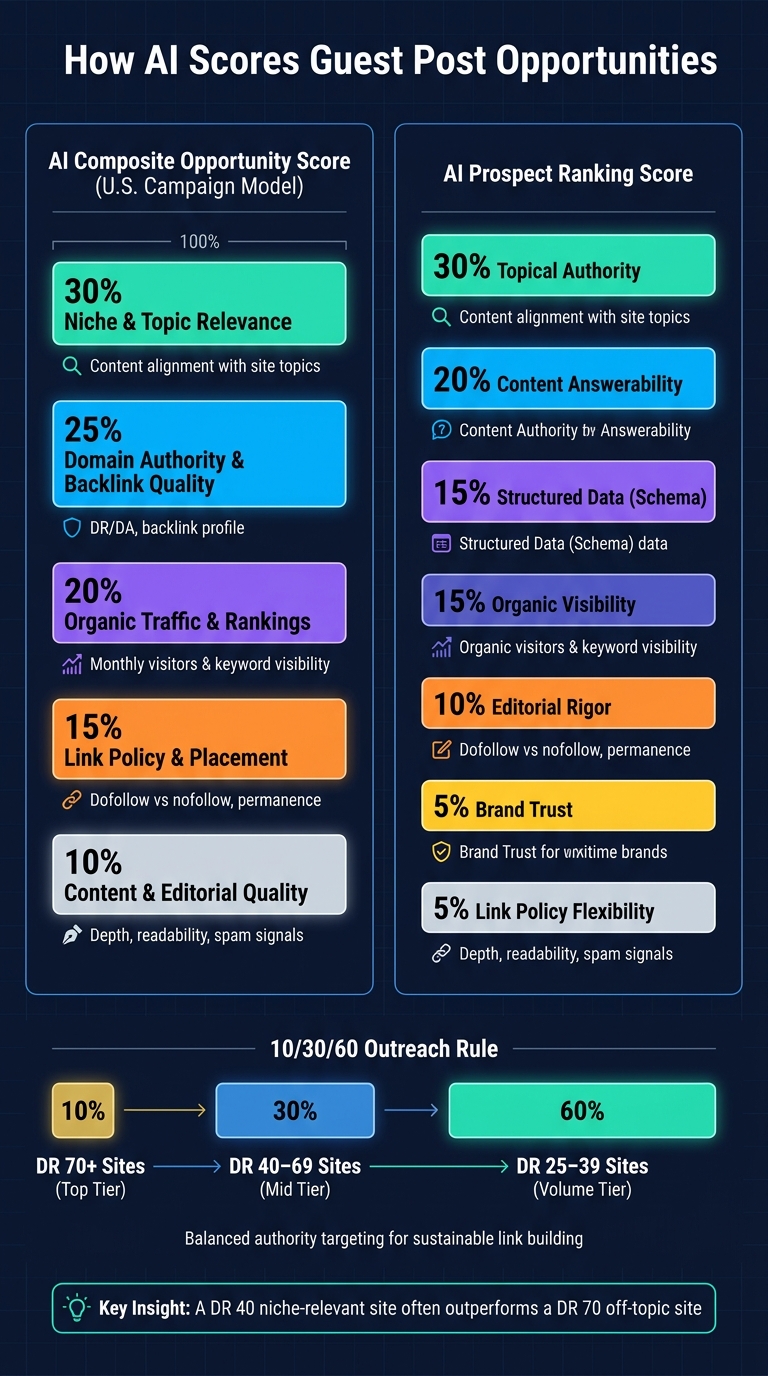
AI vs Manual Guest Posting: Composite Scoring Breakdown
Why Manual Research Falls Short and How AI Fixes It
Manual research for guest post opportunities has its limits. A marketer can only review a handful of sites daily, checking domain metrics and reading through content. It’s a slow, tedious process that can quickly become outdated. Rankings fluctuate, traffic can decline, and site policies might change – all while you’re still working through your initial list.
Consistency is another hurdle. Manual efforts often miss critical warning signs, like low organic traffic or an excessive number of outbound links. AI takes the guesswork out of the equation by applying consistent evaluation criteria across thousands of domains simultaneously. By using live SEO data, AI ensures its assessments are always up-to-date. These challenges highlight why AI’s composite scoring system offers a more reliable solution.
Key Metrics AI Uses to Evaluate Guest Post Sites
AI doesn’t rely on just one metric to evaluate a guest post opportunity. Instead, it combines multiple signals into a composite opportunity score that provides a well-rounded assessment. For a U.S.-based campaign, this scoring model might look like this:
| Metric | Weight | What It Measures |
|---|---|---|
| Niche & topic relevance | 30% | How well your content aligns with the site’s topics |
| Domain authority and backlink quality | 25% | Metrics like Domain Rating (DR) or Domain Authority (DA) |
| Organic traffic & rankings | 20% | Monthly visitors and keyword visibility |
| Link policy & placement | 15% | Dofollow vs. nofollow links, placement within content, link permanence |
| Content & editorial quality | 10% | Depth, readability, publishing frequency, and spam indicators |
For example, a DR 40 site that matches your niche can often outperform a DR 70 site that’s off-topic. In most modern guest posting strategies, relevance outweighs raw authority.
AI also dives deeper into content quality using natural language processing (NLP). It flags issues like thin or spun content and checks for positive editorial signals, such as consistent author profiles, original visuals, and well-structured articles. For U.S.-focused campaigns, AI can even identify if a site uses American English, mentions USD pricing, or covers U.S.-specific topics – helping ensure the audience is a good match. This thorough scoring approach allows AI tools to pinpoint the best guest post opportunities with precision.
AI Tools Built for Guest Posting
AI-powered platforms for guest posting streamline three critical steps: finding prospects, evaluating them, and enabling action. Prospecting tools scan the web for sites that accept guest posts, identifying patterns like "write for us" pages or editorial submission guidelines – eliminating the need for manual searches. Once prospects are identified, AI applies the composite scoring model to rank them based on their potential value.
3Way.Social takes this further by combining AI-driven domain matching with a curated network of SEO professionals. Instead of merely listing sites that accept guest posts, it prioritizes niche relevance, permanent dofollow links, and high-quality placements – key factors for maintaining strong rankings. This makes it an excellent choice for teams looking to skip the time-consuming prospecting process and focus on opportunities with the highest potential.
How to Define the Right Guest Post Opportunity
Setting clear and specific rules is key to helping AI identify the best guest post opportunities. When your criteria are precise, your AI filters can deliver results that align with your goals.
How to Set Niche and Audience Relevance Rules
Relevance isn’t just about broad categories like "marketing" or "tech." AI goes deeper by analyzing the actual topics a site covers and identifying recurring themes in its recent content. For instance, a site called "TechWeekly" might appear relevant but could rank for unrelated or even harmful keywords. A site’s name alone doesn’t guarantee suitability.
When defining your criteria, focus on audience intent overlap. Ask yourself: does the site’s audience care about the problems your content addresses? It’s crucial to verify that the readership aligns with your target market.
"In 2026, search engines no longer just reward link volume – they truly reward topical authority and audience trust gained from backlinks." – Venchito Tampon, Founder of Link Building Services IO
How to Set Authority and Quality Thresholds
Authority and quality thresholds act as safeguards, ensuring you avoid low-value sites. A good starting benchmark is a minimum Domain Rating (DR) of 40 and at least 1,000 monthly organic visitors. Sites below these levels are often "zombie websites", existing primarily to sell links rather than serve real readers.
AI scoring models typically allocate 10% weight to domain strength and 30% to topical relevance. This means that a mid-level niche site can often provide better SEO value than a high-authority general blog. It’s also important to review the site’s DR trend over time. Gradual growth usually signals organic link-building, while sharp spikes followed by steep declines may indicate a Private Blog Network (PBN).
"The best guest post targets are rarely the highest-authority domains. They are the sites where relevance, clickability, and editorial consistency overlap." – Avery Collins, Senior SEO Content Strategist
Why Link Policies and Permanence Matter
Even if a site is highly relevant and authoritative, its link policies can make or break the value of your guest post. Dofollow links from editorial placements pass ranking credit, while links tagged as nofollow or sponsored do not. Google’s May 2024 "site reputation abuse" policy cracks down on guest posts that misuse a host site’s authority, so it’s essential to ensure your contributions are treated as genuine editorial content.
Permanence is just as important. Some sites archive or remove posts after a few months, reducing long-term value. With many publishers now syndicating content through AI-driven hubs, links can sometimes be stripped or altered during this process. To avoid surprises, confirm how canonical tags are handled and whether links will remain intact. It’s also a good idea to monitor your guest posts for at least 90 days after publication to catch any changes. These steps, combined with AI scoring, help protect the lasting impact of your guest post efforts.
How AI Finds, Scores, and Ranks Guest Post Sites
How AI Builds and Analyzes Prospect Lists
AI pulls data from various sources, including web crawls, SEO indexes, and competitor backlink profiles, to generate an initial list of guest post candidates. From there, it eliminates sites that lack organic visibility, as these are effectively invisible to search engines and AI tools.
One of the quickest ways AI narrows down the list is by spotting "topic drift." This refers to sites that cover too many unrelated subjects, rely on templated content, or operate as link marketplaces without a clear editorial focus. These sites are removed early, ensuring the list remains focused and relevant.
How AI Scores and Ranks Guest Post Prospects
After building the prospect list, AI assigns scores based on several criteria. The most important factor is topical authority (30%), which assesses whether a site consistently covers a subject in depth, rather than just having a single post that aligns with your keyword. The next key factor is content answerability (20%), which evaluates if the site’s content provides structured, clear, and actionable answers – the type of content AI systems tend to prioritize.
Here’s the full scoring breakdown:
| Criterion | Weight |
|---|---|
| Topical Authority | 30% |
| Content Answerability | 20% |
| Structured Data (schema) | 15% |
| Organic Visibility | 15% |
| Editorial Rigor | 10% |
| Brand Trust | 5% |
| Link Policy Flexibility | 5% |
With this scoring system, AI platforms transform raw data into actionable insights, helping you target the most promising opportunities.
Using AI Platforms to Get Faster, Better Results
AI platforms take this scoring process a step further by streamlining guest posting efforts. Manually tracking all these signals would be time-consuming and inefficient. Tools like 3Way.Social simplify the process by offering a network of pre-vetted sites. These platforms screen for domain quality, topical relevance, and link policies, ensuring you’re matched with high-value prospects.
A Step-by-Step Guide to AI-Powered Guest Posting
How to Set Up Your Data and Configure AI Filters
Before diving into AI-powered prospecting, it’s essential to start with a solid foundation. Gather your target keywords, define your backlink goals, and outline your niche clearly. This preparation ensures the AI can pinpoint guest post opportunities that align with your focus on quality and topical authority.
Begin by configuring filters for authority and relevance. For authority, set a minimum Domain Rating (DR) of 40 and a traffic threshold of at least 1,000 monthly organic visitors. Focus on sites with a steady, upward DR trend – avoid those with erratic spikes, as this can indicate potential Private Blog Network (PBN) activity. When it comes to relevance, ensure that the sites rank for your primary industry keywords. Apply a freshness filter to include only active blogs – those updated within the last 90 days – to avoid wasting time on inactive or "ghost" blogs.
Additionally, use AI to flag any suspicious link patterns. For example, a site with an unusually high ratio of outbound links compared to referring domains could be a link farm. These steps help you narrow down prospects to high-quality, trustworthy sites.
"In 2026, search engines no longer just reward link volume – they truly reward topical authority and audience trust gained from backlinks." – Venchito Tampon, Founder, Link Building Services IO
Once your data and filters are in place, the AI takes over, streamlining the process of evaluating and ranking potential guest post opportunities.
How to Read AI Results and Pick the Best Opportunities
After configuring your filters, the AI generates a ranked list of prospects, but selecting the best opportunities requires more than just picking sites with the highest DR. Cross-check each site’s topical authority and content depth. A site that consistently publishes detailed content clusters in your niche is far more valuable than one with only a single relevant article.
To maximize your outreach, use the 10/30/60 rule:
- 10% of your efforts should target DR 70+ sites.
- 30% should focus on DR 40–69 sites.
- 60% should go to DR 25–39 sites.
This approach ensures a balanced strategy across different tiers of authority. Also, verify the site’s editorial standards. Look for author bios with headshots and LinkedIn profiles – these details indicate credibility. Be cautious of AI-generated personas, which can signal poor editorial practices.
How to Use 3Way.Social in Your Guest Posting Workflow
3Way.Social simplifies guest posting by pre-filtering prospects based on domain quality, niche relevance, and link permanence. This eliminates the need to start from scratch with an unfiltered list. Once prospects are in your dashboard, you can apply additional filters to refine them further by authority thresholds, niche, or other criteria.
The platform prioritizes permanent do-follow links, reducing the risk of placements disappearing after publication. For teams managing multiple campaigns, this tool streamlines the entire guest posting process – from finding prospects to final placement. It complements the AI-powered scoring system discussed throughout this guide, making the entire workflow more efficient and reliable.
How to Refine and Maintain Your AI-Powered Guest Posting Strategy
How to Keep AI Matching Accurate Over Time
Keeping your AI filters sharp isn’t a one-and-done task. As your niche shifts and your goals evolve, your AI criteria need to keep up. A great way to stay on top of this is by running a 30-day outreach sprint. During the final week, review your KPIs and tweak your filters to ensure the next cycle starts strong.
To keep things running smoothly, think of your guest posting workflow as a dynamic pipeline with clear stages – prospecting, qualification, pitch delivery, and publication tracking – rather than a static setup. If low-quality or irrelevant sites sneak into your results, adjust your filters immediately. Suppression lists are your friend here; they let you permanently remove underperforming sites or those that fail editorial checks, so the AI doesn’t keep recommending them.
For high-value prospects, always require human approval. This extra step ensures quality and sets you up to use performance data effectively for future refinements.
How to Use Performance Data to Improve AI Results
Once your filters are fine-tuned, monitoring live performance becomes the next priority. Post-publication data offers valuable insights for refining your prospect ranking model. After a link goes live, track metrics like referral traffic, time on page, and assisted conversions. Use these insights to adjust your scoring system.
"The best guest-post target is not the highest-authority site in the spreadsheet. It is the site most likely to move a measurable business outcome." – Signal-Driven Site Selection for Guest Post Hosts
A solid scoring framework might allocate weight like this: topical overlap (25%), referral performance (25%), crawl and index health (15%), editorial quality (15%), publish rate (10%), and trust signals (10%). Refresh this data every three months, as technical issues like crawl frequency and indexation can change quickly.
Here’s a breakdown of key KPIs to track and how they guide improvements:
| KPI | What It Measures | How to Improve It |
|---|---|---|
| Positive Reply Rate | % of replies showing genuine interest | Refine targeting and personalize by tier |
| Acceptance Rate | % of pitches approved by editors | Match topics to site format and audience needs |
| Publish Rate | % of accepted pitches that go live | Speed up drafts and align with editor requirements |
| Link ROI | Return compared to campaign cost | Focus on high-performing hosts and cut underperformers |
| Referral Decay | How long traffic lasts after publication | Choose sites with better long-term discoverability |
How 3Way.Social Supports Long-Term Link Building
To sustain your link-building strategy over time, tools like 3Way.Social can be a game changer. Building a healthy backlink profile isn’t just about placing links – it’s about ensuring those links stay live, remain indexable, and continue delivering value. 3Way.Social addresses this by focusing on permanent do-follow links within a vetted network, significantly reducing link attrition compared to unvetted outreach.
The platform also includes advanced link diversification tools, helping you avoid over-relying on a single host type or niche cluster. For teams managing ongoing campaigns, its dashboard makes it easy to filter prospects by domain quality, niche relevance, and link permanence. This organized system keeps your workflow efficient as your backlink profile grows. Over time, it simplifies spotting gaps, identifying top-performing hosts, and making smarter decisions about where to focus next.
Conclusion: Why AI Is the Smarter Way to Find Guest Post Opportunities
Manually searching for guest posting opportunities takes time and effort, while AI simplifies the process by quickly pinpointing high-authority sites – even those without public contributor ads. As Sharad Agarwal explains, "The ‘write for us’ approach is fine for getting your first one or two pitches… It is not a long-term authority strategy."
AI combines speed with scalability, efficiently evaluating hundreds of prospects so your team can focus on building relationships and handling negotiations. While AI enhances productivity, human expertise is still essential for making the final call.
"Scaling guest post outreach in 2026 isn’t about replacing humans with machines – it’s about amplifying human judgment with AI speed." – Taylor Reed, Senior SEO Editor
This hybrid strategy, where AI handles discovery and humans verify the results, creates a winning formula for guest post outreach in 2026. It allows teams to prioritize meaningful decisions instead of getting bogged down by repetitive research tasks.
FAQs
What’s the best way to set AI filters for my niche?
When evaluating potential sites, it’s important to prioritize topical relevance, audience fit, and technical quality over simply chasing authority metrics.
Key criteria to consider include:
- Semantic similarity: Does the site’s content align with your topic or niche?
- Canonical usage: Are they properly implementing canonical tags to avoid duplicate content issues?
- Site health: Factors like crawlability and page speed can impact both user experience and search engine performance.
- Engagement metrics: Look at how users interact with the site’s content – high engagement often signals quality.
To make this process easier, AI tools like 3Way.Social can be a game-changer. These tools can help filter out toxic domains and assess relevance, ensuring you connect with sites that truly match your niche and objectives.
How can I tell if a site is a PBN or link farm?
Detecting a Private Blog Network (PBN) or link farm requires a sharp eye for certain telltale signs. These sites often feature low-quality content, links that feel irrelevant or spammy, and linking patterns that don’t seem natural.
Other warning signs? They might have outdated content, little to no organic traffic, and an overload of outbound links leading to unrelated domains. Pay attention to suspicious domain names, low domain authority, and links pointing to sites that lack relevance.
To steer clear of these networks, combine manual checks with AI tools. This dual approach can help you identify and avoid these problematic setups effectively.
How do I measure if a guest post link actually worked?
To determine if a guest post link has been effective, look at metrics such as relevance, organic traffic, and engagement (like signups or conversions). A good link should bring in targeted traffic, boost search rankings, or result in valuable actions. Instead of getting caught up in vanity metrics like the number of publications or domain authority, focus on how the link supports your broader SEO and marketing objectives.