Analyzing Competitor Resource Page Links: Case Study
Competitor resource pages expose proven backlink paths; analyze them to score, target, and win high-quality links.

Last Updated on May 11, 2026 by Becky Halls
Want to improve your SEO and build quality backlinks? Look no further than competitor resource page analysis.
This approach involves studying where your competitors earn links on curated resource pages. These pages are trusted by search engines and users alike, making them a goldmine for boosting your site’s authority and traffic.
Key Takeaways:
- What are resource page links? Backlinks from curated lists of useful tools, guides, or resources.
- Why analyze competitors? It saves time, improves success rates by 40%, and helps find “link gaps” where competitors are linked, but you’re not.
- How does it work? Use tools like Ahrefs or SEMrush to identify resource pages linking to competitors. Prioritize pages with high authority and relevance to your niche.
- Results: Competitor analysis can yield up to 6x more link opportunities, increase Ahrefs Domain Rating, and drive significant traffic and conversions.
This guide breaks down how to find, analyze, and leverage competitor resource page links to grow your backlink profile effectively.
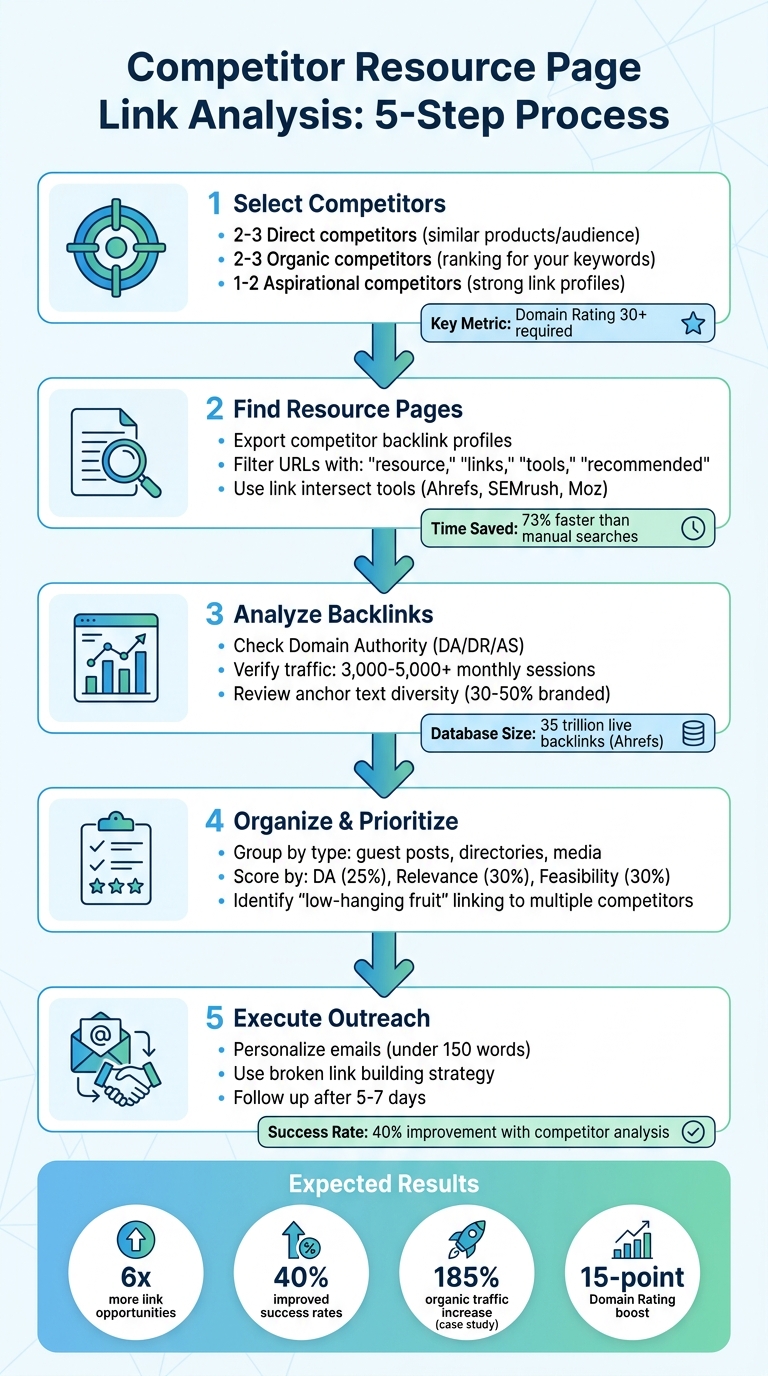
5-Step Competitor Resource Page Link Analysis Process
Selecting a Competitor to Analyze
Competitor Selection Criteria
Picking the right competitors to analyze can open the door to more link-building opportunities. Focus on three main types of competitors:
- Direct competitors: Those offering similar products to a similar audience.
- Organic competitors: Sites ranking for the keywords you’re targeting.
- Aspirational competitors: Larger, well-established sites with strong link profiles.
Stick to competitors within your industry – irrelevant ones won’t provide useful insights. A good mix might include 2–3 direct competitors of similar size, 2–3 organic search competitors, and 1–2 aspirational competitors. Pay attention to metrics like Domain Rating (DR) or Domain Authority (DA) score of 30 or higher. Also, prioritize those with a high number of unique referring domains instead of just a large total backlink count.
“Links your competitors have earned prove those opportunities exist. You’re not guessing – you’re following demonstrated paths to success.” – BacklinkGrid
When narrowing down link sources, focus on sites with at least 1,000 monthly organic visits. Keep in mind that tools like Ahrefs and SEMrush can miss 20–30% of a site’s backlinks due to crawling limitations, so it’s smart to cross-check with multiple tools.
Once you’ve selected your competitors, use these criteria to identify and analyze their resource pages.
Finding Resource Pages to Analyze
Start by exporting your competitors’ backlink profiles. Knowing how to find backlinks effectively is the first step in this process. Filter for URLs containing keywords like “resource”, “links”, “tools”, or “recommended”. Use link intersect tools in platforms like Ahrefs, SEMrush, or Moz to find domains linking to multiple competitors but not to your site. These “common linkers” are high-value targets and can save you up to 73% of the time compared to manual searches.
To expand your list, use Google search operators for more targeted results. Try queries such as:
"[keyword] + 'useful resources'""intitle:resources 'your topic'""site:edu [keyword] 'helpful links'".
After compiling a list, manually check each page to ensure it’s active, updated within the past year, and curates its links rather than functioning as a link farm. Be cautious of pages with too many outbound links, shared IP addresses (a sign of private blog networks), or those requiring payment for inclusion. Lastly, review your competitors’ “Best by links” reports to uncover their most popular assets – like tools, guides, or studies – that resource pages frequently link to.
sbb-itb-88880ed
How to Analyze Competitor Backlinks
SEO Tools for Backlink Analysis
This section dives into practical methods for assessing the quality and impact of competitor backlinks. Once you’ve identified resource pages, the next step is to extract and evaluate backlinks. Tools like Ahrefs Site Explorer are invaluable here, with its massive index of 35 trillion live backlinks across 19.2 billion pages, updated every 15 minutes. Use the Backlinks report and filter by “Referring page URL” with terms like “resources” or “links” to narrow down relevant opportunities. The Link Intersect tool can also pinpoint domains linking to multiple competitors but not to your site.
Semrush offers its Backlink Gap tool, allowing you to compare up to four competitors. It uses an Authority Score (AS) to gauge site reputability and can detect new links within an average of 40 minutes. Similarly, Moz Link Explorer provides a “Link Intersect” report for both domain and page-level analysis, relying on Domain Authority (DA) as its primary metric. For a more targeted approach, like finding resource pages about “poisonous plants for pets”, switch to “Exact URL” mode.
For a broader analysis, export referring domains from several competitors into a single CSV file. Then, use Excel’s COUNTIF formula to identify the most common link sources – these are often the most valuable.
Once you’ve gathered the data, focus on evaluating the quality of these backlinks using specific metrics.
Metrics for Evaluating Backlinks
Not all backlinks are created equal. Start by examining authority metrics – Ahrefs uses Domain Rating (DR), Moz relies on Domain Authority (DA), and Semrush uses Authority Score (AS). A score of 30 or higher is generally a good benchmark, though this can vary depending on the industry. Combine this with traffic verification: high-quality backlinks typically come from sites with at least 3,000 to 5,000 monthly sessions, which helps weed out inactive or low-value sites.
Relevance is just as important. A backlink from an unrelated niche, like an automotive blog linking to an email marketing tool, offers little SEO benefit. Examine the link profile health by comparing the number of backlinks to referring domains. If backlinks far outnumber unique domains, it could indicate manipulative practices. Also, evaluate anchor text diversity: a natural profile includes a mix of branded terms (30–50%), naked URLs, generic phrases like “click here”, and only 1–5% exact match keywords.
“Website authority isn’t a concrete metric, but rather a concept that estimates how credible and trustworthy a website is from the perspective of search engines.” – Anastasia Kotsiubynska, Head of SEO, SE Ranking
Perform a quick toxicity check using search operators like site:example.com "casino" or site:example.com "crypto" to identify questionable content. Additionally, a sudden drop in traffic could signal a Google penalty, which is another red flag.
After evaluating the backlinks, it’s time to organize your findings to streamline outreach efforts. Using a link building planner can help you track these targets effectively.
Organizing and Categorizing Links
To make the most of your analysis, group competitor backlinks by type – guest posts, resource pages, directories, media coverage, or industry associations. Use link intersect analysis to identify “low-hanging fruit”, such as sites linking to multiple competitors but not to you. These are high-priority targets. For large datasets, consolidate exports from multiple competitors into one file and use Excel’s COUNTIF to determine the most frequently mentioned referring domains.
Develop a scoring system to prioritize outreach opportunities. Assign weights to factors like Domain Authority (25%), Relevance (30%), and Acquisition Feasibility (30%) to calculate a “Weighted Score” for each prospect. Organize these prospects into pipeline stages – Prospecting, Research, Outreach, Negotiation, and Won/Lost – to keep track of your progress. For local SEO, categorize links into segments like “Colleges/Universities”, “Local News”, “Sponsorships”, and “Business Groups” to uncover specific community-related opportunities.
Finally, conduct manual quality checks to ensure editorial standards are met. Spend a few minutes reviewing each potential link source to assess its user experience and content quality. Sites with excessive outbound links or “link farm” characteristics should be avoided. A bit of extra effort here can save you from pursuing low-value or risky backlinks.
Patterns Found in Resource Page Links
Common Link Characteristics
Analyzing competitor backlinks reveals some clear trends in how high-performing resource page links are structured. These links often appear on pages with titles like “Useful Resources”, “Recommended Tools”, “Further Reading,” or “Industry Directories”. What makes these links stand out is their editorial nature – someone has intentionally chosen to include them, signaling trust and quality to search engines.
The type of content that consistently earns these placements includes original research, in-depth guides, free tools (e.g., calculators or generators), and downloadable templates. Another key factor is the anchor text profile. Successful resource pages tend to use a mix of anchor text: 30–40% branded, 20–30% generic (like “click here”), 10–20% partial match, and 5–10% exact match keywords. This balanced approach helps avoid penalties for over-optimization.
High-performing links are often found on sites with a Domain Rating (DR) of 30 or higher and at least 1,000 monthly organic visits, which indicates a level of editorial quality. Placement matters too – links embedded directly within the body of a resource list or blog post tend to outperform those stuck in sidebars or footers. Additionally, diversity in linking domains makes a difference. For example, 50 links from 50 unique domains are far more impactful than 300 links from just 5 domains. These patterns create a foundation for more advanced strategies that some competitors are using.
Unusual Strategies Observed
While these common traits are effective, some competitors are pushing boundaries with more creative link-building techniques. One standout tactic is “niche upping,” which involves targeting crossover topics instead of sticking to direct industry keywords. For instance, a rehab center might reach out to resource pages focused on bereavement, mental health, or LGBTQ support, rather than limiting efforts to “alcohol rehab” pages. This approach broadens the range of potential link opportunities.
Another strategy involves focusing on “mini” resource sections found at the end of blog posts, rather than solely targeting dedicated resource pages. Some competitors also use Outbound Link Probability (OLP) filtering to avoid sites that only link to government, nonprofit, or internal resources. A noteworthy example from May 2024 highlights how a fitness site secured high-authority links from mental health resource pages. They achieved this by promoting a strength training article that was fact-checked by a qualified nutritionist and supported by scientific studies, giving them an edge over competitors without expert-backed content.
Between September 2020 and 2024, one client successfully built 80 resource page links from organizations, local governments, and universities. This effort led to a 16-point increase in Domain Rating (DR) and a 10× boost in organic search traffic. Their success came from targeting sites with strong editorial standards and active upkeep.
“Resource page link building works because it’s a win-win for both parties involved. Website owners want to enrich their pages with quality resources, so they’re open to adding links to relevant content”.
Competitor Analysis: Understanding How a Page Got Backlinks – 1.2. Link Building Course
How to Get Resource Page Links
Once you’ve analyzed your competitors, the next step is securing those valuable resource page links.
Reaching Out to Resource Page Owners
The key to effective outreach lies in personalization and offering value. Instead of sending generic emails, find and contact the specific person managing the page. Keep your email concise – under 150 words – and clearly explain where your link fits (e.g., “This would work perfectly under your Career Planning Tools section”).
A highly effective strategy is broken link building. Start by identifying dead links on their page, then offer your content as a replacement. This approach can increase your success rate by 2 to 10 times compared to standard link requests. If you don’t hear back, send one follow-up email 5–7 days later. Keep your outreach limited to two emails total.
Creating Content for Resource Pages
In 2026, resource page curators look for content that delivers immediate and practical value. Focus on formats like original data studies, interactive tools (e.g., calculators), detailed how-to guides, or downloadable templates.
For instance, in March 2024, Novorésumé identified a gap in “networking tips” resources and created content to fill it. As a result, they earned 50 high-authority links, significantly increasing their Domain Rating from 38 to 74.
When creating your content, aim to showcase expert-level knowledge, especially in sensitive areas like healthcare or finance (known as YMYL – Your Money or Your Life – topics). Additionally, target resource pages that have been updated within the last 6–12 months. You can use search operators like “after:2025” to find active pages and curators.
Using 3Way.Social for Link Building
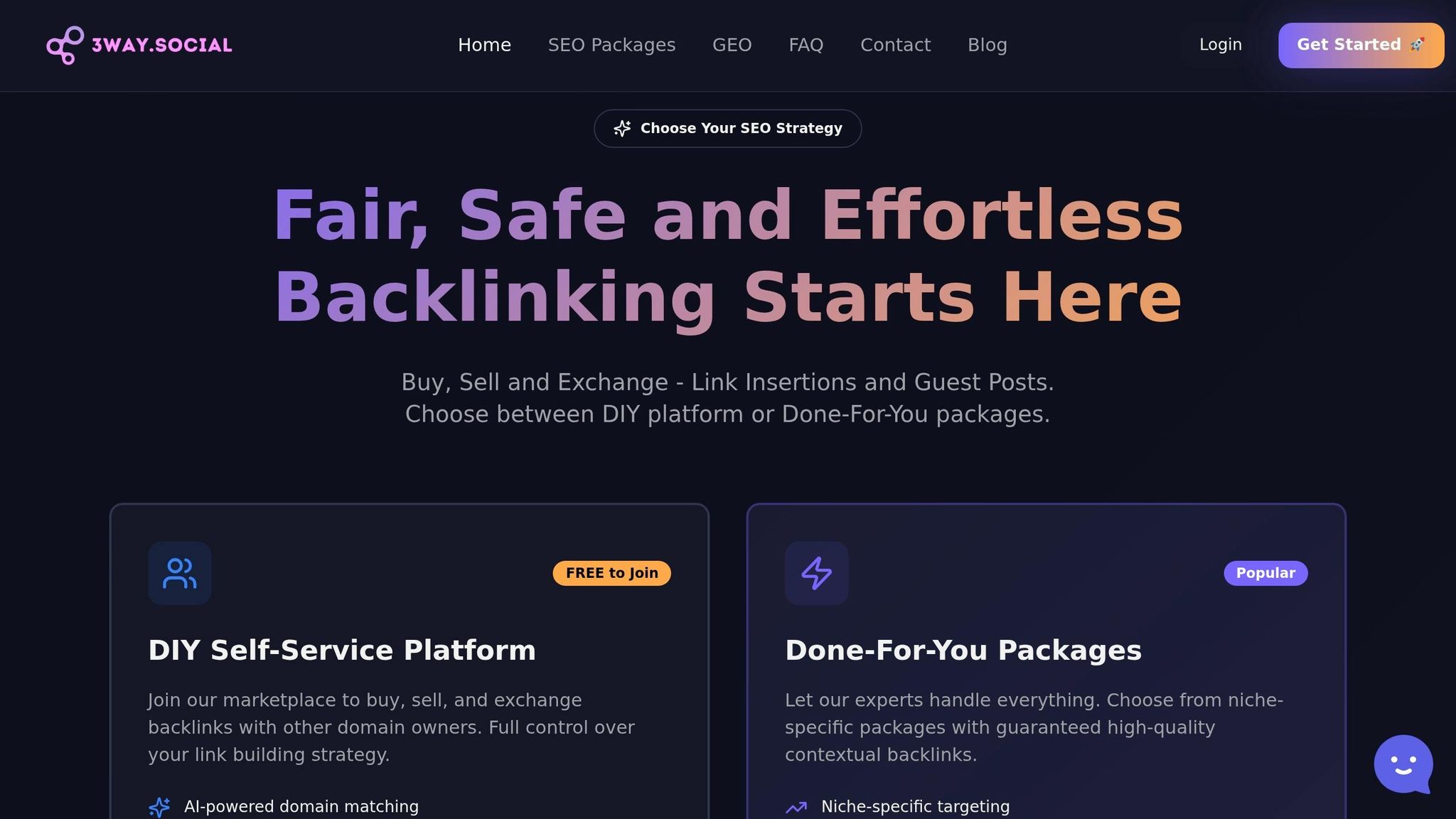
Manually prospecting for resource page links can be time-consuming, with about 70% of candidates failing to meet quality standards like Domain Rating or traffic benchmarks. 3Way.Social simplifies this process by using AI to match you with pre-vetted domains that meet strict editorial criteria.
The platform also employs an ABC link exchange model, ensuring permanent do-follow links while maintaining link equity through a trusted network of SEO professionals. Its dashboard makes it easy to track link placements, monitor domain authority, and diversify your backlink profile – all essential for running a successful resource page campaign. This tool can save you hours of manual work while improving the quality of your outreach efforts.
Results and Impact on Rankings
Changes in Rankings and Traffic
Analyzing competitor resource pages has proven to deliver measurable improvements in both rankings and traffic. Take the example of a fashion e-commerce brand: by diving into the fashion blog ecosystem and identifying gaps on resource pages, they secured 45 high-quality backlinks and built relationships with 18 bloggers. The result? A 185% surge in organic traffic and an additional $2.1 million in revenue.
Another example comes from a B2B SaaS company. They meticulously reviewed over 10,000 competitor backlinks to pinpoint 127 relevant targets. Within six months, they achieved a 24% success rate, securing 31 links that boosted their Domain Rating by 15 points. Similarly, between late 2024 and early 2025, The SEO Corner introduced a free “Internal Link Visualization Tool” and promoted it through press releases and targeted outreach. This effort earned them 274 links from 55 unique domains. The tool climbed to the 5th position for its target keywords, appeared in Google’s AI Overviews, and contributed to sitewide ranking improvements in a fiercely competitive niche.
What’s clear from these examples is that high-quality backlink placements don’t just help individual pages – they also enhance domain trust and authority. This ripple effect can lead to ranking boosts across the entire site, even for pages that aren’t directly linked.
Lessons Learned
These case studies highlight an essential takeaway: the quality of links far outweighs the quantity. For instance, The SEO Corner’s campaign initially generated over 200 press release syndications. However, the 57 organic editorial links from 38 unique domains had a much greater impact on rankings.
“One high-quality linkable asset can outperform months of guest posting”.
Another important insight comes from Anastasia Kotsiubynska, Head of SEO at SE Ranking, who notes that follow-up outreach can yield up to 40% more links. Competitor analysis also plays a crucial role, making outreach efforts more efficient and uncovering better opportunities. The key lies in filtering for quality: prioritize sites with a Domain Rating above 30, ensure they receive at least 1,000 monthly organic visits, and focus on securing dofollow contextual links rather than sidebar or footer placements.
Conclusion and Next Steps
Key Takeaways
Using competitor resource page links as a guide can transform your link-building efforts into a more strategic and effective process. By targeting “proven linkers” – websites that have already shown interest in your niche – you can significantly improve your outreach success rates.
When it comes to backlinks, quality trumps quantity. For example, Moz’s beginner guide earned over 3,200 dofollow backlinks by focusing on high-value content. To achieve similar results, prioritize sites with a Domain Rating of 30–40, active organic traffic, and regularly updated content. Additionally, acquiring 30 to 50 backlinks per month is a safe pace that avoids raising spam-related concerns.
“Leveraging competitor backlinks is one of the most easily scalable link building strategies.”
- Payman Taei, Co-founder, Respona
Competitor analysis also uncovers valuable insights into content priorities, relationship networks, and the types of resources that naturally attract backlinks. Since resource page owners are actively curating useful links, your outreach becomes more of a collaborative offer rather than a cold pitch.
With these strategies in mind, you’re ready to take actionable steps toward building a robust link-building framework without risking penalties.
How to Get Started
Here’s how you can kick off your resource page link-building strategy.
Start by identifying your key competitors. This includes 2–3 direct business competitors, 2–3 organic search competitors, and 1–2 aspirational competitors. Using link intersect tools, look for websites that link to multiple competitors but not to your site – these are your best targets.
Make sure your content stands out from what’s already listed. When reaching out, personalize your pitch by referencing specific sections of their resource page and explaining how your content complements their existing links. If you don’t hear back, send a follow-up email 5–7 days after your initial contact.
To streamline the process, consider tools like 3Way.Social. This AI-powered platform simplifies the search for high-quality link opportunities by connecting you with a vetted network of domains. Its advanced features also help you diversify your backlink profile while building authority with permanent dofollow links.
FAQs
How do I pick the best competitors to analyze?
When selecting competitors to analyze, it’s important to focus on those that align closely with your niche and SEO objectives. Look for competitors with strong domain authority, a variety of high-quality backlinks, and a noticeable online presence.
To ensure your findings are actionable, prioritize competitors that are:
- Ranking well for the keywords you’re targeting.
- Similar in size, audience, and industry to your business.
This approach helps you gather meaningful insights that can directly inform and improve your link-building strategy.
How can I tell if a resource page link is safe and high-quality?
To determine whether a resource page link is reliable and worth pursuing, focus on a few key aspects: how relevant it is to your niche, the credibility of the site providing the link, and the quality of the content on the resource page itself. Prioritize pages that are thoughtfully curated, have a clear intent, and maintain a natural link profile. Steer clear of pages overloaded with outbound links or any that display spam-like behavior. By keeping these factors in mind, you can secure links that genuinely boost your SEO efforts.
What should I create to get included on resource pages?
To get featured on resource pages, start by creating content that stands out and fits the page’s focus. Think along the lines of in-depth guides, useful tools, or any material that aligns with your niche and offers genuine help.
Next, locate resource pages that match your topic. Once you’ve identified them, evaluate their quality and relevance. When reaching out, craft a personalized pitch that clearly shows how your content can benefit their audience. Keep it simple for site owners to include your resource, and aim to build a genuine connection in the process.