Last Updated on March 27, 2026 by Becky Halls
Guest posting is still a powerful SEO tool, but doing it wrong can cause guest post penalties and harm your website. Google’s algorithms are strict about spammy practices, and penalties can take over 11 months to recover from. To stay safe and improve your rankings, follow these seven key tips:
- Choose quality sites: Target websites with relevant content, real traffic, and clear editorial standards.
- Write original content: Avoid duplicate articles. Tailor each post for the audience and check for plagiarism.
- Use natural anchor text: Keep anchor text diverse and avoid over-optimization.
- Control frequency: Build backlinks steadily – 2–4 posts per month is ideal.
- Disclose sponsorships: Clearly label paid posts and use proper link tags like
rel="sponsored". - Work with vetted networks: Use trusted platforms to find legitimate guest posting opportunities.
- Monitor backlinks: Regularly audit your backlink profile to spot and address harmful links.
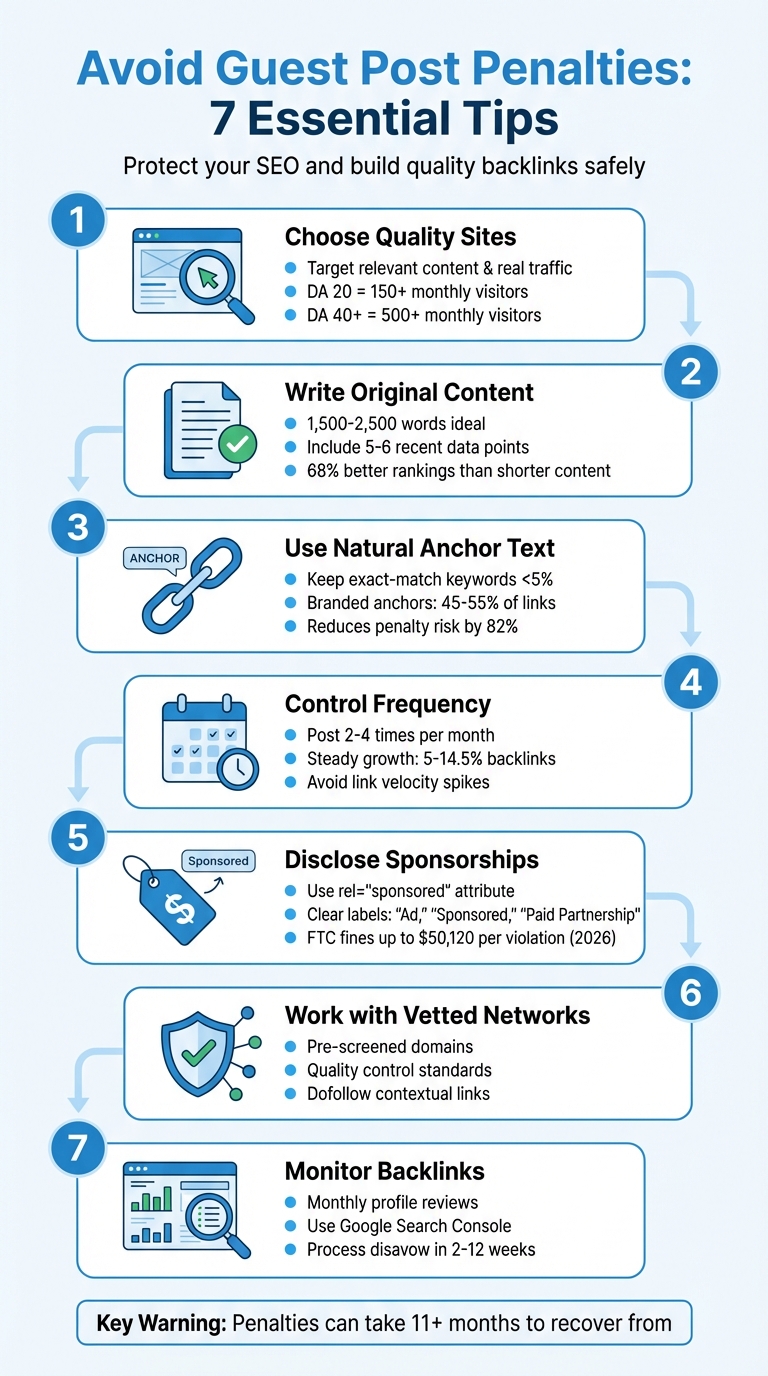
7 Essential Tips to Avoid Guest Post Penalties in 2024
4 Backlinks That Trigger Google Penalties (Avoid These)
sbb-itb-88880ed
1. Focus on High-Quality, Relevant Sites
When it comes to guest posting, the first rule is to select high-quality, relevant sites. This means choosing platforms that align with your niche – like contributing to a marketing blog for a marketing tool or a publication that covers workplace productivity. The key is ensuring your links fit naturally within the site’s context, avoiding any risk of penalties.
Why Organic Traffic Matters
A site’s organic traffic is a reliable indicator of its legitimacy. For instance, a site with a Domain Authority (DA) or Domain Rating (DR) of 20 should ideally have at least 150 monthly visitors. For DA/DR 40+ sites, look for around 500 monthly visitors. If a site boasts a high authority score but shows zero traffic, it might be a low-quality domain created solely to sell links – something you want to steer clear of.
Editorial Standards Are Key
Reputable platforms maintain strict editorial standards. Look for sites that enforce clear submission guidelines and prioritize quality content. Be cautious of platforms filled with cluttered ads, poorly written articles, or open submission policies, as these can signal low editorial oversight.
How to Vet a Site
Before pitching, take time to audit the site thoroughly. Here’s how:
- Check indexing: Use a
site:domain.comsearch to confirm the site is indexed by search engines. - Review recent posts: Look for engagement, such as comments or social shares, to gauge audience interaction.
- Inspect outbound links: Ensure links in their articles are contextually relevant and not excessive.
Real-World Example
Dana Nicole’s guest post on the Buffer blog is a great example of how choosing the right platform can pay off. Her post not only reached the right audience but also resulted in nearly 400 new email subscribers in just 11 months. This shows the power of targeting sites that align with your expertise and audience.
“We’ve seen guest post penalties happen when campaigns get templated. The moment every post follows the same structure with the same anchors, it starts to look manufactured.” Becky Halls, Strategist at 3Way Social
2. Write Original, High-Value Content
Once you’ve chosen reputable sites, the next step is ensuring your content stands out as original and meaningful. Just like picking the right platforms, the quality and uniqueness of your content play a major role in avoiding penalties.
Duplicate content is a big red flag. Google has stressed that repetitive content can cause serious drops in search rankings. Publishing the same guest post on multiple websites can be seen as a manipulative SEO tactic rather than a genuine contribution. Matt Cutts, former Head of Webspam at Google, highlighted this issue:
“The problem is that if we look at the overall volume of guest posting we see a large number of people who are offering guest blogs or guest blog articles where they are writing the same article and producing multiple copies of it… that can cause problems”.
Create Unique Posts Every Time
The best way to avoid this? Always craft a new article for each publisher. Every guest post should be tailored specifically to the host site’s audience. Before submitting, double-check its originality using tools like Copyscape or SmallSEOTools to confirm it’s completely unique. For an extra layer of assurance, you can also manually check by pasting specific paragraphs into Google with quotation marks to see if they appear elsewhere. This not only protects your rankings but also strengthens your reputation as a credible contributor.
“In our experience, the safest guest posts feel like real contributions: relevant topic, editorial standards, and a link that genuinely helps the reader find more detail.” Ian Naylor, Founder at 3Way Social
Focus on Real Value
Quality content often falls in the range of 1,500 to 2,500 words and includes 5-6 up-to-date data points or statistics from the past 2-3 years. To ensure your content resonates, follow the “80/20 Rule”: dedicate 80% of your content to providing genuine value – whether it’s educational, entertaining, or solving a problem – and keep promotional material to just 20%. Linking to primary research sources can further enhance your credibility. Research suggests that content in this word range performs 68% better in rankings compared to shorter pieces.
To make a lasting impact, align your content with industry expectations and standards.
Demonstrate E-E-A-T
Your writing should reflect Experience, Expertise, Authoritativeness, and Trustworthiness (E-E-A-T). Include author bios with real credentials and cite well-regarded sources. Wrap up each post with actionable takeaways that your readers can put into practice right away. A focus on quality over quantity can lead to a 340% higher long-term ROI compared to strategies that prioritize volume.
3. Use Natural Anchor Text
Avoiding penalties in guest posts starts with using natural anchor text. This means your links should blend seamlessly into your content without raising red flags. Anchor text – the clickable words in hyperlinks – plays a critical role in your guest posting strategy. Since Google’s 2012 Penguin update, search engines have become adept at spotting manipulative link patterns, and over-optimized anchors are a major red flag. Understanding how anchor text impacts penalty risk is key to a safe and effective strategy.
Here’s a striking stat: using the same exact-match anchors across five or more domains can increase your penalty risk by 340%. On the flip side, websites that use branded anchors for 45%-55% of their links reduce their penalty risk by 82%. The takeaway? A diverse approach to anchor text isn’t optional – it’s a necessity.
Mix Up Your Anchor Types
A strong link profile includes a variety of anchor types working together. These might include:
- Branded links: Your company or brand name.
- Naked URLs: Direct links like https://yoursite.com.
- Generic phrases: Phrases like “click here” or “learn more.”
- Partial matches: Variations of your target keyword.
Experts recommend keeping exact-match “money” keywords to less than 5% of your total anchor profile to avoid penalties.
Before you publish, try the “Read Aloud” Test: if your anchor text feels awkward or unnatural when spoken, rewrite it. Replace clunky, keyword-stuffed phrases with ones that flow naturally. Also, pay attention to the context around your links. Google’s AI now evaluates the 2-3 sentences surrounding a link to assess its relevance. Make sure your links fit smoothly into the surrounding conversation.
Placement matters too. Research suggests that 67% of penalty-free backlinks are found in the middle third of content, typically between 30%-70% of the article’s length. Links in the opening or closing paragraphs are more likely to appear promotional. Additionally, guest posts with 1-2 backlinks outperform those with three or more by 89% in rankings. The bottom line? Keep your anchor text natural, limit the number of links, and ensure they’re placed thoughtfully to maximize your SEO results without risking penalties.
4. Control Post Volume and Frequency
Once you’ve nailed down natural anchor text, the next step is managing your posting frequency. Overloading on guest posts too quickly can raise red flags with search engines. A sudden surge in backlinks – commonly called “link velocity spikes” – often signals manipulative practices. For instance, if a brand-new website suddenly racks up 50 backlinks in just one month, it can look suspicious. Google’s link policy specifically warns against large-scale article marketing or guest posting campaigns that depend on keyword-stuffed anchor text.
Studies show that high-ranking pages tend to experience steady dofollow backlink growth, typically between 5% and 14.5%. For most businesses, focusing on 2–4 high-quality posts per month is far more effective for SEO in the long run than churning out 10–20 lower-quality posts. Keeping a consistent posting schedule and prioritizing editorial quality can deliver better results without risking penalties.
Posting in high volumes comes with another risk: you may end up relying on low-quality websites just to hit your numbers. This approach can backfire, leading to manual penalties, drops in rankings, or even removal from search results. In fact, a single backlink from a well-regarded industry publication often carries more weight than 20 links from random, low-quality blogs. This highlights the importance of carefully monitoring your backlink profile and focusing on quality over quantity.
It’s crucial to align your link acquisition rate with your site’s age and authority. For newer websites, a sudden influx of backlinks can appear unnatural. Think of link building as a marathon, not a sprint – aim for steady growth over six to twelve months. Avoid bulk or automated guest posting, and instead, focus on securing placements that enhance your reputation organically over time.
5. Disclose Sponsored Content
Being upfront about financial or material connections is crucial when promoting transparency and ethical link building. The FTC mandates that any exchange of money, products, or services that could influence consumer opinions must be disclosed. This includes direct payments, free items, discounts, or even personal relationships with the brand.
Starting in 2026, the FTC can impose fines of up to $50,120 for each violation. A notable example is Fashion Nova, which was fined $4.2 million in 2022 for suppressing negative reviews. This case underscores how seriously regulators enforce these rules. Both the content publisher and the sponsoring brand can face consequences for failing to provide adequate disclosures.
To comply, place clear and visible disclosures at the very beginning of your guest post – before any affiliate links or main content. Use straightforward labels such as “Ad”, “Sponsored,” or “Paid Partnership with [Brand Name]”. Avoid unclear terms like “#sp”, “collab,” or “partner,” as these don’t meet FTC standards. As Ethan Wall, Founding Attorney at The Social Media Law Firm, emphasizes:
“A disclosure is not effective if audiences have to hunt for it”.
Proper disclosures work hand-in-hand with technical tagging to ensure full compliance.
For affiliate or sponsored links, use the correct tagging. Google requires the rel=”sponsored” attribute for such links. If necessary, you can combine it with nofollow (e.g., rel=”sponsored nofollow”). Failing to tag sponsored links properly can lead to manual penalties, which may take up to 11 months to resolve.
| Disclosure Type | Recommended Language | Vague Language to Avoid |
|---|---|---|
| Paid Post | “Ad”, “Sponsored”, “Paid partnership” | “Collab”, “Partner”, “Thanks [Brand]” |
| Affiliate Link | “I earn a commission from this link” | “#sp”, “#affiliate” |
| Gifted Product | “Gifted by [Brand]”, “Free product provided” | “In collaboration with”, “Made possible by” |
6. Work with Vetted Networks
Manually finding guest post opportunities can be a gamble. You might end up connecting with poor-quality sites, link farms, or even domains penalized by Google – none of which do your rankings any favors.
That’s where vetted networks come in. These platforms pre-screen websites to ensure they meet specific standards before linking you up. They evaluate crucial factors like domain authority, traffic levels, and niche relevance to weed out spammy or irrelevant sites. The result? You’re left with legitimate, trustworthy opportunities.
These networks stick to practices that align with Google’s rules. For example, they focus on dofollow links from contextually relevant sites and steer clear of shady tactics like link schemes or low-quality guest posts. They also emphasize link diversity and natural anchor text, which helps your backlink profile look organic instead of engineered.
When choosing a network, look for features like niche-specific domains, permanent dofollow links, and a community of professionals who’ve been thoroughly vetted. Platforms such as 3Way.Social are a great example – they use AI to match you with high-authority domains and apply strict quality controls, ensuring your backlinks provide real SEO benefits.
| Feature | Network Standard | Red Flag |
|---|---|---|
| Site Selection | Manually screens for traffic and niche relevance | Bulk placements on random sites |
| Content Quality | Original, high-value, and aligned with your brand | Low-quality, spun, or generic articles |
| Transparency | Offers live URLs and detailed reports | Vague promises without site details |
| Link Type | Dofollow links in contextual body text | Links hidden in sidebars, footers, etc. |
| Safety | Follows ethical, white-hat practices | Relies on PBNs or manipulative schemes |
Using vetted networks not only ensures quality backlinks but also gives you a solid foundation to monitor and improve your overall backlink strategy.
7. Monitor and Clean Your Backlink Profile
Keeping your backlink profile in check is crucial for safeguarding your SEO efforts. Even with the best practices in place, harmful links can sneak in – whether through negative SEO tactics, outdated link-building strategies, or websites that have declined in quality over time.
Start by using Google Search Console (GSC), a free tool that lists all the links Google has detected pointing to your site. Make it a habit to review your backlink profile monthly. Be on the lookout for unusual spikes in referring domains – like jumping from 50 to 5,000 links in a week. Such sudden increases often signal bot-driven spam or negative SEO. For a more detailed analysis, tools like SEMrush, Moz, and Ahrefs can help you assess toxicity levels and spot patterns like over-optimized anchor text.
While automated tools are helpful, they’re not foolproof. A manual review is still essential. Check flagged sites for signs of professionalism, relevance, and legitimate contact information. Watch out for red flags like excessive ads or keyword stuffing, which often indicate a toxic link. As Google’s John Mueller pointed out:
“If you’re seeing individual links that pop up… I would completely ignore those… they happen to every website and Google’s system is very good at just ignoring them”.
The key is to focus on patterns rather than isolated cases. Manual reviews work best when paired with automated alerts to maintain a clean backlink profile.
If you do find toxic links, try reaching out to site owners to request removal. Save the Disavow Tool for cases where manual removal isn’t possible or if you’re dealing with a manual penalty. Google’s Gary Illyes cautions:
“We said multiple times that the disavow tool is a very heavy gun. And if you don’t know what you are doing, you can shoot yourself in the foot with it”.
If you need to use the Disavow Tool, format your file properly using domain:spammysite.com to block the entire domain. Keep a master list of disavowed links, as uploading a new file will overwrite the old one. Be patient – Google typically processes disavow requests within 2 to 12 weeks.
For a proactive approach, consider tools like 3Way.Social, which use AI to vet potential link partners before any exchanges happen. This method reduces the risk of toxic links entering your profile in the first place, shifting your focus from cleanup to prevention. Regular monitoring ensures that your high-quality backlinks from guest posting and other strategies remain beneficial in the long run.
Conclusion
Guest posting continues to be a powerful link-building tool in 2026, but success hinges on doing it the right way. The key difference between achieving results and facing penalties lies in focusing on quality rather than quantity. Google’s algorithms are now highly adept at spotting low-effort, scattershot tactics. Instead, they reward genuine contributions that reflect Experience, Expertise, Authoritativeness, and Trustworthiness (E-E-A-T). A quality-driven guest posting strategy not only avoids penalties but also delivers a much stronger long-term return on investment.
This guide outlined seven essential tips – from selecting relevant sites and creating original content to using natural anchor text, managing post frequency, disclosing sponsorships, partnering with trusted networks, and monitoring your backlink profile. Together, these practices create a solid SEO framework, with each step reinforcing the next. By following this approach, you safeguard your site’s integrity and rankings for the future.
Using vetted networks like 3Way.Social can further streamline the process. These platforms provide pre-approved domains with clear metrics, credit-based exchanges, and built-in compliance tools, shifting your focus from fixing issues to preventing them. Their AI-driven domain matching and quality control features make it easier to connect with authoritative sites that align with your goals.
The ultimate goal is to build relationship capital and establish yourself as a trusted voice in your industry. Instead of churning out dozens of low-impact posts, aim for 5–10 high-quality, relevant guest posts each year. Each one should add meaningful insights and value to the host site’s audience.
Stick to these practices, and you’ll create a backlink profile that supports sustainable rankings, attracts targeted referral traffic, and builds lasting trust in your brand – all while staying on the right side of Google’s guidelines.
FAQs
How can I tell if a guest posting site is safe before I pitch?
To determine if a guest posting site is trustworthy, start by assessing its quality and reputation. Use tools like Ahrefs or SEMrush to analyze its organic traffic, keyword rankings, and domain authority. Make sure the site’s content aligns with your niche and steers clear of spammy or irrelevant material. Be cautious of red flags like link farms or other low-quality practices, as these can negatively impact your SEO. Taking the time to thoroughly research the site will help you make a smart choice.
What anchor text should I avoid in guest post backlinks?
Avoid stuffing guest post backlinks with overly optimized or spammy anchor texts. Using exact match keywords, overly promotional language, or manipulative phrasing can backfire, potentially leading to penalties and damaging your SEO efforts.
Instead, aim for a balanced and natural anchor text distribution. Steer clear of overusing generic phrases like “click here” or “read more”, as these can come across as forced or unnatural. Focus on creating links that flow naturally within the content and provide value to readers.
When should I use rel=”sponsored” versus nofollow on guest post links?
When dealing with links in your content, it’s important to use the right attributes to stay on the good side of search engine guidelines:
- Use rel=”sponsored” for links included in paid or sponsored guest posts. This signals to search engines that the link is part of a commercial arrangement.
- Use rel=”nofollow” when you want to avoid passing link equity or endorsing a specific link. This is especially useful for links that aren’t editorially approved.
Both of these attributes play a key role in maintaining compliance with search engine rules and protecting your site from potential penalties.