Google AI update reduces organic traffic by 34.5% – adaptation strategies revealed
Google AI Overviews have cut organic traffic by up to 34.5%; learn SEO strategies to adapt and recover visibility.
Last Updated on October 1, 2026 by Becky Halls
The digital marketing ecosystem is facing a seismic shift as Google’s AI Overviews continue to redefine how search results are presented. These AI-generated summaries, prominently displayed at the top of search engine results pages (SERPs), condense and aggregate information from multiple sources to provide users with instant answers. While these summaries enhance user experience, they are also causing significant disruptions in organic traffic for websites.
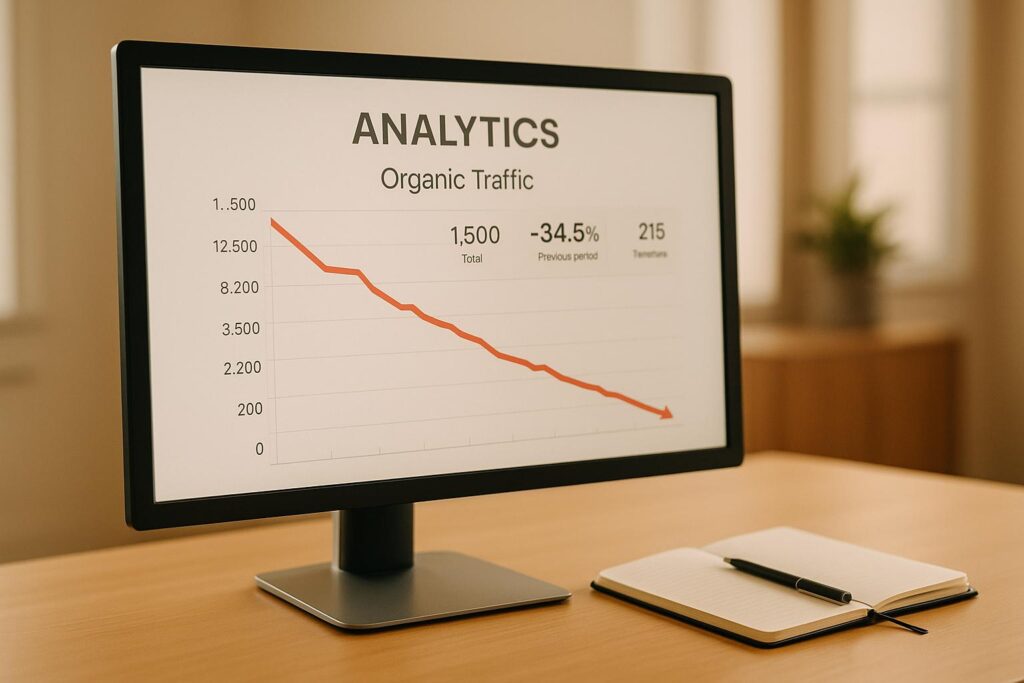
A recent analysis by SEOClarity highlights the impact, revealing a staggering 34.5% drop in click-through rates for traditional organic listings across certain industries. As a result, businesses and marketers are rethinking their strategies to remain visible on search platforms and secure positions within these AI-generated summaries.
The global expansion of AI Overviews
Initially rolled out in the United States, Google has now extended its AI Overview feature worldwide, integrating it into a broader range of search queries. According to Google Search Central Blog, while traffic to websites not featured in these summaries has suffered, AI Overviews have driven higher click-through rates for sites effectively linked within the summaries. Still, the overall challenge of diminishing traffic persists.
To address these changes, industry experts are urging marketers to optimize content specifically for AI. This includes focusing on structured data, incorporating high-quality multimedia, and creating clear, authoritative content aimed at aligning with AI algorithms.
Google says there is nothing special required to appear in AI Overviews. Standard SEO best practices still apply, with people-first, authoritative content as the priority. Structured data aids comprehension and rich results, but it does not guarantee inclusion.
Strategies for AI-driven content optimization
SEO professionals are adapting by emphasizing “entity-based optimization”, which involves clearly defining and interconnecting key concepts within content. Matt Diggity, an SEO expert, shared on X (formerly Twitter) that this approach has helped some websites achieve a remarkable “1,400% increase in AI traffic.” He noted the importance of aligning content with the processing mechanisms of large language models, which power features like AI Overviews.
Align content with the March 2024 core update and spam policies
The March 2024 core update folded the helpful content system into core ranking. Google also expanded spam policies to cover scaled content abuse, expired domain abuse, and site reputation abuse. Prune thin or duplicative pages, show first-hand expertise, and strengthen trust signals across templates.
Additionally, multimedia optimization is becoming crucial. With Google’s multimodal search capabilities, users can now conduct searches using images or other uploads, prompting marketers to include high-quality visuals and videos to enhance their potential for inclusion in AI summaries.
Core Web Vitals update, INP replaced FID in 2024
In March 2024, Google replaced First Input Delay with Interaction to Next Paint. Track INP, Largest Contentful Paint, and Cumulative Layout Shift in Search Console and PageSpeed Insights. Limit long tasks and JavaScript time, optimize images, lazy-load media, and streamline font loading.
For e-commerce businesses, revisiting Merchant Center and Business Profiles is another recommended tactic to boost visibility in AI-influenced search results. This is especially critical as competition intensifies, according to the NoGood blog.
Merchant Center Next is the default, and product data completeness affects visibility in free listings. Include GTINs when available, accurate price and availability, and consistent titles and descriptions. Display shipping speeds and return policies, and keep Business Profiles current with categories, attributes, and hours.
Declining traffic and alternative approaches
AI Overviews accounted for over 13% of searches by mid-2025, according to a report from SevenAtoms. This trend has led to the rise of “zero-click” searches, where users receive their answers directly from the SERPs without visiting the originating websites. Some publishers have reported drastic drops in organic traffic, with their share of traffic from Google Search shrinking from 52% to 28%.
Measuring impact using Search Console and GA4
Use Google Search Console to compare clicks, impressions, and CTR by query, device, and country. Annotate major launches or changes, since there is no dedicated AI Overviews filter in reports. In GA4, split branded and non-branded traffic, and check assisted conversions for substitution effects.
In response, businesses are diversifying their strategies. Many are shifting their focus beyond organic SEO to include paid media campaigns and brand awareness initiatives. For example, WebProNews suggests using tools like AdRoll retargeting and social media amplification to sustain engagement.
Preparing for future AI advancements
Looking ahead, Google’s forthcoming AI Mode promises to introduce an even more immersive search experience. Although details remain scarce, experts anticipate that these advancements could further exacerbate the visibility challenges faced by many websites. According to SEO.com, proactive adaptation is crucial to mitigating further declines.
Recommended strategies include creating evergreen content, optimizing for voice search, and adhering to Google’s guidelines for ethical AI integration. Structured data remains a key factor in maintaining visibility, as does prioritizing relevance and credibility in content creation.
A study cited in Brandastic’s blog underscores the importance of early adaptation. Brands that take swift steps to align with these changes are more likely to secure prominent placements in AI Overviews.
Finding opportunities amidst challenges
Reactions to these changes remain divided across the digital marketing community. While some marketers lament the initial traffic declines, others see opportunities for innovation. On X, Neil Patel shared insights indicating that, for small to medium-sized business clients, while impressions declined, optimized content helped stabilize clicks.
Semrush also reported that AI Overviews now appear in 13% of search results, highlighting the importance of robust traffic monitoring tools. As noted by the MBE Group’s blog, the shift represents a broader redefinition of SEO metrics. Success is no longer solely measured by rankings but by engagement and visibility within AI platforms.
Case studies and actionable insights
Practical examples shed light on how businesses can adapt. Matt Diggity’s experiments have demonstrated that reverse-engineering AI visibility strategies allowed him to rank for 164 keywords in AI Overviews. Similarly, the Single Grain guide outlines steps such as focusing on long-tail queries and leveraging user-generated content to enhance AI recognition.
In the hospitality industry, AI features have influenced direct bookings. Hotel News Resource recommends regular assessments of content for AI compatibility and incorporating tools like Google’s Rich Results Test to stay competitive.
Conclusion
As Google continues to refine its AI capabilities, the digital marketing landscape is undergoing a profound transformation. While challenges such as traffic declines and “zero-click” searches persist, brands that adapt quickly to AI-driven changes are finding new opportunities for growth. By focusing on clarity, authority, and AI-specific optimization strategies, marketers can navigate this evolving search environment and secure their place in the new era of digital visibility.