Last Updated on May 28, 2026 by Becky Halls
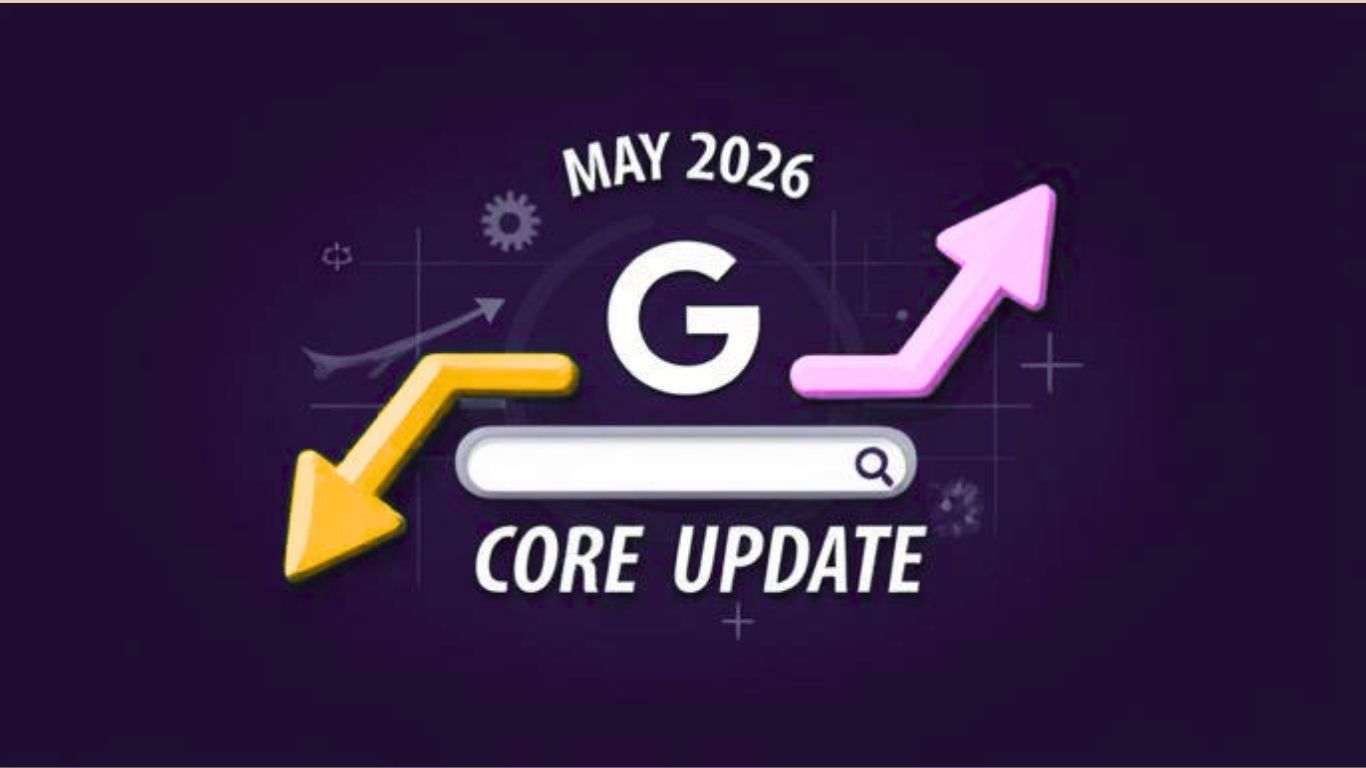
The Google May 2026 core update started rolling out on May 21st, and if your Analytics has looked like a seismograph this week – congratulations, you’re not alone.
This is the second broad core update of 2026 and the fourth confirmed ranking change of the year, landing just days after Google I/O 2026 introduced what it called the biggest overhaul of Google Search in over 25 years. The timing isn’t coincidental. Google’s core ranking systems and its AI-first search experience are being brought into closer alignment, and the ripple effects are being felt across almost every sector.
Here’s what you need to know, what it actually means for your site, and what the right response looks like.
What Google Actually Said
Google’s official description of the update is, as ever, light on detail: it’s designed “to better surface relevant, satisfying content for searchers from all types of sites.” Search Engine Land confirmed the rollout on May 21, noting a completion window of up to two weeks, meaning ranking volatility could continue until approximately June 4th.
Don’t dismiss the boilerplate. The phrase “all types of sites” is deliberately inclusive – core updates don’t target specific industries, content formats, or tactics. They reassess quality signals across the board, simultaneously, for every indexed page.
What makes this update notable is what’s reportedly running underneath it. Google has been gradually incorporating Gemini-based quality models into its ranking infrastructure throughout 2025 and 2026. This update appears to lean more heavily on those models than its predecessors, meaning Google is applying more sophisticated AI-driven content evaluation to questions like: Does this page genuinely help someone? Is the author credible? Does this add something new, or is it one of a thousand near-identical pages on the same topic?
“A regular update designed to better surface relevant, satisfying content for searchers from all types of sites.” — Google, via Search Engine Land, May 2026
Who’s Most Exposed Right Now
Early data from SEO volatility trackers points to significant turbulence in finance, healthcare, e-commerce, SaaS, and local services. Content-heavy publisher sites and affiliate-driven domains are also showing notable movement, in both directions.
The sites seeing the sharpest drops tend to share recognisable characteristics: thin content that covers a topic without genuine depth; AI-generated articles published at volume without expert review or editorial input; weak E-E-A-T signals (particularly Experience and Trustworthiness, which are harder to manufacture than Authority and Expertise); and pages built primarily around what Google’s algorithms historically rewarded rather than what real readers actually need.
None of that is new. Core updates have always separated sites that look good from sites that are good. What’s changed is the sophistication of how Google makes that determination.
“Every core update is essentially Google re-asking itself: ‘Would a real expert write this?’ The difference now is it has a far more sophisticated way of answering that question. The bar for what counts as genuinely helpful content keeps rising, and honestly, that’s good news for anyone who’s been building for quality rather than gaming signals.” Ian Naylor, Founder, 3way.social
The AI Overview Complication
Here’s where this update gets more complicated than previous cycles: it’s happening in the middle of a fundamental shift in what “search visibility” even means.
According to data compiled in position.digital’s 2026 AI SEO Statistics report, organic click-through rates drop by 61% when an AI Overview appears for a query. Meanwhile, approximately 60% of all Google searches now end without any click to any website and in queries where AI Mode is active, that figure climbs to 93%.
What this means in practice: you can recover your rankings from a core update hit and still see your organic traffic flat or declining. Traditional core update recovery, improve content quality, is still the right approach, but it’s no longer the complete picture.
Recovery in 2026 means recovering both your organic rankings and your AI visibility. Increasingly, those are separate disciplines.
“Clients often come to us confused as their rankings have bounced back after a core update, but traffic is still down. Almost every time, the missing piece is AI Overviews. If a competitor is getting cited in the AI answer and you’re not, even a number-one ranking can underperform what it used to deliver.” Becky Halls, Strategist, 3way.social
A Practical Response Framework
The temptation when rankings drop is to do something immediately. Resist it. The rollout is still active, and making significant changes to pages mid-rollout can muddy the water. Wait until around June 4th for volatility to settle before drawing conclusions or pulling levers.
Once the dust settles, here’s a sensible approach:
Start with your most-affected pages, not your whole site. Core updates rarely affect everything equally. Identify the pages with the steepest traffic or ranking drops and audit those first. Ask honestly: does this page tell someone something they couldn’t find on ten other sites? Does it reflect real expertise or real experience? Is it useful, or just comprehensive-looking?
Tighten your E-E-A-T signals. Who wrote this? Is that visible? Are claims supported with real sources? First-hand experience content (“here’s what we tested and found”) consistently outperforms generically authoritative-sounding prose in post-update assessments.
Audit your backlink profile. Core updates and link quality are related. Low-quality, irrelevant, or spammy links drag down site-wide quality signals. This is worth addressing regardless of update timing.
Start building for AI visibility alongside traditional SEO. Structured data, clear entity associations, original research or data, cited sources, and comprehensive topic coverage all influence whether AI systems pick up and cite your content – which increasingly matters as much as ranking position itself.
One final note: Google has consistently said that recovery from a core update takes time – often several months until the next core update. Sustained, genuine quality improvement is the mechanism. There’s no technical shortcut that bypasses it.
FAQ: Google May 2026 Core Update
Q. How long will the May 2026 core update take to finish rolling out?
A. Google said the rollout started May 21 and could take up to two weeks. Expect continued ranking fluctuations until approximately June 4, 2026.
Q. My rankings dropped – has my site been penalised?
A. Not in the traditional sense. Core update ranking drops are not penalties. They reflect Google’s reassessment of your content quality relative to competing pages. There’s no specific action to “reverse” it – the path forward is genuine quality improvement over time.
Q. Which types of sites are being hit hardest?
A. Early reports point to finance, healthcare, e-commerce, SaaS, local services, and content publishers. Sites with AI-generated content published at volume and without strong editorial oversight are particularly exposed.
Q. What’s different about this update compared to previous core updates?
A. This one reportedly uses Gemini-based quality models, making Google’s evaluation of content helpfulness and credibility more sophisticated. It also arrives directly after major AI search changes at Google I/O 2026, suggesting alignment between core ranking signals and AI visibility systems.
Q. Should I start changing my content straight away?
A. No. Wait until the rollout completes around June 4 before assessing impact and making strategic changes. Reactive edits mid-rollout are hard to attribute meaningfully.
Q. Can link building help with core update recovery?
A. Yes, indirectly. Strong editorial backlinks signal that your content is trusted by others in your space, supporting overall authority and E-E-A-T signals. It’s one important piece of recovery, alongside content quality improvements.