How Traffic Metrics Impact Backlink Quality
Learn how traffic metrics like referral traffic, bounce rate, and CTR influence backlink quality and your SEO strategy.
Last Updated on October 9, 2026 by Becky Halls
Not all backlinks are equal. The strength of a backlink can make or break your site’s performance on search engines. Traffic metrics – like referral traffic, bounce rate, time spent on page, and click-through rate (CTR) – are essential for evaluating backlink quality. These metrics help identify links that genuinely drive engagement and improve SEO rankings.
Key Takeaways:
- Referral Traffic: Measures how many users click through a backlink and engage with your content.
- Bounce Rate: Low bounce rates indicate relevant content; high rates suggest a mismatch.
- Time Spent on Page: Longer visit durations signal engaging content.
- CTR: High CTRs reflect content relevance and visibility in search results.
- Measurement Sources: Use GA4 for referral sessions and engagement time, and Google Search Console for impressions, clicks, CTR, and average position.
Prioritize backlinks from high-traffic, relevant sites with strong engagement metrics. Tools like 3Way.Social use AI to streamline backlink assessment, ensuring better link quality and SEO outcomes.
How to check if a Backlink has traffic & why its important!
Key Traffic Metrics That Determine Backlink Quality
Knowing which traffic metrics to focus on can completely change the way you assess backlinks. These four metrics offer a clear view of a backlink’s performance and its potential to boost your SEO efforts.
Referral Traffic Volume
When it comes to backlinks, referral traffic volume is a direct indicator of how much user engagement a link generates. This metric measures the actual clicks coming through a backlink, giving you a real sense of its effectiveness. A backlink that consistently drives traffic shows that it’s not just sitting there – it’s actively connecting users to your content.
To measure this in practice, open GA4 and go to Reports, Acquisition, Traffic acquisition. Set the Primary dimension to Session default channel group and filter for Referral. Break down by Session source or Session source/medium to see which domains send traffic. In Google Search Console, use Performance, then Pages, to review clicks and CTR for the landing pages that gained new backlinks. GSC data is delayed by about two days, while GA4 reports near real time.
But it’s not just about the number of clicks. The quality of the traffic matters even more. For instance, 100 visitors from a tech blog who are genuinely interested in your software are far more valuable than 500 random clicks from an unrelated entertainment website. Targeted traffic like this not only converts better but also signals to search engines that your content aligns with user intent.
Keep an eye on referral traffic trends over time. A backlink that continues to deliver traffic month after month proves its long-term value. On the other hand, a drop in referral numbers could hint at issues like a change in the source site’s audience or declining relevance of your content.
Watch for referrer spam that inflates numbers without real visits. GA4 applies known bot filtering, and you can define Internal traffic and mark Developer traffic so test hits don’t pollute reports. Validate referral quality by checking for valid hostnames, non-zero average engagement time, and consistent landing pages. Sudden spikes from unfamiliar domains with zero engagement usually indicate spam or misattribution.
For links you can influence, like guest posts, use UTM parameters to keep attribution clean. Standardize utm_source, utm_medium, and utm_campaign so you can report on performance across partners. If you add parameters to URLs, ensure the target page declares a canonical pointing to the clean URL to prevent duplicate indexing.
Bounce Rate Analysis
Bounce rate tells you whether visitors find your content relevant after clicking through a backlink. If users leave your site immediately, it’s a sign that the link’s context and your landing page content don’t align.
In GA4, Bounce rate is the inverse of Engagement rate. A session is considered engaged if it lasts longer than 10 seconds, records a conversion event, or views at least two screens or pages. Review bounce alongside engaged sessions to judge whether backlink visitors interact in meaningful ways.
While the ideal bounce rate varies depending on the type of site, rates below 40% generally suggest that visitors are finding what they’re looking for. For example, e-commerce sites typically see bounce rates between 20–45%, while blogs and informational sites might fall in the 40–70% range. Even detailed guides can have slightly higher bounce rates if users leave after finding the specific information they needed.
By analyzing bounce rates specifically from your backlinks, you can identify which links are bringing in engaged visitors. This insight helps you fine-tune your link-building strategy to focus on contexts that work best for your content.
Time Spent on Page
Another critical metric to watch is time spent on page, which measures how long visitors stay on your site after clicking a backlink. If users stick around for several minutes, it’s a strong sign that your content is engaging and relevant – something search engines take note of.
GA4 emphasizes Average engagement time and Average engagement time per session, which track active time rather than passive page open time. “Dwell time,” the gap between a search click and a return to the results, is not reported in GA4, but longer engagement and low “pogo-sticking” correlate with stronger relevance. Turn on Enhanced Measurement to capture scrolls and outbound clicks so you can read engagement beyond simple time metrics.
For example, visitors spending 3–5 minutes on an in-depth article or tutorial show genuine interest, which boosts the SEO value of the backlink. Of course, engagement expectations vary by content type. Quick reference pages or product listings might naturally have shorter visit durations, but they can still be effective if they consistently meet user needs.
Tracking this metric helps you pinpoint the content formats and topics that resonate most with your audience. Pages that consistently keep backlink traffic engaged for long periods offer valuable clues for creating future link-worthy content.
Click-Through Rate Performance
Click-through rate (CTR) goes hand-in-hand with other engagement metrics like referral traffic and time on page. This metric reflects how often users click on your content when it appears in search results. A high CTR shows that your titles and descriptions are doing their job – convincing users to click through to your site.
While strong backlinks can improve your search rankings, CTR determines how much traffic those rankings actually bring in. For instance, a page ranking #3 with a 15% CTR can outperform a #2 ranking with only 8% CTR in terms of traffic. More clicks also reinforce your content’s relevance in the eyes of search engines.
To track shifts, use GSC’s Performance report to compare equal date ranges before and after acquiring notable backlinks. Segment by device, since position and snippets vary on mobile and desktop, and use query and page tabs to find where CTR improved. Because CTR changes with position, focus on trends over time, not single-day swings.
Pay attention to how CTR changes after acquiring new backlinks. If you see a noticeable improvement, it’s a sign that the backlink has bolstered your content’s authority and visibility in search results. Plus, links from authoritative and relevant sources often lead to better search performance across multiple keywords, creating a ripple effect that benefits your overall SEO strategy.
How Traffic Metrics Affect Backlink SEO Value
Traffic metrics play a crucial role in shaping backlink strategies, as they help search engines gauge the authority and trustworthiness a link conveys.
High-Traffic Sites Signal Authority
Backlinks from high-traffic websites carry more weight, especially when those sites show steady growth and align with your industry. Search engines factor in traffic consistency when assessing the quality of a backlink, which means links from trusted and relevant sources can significantly enhance your SEO efforts.
On top of that, the traffic these backlinks bring to your site further strengthens your SEO performance, proving their value.
Link Attributes and Their Impact on Value and Tracking
Link attributes shape how search engines interpret connections between pages. The rel=”nofollow” attribute tells crawlers not to pass ranking signals, the rel=”sponsored” attribute labels paid relationships, and rel=”ugc” marks user-generated links. Google has treated nofollow as a hint for ranking since 2019, and as a hint for crawling and indexing since March 1, 2020.
These attributes do not block referral traffic or user engagement, so they can still send visitors who read, click, and convert. Paid placements should be labeled with rel=”sponsored” to comply with Google guidelines. When evaluating backlinks, include links with these attributes in your traffic and engagement review, then weigh their SEO value based on context and compliance.
Referral Traffic Boosts SEO Rankings
Referral traffic is another key indicator of backlink effectiveness. When users click through to your site, it signals to search engines that your content is relevant and meeting user expectations. This can lead to improved rankings for your target keywords, creating a cycle where better engagement drives even higher visibility.
Fresh referral traffic from new backlinks also shows that your content is engaging and up-to-date. If this traffic spans multiple regions, it reflects your content’s appeal to diverse audiences.
Segment results by geography and device to confirm audience fit. In GA4, check Demographics for country and region splits, and Tech for device category and operating system. If referral visitors match your target regions and use the devices you optimize for, you are more likely to see deeper engagement and repeat visits. Revisit these splits weekly to rule out one-off anomalies.
However, the true measure of success lies in how these visitors interact with your site.
User Engagement Reflects Content Quality
When users engage deeply with your content – spending more time on the page, exploring other sections, or completing actions like signing up or purchasing – it sends a strong signal to search engines about the value of your page. Metrics like low bounce rates, conversions, and social shares highlight quality and relevance, amplifying the impact of your backlinks.
Page experience metrics influence whether referral visitors stay. Core Web Vitals set clear targets, with Largest Contentful Paint at 2.5 seconds or faster, Interaction to Next Paint at 200 milliseconds or faster, and Cumulative Layout Shift at 0.1 or less. INP replaced FID as one of the Core Web Vitals in March 2024. Improving these metrics reduces layout shifts and input delay, which lowers abandonment from backlink traffic.
Additionally, when users share your content on social media after discovering it through backlinks, it opens the door to even more linking opportunities. This ripple effect reinforces that your content resonates with real audiences and adds further weight to your SEO strategy.
Evaluate Backlink-Driven Conversions With GA4 Attribution
Backlinks do more than start sessions. In GA4, the default cross-channel attribution model is data-driven where eligible, which assigns fractional credit across touchpoints based on observed impact. Use Advertising, Attribution, Model comparison to see how referral traffic performs under data-driven versus last click, and use Conversion paths to view where referrals assist.
Use Conversion paths to quantify when a referring domain starts or supports journeys that end in sign-ups or purchases. Set a lookback window that matches your sales cycle so long consideration paths are not missed. This approach ties link quality to measurable outcomes, not just surface metrics.
sbb-itb-88880ed
Common Mistakes When Using Traffic Metrics for Backlink Assessment
Traffic metrics can offer valuable insights into backlink potential, but they’re not foolproof. Many website owners fall into common traps when evaluating link opportunities, leading to wasted time, missed chances, or even SEO penalties that hurt their rankings. Let’s break down some of these typical missteps so you can make better use of traffic data.
When High Traffic Doesn’t Equal High Quality
Just because a site has a lot of traffic doesn’t mean it’s a good fit for your backlink strategy. The source of that traffic matters – a lot. For instance, a viral meme site may attract millions of visitors, but if your business operates in a niche like financial services, a backlink from such a site won’t do much for you. Why? Because the audience isn’t relevant to your industry.
Imagine a B2B company receiving links from high-traffic entertainment sites. While the numbers might look impressive on paper, the reality often tells a different story: poor engagement metrics like high bounce rates and low time spent on your pages. This mismatch between audience and content signals to search engines that the traffic isn’t meaningful.
Focusing solely on traffic volume can also backfire. A backlink profile filled with irrelevant, high-traffic sources can attract algorithmic penalties or even manual actions from search engines, harming your rankings in the long run. The takeaway? Quality and relevance should always outweigh sheer traffic numbers when evaluating backlinks.
Why Traffic Metrics Alone Don’t Tell the Whole Story
Traffic metrics are just one piece of the puzzle when assessing backlink quality. A site with moderate traffic but strong topical relevance – like a respected industry publication – often provides more SEO value than a high-traffic lifestyle blog. Search engines prioritize relevance over raw visitor numbers.
Anchor text and link placement are also key factors that traffic metrics don’t account for. A link embedded naturally within relevant content, using descriptive and semantically related anchor text, delivers far more SEO value than a generic sidebar link – even if the referring site has high traffic.
Another overlooked aspect is the trustworthiness of the linking domain. A site might show decent traffic but have a history of penalties or questionable practices, severely diminishing its value as a backlink source. Traffic reports don’t capture these quality signals, but they play a big role in how search engines evaluate links.
The context surrounding the link is equally important. A thoughtful mention in a well-written article carries more weight than a random link in low-quality content. Search engines recognize this editorial judgment as a sign of credibility and relevance – something traffic metrics alone can’t measure.
To truly assess backlink quality, you need to go beyond traffic data. Combine it with domain authority scores, relevance checks, and content quality evaluations. This balanced approach ensures your backlinks contribute to meaningful SEO growth rather than just inflating vanity metrics.
When to Use Google’s Disavow Tool
Google advises most sites not to use the Disavow Tool. It is intended for cases where your site has a manual action for unnatural links, or when you have a large volume of spammy links you cannot remove through outreach. If there is no manual action and your profile includes incidental low-quality links, Google’s systems will usually ignore them.
Focus on earning relevant links that show real engagement. Reserve disavow for genuine risk scenarios, document the domains you include, and monitor Search Console for any changes to manual actions or indexing behavior.
AI-Powered Tools for Better Backlink Assessment
AI-powered tools have revolutionized the way backlinks are evaluated, offering a faster and more reliable alternative to manual methods. Let’s face it – manually assessing backlinks is tedious and prone to mistakes, especially when dealing with hundreds of potential opportunities.
These advanced tools analyze multiple quality signals – like domain authority, content relevance, link context, and traffic patterns – in just seconds. The result? A more precise evaluation of backlinks and a better return on your SEO efforts. By automating this process, AI eliminates the inefficiencies of manual assessments, providing quicker and more accurate insights.
This technology directly addresses the challenges of manual backlink evaluation, as discussed earlier.
3Way.Social Platform Features
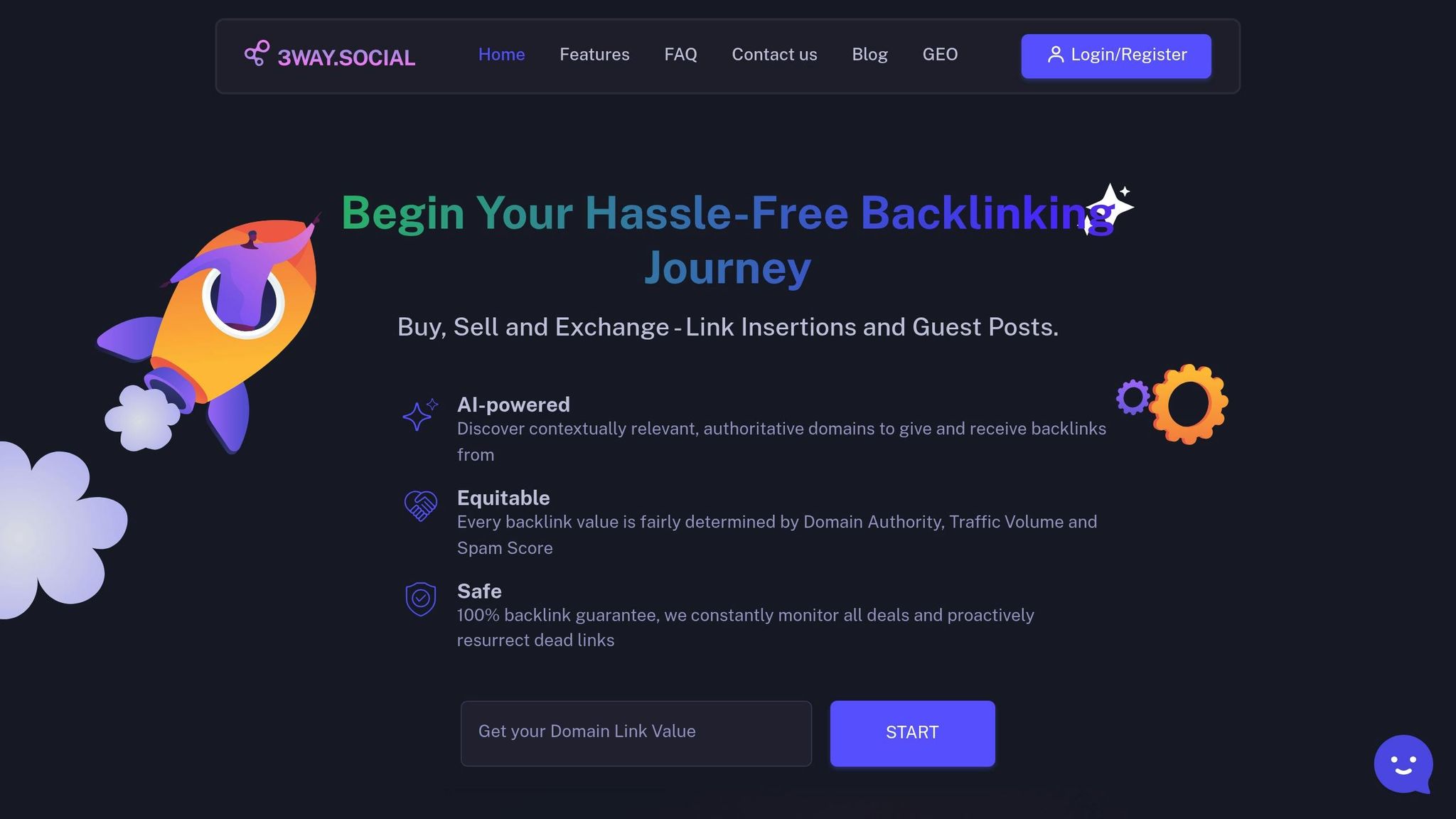
3Way.Social is a great example of how AI can transform backlink assessment. This platform uses AI to simplify backlink acquisition while maintaining high standards of quality. Its AI-powered domain matching system identifies potential link partners based on factors like topical relevance, domain authority, and traffic quality.
Another standout feature is its machine-learning-driven link value assessment. This tool ensures partnerships are fair and mutually beneficial by evaluating referral traffic potential, domain authority scores, and niche relevance. The platform’s focus on equitable exchanges means both parties gain value from the relationship.
Additional features include permanent do-follow links for lasting SEO benefits and quality control filters that automatically remove low-performing domains from your list of potential partners. Plus, the platform’s advanced link diversification tools ensure your backlink profile looks natural by sourcing links from a variety of industries and locations – an approach that aligns with search engine preferences. On top of that, secure payment integration ensures all transactions are handled safely.
How 3Way.Social Uses AI to Improve Backlink Quality
3Way.Social takes backlink quality to the next level with its AI-powered algorithms. These systems continuously analyze traffic patterns to identify the most promising link opportunities. By studying historical link exchange data, the platform predicts referral traffic potential with impressive accuracy.
Its machine learning models also evaluate user engagement signals – like bounce rates, time on page, and click-through rates – from potential linking domains. Sites with poor engagement metrics are filtered out, ensuring you only connect with domains that can drive meaningful traffic to your site.
The platform also streamlines guest posting. Using AI, it analyzes content performance and audience overlap to match you with publications where your content will resonate most. This means higher engagement and better-quality traffic from the resulting backlinks.
To ensure all link exchanges meet strict standards, 3Way.Social combines the power of AI with human expertise. The AI pre-screens potential partners, while experienced SEO professionals provide the final approval. This blend of automation and human judgment ensures the best possible outcomes for your backlink strategy.
Key Points About Traffic Metrics and Backlink Quality
Traffic metrics go beyond just domain authority – they provide insight into how visitors interact with linked content, offering a clearer picture of backlink value. User engagement plays a critical role in refining the quality of backlinks.
Backlinks from sites with active user engagement are far more valuable. For instance, a link from a moderately trafficked site where users spend significant time exploring content can outperform one from a high-traffic site with low engagement. Metrics like click-through rates and user behavior are now essential in evaluating backlinks effectively.
That said, traffic numbers alone don’t paint the full picture. High traffic doesn’t always mean high quality. Some sites generate large volumes of traffic through low-value content, which can lead to poor user experiences and negatively impact search engine performance. The key lies in balancing traffic volume with strong engagement signals when assessing backlink quality.
To make backlink evaluation more efficient, AI-powered tools are becoming indispensable. For example, 3Way.Social uses advanced AI to analyze various traffic signals, uncovering valuable backlink opportunities that might otherwise go unnoticed.
FAQs
How do metrics like bounce rate and time on page affect the quality of a backlink?
Metrics like bounce rate and time on page are key indicators when assessing the quality and impact of a backlink for SEO. A high bounce rate suggests that visitors might find the linked content irrelevant or unappealing, which can lower the backlink’s value in search engine rankings. On the flip side, when users spend more time on a page, it shows they find the content engaging and useful, enhancing the backlink’s credibility and influence.
To get the most out of your backlinks, focus on delivering a great user experience and crafting content that’s both relevant and engaging. These metrics not only showcase how well your content is performing but also shape how search engines view your site’s authority and relevance.
Why is it more important to focus on backlink relevance than just traffic volume?
Focusing on the relevance of a backlink source is key because it links your website to an audience that’s genuinely interested in what you have to offer. This connection not only encourages more meaningful engagement but can also increase the chances of turning visitors into customers.
Backlinks from well-regarded, contextually related websites hold greater value in search engine rankings. They signal trust and reliability to search engines, which can positively impact your SEO. However, even if a site has high traffic, it won’t provide the same benefits if its audience doesn’t align with your content or niche.
How can AI tools make evaluating backlink quality faster and more reliable?
AI tools make evaluating backlink quality faster and more precise by processing large datasets in no time. They assess critical factors like domain authority, traffic trends, and engagement levels to pinpoint the backlinks that can deliver the most value to your site. This approach eliminates the tedious and error-prone process of manual analysis.
With automated features for tasks like link prospecting and quality assessments, AI helps ensure your SEO efforts are both productive and time-efficient. These tools allow you to concentrate on securing high-quality backlinks that enhance rankings, increase traffic, and strengthen domain authority – all while conserving your time and resources.