Advanced Analytics for Backlink Targeting
Not all backlinks help; use advanced analytics to spot high-value links, avoid toxic ones, and build smarter link strategies.

Last Updated on October 9, 2026 by Ian Naylor
Not all backlinks are created equal. Some links can significantly boost your rankings, while others might waste your time – or even harm your site. This guide breaks down how advanced tools like Ahrefs, SEMrush, Moz, Google Search Console, and 3Way.Social help you identify high-quality backlinks and avoid risky ones.
Key takeaways:
- Ahrefs: Massive 35-trillion-link index, real-time updates, and powerful filtering tools for competitor analysis.
- SEMrush: 43-trillion-link database, toxicity scoring, and streamlined outreach features.
- Moz: Reliable metrics like Domain Authority and Spam Score, with user-friendly tools.
- Google Search Console: Free, accurate backlink data directly from Google, but limited features.
- 3Way.Social: AI-powered domain matching and a credit-based system for fast link acquisition.
Quick Comparison:
| Tool | Database Size | Key Features | Cost Range |
|---|---|---|---|
| Ahrefs | 35 trillion links | Real-time updates, DR/UR metrics, API access | $23–$999/month |
| SEMrush | 43 trillion links | Toxicity score, outreach integration | $129–$499/month |
| Moz | 45.5 trillion links | Domain Authority, Spam Score | $99–$599/month |
| Google Search Console | N/A | Free, Google-verified backlink data | Free |
| 3Way.Social | N/A | AI-matched domains, ABC link exchange system | Credit-based, Free to join |
Each tool offers unique strengths, from in-depth competitor analysis to fast, AI-driven link-building. The right choice depends on your goals, budget, and preferred workflow.
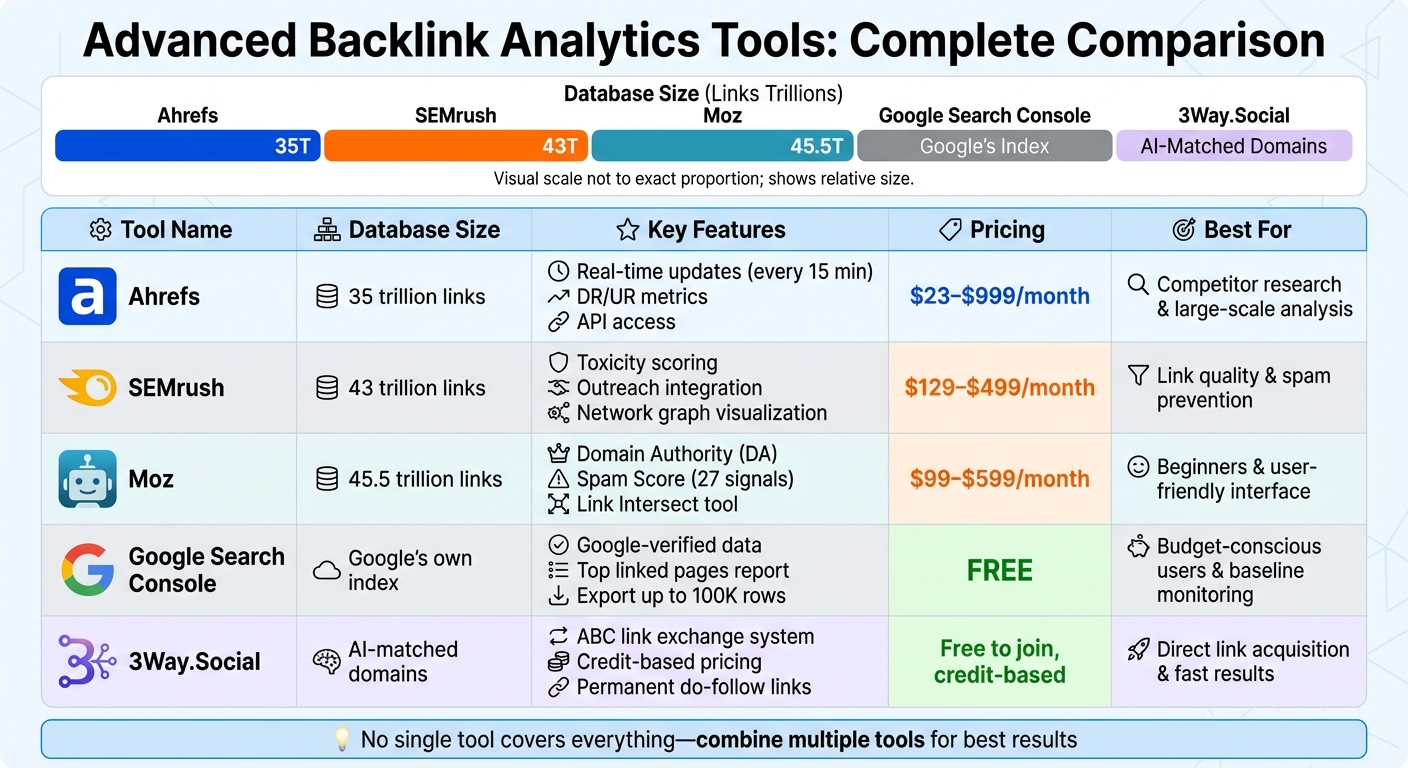
Backlink Analytics Tools Comparison: Features, Database Size, and Pricing
1. Ahrefs
Backlink Discovery
Ahrefs runs one of the most active web crawlers in the industry, as confirmed by CloudflareRadar. Its database includes an impressive 35.0 trillion external backlinks across 500 million domains. This vast collection of data is updated every 15 minutes, offering users nearly real-time insights into competitor link-building strategies.
Using the Site Explorer tool, you can dig into any competitor’s backlink profile simply by entering their domain. From there, you can apply filters like Domain Rating (DR), URL Rating (UR), and even estimated organic traffic to the linking page. That last filter is especially helpful because, as Joshua Hardwick, Head of Content at Ahrefs, explains:
Rumor suggests Google values backlinks from high-traffic pages. If Google is sending traffic to the linking page, then they must see that page as valuable.
The "Best by Links" report is another standout feature. It highlights the types of content in your niche that attract the most backlinks. You can even filter for "404 not found" pages – these are broken pages with active backlinks, offering you a chance to pitch your content as a replacement. For more focused outreach, search for specific terms like "resource", "podcast", or "guest post" in referring page titles and URLs.
Ahrefs doesn’t stop at backlink discovery. It also provides tools to refine and analyze this data for smarter strategies.
Quality Metrics
Ahrefs uses several key metrics to help you evaluate the quality of backlinks. Its Domain Rating (DR) has become a go-to metric for many SEO professionals – 44% of them rely on it as their primary measure for SEO. Both DR and URL Rating (UR) are on a logarithmic scale from 0–100, with UR working similarly to Google’s original PageRank system.
The platform also categorizes links into Dofollow, Nofollow, UGC, and Sponsored, making it easier to see which links pass authority. However, Ahrefs advises against relying solely on DR. For example, a DR 94 site like the New York Times may pass less link equity than a lower-DR site if it links out to too many other domains. This nuanced approach is why 64% of SEO professionals prefer Ahrefs’ link data over competing tools. Combining DR with traffic metrics gives a more accurate picture of a link’s value.
Advanced Features
Ahrefs goes beyond basic link discovery with advanced tools that enhance your backlink strategy. The Content Explorer database, which includes over one billion pages, helps you find linkable topics by filtering for pages with high organic traffic but few referring domains. You can also use the "Anchor and backlink" column to see the context around each link, whether it’s a recommendation, a citation, or something else.
For tracking ongoing campaigns, the "New" and "Lost" backlinks tabs are invaluable. These tabs show link velocity and status updates like "Newly published", "Link added", or "Link restored". You can even search for image file extensions (e.g., .PNG, .JPG) in the Target URL filter to identify sites using your images without proper credit.
Ahrefs also supports integration with AI tools through API v3 and the Model Context Protocol (MCP), enabling direct connections to systems like ChatGPT and Claude. Additionally, a browser extension allows you to view DR and UR metrics directly in search results.
Cost-Effectiveness
For website owners, Ahrefs Webmaster Tools is available for free to monitor backlink profiles. Paid plans start at $23/month for the Starter tier, which covers basic competitor analysis. There are also free standalone tools like the Backlink Checker, Website Authority Checker, and Broken Link Checker.
As we explore the next tool, think about how different platforms tackle the same goal: identifying and leveraging high-quality backlink opportunities.
sbb-itb-88880ed
2. SEMrush
Backlink Discovery
SEMrush boasts a massive database of over 43 trillion backlinks, ranking it among the largest link indexes available. The platform is impressively fast, adding new links within an hour and refreshing its interface every 15 minutes. On average, a newly published link appears in the Backlinks tool in just 40 minutes.
The Backlink Gap Tool is a game-changer for competitive analysis. It lets you compare your backlink profile with up to four competitors at once. The "Best" filter highlights domains that link to your competitors but not to your site. These domains are prime candidates for outreach since they’ve already shown interest in your niche. SEMrush also simplifies broken link building. By filtering a competitor’s "Indexed Pages" for 4xx or 5xx status codes, you can identify dead pages with valuable backlinks and target them with replacement content. The Network Graph further helps by visualizing the backlink structure to assess the quality of those links.
For outreach, the Link Building Tool streamlines the entire process. It creates prospect lists based on keywords and competitor data, integrates an email interface for pitches, and tracks the progress of each link request. This all-in-one approach eliminates the hassle of switching between multiple tools.
SEMrush doesn’t just stop at discovery – it uses quality metrics to pinpoint the most authoritative links.
Quality Metrics
SEMrush relies on its Authority Score (AS), which ranges from 0–100, to measure a domain’s credibility. This score evaluates factors like Link Power (quality and quantity of backlinks), Spam Factors (the ratio of spammy to natural links), and Organic Traffic. While AS isn’t an exact match for Google’s metrics, it provides a reliable way to benchmark against competitors.
Another key metric is the Toxicity Score (0–100), which flags harmful links. Scores from 0–44 are safe, 45–59 are potentially risky, and 60–100 are toxic. SEMrush advises against disavowing links unless a manual penalty is likely, echoing Google’s stance:
Google works very hard to make sure that actions on third-party sites do not negatively affect a website.
A smart strategy is to focus on referring domains rather than total links. Ten links from ten unique, high-quality domains carry more weight than ten links from a single domain. Google treats each unique domain as an independent "vote of confidence".
Advanced Features
One standout feature is the Network Graph, which maps a domain’s link network up to three tiers deep, covering as many as 960 websites (12 first-tier, 10 second-tier, and 8 third-tier links per site). The graph uses color-coded dots to indicate link quality – red dots often signal Private Blog Networks (PBNs) that should be avoided. These insights allow users to focus on acquiring the most impactful backlinks.
Michelle Symonds, Founder and Managing Director at Ditto Digital, shares a practical example:
One of the best features of Backlinks is seeing which links were lost due to another site’s structure changes – not removal. We found a few high-authority placements… where the linking site had redesigned or shifted content.
Another useful tool is the Semrush Copilot, an AI assistant that sends automated updates about authority score changes, lost backlinks, and new link-building opportunities. For a comprehensive audit, you can even integrate SEMrush’s backlink data with Google Search Console.
Cost-Effectiveness
SEMrush offers a free account with 10 requests and 10 results per day. For more extensive needs, paid plans include:
- Pro SEO Plan: 3,000 requests/day, 10,000 results/report
- Guru SEO Plan: 5,000 requests/day, 30,000 results/report
- Business SEO Plan: 10,000 requests/day, 50,000 results/report
All paid plans include full access to the Network Graph.
Backlinks remain critical for rankings. A 2024 study found that 8 of the top 20 ranking factors were tied to backlinks, making SEMrush an essential tool for link building and competitive analysis.
3. Moz
Backlink Discovery
Moz brings a fresh perspective to backlink discovery with its Link Explorer tool. Powered by the Dotbot crawler, which uses a machine-learning algorithm, this tool prioritizes high-value links. Its impressive index includes 45.5 trillion links across 8.7 trillion URLs – plenty to meet most link-building needs.
One standout feature is the Link Intersect tool, which is ideal for competitive analysis. It pinpoints domains or pages linking to up to five competitors but not to your site. This creates a clear "link gap" list of prospects already engaging with your niche. You can even narrow the analysis to the page level for more targeted backlink opportunities.
The Top Pages Report is another useful tool, showing which competitor pages attract the most backlinks. This insight helps you identify successful content formats and topics for earning high-authority links. Plus, Moz updates its index with newly discovered links in about 3 days, ensuring up-to-date data.
These tools lay the groundwork for Moz’s approach to evaluating backlink quality.
Quality Metrics
Moz assesses backlink quality using Domain Authority (DA) and Page Authority (PA), both measured on a logarithmic scale of 0 to 100. Because of this scale, improving a score from 70 to 80 is much harder than moving from 20 to 30, reflecting the challenges of building authority at higher levels. These metrics aim to align closely with how search engines evaluate links.
Another key metric is the Spam Score, which uses 27 signals to gauge risk. High scores require manual review to ensure link safety. A balanced anchor text distribution is also crucial: 40–60% branded anchors and only 1–5% exact match keywords are recommended to avoid penalties for over-optimization. Moz also emphasizes the importance of focusing on unique linking root domains rather than total links, as Google values each unique domain as a single "vote of confidence".
Advanced Features
For streamlined backlink management, Moz offers advanced tools like Link Tracking Lists and MozBar. These features help you monitor backlink quality and evaluate prospects with ease.
The Link Opportunities tool further simplifies the process by automating competitor analysis and prioritizing link targets based on their relevance and authority.
Cost-Effectiveness
Moz provides 10 free queries per month with a community account, making it accessible for beginners. For more in-depth link-building, paid plans are available in Standard, Medium, Large, and Premium tiers. The Medium plan or higher is recommended for serious efforts. Additionally, the Moz API offers programmatic access to metrics like DA, PA, and Spam Score, with plans starting at just $5/month.
Emma Moody, Marketing Manager at Plug&Play, praises the platform:
Moz’s Link Explorer gives us accurate link data that is essential for benchmarking the Domain Authority of our clients. The tool is fundamental to our SEO offering.
With its mix of powerful tools and flexible pricing, Moz supports a well-rounded, data-driven backlink strategy.
4. Google Search Console
Backlink Discovery
Google Search Console provides backlink data straight from Google’s own index, making it a trusted source for accurate information. Alex Sandro, Senior Product Manager at Serpzilla, highlights its reliability:
As it comes directly from Google, it’s considered the most accurate source of information about your backlinks.
The Links report offers three key views: Top linked pages, Top linking sites (root domains), and Top linking text (anchors). These help you understand where your site is earning links. You can even dive deeper to see which specific pages on a referring domain link to particular URLs on your site. While the interface shows up to 1,000 rows, you can export as many as 100,000 rows for more detailed analysis.
Quality Metrics
Unlike paid tools, Google Search Console gives you raw backlink data, which requires manual interpretation. To gauge authority, you can look at which pages attract the most links and identify the root domains linking to your site most often. The Top linking text report is another useful tool, helping you track anchor text usage to detect any over-optimization or spammy patterns. However, it has its limitations: the report doesn’t indicate whether a link is follow or nofollow and only provides a sample of your links, not a complete list.
Cost-Effectiveness
One of the best things about Google Search Console? It’s completely free. While it doesn’t offer the advanced metrics you’d find in paid tools, many SEO professionals export its data into platforms like Ahrefs or SEMrush for deeper analysis. For basic backlink monitoring and understanding which links Google acknowledges, it’s an excellent starting point. This foundational data lays the groundwork for more advanced backlink strategies discussed later in the article.
| Feature | Google Search Console | Advanced Paid Tools |
|---|---|---|
| Cost | Free | Subscription-based |
| Data Source | Direct from Google Index | Independent Web Crawlers |
| Quality Metrics | None (raw counts only) | Metrics like DR, DA, Spam Score |
| Export Limit | 100,000 rows | Varies (often millions) |
| Competitive Analysis | Limited to own site | Full competitor access |
Top Backlink Analysis Tools 2025: Ahrefs, Semrush, Moz
5. 3Way.Social
3Way.Social simplifies backlink targeting by using AI-driven domain matching combined with detailed metrics to help you find the right partners more effectively.
Backlink Discovery
With its AI-powered domain matching, 3Way.Social identifies backlink opportunities that are both relevant to your niche and high in authority. Instead of manually sifting through massive databases, the platform analyzes your domain and suggests potential link partners based on their relevance and authority. You can fine-tune your search by filtering for Domain Authority, organic traffic, and spam score, ensuring your outreach aligns with your SEO strategy. Plus, the "Get your Domain Link Value" tool allows you to preview matches instantly – no signup required. The entire process is designed to combine efficiency with thorough quality checks.
Quality Metrics
To assess potential partners, 3Way.Social taps into data from the Ahrefs API and evaluates three key metrics: Domain Rating (DR), organic traffic, and spam score. These metrics are used to create a transparent credit system. For example, a domain with a DR of 74 and 38,000 monthly visitors might be assigned about 133 credits. Interestingly, a DR 70 site with no traffic is considered less valuable than a DR 50 site with 50,000 monthly visitors. By combining authority and traffic data, the platform ensures you’re targeting sites with real performance rather than relying on superficial metrics. This approach lays the groundwork for more effective link-building strategies.
Advanced Features
One of the platform’s standout tools is its ABC link exchange system. This system creates a triangular linking pattern where Site A links to B, B links to C, and C links back to A. This structure looks more natural to search engines and avoids the issues associated with direct reciprocal linking. Additionally, the platform monitors backlinks, restores broken links, and even refunds credits when necessary. Sophia Martinez, an SEO Manager, shared her experience:
3Way.Social’s innovative ABC link exchange system has significantly improved our site’s rankings.
All links provided through the platform are guaranteed to be permanent, do-follow, and free of "sponsored" tags, ensuring they deliver maximum SEO value.
Cost-Effectiveness
Beyond its technical capabilities, 3Way.Social offers a straightforward and budget-friendly model. Joining the platform is free, and it operates on a credit-based system where link value is tied to objective SEO metrics rather than arbitrary pricing. You can earn credits by offering placements on your site or purchase them via Stripe, with payouts available through PayPal. For guest posts, sellers can set prices between 100% and 200% of the base credit value to account for the effort of creating content. This pricing model is a refreshing alternative to traditional outreach methods, which often require a lot of time with no guaranteed results.
Strengths and Weaknesses
Each of these tools brings something different to the table, with distinct advantages and limitations.
Ahrefs stands out with its enormous 35-trillion-link index, refreshed every 15 to 30 minutes. This makes it a top pick for thorough competitor research. That said, its pricing – ranging from $99 to $999 per month – can be a hurdle for smaller businesses.
Google Search Console shines as a free option, offering Google-verified data. However, it falls short when it comes to competitor analysis and advanced metrics like authority scores.
SEMrush is packed with features like integrated backlink audits, toxicity scoring, and outreach management. With pricing between $129 and $499 per month, it’s a robust tool, though its interface can feel overwhelming for those new to SEO.
Moz is known for its ease of use and trusted Domain Authority metrics. However, its index of 40+ trillion links trails behind Ahrefs. Pricing starts at $99 per month and goes up to $599 for advanced features.
3Way.Social takes a different approach as a direct link acquisition platform. It streamlines the process with AI-powered domain matching and a credit-based exchange system, guaranteeing permanent do-follow links. The platform is free to join, but it provides limited competitor data, focusing more on quick link-building through its ABC exchange system.
Choosing the right tool depends on your specific SEO goals. If in-depth competitor analysis is your priority, Ahrefs is a powerful option despite the cost. For users focused on cleaning up backlinks and evaluating link quality, SEMrush offers valuable tools. Budget-conscious users can make the most of Google Search Console‘s free data. Meanwhile, those looking for a straightforward way to build links might find 3Way.Social‘s streamlined system especially appealing. Tailor your choice to fit your SEO strategy and priorities.
Conclusion
Selecting the right analytics tool depends on your SEO goals, budget, and the level of insight you need. Ahrefs is a great option if you’re focused on competitor research and accessing a large backlink index. If link quality and spam prevention are your priorities, SEMrush stands out with features like its Toxic Score and integrated outreach tools, starting at $129 per month.
For those on a tighter budget, Google Search Console offers free, reliable data about your site’s link profile, making it an excellent starting point. On the other hand, Moz is a solid choice for beginners and intermediate users, offering trusted Domain Authority metrics and user-friendly tools with plans ranging from $99 to $599 per month.
If you’re looking for a different approach, 3Way.Social provides AI-powered domain matching and a credit-based ABC exchange system, making link acquisition more direct and cost-effective. They even offer a free plan to help users get started.
No single tool will cover everything you need. A well-rounded backlink strategy often requires combining insights from multiple sources. For example, you can use Ahrefs’ Link Intersect tool to spot sites linking to competitors but not to you. SEMrush can help with regular audits to identify and disavow harmful links, while 3Way.Social simplifies the process of building quality backlinks. By leveraging the strengths of these tools together, you can create a more effective, data-driven strategy.
FAQs
How can I tell if a backlink is worth pursuing?
To assess the quality of a backlink, start by examining the authority of the linking domain. For example, a domain authority (DA) score above 50 is often a good benchmark. Beyond that, check if the site has real traffic and aligns with your niche – relevance is key.
Focus on backlinks that feature natural anchor text, come from pages with strong credibility metrics, and are embedded within content that’s directly related to your industry. Links from niche-specific websites or high-authority pages tend to carry more weight. On the flip side, avoid backlinks from low-quality or irrelevant sites, as they might negatively impact your SEO efforts.
What’s the safest way to handle “toxic” or spammy backlinks?
To deal with "toxic" or spammy backlinks, the first step is spotting them. Look out for warning signs like links from unrelated websites, anchor text that’s stuffed with keywords, or unusual spikes in backlinks. Once identified, try reaching out to the webmasters to request link removal. If that doesn’t work, you can turn to Google’s disavow tool – just use it carefully. Regularly auditing your backlinks and sticking to ethical link-building methods will help keep your site’s profile clean, safeguard it from penalties, and maintain trust with search engines.
Should I use one tool or combine multiple tools for backlink targeting?
Combining several tools for backlink targeting can yield better results than sticking to a single option. Each tool shines in specific areas, such as analyzing competitors, evaluating backlink quality, or monitoring your link profile. By using a mix, you can take a more thorough approach – spotting valuable backlinks, steering clear of harmful ones, and refining your SEO efforts with a variety of data-driven insights.