Last Updated on June 1, 2026 by Becky Halls
Anchor text optimization is critical for improving SEO, but doing it manually is time-consuming and prone to errors. SEO AI software strategies simplify this process by analyzing context, balancing anchor types, and scaling for large websites.
Here’s what these AI tools for anchor text can do:
- Use NLP (Natural Language Processing) to suggest contextually relevant anchor text.
- Balance anchor text ratios (e.g., exact-match, partial-match, branded).
- Automate large-scale audits and link recommendations.
- Integrate with SEO workflows for seamless management.
Some top tools include:
- 3Way.Social: Focuses on link exchanges with a strategic anchor text mix.
- Taskade AI: Generates precise anchor text and links it to content clusters.
- WordLift: Uses a Knowledge Graph for semantically accurate anchors.
- UpGrowth: Offers detailed control over anchor text ratios.
- AI-Assisted Internal Linking Tools: Optimizes internal links with context-aware suggestions.
Key takeaway: AI tools for anchor text save time, reduce errors, and improve SEO outcomes by making anchor text optimization scalable and precise.
Backlink Anchor Text Creation With AI – 500 Optimized SEO Anchor Text Made Easy!
sbb-itb-88880ed
How AI and NLP Work in Anchor Text Optimization
AI tools analyze anchor text by examining the context around it – usually the 15–25 words nearby, the headings on the destination page, and the first 1,500–2,000 characters of the target content. This kind of contextual analysis is at the core of how AI optimizes and balances anchor text.
“The 15 to 25 words surrounding a link often carry more relevance weight than the anchor text itself. Modern search systems assess context at the sentence, paragraph, and page levels.” – Manish, Link Building Journal
Natural Language Processing (NLP) takes this further by categorizing anchor text into informational, navigational, or transactional types to align with the purpose of the linked page. For instance, action-driven anchors are better suited for a pricing page compared to purely descriptive ones.
NLP also plays a key role in balancing anchor types by analyzing backlink profiles for over-optimization. Research shows that top-ranking pages tend to use exact-match anchors for only 3–8% of their external links, while lower-ranking sites often overuse them at rates of 14–25%. AI tools leverage this data to ensure a balanced mix of anchor types.
These methods are essential in both planning campaigns and auditing existing strategies, laying the groundwork for the AI-powered optimization tools discussed later.
Modern AI models now interpret anchor text as part of a broader entity-relationship signal rather than just a keyword for rankings. As Lauren Caldwell from GetGeology explains, a detailed anchor like “our pricing page for early-stage SaaS startups” provides clarity about the entity, its purpose, and its audience, far surpassing the simplicity of an exact-match phrase like “SaaS pricing”.
Grasping these NLP-driven techniques is vital since they underpin tools like 3Way.Social, which refine anchor text strategies and boost SEO outcomes.
How to Evaluate AI Anchor Text Tools
When assessing AI anchor text tools, it’s important to focus on their ability to understand context rather than just matching keywords. Here’s a breakdown of what to look for when evaluating these tools.
NLP capabilities are key. A good tool should do more than just identify keywords – it should understand the context of your content. For instance, instead of repeatedly suggesting “CRM software”, it might recommend a more specific anchor like “best CRM for small businesses.” To evaluate this, ask vendors how their tool adapts recommendations based on page context. Request sample outputs for different query types, such as commercial, informational, and navigational, to see how well it performs in various scenarios.
Distribution control is equally important. The tool should allow you to manage anchor text ratios – covering exact-match, partial-match, branded, and generic anchors. It should also provide a clear view of your current anchor profile alongside suggested improvements. The best tools will identify overused anchors and recommend safer alternatives, helping you avoid potential SEO penalties.
Scalability and integration make a difference. For larger websites, the ability to handle bulk analysis and batch recommendations is essential. Look for tools that let you set custom rules, like prioritizing partial-match anchors for specific pages (e.g., comparison pages). Seamless integration with your existing systems – such as your CMS, rank tracker, or project management tools – is also crucial. API access can be a game-changer, enabling automated audits and streamlining your anchor text management within your SEO workflow.
Here’s a quick summary of the key factors to consider:
| Evaluation Factor | Key Attributes |
|---|---|
| NLP capabilities | Contextual understanding, synonym handling, and semantic matching |
| Distribution control | Ability to set and monitor ratios for different anchor types |
| Scalability | Bulk processing, batch recommendations, and configurable rules |
| SEO workflow integration | CMS plugins, API access, export options, and collaboration features |
| Reporting | Insights into rankings, traffic changes, and anchor profile adjustments |
Governance and safety are also crucial for ensuring the tool aligns with your broader SEO strategy. The best tools include workflows that let SEO leads review, edit, or reject suggestions before they go live. They should also flag risky practices, like overusing manipulative anchors such as “buy [keyword] online”, and ensure compliance with Google’s link spam policies. A detailed change log is another helpful feature, as it allows you to track who approved changes and correlate those decisions with performance outcomes.
1. 3Way.Social
3Way.Social is an AI-driven platform that uses a unique ABC link exchange strategy. Essentially, site A links to site B, while site C links back to site A. This method avoids the obvious reciprocal linking patterns that Google’s spam detection systems are designed to catch, creating a more natural link profile.
NLP Capabilities
At its core, 3Way.Social’s AI is all about domain and niche matching. It ensures your site is paired with partners that are contextually relevant, rather than random, unrelated placements. This focus on thematic alignment helps boost the semantic weight of your links. While the platform doesn’t reveal the specifics of its NLP models, it clearly prioritizes aligning donor and target pages by topic to ensure contextual relevance.
Anchor Text Distribution Control
3Way.Social offers flexibility when it comes to anchor text. It supports six key anchor types: exact match, partial match, branded, generic, naked URL, and variations. What sets it apart is the ability to plan your anchor text mix across an entire campaign, not just link by link. This means you can manage your anchor ratios strategically – like keeping exact-match anchors below 10% while favoring branded and partial-match anchors for a natural profile. You can also distribute links across homepages, inner pages, and blog posts, making it easy to scale your strategy for larger campaigns.
Scalability for Large Campaigns
The platform’s smart matching system is built to handle large-scale SEO campaigns. Whether you’re an agency or an in-house team managing multiple U.S.-based clients, 3Way.Social simplifies the process with its network of SEO professionals. Automated partner discovery and ABC routing take the hassle out of manual outreach and link negotiations. Plus, a centralized dashboard helps you monitor links and domains across all campaigns, ensuring consistency in your anchor text policies even as your campaign volume grows.
Integration with SEO Workflows
3Way.Social fits neatly into existing SEO workflows, acting as a dedicated layer for link building and anchor text management. The process is simple: define your anchor strategy in your SEO tools, import those assignments into 3Way.Social to handle placements, and track performance using platforms like Google Search Console or GA4. Additionally, the platform’s guest posting feature allows you to insert anchors into longer-form content, adding context that strengthens topical relevance.
2. Taskade AI Anchor Text Optimization Generator
Taskade’s AI Anchor Text Optimization Generator (v1, launched in 2026) brings anchor text generation directly into your SEO automation workflow. It’s designed to simplify and improve how you create and manage anchor text.
NLP Capabilities
Taskade’s AI leverages natural language processing (NLP) to craft precise, keyword-rich anchor phrases. These phrases provide clear signals to both users and search engines, moving away from generic link text toward anchors that clearly convey the destination page’s content. As Taskade explains:
“AI-powered anchor text optimization can revolutionize the way you approach your website’s SEO. It can help you create engaging and effective anchor texts in a fraction of the time it would take to do it manually.”
Anchor Text Distribution Control
The AI Project Studio serves as the hub for managing anchor text distribution. Here, you can define your optimization goals, set parameters like tone and keyword density, and upload existing content, keyword lists, or target URLs. This ensures the AI generates anchors that align with the actual context of your pages, rather than generic or irrelevant suggestions.
Scalability for Large Campaigns
For websites with complex structures, Taskade significantly reduces the workload. Its AI SEO Kits automate tasks like topic clustering, entity analysis, EEAT checks, and keyword research. This ensures that anchor texts are seamlessly integrated into content clusters, saving time and effort when manual creation becomes overwhelming.
Integration with SEO Workflows
Taskade goes further by connecting anchor text generation with its AI Keyword List Generator and AI Sitemap Generator. Within a single workspace, you can refine suggestions before publishing. The recommended workflow? Use the AI SEO Kits to create topic clusters, then use those clusters to guide anchor text distribution across related pages. For added flexibility, manual adjustments let you align anchors with your brand voice. This seamless integration makes Taskade an essential tool in any AI-driven SEO strategy.
3. WordLift Anchor Text Optimization Tool
WordLift takes a unique approach to anchor text optimization by using a custom Knowledge Graph. Instead of relying on simple keyword matching, it creates semantically accurate anchors that align with your topics, concepts, and entities. This ensures that every anchor text adds meaningful SEO value while reinforcing your content’s focus on natural language processing (NLP).
NLP Capabilities
WordLift’s NLP engine prioritizes understanding the meaning behind content rather than isolating individual keywords. As noted on the WordLift Blog:
“The WordLift Agent does not just look at keywords in isolation; it understands how entities, concepts, and ideas relate to each other within your website’s custom knowledge graph.”
By identifying how concepts interconnect within your site, the tool creates links between semantically related pages – even when they don’t use the same vocabulary. This approach diversifies your anchor text profile automatically, improving SEO without manual intervention.
Anchor Text Distribution Control
The tool also lets you fine-tune anchor text distribution using customizable rules. For instance, you can set parameters to:
- Keep anchors under 30 characters.
- Exclude links to the homepage.
- Prioritize linking to pages with high impressions but low click-through rates (based on Google Search Console data).
These controls help you maintain a balanced link profile, reducing the risk of over-optimization and potential search engine penalties.
Scalability for Large Campaigns
WordLift is built to handle large-scale SEO campaigns efficiently. Its batch processing capabilities significantly cut down on tasks like local SEO analysis and Schema.org auditing, saving users up to 40% of the time they’d typically spend on manual SEO work. For e-commerce businesses, the tool can generate and validate content for over 2,000 product detail pages in just one minute.
Integration with SEO Workflows
WordLift integrates seamlessly with various platforms through the Model Context Protocol (MCP). It works with popular AI tools like Claude, ChatGPT, Google Gemini, and Microsoft Copilot. Additionally, it connects directly with WordPress, Google Search Console, Google Ads, and Google Business Profile, grounding its anchor text recommendations in real-world search data. Giovanni Carparelli, Head of Marketing at BeRebel, highlighted its impact:
“Integrating BeRebel’s knowledge graph into the Agent has enabled us to generate FAQs, paragraphs, and ideas for new articles that match our tone of voice, enhancing both the visibility and relevance of our published content.”
WordLift’s AI SEO Agent is available for $200/month and is included in the Professional, Business, and Enterprise plans. With its powerful features and seamless integration, WordLift stands out as a scalable solution for modern SEO challenges, setting the stage for even more advanced AI-driven optimizations.
4. UpGrowth Anchor Text Generator
UpGrowth takes anchor text optimization to a new level, offering a refined, data-driven approach that minimizes the guesswork. By using advanced natural language processing (NLP), the tool addresses challenges like unnatural phrasing and over-optimization – issues that can often slip past manual methods.
NLP Capabilities
With its NLP-powered engine, UpGrowth goes beyond simple keyword matching. It identifies patterns that could trigger penalties by grouping anchors based on meaning rather than exact wording. The tool’s intent detection feature ensures that anchor text aligns with its purpose – whether it’s informational, navigational, or transactional – creating a smoother user experience. Plus, it evaluates how well the anchor text fits within the surrounding content, helping avoid awkward or forced placements.
Anchor Text Distribution Control
UpGrowth gives you detailed control over anchor text ratios. You can set a total link count and assign percentage targets for different anchor types – like exact match, partial match, branded, mixed, or generic. The tool then converts these percentages into precise numerical counts. To keep things balanced, it employs automated distribution smoothing, which helps avoid over-optimization across large link profiles . This level of control ensures your anchor text strategy aligns with broader SEO goals.
Integration with SEO Workflows
This tool fits seamlessly into your existing SEO processes. It allows you to export recommendations in structured formats like CSV or JSON, simplifying data sharing and integration. For larger projects, UpGrowth’s centralized dashboard enables direct editing of anchor text and one-click updates across multiple pages – eliminating the need for tedious spreadsheet management .
5. AI-Assisted Internal Linking Tools
Building on AI-driven anchor text optimization, internal linking tools take SEO a step further by organizing your site’s structure for better performance. While earlier tools focused on anchor text creation and placement, these advanced tools analyze your site’s architecture to recommend where links should go, which anchor texts to use, and how to maintain link health. Let’s dive into how these tools automate internal linking strategies.
NLP Capabilities
These tools go beyond simple keyword matching, leveraging Natural Language Processing (NLP) to ensure links make sense in context. For instance, SmartLinker uses Jina AI neural reranking to measure “semantic distance” between pages, helping suggest links that are contextually meaningful. Similarly, LinkMind considers the full context of a page to ensure links align editorially, not just based on shared keywords. Linkilo takes it further by employing OpenAI‘s text-embedding-3-small model to classify content by user intent (informational, transactional) and funnel stage (TOFU, MOFU, BOFU) before making link recommendations.
“Finally, an internal linking tool that understands context. The smart anchor feature alone saved us from over-optimization penalties.” – Mike K., SEO Director
Anchor Text Distribution Control
These tools also handle the tricky task of diversifying anchor text automatically. For example, SmartLinker only uses exact-match anchors when pages share over 90% semantic similarity, opting for synonyms, long-tail phrases, or generic anchors for less closely related content. LinkBoss includes a feature to detect and flag anchor text cannibalization, ensuring no single anchor is overused across your site. Meanwhile, Linkilo uses a four-step selection process to prioritize naturally occurring text in your content, so anchors sound organic without requiring extra edits.
“The Wikidata integration for synonyms is genius. Our anchor text diversity improved 300% without any manual work.” – James P., Technical SEO
In short, these tools not only improve anchor text variety but also make scaling internal linking across large sites much easier.
Scalability for Large Campaigns
When managing thousands of pages, manual internal linking just isn’t practical. Tools like AI Link Genius, designed for large-scale sites, automate the process by mapping keywords to URLs and offering bulk updates. For example, LinkBoss can handle up to 100,000 URLs and claims its workflow is 40x faster than manual linking. A site with 500 posts can be fully analyzed for link opportunities in about 5 minutes, a task that would otherwise take an entire day.
Integration with SEO Workflows
Most of these tools integrate seamlessly into existing SEO workflows. Many, like SmartLinker and LinkBoss, offer WordPress plugins for quick setup. Others, like LinkMind, connect with Google Search Console to prioritize linking high-traffic pages to underperforming ones. For those who prefer manual oversight, tools like SmartLinker and LinkMind allow CSV and JSON exports for offline review. Advanced options, such as AI Link Genius, even include rollback features to undo bulk changes if necessary.
Here’s a quick comparison of some leading internal linking tools:
| Tool | Anchor Logic | Bulk Actions | Unique Feature | Starting Price |
|---|---|---|---|---|
| AI Link Genius | Context-aware suggestions | 1-click bulk updates + rollback | Nofollow link detection | $7.99/month |
| SmartLinker | Semantic distance matching | 1-click deployment | Wikidata synonym graph | $29/month |
| LinkBoss | NLP-optimized flow | 1-click Silo builder | Anchor cannibalization checker | $11/month |
| LinkMind | GSC traffic weighting | CSV export for editors | Orphaned page finder | Pro plan (Linkstonic) |
Tool Comparison Table
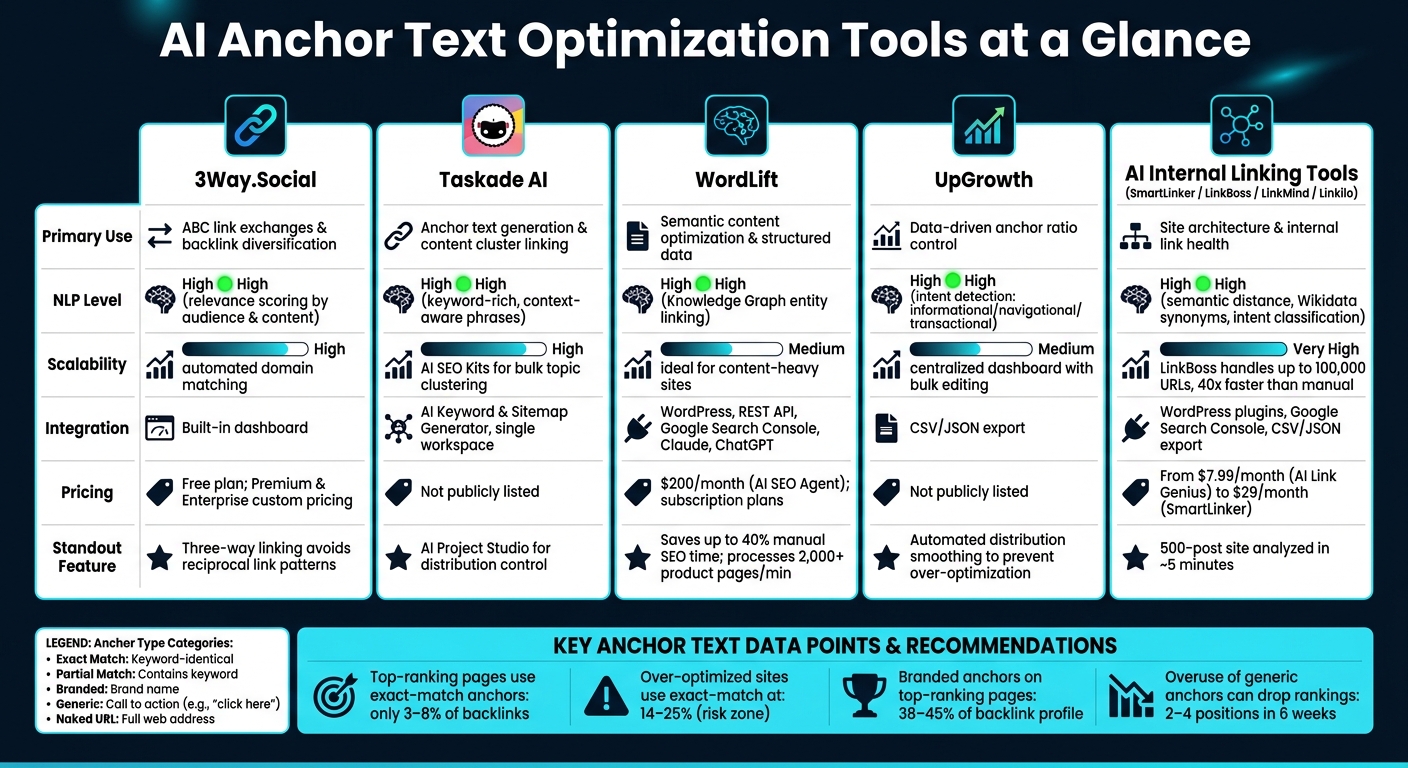
AI Anchor Text Optimization Tools Compared: Features, Scalability & Pricing
AI and NLP advancements have transformed anchor text optimization, making it more efficient and precise. Here’s a quick look at two AI tools designed to streamline this process. The table highlights their main use cases, NLP capabilities, scalability, integration options, and pricing structures.
| Tool | Primary Use Case | NLP Sophistication | Scalability | Integration | Pricing Model |
|---|---|---|---|---|---|
| 3Way.Social | ABC link exchanges & backlink diversification | High – relevance scoring based on audience and content alignment | High – automated domain matching | Built-in dashboard | Free plan; Premium & Enterprise at custom pricing |
| WordLift | Semantic content optimization & structured data | High – knowledge graph–based entity linking | Medium – ideal for content-heavy sites | WordPress, REST API | Subscription-based |
3Way.Social stands out for its focus on quality external link exchanges, emphasizing audience relevance and contextual alignment rather than just relying on domain metrics. This comparison offers a clear perspective on how 3Way.Social can support more targeted and effective SEO efforts.
AI Tools for Anchor Text – Conclusion
AI has made anchor text optimization more precise and efficient. Instead of manually sifting through countless links or guessing the right phrases, NLP-driven tools now offer contextual suggestions, flag risky exact-match patterns, helping you build quality backlinks without penalties, and replace vague anchors like “click here” with descriptive text that improves relevance for search engines.
Data shows that top-ranking sites (positions 1–3) typically keep exact-match anchors within 3–8% of their backlink profile, while branded anchors dominate at 38–45%. Overuse of generic anchors can hurt rankings, often leading to a drop of 2–4 positions in just six weeks.
This highlights the importance of a strategic approach to anchor text management. Tailor your strategy to your needs. For a diverse and high-quality backlink profile, 3Way.Social offers AI-powered domain matching and link diversification, ensuring a natural anchor text distribution. This aligns perfectly with the techniques discussed earlier, making 3Way.Social an essential part of your SEO toolkit.
A practical game plan? Conduct quarterly audits, eliminate generic anchors immediately, and vary anchor text – even when linking to the same page. As SEO expert Vadim Kravcenko points out:
“Anchor text is one of the cheapest things to fix, so even if the effect size is modest, the ROI is high.”
Start by tackling your biggest weakness – whether it’s unbalanced anchor usage or an over-reliance on generic anchors – and build a stronger, more effective strategy from there.
FAQs
What AI tools for anchor text are safest?
Creating a secure anchor text strategy means focusing on branded terms and natural variations that mimic authentic linking behavior. Here’s a solid breakdown:
- 30%-50% branded anchors: These include your brand name or variations of it, helping to establish trust and authority.
- 20%-30% naked URLs: Plain URLs (like www.example.com) keep your profile looking natural.
- 15%-25% generic phrases: Examples include “click here”, “learn more”, or “visit this site.”
When it comes to keywords, keep partial-match keywords at 15%-25% and limit exact-match keywords to just 5%-10%. A diverse anchor text mix not only strengthens your SEO but also reduces the risk of penalties from search engines.
How do AI tools for anchor text pick the best text for a link?
AI tools use natural language processing (NLP) to interpret the meaning and context of anchor text. Rather than just counting keywords, they assess how the anchor text connects to both the page it’s on and the one it links to. This approach ensures that anchors are clear, diverse, and seamlessly woven into the content. The result? Search engines can better associate your content with relevant topics, giving your SEO a boost.
How can I scale internal linking without over-optimizing anchors?
To make your internal linking strategy more effective, focus on using a variety of anchor texts. Repeating the same exact-match keywords over and over can come across as manipulative to search engines. Instead, aim for a mix that feels natural. This includes:
- Exact-match keywords: Directly related to your target term.
- Branded terms: Your company or product name.
- Generic phrases: Words like “click here” or “learn more.”
- Partial-match keywords: Variations of your main keyword.
- Long-tail variations: Longer, more specific keyword phrases.
This approach not only keeps your strategy diverse but also reduces the risk of penalties from search engines.
If managing all this feels overwhelming, tools like 3Way.Social can simplify the process. Its AI-powered features can:
- Pinpoint high-quality internal linking opportunities.
- Track how anchor texts are being used.
- Spot patterns that might lead to ranking penalties.
By automating these tasks, you can maintain a balanced anchor text strategy without the extra hassle.