Crawled, currently not indexed: why Google skips your pages in 2026
Last Updated on October 29, 2026 by Becky Halls
Open Google Search Console, click into the Pages report, and there’s a fair chance the biggest number on screen isn’t “indexed”. It’s “Crawled, currently not indexed.” Google came, looked at your page, and decided not to bother. No error message or penalty – Just a shrug.
You’re in a big crowd!! A study by IndexCheckr that tracked more than 16 million pages found 61.94% of them weren’t indexed at all. Only about 37% were fully in. So if half your site is sitting in limbo, that’s closer to normal than you’d sadly like.
And it’s got sharper in 2026: Rankings have been volatile all month, the September 2026 spam update only finished rolling out on 8 October, and the general direction of travel is Google being fussier about what earns a spot in the index. So this matters more than it did two years ago.
Google got pickier, and it’s telling you so
For years we treated indexing as automatic. Publish, submit a sitemap, get indexed. That deal’s off and things are getting tougher!
The bit that changed how I think about it: Gary Illyes from Google has been fairly open that crawling follows demand and quality, not a fixed allowance. On a Google podcast he said that the moment Google gets “signals back from search indexing that the quality of the content has increased”, it’ll start “turning up demand” for those URLs (Search Engine Journal). He also said: if you want Google to crawl more, “you somehow have to convince search that your stuff is worth fetching.”
So “crawled, currently not indexed” is often Google’s way of saying this page didn’t clear the bar. That’s not great to hear but it is useful, because it’s feedback.
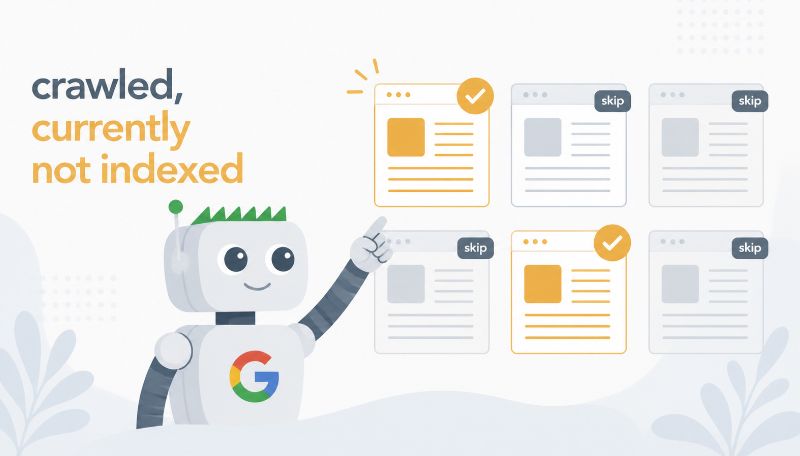
Why a page gets crawled and then ignored
A few usual suspects. Most of the time it’s one of these.
It’s thin or near-duplicate. If the page says roughly what ten other pages on your site already say, Google sees no reason to store another copy. Programmatic pages and thin tag archives are the classic offenders.
It’s low on demand. Illyes’ point again. If nothing links to it and nobody searches for what it covers, Google doesn’t see the value in holding it.
It’s buried. A page five clicks from the homepage with one internal link pointing at it looks unimportant, because structurally it is. Internal linking is a quality signal whether you meant it to be or not.
It’s new and in the queue. Sometimes it’s just time. That same IndexCheckr study found pages took an average of 27.4 days to get indexed, and 93.2% of the ones that made it were in within six months. So a two-week-old page in limbo might just need patience.
Working out which one you’ve got is the whole job. Fix the wrong thing and you waste weeks.
Crawl budget: real problem or a distraction?
Most sites worry about crawl budget when they shouldn’t, and ignore it when they should. Google’s line for years has been that the vast majority of sites never need to think about it. If you’ve got a few hundred or a few thousand pages, it’s not your problem.
I asked Peter whether this matters…
“Crawl budget is a real thing on big sites. Think hundreds of thousands of URLs, faceted navigation, endless parameter combinations. On a normal business site it’s a red herring. If your pages aren’t getting indexed and you’ve got 2,000 of them, look at quality, internal linking and duplication first. Crawl budget won’t be your problem, and the log-file rabbit hole will just eat your afternoon.” Peter Fox, Head of Dev Team at 3Way.Social
That matches what I see. The log files and crawl-budget deep dives are fun to geek out on, but for most of you the win is making fewer, better pages that Google actually wants.
How to actually get a page indexed
Right, the practical bit. If a page you care about is stuck:
Make it worth indexing. Harsh but true! Add the depth, the first-hand detail, the thing the ten other pages don’t have. If you can’t make it better than what already ranks, ask whether it should exist at all.
Point real internal links at it. From relevant, already-indexed pages, with descriptive anchor text. Not a footer link. A contextual one in the body of a page Google already trusts.
Prune the deadweight. The one people hate. If you’ve got 500 thin pages dragging your site’s average quality down, cutting or merging them can lift what’s left. Fewer, stronger pages beat a big pile of filler.
Check it’s actually crawlable. No accidental noindex, not blocked in robots.txt, returns a clean 200, sitting in the sitemap. Basic stuff, but I’ve lost hours to a stray noindex a developer left in.
Then request indexing, once. And don’t lean on it.
Don’t just hit “request indexing” and pray
Loads of people treat the Request Indexing button as the fix. It isn’t. The same 16-million-page study found pages submitted through indexing tools only got in 29.37% of the time. So seven out of ten stayed out even after a nudge.
Submitting tells Google the page exists. It does nothing about whether Google thinks it’s worth keeping. If the page is thin, you can submit it fifty times and it’ll stay in limbo. Fix the page, then submit.
I think this is where strategy and tech have to talk to each other, which they usually don’t.
“When a client’s pages won’t index, the knee-jerk is to call it a technical fault (we’ve all said that before!) Half the time it’s a content problem wearing a technical costume. Google is basically reviewing your work and saying ‘not this one.’ The fix is a content decision, what to keep, what to merge, what to kill, and that’s a strategy call more than a dev ticket. The sites that sort this out are the ones that stop publishing for the sake of it.” Becky Halls, Strategist at 3Way.Social
Crawled currently not indexed – FAQ
What does “crawled, currently not indexed” actually mean?
Google found your page and read it, but chose not to add it to the index. It’s usually a signal about quality, uniqueness or demand rather than a technical error.
Is it a penalty?
No. There’s no manual action and no penalty involved. Google has just decided the page isn’t worth indexing right now, and that can change if you improve it or earn links to it.
How long should I wait before worrying?
Give a new page three to four weeks. The average time to index runs around 27 days, and most pages that get indexed do so within six months. If an important page is still out after a month, start investigating.
Will requesting indexing in Search Console fix it?
Rarely on its own. Submission only got pages indexed about 29% of the time in one large study. Improve the page first, then request indexing.
Does cutting pages really help the rest of my site get indexed?
Often, yes. Removing or merging thin, low-value pages can raise the overall quality signal Google reads from your site, which can help your stronger pages get crawled and indexed more readily.
Do I need to worry about crawl budget?
Only if you’ve got a very large site. Think six figures of URLs, faceted navigation, or lots of parameter-driven pages. For a normal business site, indexing problems are almost always about quality and internal linking.
Becky Halls leads strategy at 3Way.Social and also runs an SEO/GEO agency BeckyHalls.com