Internal linking strategy: how to stop leaking rankings in 2026
Last Updated on October 8, 2026 by Becky Halls
I see the same pattern in nearly every audit: A site with decent backlinks and decent content, rankings stuck in the mud. The authority’s flowing in from external links but there’s no internal linking strategy. It’s just pooling on the homepage and never reaching the pages that need it.
Internal linking is how you move it around, and it’s the cheapest win in SEO. There’s no outreach to do and nothing to buy. You’re connecting pages you already own, in a way that tells Google which ones matter. And in 2026, with external links counting for a bit less than they used to, your own site structure carries more of the weight.
Why internal links do more than you think
John Mueller from Google has been blunt about this. “Internal linking is super critical for SEO,” he said. “I think it’s one of the biggest things that you can do on a website to kind of guide Google and guide visitors to the pages that you think are important.”
Internal links do three jobs at once. They pass authority (that “link equity” everyone obsesses over with backlinks works internally too). They tell Google which pages you think are most important, by how you link to them. And they help crawlers actually find your pages. Miss the third one and the first two don’t matter, because an uncrawled page can’t rank.
The orphan page tax
Here’s the number that should worry you. Ahrefs studied over a billion pages and found 96.55% of them get zero traffic from Google. Zero. As in none at all.
Plenty of reasons for that, but a big one is pages nobody links to. Orphan pages. A page with no internal links pointing at it is a page Google struggles to find, struggles to value, and mostly ignores. You published it, it sits there, it does nothing.
Interestingly, that same Ahrefs research found the pages that do rank without any backlinks almost always sit on high-authority sites, where internal linking passes enough power to get them over the line. So your internal structure can rank pages that have never earned a single external link. That’s a lever most people leave untouched.
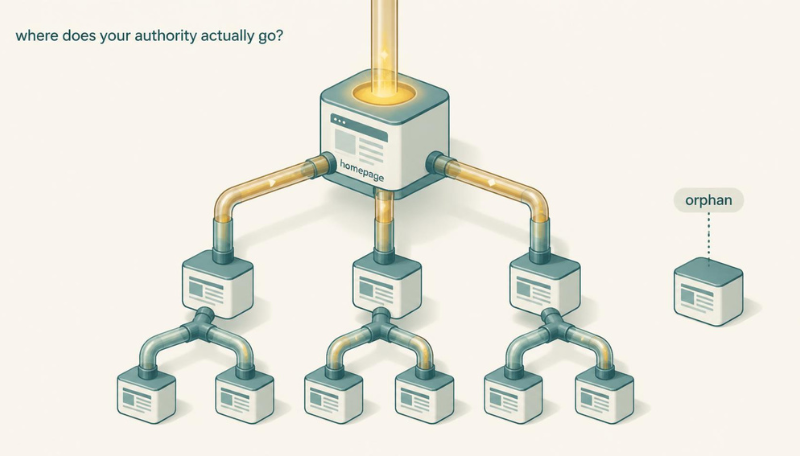
Create your internal linking strategy – Go find your orphan pages. Screaming Frog or Ahrefs Site Audit will list them in a few minutes. Then link to them from relevant, already-indexed pages. Some of mine have started ranking within a couple of weeks of nothing more than that.
How many internal links does a page need?
Cyrus Shepard ran one of the better studies on this. His team at Zyppy analysed 23 million internal links across 1,800 sites against real Search Console data. The finding I keep coming back to: aim for around 10 varied internal links pointing at each important page, from different pages across your site.
The graph climbed steeply up to about 10 links, then flattened. So the first 10 matter a lot. The twentieth, not so much. If a key page only has 2 or 3 internal links pointing at it, that’s your weekend sorted.
“When a client’s traffic plateaus, internal linking is the first place I look before we spend a penny on outreach. Half the time there’s a page they want to rank that nothing on the site actually links to. We fix that in an afternoon and it moves.” Peter Fox, AppInstitute
Vary your anchor text
This was the most interesting bit of Shepard’s study. For internal anchor text, variety kept helping, the chart “went up and up and up” with no real ceiling. That’s the opposite of backlink anchor text, where identical exact-match anchors at scale get you penalised.
So internally, don’t link to your “running shoes” page with the words “running shoes” every single time. Mix it up. “Best trail shoes,” “our shoe guide,” “lightweight running shoes,” all pointing at the same page. It gives Google more context about what the page covers, and it reads more naturally to a human too.
Build topical authority on purpose
Topical authority is just Google trusting that you cover a subject properly, not in one post but across a connected set of them. Internal linking is how you wire that connection up.
The model is simple. One broad pillar page on a core topic. A cluster of deeper pages on the subtopics. Every cluster page links up to the pillar, and the pillar links down to each cluster page. Related cluster pages link across to each other where it’s useful.
Done right, that does two things. It tells Google you’ve covered the topic in depth. And it keeps a reader moving through your content instead of bouncing back to the search results.
A warning that fits the moment: Google said this autumn it can “lose faith” in sites that mass-produce low-value pages. So don’t build 50 thin cluster pages for the sake of a diagram. Build pages worth reading, then link them properly. Structure amplifies good content. It can’t rescue filler.
“From a technical angle, internal links are how crawlers find and prioritise your pages. If an important page is five clicks deep with one link to it, you’ve buried it. Flatten the path, add a few links from strong pages, and you often see it get crawled and indexed faster.” Peter Fox, AppInstitute
A 30-minute internal linking strategy audit you can run today
You don’t need a project plan for this. Open a crawler and work through the list.
- Pull your list of orphan pages. Link to each one from 2 or 3 relevant pages. Done first because it’s the fastest win.
- Find your 5 most important commercial pages. Count the internal links pointing at each. Anything under 10, top it up from related content.
- Check your highest-authority pages (your best blog posts, usually). Make sure they link out to the pages you actually want to rank. That’s where your internal equity is sitting.
- Scan your anchor text. If it’s all identical, vary it.
- Check click depth. Anything important that’s more than 3 clicks from the homepage, pull it closer.
That’s it. No editors to chase, no budget, no waiting. Just better plumbing.
Internal linking strategy FAQ
How many internal links per page is too many?
There’s no hard cap, but use judgement. Links should help a reader, not paper the page in blue text. If a link wouldn’t be useful to a human, don’t add it just for SEO. A long article naturally carries more than a short one.
Do internal links pass as much value as backlinks?
Not as much per link, but they’re fully in your control, and you can add as many as make sense. Backlinks are votes from other sites. Internal links are how you distribute those votes around your own. You want both, but only one is free.
What’s the difference between a pillar page and a cluster page?
A pillar page covers a broad topic at a high level and links out to deeper pages. Cluster pages cover the specific subtopics in detail and link back up to the pillar. Together they signal that you cover the whole subject, not one slice of it.
How do I find orphan pages?
Run a crawl in Screaming Frog, Ahrefs, or Sitebulb and look for pages with no incoming internal links. Cross-reference against your sitemap or CMS so you catch pages the crawler can’t even reach. Those are the truly stranded ones.
Should I use breadcrumbs as well as body links?
Yes, they help, but they’re not a substitute. Breadcrumbs give structure and a little context. Contextual links inside your content carry more weight because they’re specific and relevant. Use both.
How often should I review internal links?
Every time you publish, link the new page to and from relevant existing ones. Then a fuller sweep once a quarter. Sites grow and pages drift into orphan status without anyone noticing, so a regular check keeps the structure tight.
Ian Naylor is the Founder of 3way.social. He writes about where link building and SEO are heading.