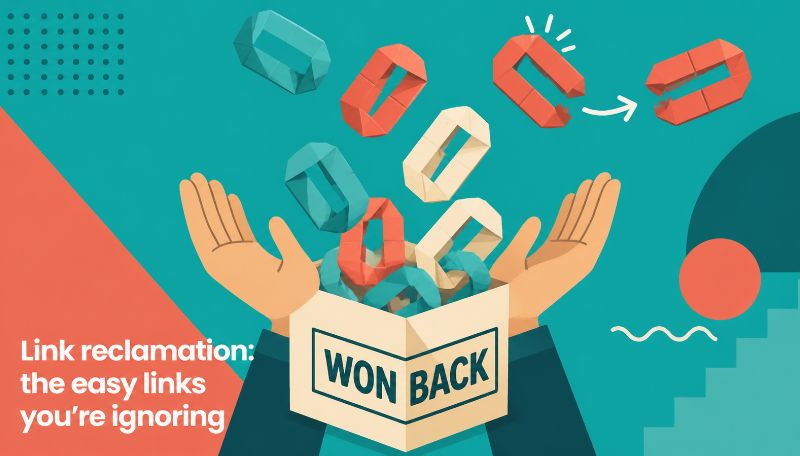
Link reclamation: the backlinks you already earned and lost
Last Updated on November 2, 2026 by Becky Halls
I pulled a client’s lost-links report last Tuesday and 40 decent links had gone missing in about a month. Nobody killed them on purpose – A site rebuilt a page, a migration ate a redirect, one editor swapped our link for a shinier resource. Links rot, and most people never look.
That’s a shame – Winning those links back is the easiest link building going. It doesn’t involve a cold pitch to a stranger, no begging for a guest slot. You earned the link once already, which means somebody already decided you were worth citing and you just need to gently remind them.
What link reclamation actually covers
Two jobs hide under this one term, and they’re worth keeping apart.
The first is recovering links you had and lost. A page that linked to you got rebuilt, deleted, or edited, and your link went with it. You’re just asking for it back.
The second is converting unlinked mentions. Someone wrote about you, named you, maybe quoted your data, and never added the link. You never had that link, so strictly it isn’t reclamation. As Ahrefs’ Tim Soulo put it, “You can’t reclaim a link you never had in the first place.” Different job, same spirit: a link that should exist and doesn’t.
I bundle them together because the mindset is identical. You’re going after links that are basically yours already.
Why I’d do this before anything else right now
If you’ve watched the trackers through late October, you’ll know it’s been rough. Weeks of volatility, a nasty Monday around the 20th and again near the 24th, and no confirmed broad core update since spring. Most people think one’s coming.
When the ground’s moving like that, the last thing I want is a stack of fresh, risky links I can’t vouch for. Reclaimed links sit at the opposite end of the risk scale. They’re editorial, they’re relevant, they lived on pages that already linked to you once. You’re repairing what you earned. That’s a smart place to put your hours while Google sorts itself out.
Finding your lost links
Pull the report
Open Ahrefs Site Explorer (Semrush and Majestic do this too), drop in your domain, and go to Backlinks, then Lost. You’ll probably get a scary number. For their own site, Ahrefs showed 6,285 links lost in 30 days. Don’t panic at the total as most of it is just noise.
Turn on the best-links filter so you’re only looking at links worth the effort. A lost link from a DR 30 blog that never sent a visitor isn’t worth an email. One from a DR 90 industry title is.
Check why it went
Every lost link comes with a reason, and the reason tells you whether to bother.
Link removed is worth a look. If the page got refreshed and your mention got cut, you can often ask for it back, especially if your resource is still the best one going. A deleted page (404) is sometimes worth it, mainly if the deletion looks accidental. Redirect or canonical changes you can usually skip, because the link often still counts somewhere. Crawl errors you can ignore, they tend to come back on the next crawl.
This is where a bit of technical know-how pays off.
"Half the lost links I see weren't lost on purpose. A migration drops a redirect, a page starts 404ing, and the link's still pointing at nothing. Fix the plumbing first. Then go ask for the ones that are actually gone." Peter Fox, Head of Dev at 3way.Social
Turning unlinked mentions into links
Set up a listening tool. Google Alerts is free and fine to start with. Ahrefs Alerts, Brand24, Mention and BrandMentions all do it better. Watch for your brand name, your founder’s name, your product, and any data you’ve ever published.
When a mention lands without a link, that’s the warmest lead in link building. They already wrote about you. They already thought you were worth naming. All you’re asking for is a hyperlink on words they’ve already typed.
The numbers make the case. A Hotjar reclamation campaign run by uSERP converted unclaimed mentions into links at a 30% rate and landed 210+ links. And when Antonio Gabric ran a reclamation push, he pulled 31 links from 166 emails. Ahrefs’ Joshua Hardwick called that “an 18.67% conversion rate, which is pretty much unheard of in link outreach these days.”
Compare that to a cold guest-post pitch, where any reply at all feels like a win.
The pitch that gets a yes
Keep it short – Maybe two or three sentences. You’re not writing a cover letter.
Say where you saw the mention or the old link, say thanks if a thanks fits, and ask for the one specific thing: a link on this phrase, pointing to this URL. Make it a two-second yes. The harder you make them think, the faster you hit the bin.
One thing I learned the slow way: email a person, not the generic inbox. The author who wrote the piece, or the editor, can add a link in half a minute. info@ goes nowhere.
A 30-minute reclamation sprint
If you’ve never done this, block half an hour this week.
First 10 minutes, pull your lost links, filter to the good ones, and list anything from a DR 50-plus site with a loss reason worth chasing. Next 10, search your brand name in your alerts tool, or just Google your brand in quotes with your own domain excluded, and note the mentions with no link. Last 10, write five short emails. Not fifty. Five good ones.
Do that weekly and it compounds. Links come back, mentions turn into links, and you’ve spent no money and taken on no risk.
FAQ
Is link reclamation white hat?
Yes. You’re asking for an editorial link on a real mention or recovering one you earned. Nothing bought, nothing manipulated.
How often should I check for lost links?
Monthly is plenty for most sites. Weekly if you publish a lot or get regular press.
Do unlinked mentions help even without the link?
Google has said it can understand brand mentions to a point, but a real link still passes value and sends actual traffic. So chase the link.
What tools do I need?
Ahrefs, Semrush or Majestic for the lost-links report. Google Alerts, Ahrefs Alerts, Brand24 or Mention for brand mentions.
What counts as a good conversion rate?
Anything in the teens is strong. Reclamation beats cold outreach because the relationship’s already there, so expect better than you’d get pitching strangers.
Ian Naylor is the founder of 3way.social. He’s spent years watching SEOs chase shiny new links while the ones they’d already earned slipped off the web unnoticed.