Reactive digital PR in 2026: win links by being the fastest source in the room
Last Updated on October 29, 2026 by Becky Halls
HARO is dead (Again!) Cision rebranded it to Connectively, shut Connectively down in December 2024, then brought the HARO name back in April 2025 and let it fill up with AI-written pitches until journalists stopped reading. The old habit a lot of us leaned on, answer three queries over coffee and wait for a link, doesn’t really pay the way it used to – which is a real shame as I was a fan of the old HARO.
So where do the links live now? For a lot of them, reactive digital PR.
I’ll be honest, I used to think reactive was the chaotic cousin of proper campaigns. The thing you did when your big data study flopped. I’ve changed my mind. When a story breaks and a journalist needs a credible voice in the next two hours, that’s one of the cleanest ways to earn a real editorial link in 2026. No survey budget. No 40-slide pitch deck. Just the right person saying something useful, fast.
HARO’s gone, so where do the links go?
The gap it left is a real big one. HARO trained a whole industry to sit and wait for requests to land in an inbox. Now the requests are scattered. Qwoted, Featured (used to be Terkel), Source of Sources, Help a B2B Writer, plus journalists firing off #journorequest on whatever’s replaced Twitter in their life. The tooling is catching up too. Featured rolled out a free newsjacking tool this month aimed squarely at agencies who want to run reactive for every client, which tells you where the money thinks this is heading.
And it’s getting harder, not easier. In BuzzStream’s State of Digital PR 2026, 60.8% of digital PRs said finding relevant journalists was harder this year than last. More noise, fewer reporters, smaller newsrooms. So the people who win are the ones who show up relevant and quick, not the ones who blast a list of 400 contacts.
So what is reactive digital PR, really?
Leah Daly, who runs digital PR at FatJoe, put it about as plainly as anyone:
“Reactive is basically anything that you can jump on quickly.” (via BuzzStream)
That’s it. A story breaks, or a season rolls round, or a stat drops, and your client has something real to say about it. You get a quote to the right journalist before the page fills up.
The link is a by-product. You’re handing a reporter the thing they need to finish a piece they’re already writing, and the link comes along for the ride. That’s why it works, and that’s why it survives Google’s spam updates. The September 2026 spam update finished rolling out on 8 October and rankings have been twitchy ever since, with a lot of chatter about an unconfirmed update around 20-21 October. Through all of it, a genuine editorial mention on a real news site keeps doing its job. The bought stuff is exactly what those updates are built to catch.
Speed is the whole game
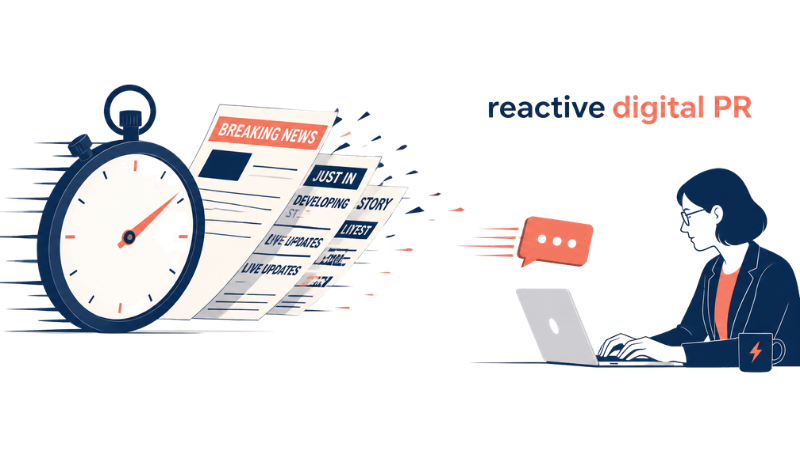
I can’t say this strongly enough. Reactive lives and dies on minutes.
Mark Rofe, who’s built a name doing exactly this, described one of his wins on the BuzzStream podcast:
“I saw the news breaking, got the comment out, and within about three hours, I got my client coverage. So you have to be quick.” (via BuzzStream)
Three hours. Not three days. If your client needs a fortnight to sign off a two-line quote, reactive isn’t for them, and that’s a conversation worth having up front.
The maths is simple. When a story breaks, a journalist has a near-empty page and a panic. They want a quote now. The first three credible people in get used. Everyone after that is filler for a story that’s already live. So the whole job is being set up to move before your competitors have opened their laptops.
Relevance beats volume, every time
The other half is not being annoying. Journalists are drowning. Cision’s data (again via BuzzStream) says 72% of reporters get more than 50 pitches a week, and 88% will immediately bin a pitch that doesn’t match what they actually cover. Nearly nine in ten pitches die on contact because they’re off-topic. That’s brutal, and it’s your opening.
Leah Daly’s test is a good one. If a reader would find it weird that your expert is commenting on this, don’t send it. A plumbing client commenting on interest rates is a waste of everyone’s morning. Worse, she points out your client can lose credibility by sounding tone-deaf on something they’ve no business discussing.
So match the expert to the story like your reputation depends on it. Because the journalist’s does.
How to run reactive PR without a 10-person team
Most people who bounce off reactive do so because it feels like you need a newsroom. You don’t. You need a system.
Set up your listening
Google Alerts for your client’s topics. A few journalists followed on social. One of the sourcing platforms (Qwoted and Help a B2B Writer are both free to start). Maybe a Slack channel where anyone who spots a relevant story drops the link. The goal is that a breaking story reaches you in minutes, not when you catch the news at 6pm.
Pre-approve your experts
This is the bit everyone skips and then regrets. Sit down with your client before anything breaks. Agree the three or four topics they can speak on with authority. Draft a short bio. Get sign-off on the idea that quick quotes can go out without a legal review each time. Do this once and you buy yourself speed forever.
Write the quote, not an essay
Leah Daly again: “It’s more about drafting the perfect quote and making sure you cover all the key elements.” A journalist wants two or three tight sentences they can drop straight in. Give them an opinion, a reason, and a line they’d want to pull out as a highlight. Don’t send 600 words and make them do the editing.
What kills a reactive pitch
A few things I see go wrong, over and over.
Being slow. Covered it, but it’s the number one killer.
Sending the same comment everyone else sends. Rofe says he likes “the unplanned high media interest sphere” precisely because low competition means higher hit rates. If it’s predictable and everyone’s doing it, your quote is one of fifty identical ones and the journalist can only use one.
No point of view. “Experts say this is important” helps nobody. Have an actual take. Disagree with something. Give a number.
Chasing everyone, everywhere. Pick the handful of outlets that matter for the client and the link profile you want. Quality of placement over a spreadsheet of 400 names.
Where this goes next
I asked Ian for his read on where reactive sits in the bigger picture.
“Reactive used to be the thing agencies bolted on. Now I think it’s close to the core of how links get earned, because it’s the one tactic that rewards being actually useful to a journalist in the moment. Google keeps squeezing the easy, bought stuff out, and what’s left is relationships and relevance. That suits the people doing the work properly and terrifies the ones who were buying their way in.” Ian Naylor, Founder at 3Way.Social
That’s about right. The tooling will keep improving, the sourcing platforms will keep multiplying, and the AI slop will keep flooding the ones that let it. The edge isn’t the tool. It’s a real person with something to say and a client who’ll back them quickly.
Start small. One client, one topic, one fast win. You’ll feel the difference the first time you land a national link off a story that broke that morning.
FAQ
Is HARO actually back or not?
Sort of. The HARO name returned in April 2025 after Connectively shut down, but most PRs have moved to alternatives like Qwoted, Featured and Help a B2B Writer because the quality and response rates there are better right now.
How fast do I really need to be for reactive PR?
For true breaking news, inside two to three hours. For softer, seasonal stuff you’ve got a day or two. The faster you move on a breaking story, the lower the competition, because most people aren’t set up to respond quickly.
Do reactive links still count after the 2026 spam updates?
Yes. Earned editorial mentions on real news sites are the kind of links Google’s spam updates are trying to protect. The stuff getting hit is bought links, link networks and exact-match anchor spam.
What’s the difference between reactive and proactive digital PR?
Proactive is you creating the story (a data study, a survey, a stunt) and pitching it. Reactive is you jumping on a story that already exists and adding a useful voice. Most good programmes run both.
Can small businesses do reactive PR, or is it just for big agencies?
Small businesses can absolutely do it, and often faster, because sign-off is quicker when the owner is the expert. You don’t need a big budget. You need alerts, a clear topic, and the willingness to reply fast.
How do I measure whether reactive PR is working?
Track coverage, linked mentions, referring domains and the authority of the sites you land on. BuzzStream’s data suggests most PRs expect measurable results within three to six months, so give it a quarter before you judge it.
Becky Halls is a Strategist at 3way.social, where she works on link building and content strategy for clients who’d rather earn their rankings than rent them.