How AI Improves Link Diversity for Better Rankings
AI turns backlink diversity into a measurable advantage, using audits and predictive outreach to boost authority and stabilize rankings.

Last Updated on October 9, 2026 by Becky Halls
AI is transforming link-building by simplifying the process of creating diverse backlinks, so learning exactly how AI improves link diversity is essential for better search engine rankings. Instead of relying on manual efforts, AI tools analyze link profiles, identify gaps, and suggest opportunities to secure links from varied sources like blogs, news sites, forums, and directories. This variety helps search engines view your site as credible and reduces risks associated with over-reliance on a single link type.
Key Takeaways:
- Why Link Diversity Matters: A mix of link types (e.g., dofollow, nofollow, editorial) and varied anchor text signals natural and credible link acquisition.
- AI’s Role: AI audits backlink profiles, flags risks, and suggests high-value opportunities. It also tracks real-time metrics like domain variety and link decay.
- How to Use AI: Start with an AI-powered audit, find relevant domains, build links strategically (e.g., guest posts, editorial mentions), and monitor progress using AI dashboards.
- Results: Sites with diverse backlinks show more stable rankings and improved authority, especially in AI-driven search results.
AI tools make link-building faster and more precise, ensuring your backlink strategy aligns with evolving search engine and AI algorithms.
Why Link Diversity Matters for SEO Rankings
What Is Link Diversity?
Link diversity refers to earning backlinks from a wide range of sources and formats. These sources can include news websites, blogs, forums, and even social media platforms. It also involves different types of links, such as dofollow, nofollow, and sponsored, as well as varied anchor texts like branded terms, naked URLs, generic phrases, and partial-match keywords. A well-rounded backlink profile signals to search engines that your links are acquired naturally, steering clear of manipulative practices. Typically, a healthy profile balances the ratio of dofollow to nofollow links and incorporates a natural mix of anchor text types.
“Link diversification is a strategy for building a backlink profile by acquiring diverse links… Its goal is to create a natural and credible experience for both users and Google’s algorithms.”
– Kasia Śliwa, Senior Off-site SEO Specialist, Delante
This kind of variety not only builds trustworthiness but also plays a direct role in improving your site’s performance, as you’ll see below.
How Link Diversity Affects Your Rankings
Understanding link diversity is crucial because its variety directly impacts how search engines evaluate your site. A diverse backlink profile strengthens domain authority and helps maintain stable rankings. Sites with links from multiple sources and formats appear more credible, which search engines reward with consistent performance, especially during algorithm updates.
On the flip side, a lack of diversity can put your site at risk. Search engines like Google are adept at spotting unnatural patterns. If too many of your links come from a single type of source, it raises a red flag and could lead to your profile being flagged as manipulative. Scott Stouffer, CEO of MarketBrew, explains:
“If a website has a high concentration of links from a single source, it may be seen as spammy or manipulative by search engines.”
Link diversity is also becoming increasingly relevant for visibility in AI-driven search results. By 2026, platforms like ChatGPT, Gemini, and Perplexity rely on consensus across a variety of online sources to determine which ones to cite. Appearing in multiple formats – such as news articles, forums, Q&A sites, and curated lists – helps train these AI systems to recognize your brand as an authoritative source.
AI Link Building in SEO | KGMID & Brand Backlinks
How AI Improves Link Diversity
AI has revolutionized the way link diversity is managed, turning it into a precise, data-driven process. Machine learning algorithms now scan the web continuously, indexing inbound links, domains, and anchor texts. This automation ensures your backlink profile stays updated without requiring constant manual input. It’s a game-changer for addressing SEO risks, such as relying too heavily on uniform backlink sources.
The real power of AI lies in its ability to recognize patterns and detect errors. By analyzing massive datasets, AI identifies issues that might go unnoticed – like depending too much on one type of link or receiving too many backlinks from similar sources. It evaluates multiple factors simultaneously, such as domain authority, page authority, link attributes (dofollow versus nofollow), and link placement. This proactive approach helps catch potential problems before they impact your rankings.
AI also assesses how your brand is mentioned across the web, ensuring that the surrounding content aligns with your niche. This is becoming increasingly important as search behavior shifts. For example, as of 2024, Google AI Overviews appear in nearly 47% of search results, and around 60% of Google searches end without a click to an external site. By tracking external signals like unlinked brand mentions, AI uncovers trust indicators that traditional backlink tools might miss. These capabilities set the stage for specific AI-driven features that improve link diversity.
AI-Powered Backlink Audits
AI-powered audits provide a detailed, multi-faceted view of your backlink profile. They evaluate domain variety, focusing on the number of unique referring domains and the diversity of industries and website types linking to you. Geographic distribution is another key factor – AI flags imbalances, such as most links originating from a single country despite having a global audience. These audits also include link detox features, which use risk-assessment algorithms to identify harmful links. They score relevance based on factors like topical similarity, audience overlap, and historical linking patterns, helping you pinpoint which links strengthen your profile and which could harm it.
AI-Based Link Building Recommendations
Building on audit findings, AI systems offer tailored recommendations for link-building strategies. For instance, they might suggest guest blogging opportunities on untapped industry sites, editorial links from high-authority news platforms, or directory listings in relevant categories. Predictive analytics estimate the potential impact of acquiring specific links, allowing you to focus your outreach efforts where they’ll have the most benefit. Features like Smart Topic Matching help align content semantically and geographically with your target pages. Additionally, AI can identify link intersects – domains that link to your competitors but not to you – highlighting valuable opportunities to diversify your backlinks.
Real-Time Tracking and Adjustments
AI-powered dashboards provide real-time monitoring of link diversity metrics. Instead of relying on periodic manual audits, these tools alert you immediately to significant changes, such as shifts in the dofollow-to-nofollow ratio or a sudden influx of links with identical anchor text. They also track link decay and assess its impact on rankings and revenue. Guardrails ensure proper anchor text distribution, attribute ratios, and spam-score thresholds. Some advanced systems even measure your brand’s presence across trusted sources, which is an increasingly important signal of reliability in today’s AI-driven search environment.
Platforms like 3Way.Social leverage these AI capabilities to deliver advanced domain matching, in-depth backlink audits, and real-time monitoring. Together, these tools enhance your backlink profile, boost search rankings, and provide a structured approach to achieving link diversity.
sbb-itb-88880ed
Step-by-Step: Using AI to Diversify Your Backlinks
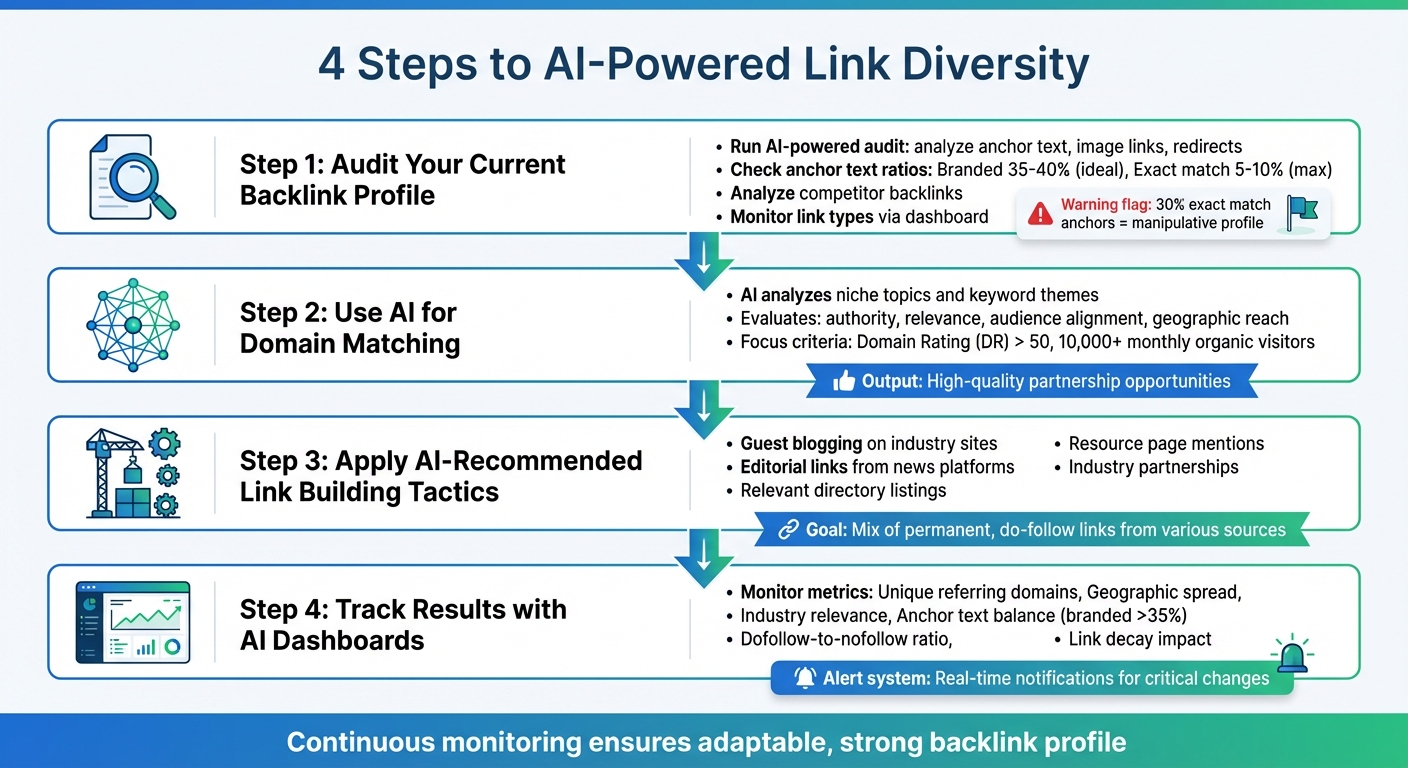
4-Step AI-Powered Link Diversification Process for Better SEO Rankings
You don’t need to be a tech wizard to use AI for boosting your backlink diversity. It’s all about following a structured plan. The process involves auditing your current links, finding the right domains, implementing strategic link-building tactics, and keeping track of your progress. Each step builds on the last, creating a solid strategy to improve your backlink profile. Here’s how AI can help you make meaningful changes to your backlink game.
Step 1: Audit Your Current Backlink Profile
Start with an AI-powered audit to get a clear picture of your backlink profile. These tools analyze your links – looking at anchor text, image links, redirects, and canonical links – to identify any red flags. For example, an ideal profile might have branded anchor text making up 35-40%, while exact match keywords should be limited to 5-10%. If your audit reveals 30% exact match anchors, search engines might view your profile as manipulative.
AI can also analyze your competitors’ backlinks, identifying industries and domains where they’ve earned links that you haven’t. Many AI tools feature dashboards to monitor your link types. For instance, if guest posts dominate your profile, you might need to balance it out with links from forums, directories, or news outlets.
Step 2: Use AI for Domain Matching
Once you understand your current profile, the next step is finding the right domains to partner with. AI-powered tools like 3Way.Social can help by analyzing niche topics and keyword themes to suggest potential partners for link exchanges. These tools evaluate domains based on factors like authority, relevance, audience alignment, and geographic reach.
To avoid wasting time on low-quality opportunities, focus on domains with a Domain Rating (DR) above 50 and at least 10,000 monthly organic visitors. This approach ensures you’re connecting with sites that enhance your backlink profile instead of just adding numbers. AI simplifies this process by taking the guesswork out of domain selection, helping you build meaningful connections.
Step 3: Apply AI-Recommended Link Building Tactics
With your audit insights and domain matches in hand, it’s time to execute AI-suggested link-building strategies. These could include guest blogging on industry-specific websites, securing editorial links from trusted news platforms, or getting listed in relevant directories. AI tools identify opportunities with the most potential, guiding your outreach efforts toward high-value links.
Leverage AI-driven outreach tools to personalize your pitches. Customizing your requests based on the recipient’s content can significantly increase your chances of success. Aim to secure a mix of permanent, do-follow links from various sources – such as guest posts, resource pages, industry mentions, and partnerships. This variety helps create a natural backlink profile, which search engines tend to favor.
Step 4: Track Results with AI Dashboards
Finally, set up real-time monitoring using AI dashboards to keep an eye on your backlink diversity. These tools can alert you to critical changes, like a sudden spike in links with identical anchor text or shifts in your dofollow-to-nofollow ratio. Key metrics to track include the number of unique referring domains, geographic spread, industry relevance, anchor text balance, and the impact of link decay on your rankings.
Use these insights to fine-tune your strategy. For instance, if your branded anchor text drops below 35%, you’ll know it’s time to focus on earning more brand mentions. Continuous monitoring ensures your backlink profile stays strong and adaptable as your website evolves. AI makes this process seamless, helping you stay ahead of potential issues.
Measuring Results from AI-Driven Link Diversity
Metrics to Monitor
To truly understand the effectiveness of AI-powered link diversity strategies, you need to focus on the right metrics. One of the most important is unique linking domains. Why? Because search engines and AI models prioritize diversity over sheer volume. For example, a site with 100 links from 80 different domains will typically rank better than one with 500 links from just 20 domains. It’s all about how many different sites vouch for your content.
Another key metric is your AI Share of Voice (SoV). This measures how often your brand gets mentioned across AI platforms like ChatGPT, Gemini, and Perplexity. With tools like Google AI Overviews now appearing in nearly half (47%) of searches, tracking SoV is becoming a must. Your Authority Score also matters – a higher score can lead to a noticeable increase in mentions. For instance, sites moving from the 8th to the 9th decile of authority see their median mentions jump from 21.5 to 79.0.
Don’t overlook your nofollow-to-follow ratio. While a balanced ratio, such as 70:30 or 80:20 in favor of followed links, is generally recommended, AI tools like Gemini and ChatGPT also value nofollow links. Additionally, image-based backlinks are worth tracking – they show a stronger correlation with AI mentions (0.538) compared to text links (0.472). Finally, examine your anchor text distribution to ensure it aligns with best practices.
For ongoing monitoring, platforms like 3Way.Social provide AI-driven dashboards to keep an eye on these metrics. Use this data to conduct regular audits and make informed adjustments to your link-building strategy.
Regular Optimization
Tracking metrics is only half the battle – you need to act on the insights. Conduct regular AI audits to maintain and improve your backlink profile. These audits will help you identify shifts in search engine and AI ranking trends before they affect your visibility. Keep in mind that the relationship between authority and AI visibility is not linear. Reaching certain thresholds, such as landing in the top 20-30% of authority scores, can lead to significant gains.
Audits are also a great opportunity to clean up your profile by removing low-quality links, which can help you avoid penalties. As algorithms evolve, your strategy should too. For instance, if you notice your branded anchor text dropping below 35% or your image link count falling behind, it’s time to adjust your outreach efforts. Regular optimization ensures your backlink profile stays strong and adapts to changes in both your website and search engine algorithms over time.
Conclusion
Building a diverse backlink profile has become a cornerstone for success in both traditional SEO and AI-driven search results, so learning how AI improves link diversity is important in 2026. Research highlights a strong correlation (r = +0.62) between referring domain diversity and higher rankings in large language model search outputs. With AI overviews now appearing in 47% of all search results, adapting your strategy to these changes is more critical than ever.
AI-powered tools are reshaping how link-building strategies are executed. Instead of chasing only high Domain Rating scores, these tools emphasize contextual relevance by securing links from a variety of sources – blogs, news outlets, educational sites, and industry platforms. This approach not only strengthens rankings but also minimizes the risk of penalties tied to manipulative linking practices.
This shift is gaining recognition among industry experts:
“In 2025, AI citation emerges as a new metric of authority, focusing on being a trusted source in AI-generated answers”
– Janet Bartoli, The Marketer’s Brief
Interestingly, 76% of AI citations are drawn from pages already ranking in the top 10 of organic results, underscoring the importance of a well-rounded backlink profile in building trust and boosting AI citation rates.
Platforms like 3Way.Social are leading the charge in simplifying this process. By leveraging AI for domain matching, equitable link valuation, and advanced diversification, they provide tools to streamline link-building efforts. Their network of vetted SEO professionals and real-time tracking capabilities allow you to audit and refine your backlink strategy while focusing on broader growth goals.
How AI Improves Link Diversity – FAQs
How many referring domains do I need to see ranking gains?
A strong and varied backlink profile plays a big role in improving your rankings. The exact number of referring domains you need can vary, but having links from a range of sources tends to lead to more stable rankings and stronger SEO results. When your site has a mix of different link types, it creates greater link diversity – something search engines value highly.
What’s a safe anchor text mix to avoid link spam signals?
A well-rounded anchor text strategy blends branded, generic, and long-tail keywords. Overloading your links with exact match anchors can make your backlink profile look unnatural and raise red flags for search engines. By keeping your anchor text diverse, you minimize the risk of being flagged for spam while boosting your SEO efforts effectively.
How do I know if AI-found link opportunities are relevant and trustworthy?
When using AI to discover link opportunities, it’s crucial to assess both relevance and trustworthiness.
- Relevance: This means ensuring the domain’s content aligns closely with your niche or industry. A link from a site unrelated to your focus won’t provide much value and could even harm your SEO efforts.
- Trustworthiness: This involves looking at metrics like domain authority, spam scores, and overall site quality. High-authority, well-maintained sites are far better for building credibility than low-quality or spammy ones.
While AI tools can make this process faster and more efficient, they aren’t perfect. A manual review is still necessary to confirm that links come from reliable, relevant sources. By combining AI’s efficiency with human judgment, you can build a backlink profile that’s both natural and effective.