Last Updated on May 6, 2026 by Becky Halls
Building strong connections is the key to successful link building in today’s SEO landscape. Search engines now prioritize the quality and relevance of links over sheer quantity. Cold outreach yields low success rates (0.5%-1.5%), while relationship-driven strategies can boost success rates to 18%-35%. Here’s why relationships are critical:
- Higher success rates: Warm outreach to trusted contacts outperforms cold emails by 10x.
- Long-term benefits: Links built through partnerships are more stable and less likely to disappear.
- SEO advantages: Links from credible sources improve rankings and visibility in AI-driven search results.
In short, relationships create a ripple effect, leading to more opportunities, better backlinks, and lasting SEO success. Following a checklist for high-authority backlinks can help streamline this process.
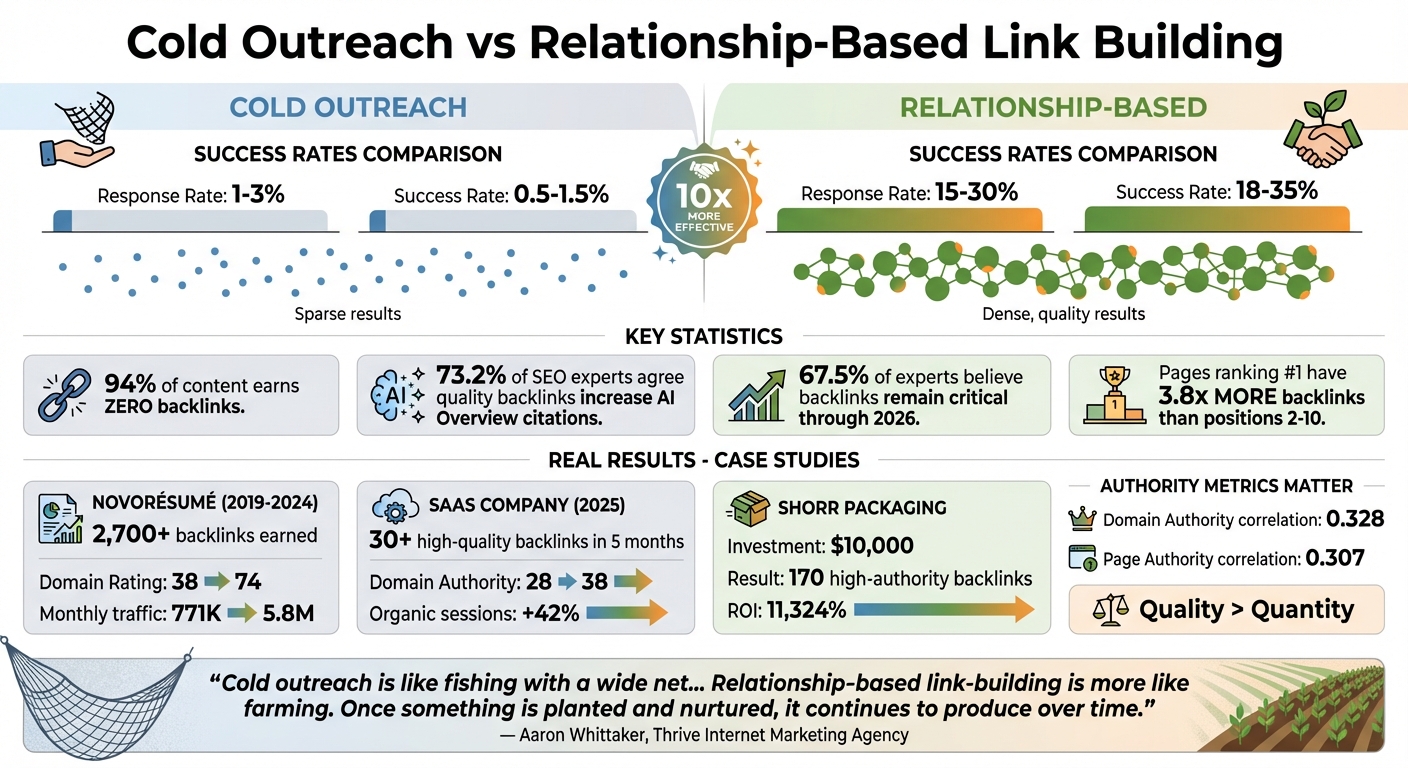
Cold vs Relationship-Based Link Building: Success Rates and ROI Comparison
Research Findings on Relationship-Based Link Building
Studies on Relationship-Driven Backlink Success
When it comes to link building, research consistently shows that building connections beats cold outreach by a long shot. Studies reveal that warm outreach to existing contacts yields response rates of 15% to 30%, compared to a mere 1% to 3% for cold link requests. That’s a staggering 10x difference.
Moz‘s findings highlight another key point: Domain Authority (0.328) and Page Authority (0.307) are stronger indicators of ranking success than the sheer number of links. This underscores the importance of quality over quantity – high-authority sites are far more likely to engage with people they trust rather than respond to generic pitches.
The data from Ahrefs adds another layer: 94% of all published content doesn’t earn a single external backlink. Building relationships can help you avoid becoming part of that statistic. For example, Adam Enfroy, between 2024 and 2026, used relationship-focused strategies to grow his site’s Domain Rating from 0 to 78. By prioritizing high-value editorial collaborations, he managed to attract over 500,000 monthly readers without relying on one-sided link requests.
Another study of 1,000 domains found a direct connection between high Authority Scores – fueled by quality backlinks – and frequent mentions in AI-generated results. In fact, 73.2% of SEO experts agree that high-quality backlinks increase the likelihood of being cited in AI Overviews. Relationships don’t just boost traditional SEO; they’re becoming critical for staying visible in an AI-driven landscape. These findings highlight the immediate benefits of this approach while also pointing to its long-term value.
The Role of Relationships in Long-Term Link Retention
Links built on genuine partnerships tend to stick around. They’re part of a larger story, rooted in shared interests and meaningful content, making them less likely to vanish during site updates, rebrands, or platform changes. These links endure because they’re earned, not bought.
This stability creates what many call the “flywheel effect.” One strong relationship doesn’t just result in a single link – it often leads to organic mentions across various platforms. In contrast, links secured through cold outreach are far less reliable. Even if you manage to get one, there’s no guarantee it will last. Transactional links are fragile, prone to disappearing when priorities shift or when algorithms flag them as manipulative. On the other hand, 67.5% of SEO experts believe backlinks will remain a critical ranking factor in 2026, but only when they’re built on trust, context, and editorial credibility.
“Cold outreach is like fishing with a wide net. … Relationship-based link-building is more like farming. Once something is planted and nurtured, it continues to produce over time.” – Aaron Whittaker, VP of Demand Generation, Thrive Internet Marketing Agency
With relationship-based links, the benefits grow over time. Unlike transactional links that often fade away, these connections create a compounding effect. And in a world where pages ranking #1 on SERPs have 3.8x more backlinks than those in positions 2 through 10, the quality and resilience of your link profile can make all the difference.
sbb-itb-88880ed
Case Studies: How Relationships Drive Link Building Success
Guest Posting Partnerships for Backlink Growth
In 2025, a mid-sized SaaS company (DA 28) teamed up with an industry media blog (DA 55) to grow their backlinks. Instead of relying on one-off guest post pitches, they established a structured collaboration. This included shared editorial calendars and regular meetings to align on topics. The results? Within five months, this relationship-focused strategy earned them 30+ high-quality backlinks, boosting their DA to 38 and driving a 42% increase in organic sessions.
“Beyond transactional exchanges, developing trust and alignment ensures longevity and more favorable editorial terms.” – Elena Marshall, Senior SEO Strategist, Link Authority Lab
The key to their success was mutual investment in understanding each other’s audience and maintaining high-quality standards. This approach not only cut content revision cycles in half but also reduced outreach time by 30%.
This example highlights how collaborative content initiatives can deliver exceptional results.
Collaborative Content and Reciprocal Linking
Another success story comes from Novorésumé, who partnered with LinkPitch on a collaborative content strategy between 2019 and 2024. The link-building team identified content gaps, such as the lack of resources on “networking tips”, and suggested filling them. This effort resulted in over 50 links from respected institutions like the University of Utah and University College Cork. Over five years, their efforts secured 2,700+ backlinks, raised their Domain Rating from 38 to 74, and grew monthly organic traffic from 771,420 to 5.8 million.
Shorr Packaging also demonstrated the power of relationship-driven link building. They invested $10,000 in original research and data-driven content, which they pitched to high-DA publications through personalized outreach. By focusing on mutual value, they earned 170 high-authority backlinks from major outlets like Forbes, CNBC, and Entrepreneur. This campaign delivered an 11,324% ROI, while significantly boosting brand visibility.
These examples show how prioritizing collaboration and long-term partnerships can lead to impressive link-building outcomes. By focusing on shared goals and quality, businesses can achieve lasting SEO success.
Using AI Platforms for Relationship-Based Link Building
How 3Way.Social Supports Relationship-Driven SEO
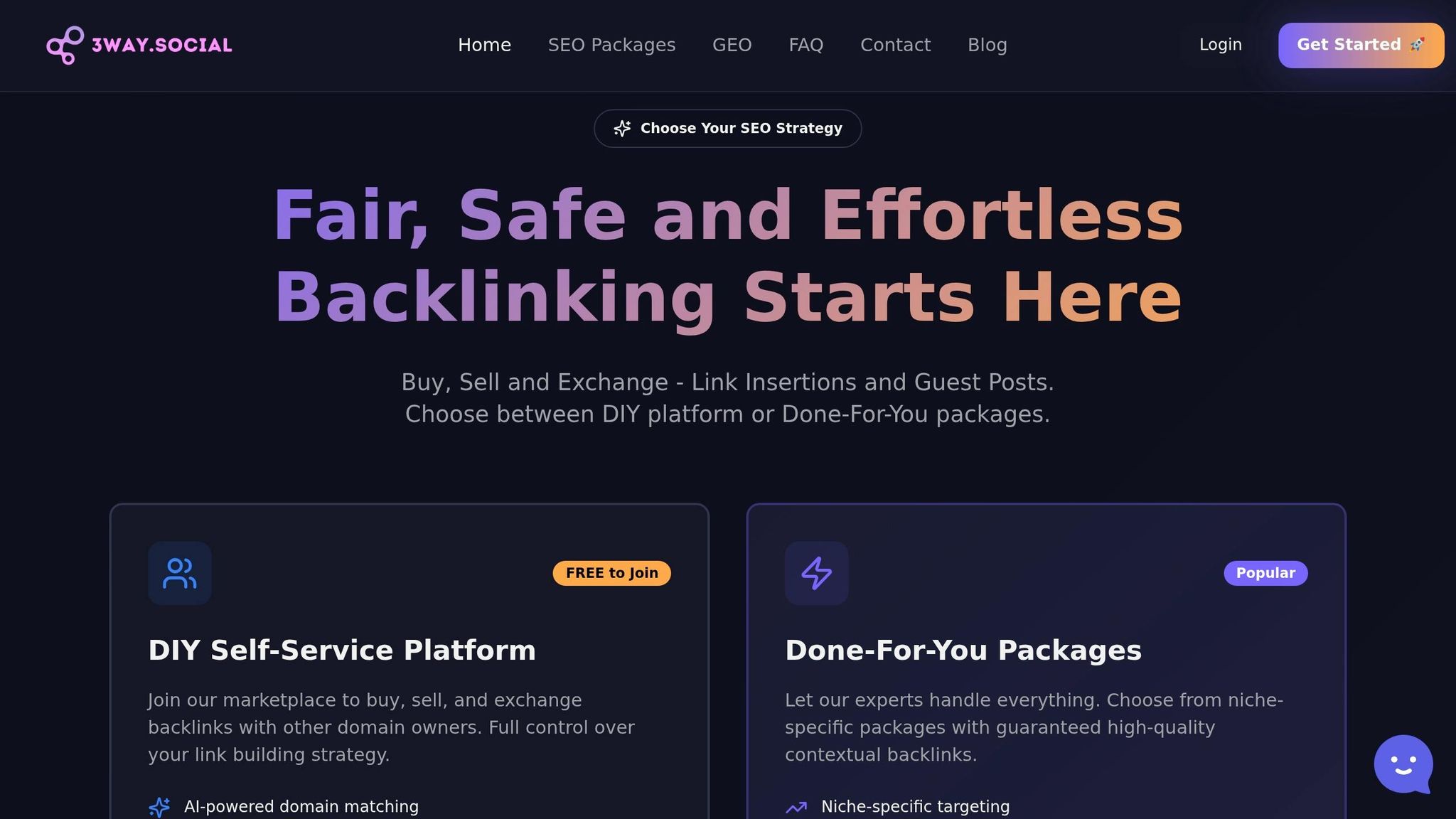
AI tools are changing the way SEO professionals build meaningful, long-lasting link partnerships. 3Way.Social simplifies ABC link exchanges – where Site A links to Site B, Site B links to Site C, and Site C links back to Site A. This method creates a natural-looking link structure that reflects authentic, relationship-driven growth.
The platform connects users with carefully selected partners in related niches. With its domain matching feature, it ensures that links are exchanged between sites that genuinely align in focus – an important step in staying resilient against algorithm updates. It also automates the monitoring process, keeping track of link placements and verifying “dofollow” status to maintain trust and ensure consistent performance. These features help build partnerships that last.
“Relationship-based approaches create a higher-quality pipeline with better conversion rates and longer-term value, whilst cold outreach provides speed and scale when you need immediate results.” – Sharon Thind, PR, POLARIS Agency
Warm outreach, supported by these tools, often leads to better success rates. It can even open up additional opportunities, like podcast invites or collaborative content projects. All of this makes for safer, more valuable backlink exchanges.
Benefits of AI-Powered Tools in Link Diversification
Expanding on its focus on relationships, 3Way.Social also supports link diversification through advanced AI features. This helps mimic the natural development of backlinks while reinforcing the strong connections built earlier.
AI platforms make it easier to find and connect with high-value partners for secure backlinks. 3Way.Social encourages SEO professionals to move away from risky direct reciprocal exchanges and instead adopt ABC patterns, which are less likely to raise red flags with search engines.
In 2026, the shift from transactional to relational link-building is becoming more prominent. Marketers are focusing on “farming” links through long-term partnerships rather than “fishing” with mass cold outreach. To get the best results, prioritize links from topically relevant sites, use a mix of branded and natural anchor text, and regularly check that links remain “dofollow” and active. While ABC exchanges are a safer choice than direct swaps, they should still be used thoughtfully to keep your backlink profile looking natural.
“Build relationships” before you link build – with Amit Raj
Conclusion: Building Relationships for Long-Term SEO Success
Research and case studies consistently highlight one key takeaway: successful link-building thrives on strong relationships. The move away from one-off, transactional link-building toward relationship-centered strategies isn’t just a passing phase – it’s a core shift in how search engines and AI platforms assess authority. For instance, while cold outreach might result in one link after contacting 50 sites, cultivating genuine relationships with 10 trusted peers can organically generate over 30 links over time. This ripple effect shows how investing in authentic connections pays off in the long run.
Digital PR has become the go-to tactic for nearly half (48.6%) of SEO professionals. Why? Because it focuses on creating assets that naturally attract attention – think original research, exclusive data, or visually engaging explainers. By offering value upfront, you build a network of trust where one solid connection can lead to multiple opportunities across various platforms.
Modern algorithms have evolved to evaluate more than just the number of backlinks. They dig into the context of each link, the authority of the source, and how your brand is discussed across credible sites. Even nofollow links, which were once dismissed, now carry weight in AI-driven visibility, often performing almost as well as follow links. This means that every authentic mention – link or not – can contribute to your online presence.
To keep up with these changes, SEO professionals need to expand how they measure success. Instead of focusing solely on metrics like Domain Authority vs Page Authority, consider tracking referral traffic quality, brand mentions in AI-generated content, and your share of voice in industry discussions. Tools like CRMs and a link building planner can help manage long-term partnerships, while platforms like 3Way.Social can assist in building natural, sustainable link patterns through fair exchanges.
Ultimately, the brands that achieve the greatest visibility are those that position themselves as trusted sources of knowledge – not just entities chasing links. Focus on creating content worth citing and nurturing advocates who believe in your value. The most impactful links come from genuine, mutually beneficial relationships.
FAQs
How do I turn cold outreach into warm outreach?
To make cold outreach feel more personal and effective, concentrate on creating authentic connections over time. Interact with your target’s content – comment on their posts, share their work, or engage in meaningful ways. Offer value upfront, whether that’s through sharing insights, providing helpful resources, or supporting their projects, before asking for anything in return. Skip the cookie-cutter templates and instead write customized messages that demonstrate you’ve taken the time to understand their work and highlight any mutual interests. By consistently showing genuine interest and building trust, you’ll not only improve your chances of earning quality backlinks but also open the door to lasting partnerships.
What should I track besides Domain Authority to measure link-building success?
To get a well-rounded understanding of your link-building strategy and its effect on SEO, don’t just focus on Domain Authority. Keep an eye on other key metrics like Page Authority, the total number of links, the diversity of linking root domains, the relevance of the linking page, and anchor text. Additionally, advanced metrics like Trust Flow and Citation Flow can offer deeper insights into the quality and trustworthiness of your backlinks.
Are ABC link exchanges safe for SEO if done carefully?
ABC link exchanges can be a safe part of your SEO strategy if handled carefully. The key is to prioritize contextually relevant backlinks from trusted, high-quality sources. But here’s the catch: going overboard or poorly managing these exchanges can put your site at risk of penalties. To stay on the right track, focus on moderation and always aim for quality over quantity.