Anchor text strategy in 2026: how to stop links looking spammy
Last Updated on October 12, 2026 by Becky Halls
Google finished rolling out its September 2026 spam update on 8 October. It took nearly 14 days, which is a long time for a spam update, and phase three landed around the 4th to the 6th (Search Engine Roundtable tracked the whole thing). The sites that got shaken weren’t the ones with too few links – A lot of them actually had plenty. Their problem was that every link pointed home with the exact same two or three keyword-stuffed words.
That’s an anchor text problem. And it’s the one bit of link building people still get lazy about.
What anchor text actually tells Google
Anchor text is the clickable words in a link. “Reformer pilates in Nottingham” is anchor text. So is “read more”, so is a bare URL, so is your brand name.
Google uses it as a context signal. When a few sites link to a page using similar language, that’s a hint about what the page is about. Useful. The trouble starts when the hint looks manufactured, because real editorial links almost never line up that neatly.
Here’s what most people miss about inbound anchors: you mostly can’t pick them. When a journalist or a blogger links to you, they write whatever they want. John Mueller made this point when someone asked him about the ideal mix of inbound anchor text.
“Usually that’s something you wouldn’t have control over anyway.” – John Mueller, Google, on Search Engine Journal
Read that as a tell. If your backlink profile is full of tidy, keyword-rich anchors, Google knows a human editor didn’t choose those words. You did. Or someone you paid did.
Why one anchor pattern gets you flagged
Ahrefs studied anchor text across 384,614 web pages, and the pattern in natural link profiles is messy on purpose. Brand mentions, naked URLs, random “click here” links, the odd exact-match phrase. Real links are scruffy.
Now picture a page where 80% of the backlinks say “best CRM software”. No real editor writes like that at scale. So when a spam update runs its detection over your profile, that uniformity is a flag. Not a guarantee of a hit, but a weight on the wrong side of the scale.
And it’s an expensive mistake to make on purpose. BuzzStream’s market data puts the average paid link insertion at around $141, and the ones people buy almost always come with an exact-match anchor baked in, because that’s what the buyer asked for. So you’re paying for the exact signal that gets you flagged!
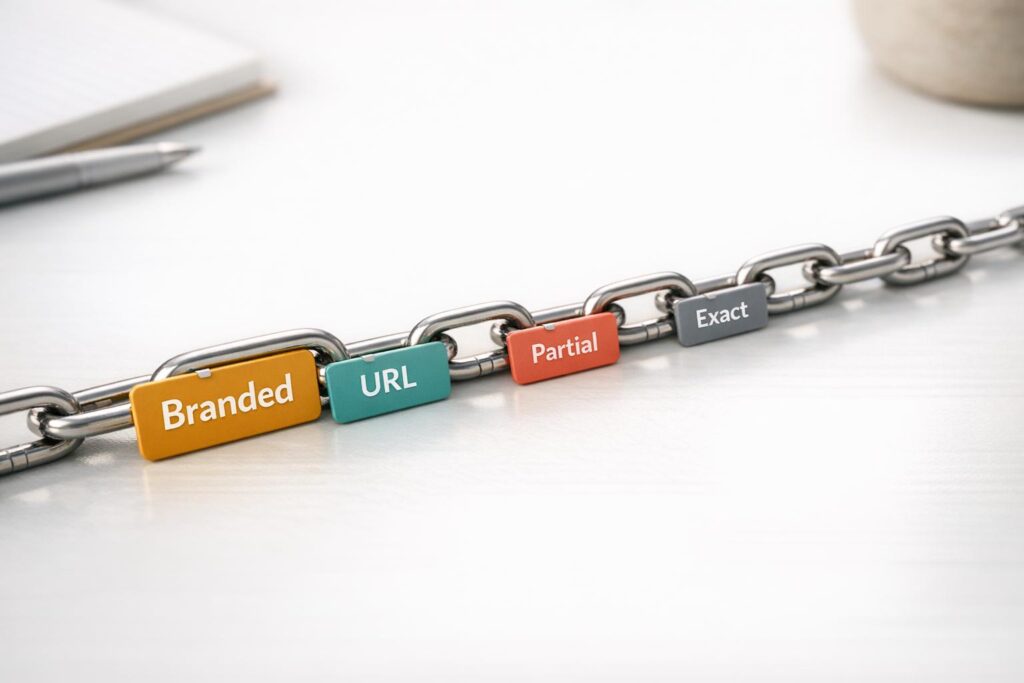
The anchor types, and roughly how they should sit
There’s no magic ratio. Anyone who gives you an exact percentage is guessing. But the shape of a healthy profile is well understood, so aim for variety over any single number.
Brand anchors
Your business name, or your name plus a word. “FLOW Reformer Studio”, “Becky Halls SEO”. These should be your biggest bucket. Real people link to you by name all the time, and brand anchors are basically impossible to over-optimise.
Naked URLs
Just the link itself, like flowreformerstudio.co.uk. Common in forum posts, directories, citations. Totally natural, and they add bulk without risk.
Partial-match anchors
A phrase that includes some of your target words but reads like a human wrote it. “Becky’s guide to local SEO” rather than “local SEO Nottingham”. This is where you get topical relevance without the spam smell.
Exact-match anchors
The target keyword, word for word. “reformer pilates Nottingham”. These still carry weight, which is why people abuse them. Use them rarely and only where they read naturally in the sentence.
Generic and topic anchors
“Read the full study”, “this breakdown”, “more on that here”. They look like nothing and they’re worth more than people think, because this is how actual editors link.
The quick test: read the sentence around the link out loud. If it sounds like a press release wrote it, change the anchor.
“When I audit a client’s backlinks, I don’t start with the number of links. I start with the anchors. If I see the same money phrase 30 times, I know two things straight away: someone bought those links, and we’ve got cleanup to do before we build anything new.” Becky Halls, Strategist 3Way.Social
What this means for link exchanges and partnerships
If you’re building links through partnerships or exchanges, anchor text is the part you have to actively manage, because now you do control it. That’s a gift and a trap.
Set a rule for your own team and your partners: brand and partial anchors by default, exact-match only when the surrounding content genuinely calls for it. Vary the wording every single time. If you’re placing five links this month, they should read like five different people wrote them, because the whole point is that it looks like they did.
And relevance beats the anchor every time. A link from a site your audience actually reads, with a plain brand anchor, is worth more than a keyword-perfect anchor from a site about nothing in particular.
“The whole industry spent a decade treating anchor text like a slider you crank up for more rankings. That era’s over. The platforms that last are the ones matching sites on relevance first and letting the anchors stay natural. Boring, maybe. But boring survives the updates.” Ian Naylor, Founder 3Way.Social
A 20-minute anchor audit you can run today
You don’t need a big budget for this. Pull your backlink profile from Ahrefs, Semrush or Google Search Console and do four things.
First, export your anchors and sort by frequency. Look at the top 10. If one keyword-rich phrase dominates, that’s your risk.
Second, work out roughly how much is branded. If it’s a thin slice, your profile looks bought even if it isn’t.
Third, flag any exact-match anchors sitting on low-quality or irrelevant sites. Those are the ones to disavow or get removed.
Fourth, before your next campaign, write out the anchors you’ll use and make sure no two are the same. Takes five minutes and saves you a cleanup later.
Do that once a quarter and you’ll never be the site that panics every time a spam update rolls out.
Anchor text strategy in 2026 – FAQ
What’s a safe anchor text ratio in 2026?
There isn’t a fixed one, and I’d be suspicious of anyone who quotes you exact numbers. Lean heavily on brand and naked URL anchors, use partial-match for relevance, and keep exact-match rare. Variety is the actual target, not a percentage.
Can over-optimised anchor text get my site penalised?
It can contribute. A profile where most links use the same keyword-rich anchor is a classic manipulation pattern, and spam updates look for exactly that. It’s rarely the only factor, but it’s an easy one to fix.
Should I disavow links with bad anchor text?
Only if they’re from genuinely spammy or irrelevant sites and you can’t get them removed. A few odd exact-match anchors from decent sites are normal. Don’t disavow your way into a thinner, scarier-looking profile.
Do internal links follow the same rules?
Internal links are different, because you control the whole site, so descriptive anchors that match the page are fine and useful there. The over-optimisation worry is mostly about inbound links from other sites.
Does anchor text still matter for rankings at all?
Yes. It’s still a context signal. It matters less than it did in 2015, and relevance of the linking site matters more, but it hasn’t gone away. Treat it as one lever among many, not the whole machine.
Becky Halls is a Strategist at 3Way.Social, where she works on link building campaigns and content strategy for clients who’d rather rank than gamble. She also works on Local SEO in Nottingham.