Ahrefs vs. Majestic: Backlink Reporting Features
Compare Ahrefs' real-time backlink tracking and tools with Majestic's deep historical link metrics to choose the right reporting tool.

Last Updated on October 9, 2026 by Becky Halls
Ahrefs and Majestic are two popular tools for backlink analysis, but they cater to different needs. Ahrefs focuses on real-time backlink tracking, offering features like Domain Rating (DR), URL Rating (UR), and detailed filters for link attributes. It updates its index every 15–30 minutes and includes tools like Site Explorer and New/Lost Links reports, making it ideal for ongoing SEO strategies. Majestic, on the other hand, emphasizes long-term link data with its dual-index system: the Fresh Index (last 120 days) and Historic Index (dating back to 2006). It uses Trust Flow (TF) and Citation Flow (CF) to assess link quality and relevance, with niche-focused metrics like Topical Trust Flow.
Ahrefs vs. Majestic – Quick Takeaways:
- Ahrefs: Best for real-time updates, comprehensive SEO features, and user-friendly dashboards. Pricing starts at $129/month.
- Majestic: Best for historical data, link-quality insights, and niche-specific analysis. Pricing starts at $49.99/month.
Quick Comparison:
| Feature | Ahrefs | Majestic |
|---|---|---|
| Focus | SEO suite with backlink analysis | Specialized in backlinks |
| Data Freshness | Updates every 15–30 minutes | Daily updates (Fresh Index) |
| Historical Coverage | 6 months–5 years (plan-dependent) | Since 2006 (Historic Index) |
| Metrics | DR, UR | TF, CF, Topical Trust Flow |
| Best For | Broad SEO strategies | Link-building specialists |
| Starting Price | $129/month | $49.99/month |
Choose Ahrefs for a wide range of SEO tasks and Majestic if your primary focus is backlink analysis.
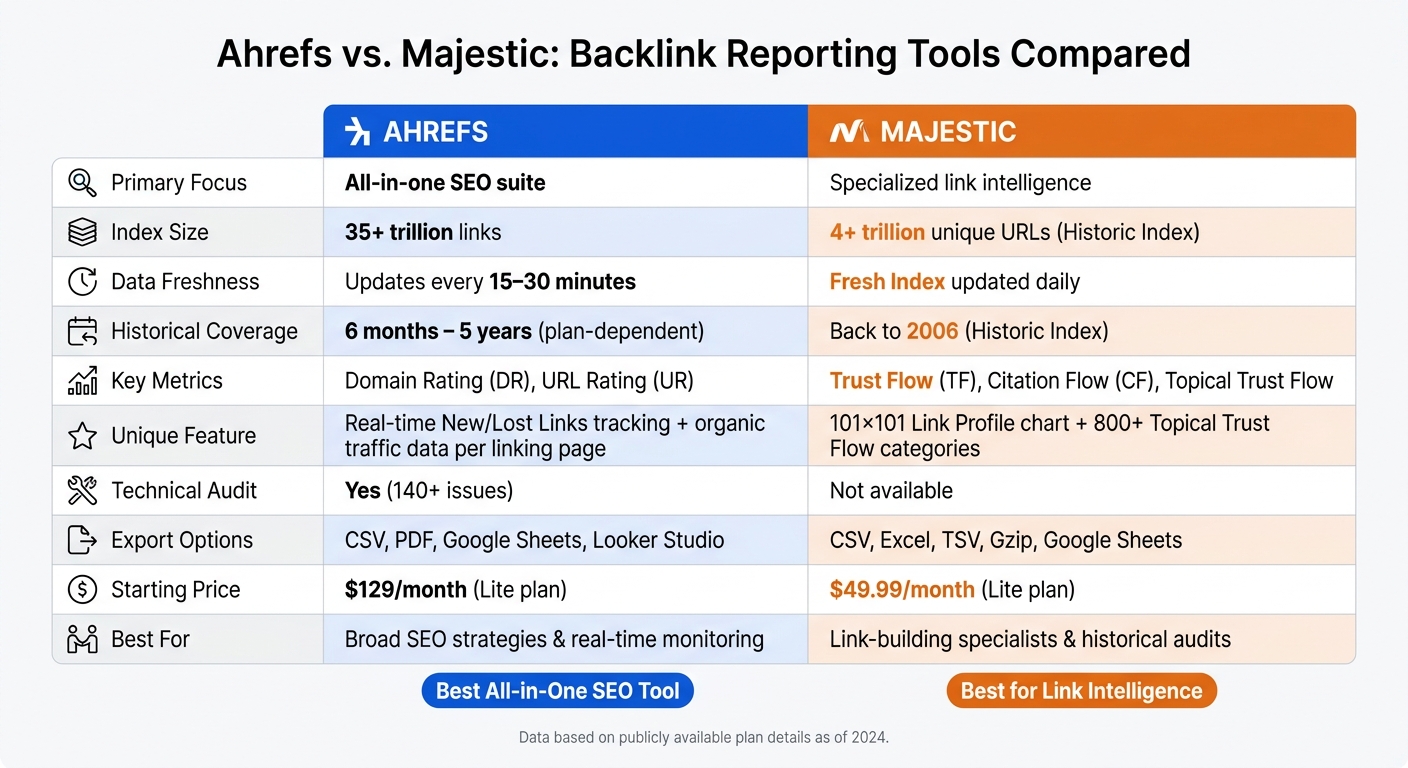
Ahrefs vs. Majestic: Backlink Tool Comparison
Ahrefs Vs Majestic: Which Is The Best Backlink Checker?
sbb-itb-88880ed
Ahrefs vs. Majestic Backlink Reporting Scope: What Each Tool Covers
Ahrefs and Majestic both excel in backlink tracking and monitoring, but their approaches couldn’t be more different. Ahrefs is designed as a comprehensive SEO tool, while Majestic focuses solely on link intelligence. This core distinction shapes how each platform collects, organizes, and presents backlink data. Let’s break down how these differences impact their reporting capabilities.
Core Backlink Indexes
Ahrefs boasts an index of over 35 trillion links. On the other hand, Majestic uses a dual-index system: the Fresh Index, which covers the last 120 days, and the Historic Index, which dates back to 2004.
When comparing their outputs, Majestic tends to prioritize quantity. For instance, in one test, it identified 17,722,241 backlinks compared to Ahrefs’ 8,551,709. However, Ahrefs leans more toward quality and recency in its data.
Next, let’s see how they handle referring domains and anchor text analysis.
Referring Domains and Anchor Text Analysis
Ahrefs evaluates referring domains using Domain Rating (DR) and URL Rating (UR). Its Anchors report categorizes links into types such as Exact Match, Phrase Match, Branded, and Naked URL. It even highlights the surrounding text near a link, which is especially helpful when the anchor text itself is vague.
Majestic, meanwhile, uses Trust Flow (TF) and Citation Flow (CF) to assess domain quality and influence. One standout feature is its Topical Trust Flow, which organizes backlinks into over 700 topic categories. This helps identify not just the number of referring domains but also their relevance to the site’s niche.
“A domain with DR 70 but TF 15 likely built links through volume rather than quality… high CF with low TF signals potential spam.” – AEO Engine Blog
Link Discovery and Historical Data
Update frequency plays a key role in how quickly users can respond to changes. Majestic’s Fresh Index updates daily, making it ideal for regular reporting.
However, historical depth is where Majestic truly shines. Ahrefs restricts historical data based on plan tiers – from 6 months on Lite plans to 5 years on Advanced plans. In contrast, Majestic’s Historic Index has no such limitations, offering a comprehensive view of a domain’s entire link history.
“Majestic’s Historic Index also allows users to track backlink growth over time, offering a deeper perspective on long-term link-building trends.” – Arman Advani, Director of SEO Strategist, Search Atlas
Ahrefs Reporting Features
Ahrefs revolves around its central tool, Site Explorer – a go-to resource for many SEO professionals, especially for backlink analysis. With one of the most active crawlers in the industry, it maintains an extensive and frequently updated backlink index.
Site Explorer and Backlink Reports
With Site Explorer, you can dive into any domain, URL prefix, or specific page. Its Backlink Profile report organizes inbound links by referring page, anchor text, and target URL. You can also apply filters for link attributes like Dofollow, Nofollow, UGC, or Sponsored, making it easier to differentiate between links that pass authority and those that don’t.
What makes this tool stand out is its inclusion of estimated organic traffic data for each linking page. This means you’re not just identifying who links to you but also whether those pages attract visitors. That’s a critical factor when deciding which backlinks hold the most value.
“Site Explorer is often near the top of the list… It is efficient. It tends to give useful answers quickly.” – ALM Corp
This level of detail also supports long-term monitoring, helping you monitor back links to track how your link profile evolves over time.
Lost and New Links Tracking
Ahrefs keeps you updated with its New and Lost Links report, which is particularly handy for spotting link drops early. Whether a link disappears due to a page removal, a redirect issue, or an accidental noindex tag, this report ensures you catch it quickly.
The “Link restored” filter is another useful feature, highlighting links that were previously lost but have been recovered. This eliminates the need for tedious manual checks, giving you a clear view of successful link reclamation efforts.
With these real-time tracking capabilities and export options, you can seamlessly integrate insights into your reporting process.
Export and Data Visualization Options
Ahrefs offers flexibility with its reporting, allowing you to export data as CSV or PDF files. Additionally, the Export to Google Sheets feature is being rolled out across the platform. For teams managing client dashboards, the platform’s Looker Studio connectors let you integrate backlink stats, history charts, and referring domain data into external reports. You can even combine this data with GA4 or CRM information for a well-rounded view.
Interactive history charts provide a visual representation of the rise or fall of referring domains over time. These charts also include overlay notes for Google algorithm updates, making it easy to connect backlink trends with major search engine changes. For those who need tailored, automated dashboards, Ahrefs offers a Report Builder add-on for $99/month.
Majestic Reporting Features
While Ahrefs focuses on speed, Majestic prioritizes historical depth and unique link quality metrics to deliver detailed insights.
Fresh Index and Historic Index
Majestic uses two distinct indexes for its reporting.
The Fresh Index, updated almost daily, tracks links discovered within the past 120 days. This index is perfect for monitoring the immediate effects of link-building campaigns or assessing the short-term impact of a press release.
The Historic Index, available with the Pro plan ($99.99/month) and higher, contains an archive of over 4 trillion unique URLs dating back to June 2006. This extensive database is a valuable resource for tasks like auditing a domain before purchase, creating a disavow list after a Google penalty, or identifying harmful links that could be affecting rankings.
“The Historic Index can be used as a toxic backlink audit tool to help clients recover from penalties and build Disavow lists for Google.” – Majestic
By combining the Fresh and Historic Indexes, Majestic enables users to compare a site’s current link profile with its historical trends. This dual-index approach provides insights that single-index tools simply can’t match. Together, these indexes form the backbone of Majestic’s detailed link profile summaries and anchor text analysis.
Link Profile Summaries and Anchor Text Reports
Majestic uses two proprietary metrics to evaluate backlinks: Trust Flow, which measures link quality, and Citation Flow, which measures link quantity. A significant mismatch – such as a high Citation Flow paired with a very low Trust Flow – can indicate a spammy or manipulated link profile.
A standout feature is the 101×101 Link Profile chart, which plots backlinks based on Trust Flow (y-axis) and Citation Flow (x-axis). A natural, healthy backlink profile often creates a “flame” shape on this chart.
For anchor text analysis, Majestic categorizes links by frequency and distribution, making it easier to detect over-optimization or unnatural patterns. The Topical Trust Flow feature further enhances analysis by classifying backlinks into over 800 topic categories, showing which industries or niches contribute to a site’s authority.
“The data that you get from Majestic is perhaps the best and cleanest in the industry.” – Ross Tavendale, Type A Media
Export and Visualization Tools
Majestic provides flexible data export options, including CSV and PDF formats, with additional features available for Pro plans. Larger datasets can also be downloaded as compressed Gzip files.
For those who prefer visual data, Majestic offers the Link Graph tool, which creates an interactive visualization of a site’s link neighborhood. This tool highlights tier 2, 3, and 4 backlinks, helping users uncover link networks or spam clusters that might be overlooked in a standard URL list.
“The Link Graph means I can look right into link networks. It’s much more digestible than a large list of sites and pages.” – Lydia Fox, Offpage SEO consultant
Majestic also includes visual outputs like scatter plots, link graphs, and backlink history charts, making it easier to share findings with clients or stakeholders. The Full Export, updated in 2020, now uses standardized column headers, simplifying the process of integrating Majestic data into other tools or internal reporting workflows.
Cross-Platform Reporting Comparison
Ahrefs and Majestic take very different approaches to backlink reporting. Ahrefs is an all-in-one SEO platform where backlink analysis is just one piece of the puzzle. Majestic, on the other hand, is laser-focused on backlinks, making it a specialized tool for link intelligence. This fundamental difference shapes how each platform presents data and the value it provides to users. Let’s break down these distinctions further.
Ahrefs stands out for its user-friendly interface. Its interactive dashboards make it easy to drill down into specific metrics, which is great for users who want a streamlined experience. Majestic, however, leans toward a data-heavy, static interface, which may appeal more to advanced users who prefer detailed, granular insights.
“Ahrefs is just easier to navigate… Ahrefs beats Majestic here, offering ample opportunities for SEOs to dig into those settings and strengthen the backlink profile.” – Renee DeCoskey, Freelance Content Writer
Where Majestic shines is in its historical data and specialized link intelligence. It offers extended archives that go back further than Ahrefs, making it ideal for tasks like acquisition audits or penalty recovery. This historical perspective is crucial when analyzing how algorithm updates affect backlink strategies over time. Ahrefs counters this with real-time crawling, updating its index every 15–30 minutes. It also captures a broader range of data, including JavaScript-rendered links, which Majestic doesn’t track.
Ahrefs vs. Majestic: Reporting Features Comparison Table
| Feature | Ahrefs | Majestic |
|---|---|---|
| Primary Focus | All-in-one SEO suite | Specialized link intelligence |
| Report Depth | 77 data points per link | Link Context, Topical Trust Flow |
| Data Freshness | Every 15–30 minutes | Fresh Index updated daily |
| Historical Coverage | 6 months–5 years (plan-dependent) | Back to 2006 via Historic Index |
| Filtering | Advanced (e.g., JS link filters) | Topical, language, and industry filters |
| Visualization | Interactive dashboards, charts | Link Graph, Flow Metric charts |
| Export Options | CSV, Excel; high row limits | CSV, Excel, TSV, Google Sheets |
| Technical Audit | Comprehensive (140+ issues) | Not available |
| API Access | Enterprise plan; Looker Studio support | Open Apps, GitHub connectors |
Majestic offers some standout features for agencies, like the ability to upload up to 1 million websites in bulk for metrics extraction via CSV. This makes it a solid choice for managing large-scale client portfolios. Ahrefs, meanwhile, keeps many of its advanced reporting tools within its ecosystem, encouraging users to upgrade to higher-tier plans for API access.
“If you need one tool to run your entire SEO operation, Ahrefs wins. If you are a link-building specialist… Majestic’s narrow focus becomes its strength.” – AEOEngine Team
Reporting for Backlink Performance
Link Growth and Loss Analysis
Using a backlink monitoring tool to track growth and loss is a key part of managing SEO efforts. Ahrefs offers New and Lost backlink reports that update every 15–30 minutes. This near real-time data is especially useful for keeping tabs on outreach campaigns and catching any unexpected drops in backlinks. These reports provide a solid foundation for assessing domain performance and exporting data for further analysis.
Majestic’s Backlink History tool takes a broader view, showcasing link acquisition trends across up to 10 domains. It offers three charting options:
- Daily: Highlights spikes in link activity.
- Cumulative: Shows long-term growth trends.
- Normalized: Measures link efficiency per million pages.
The tool’s data stretches all the way back to 2004, giving users a comprehensive perspective.
“Majestic’s Backlink History tool tracks the number of new backlinks acquired over time and provides critical insights into the referring domains contributing to the website’s backlink profile.” – Majestic
Domain-Level Reporting and Stakeholder Exports
While tracking individual link changes is important, analyzing overall domain performance gives a clearer picture of SEO health. At this level, Ahrefs uses Domain Rating (DR) to measure link strength, while Majestic relies on Trust Flow (TF) and Citation Flow (CF) to distinguish between quality-driven and volume-driven backlink growth.
Vijay Jacob, Founder of AEOengine.ai, explains the significance of these metrics:
“A domain with DR 70 but TF 15 likely built links through volume rather than quality. A domain with balanced TF/CF ratios (both around 40) often shows natural link growth.”
Both platforms make it easy to share insights with stakeholders through export options. Majestic supports downloads in formats like Excel, CSV, and TSV, along with automated reporting schedules. Ahrefs offers its Report Builder add-on, enabling PDF and CSV exports, as well as integration with Looker Studio. For enterprise users, Ahrefs also includes SSO support, streamlining access for large teams.
Choosing the Right Tool for Your Reporting Needs
Matching the Tool to Your Use Case
When deciding between Ahrefs vs. Majestic, it all comes down to what you need. If you’re looking for a tool that handles a variety of SEO tasks, including backlink analysis, rank tracking, technical audits, and keyword research, Ahrefs is a solid choice. Its near real-time updates make it a go-to for those who need up-to-date SEO insights across multiple areas. On the other hand, Majestic shines for its deep historical link data and niche-specific metrics. With its Historic Index dating back to 2006 and over 21 trillion unique URLs, it’s a treasure trove for link-building specialists who want a detailed look at past link trends. Metrics like Topical Trust Flow help assess whether backlinks align with specific niche topics.
For those focused solely on backlink analysis, Majestic offers great value, especially at its starting price of $49.99 per month for the Lite plan. In contrast, Ahrefs, with its broader SEO capabilities, comes at a higher cost of $129 per month for its Lite plan. Ultimately, if you need a specialized tool for link intelligence, Majestic is a strong pick. But for a more versatile SEO toolset, Ahrefs is worth the investment.
“I do believe that Majestic is the master of link building intelligence.” – Andrew Stubbs, LKOA SEO
Other Tools That Work Alongside These Platforms
While Ahrefs and Majestic are excellent for measuring backlinks, they don’t actually build them. That’s where complementary platforms come into play. For example, 3Way.Social is an AI-powered platform designed to enhance your link-building efforts. It focuses on facilitating ABC link exchanges by connecting you with a network of vetted SEO professionals. Through domain-matched placements, you can secure permanent do-follow backlinks, which directly improve metrics like Domain Rating, Trust Flow, and Citation Flow.
Conclusion: Picking the Best Backlink Reporting Tool
So… Ahrefs vs. Majestic?? After analyzing the features, it’s clear that the right backlink reporting tool depends on your SEO goals. Ahrefs provides an all-in-one solution with real-time data, while Majestic focuses on historical insights and specialized link-quality metrics. Each tool caters to distinct SEO workflows.
“Choose Ahrefs if you want a complete SEO tool with excellent backlink data. Go with Majestic if specialized backlink analysis is your only priority.” – Paul Vengeons, Co-Founder & SEO Consultant, ChatSEO
Ahrefs stands out for its versatility and real-time monitoring, making it ideal for those managing broad SEO strategies. On the other hand, Majestic excels in evaluating link quality and historical trends, perfect for specialists. Pricing reflects these differences: Majestic’s Lite plan at $49.99/month is a budget-friendly choice for those focused solely on backlink analysis, while Ahrefs’ higher cost covers its extensive range of features.
For agencies, using both tools can offer a competitive edge. Ahrefs can handle tasks like real-time link monitoring and competitive analysis, while Majestic’s Trust Flow and Topical Trust Flow metrics help refine outreach strategies. Together, they provide a well-rounded approach to backlink performance reporting.
Ultimately, the best tool is the one that aligns with your specific SEO needs. Choose based on your workflow and priorities, ensuring the tool works for you – not the other way around.
Ahrefs vs. Majestic FAQs
How do DR/UR and TF/CF compare?
When it comes to evaluating backlink profiles, Ahrefs and Majestic offer two distinct sets of metrics: DR/UR from Ahrefs and TF/CF from Majestic.
- DR (Domain Rating) and UR (URL Rating): These metrics from Ahrefs measure the authority of a domain or a specific page. They take into account both the quality and quantity of backlinks, providing a real-time overview of a website’s backlink strength.
- TF (Trust Flow) and CF (Citation Flow): Majestic’s metrics focus more on the trustworthiness and influence of backlinks. While Trust Flow assesses the quality of links, Citation Flow focuses on their volume, offering a more historical perspective.
Ahrefs excels in delivering a broader, up-to-the-minute view of backlink profiles, while Majestic shines with its detailed, trust-oriented analysis over time. Both tools bring unique insights, making them valuable for different aspects of SEO strategy.
Which tool finds new or lost links faster?
Ahrefs stands out for its speed in detecting new or lost links, thanks to its frequently updated crawler, AhrefsBot, which refreshes backlink data every 15 to 30 minutes. On the other hand, Majestic emphasizes historical backlink data and offers instant analysis, but it doesn’t match the same rapid update frequency. For those needing near-real-time tracking, Ahrefs tends to be the quicker option.
When should I use historic backlink data?
Analyzing historic backlink data is a smart way to uncover long-term trends in a website’s backlink profile. By digging into this data, you can evaluate how past SEO strategies have performed, monitor the growth of backlinks over time, and spot patterns that could shape future campaigns.
This approach is particularly useful for understanding the stability and quality of backlinks. It helps you make better decisions about which links to build, which low-quality links to disavow, and how to use past trends to boost rankings and organic traffic. In short, it’s about learning from the past to create a stronger strategy moving forward.