Future of Link Exchange Platforms
AI-driven link exchange platforms automate safe ABC exchanges, vet domains, and boost ROI while cutting manual outreach time.

Last Updated on October 9, 2026 by Becky Halls
Link exchange platforms have evolved significantly, moving from manual processes to AI-powered tools that save time and improve results. AI now plays a key role in automating backlink strategies, offering faster outreach, better quality control, and safer alternatives like three-way link exchanges. Here’s what you need to know:
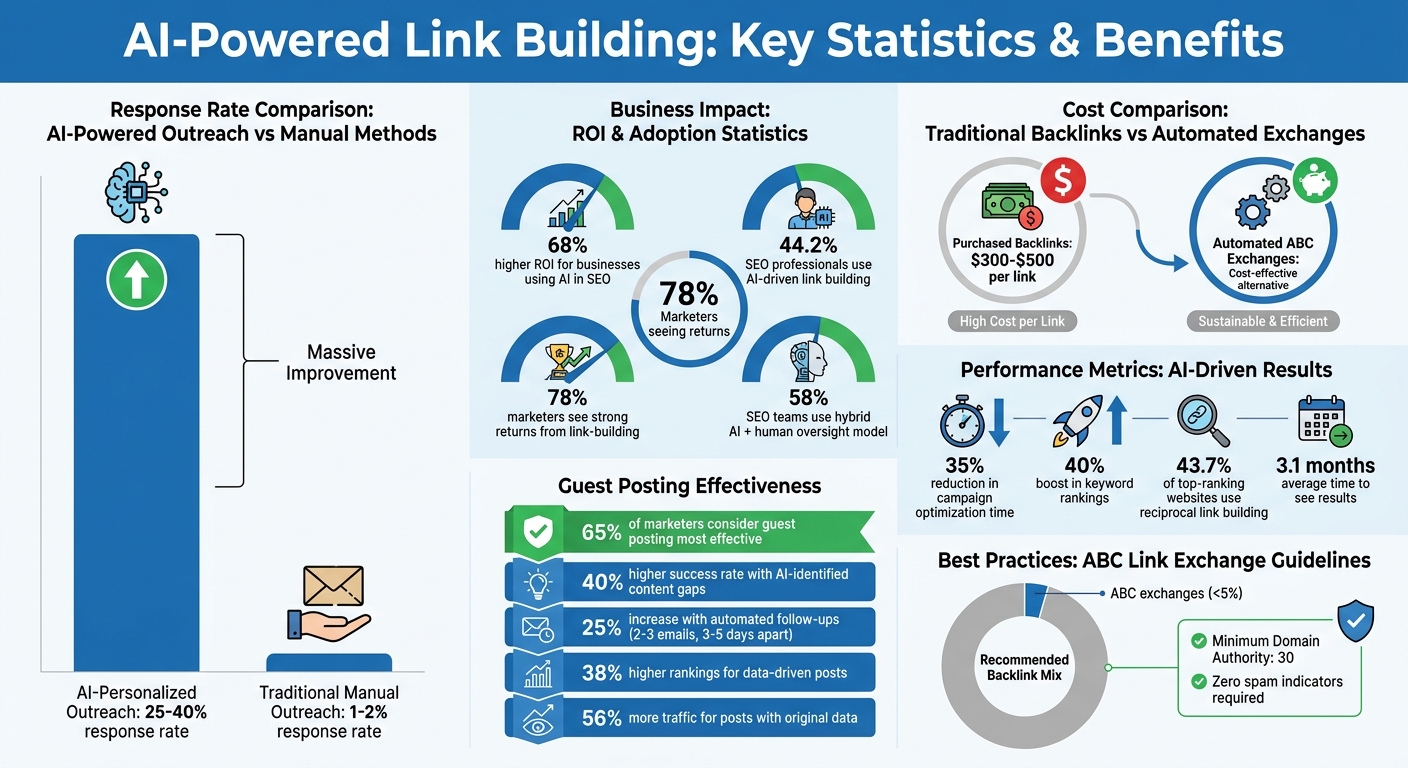
- AI-Powered Outreach: Personalized emails now achieve response rates of 25–40%, compared to 1–2% for manual efforts.
- Three-Way Link Exchanges: This approach avoids direct reciprocity, reducing penalties from search engines.
- Automation Benefits: AI tools analyze domain authority scores, relevance, and spam scores in seconds, ensuring high-quality exchanges.
- Cost-Effective Solutions: Automated exchanges are cheaper than purchasing backlinks, which can cost $300–$500 each.
- Ongoing Monitoring: AI tracks link health, ensuring compliance and avoiding issues like link rot or over-optimization.
Platforms like 3Way.Social are leading this shift, combining automation with advanced quality filters to simplify link-building. SEO teams using AI report higher ROI, faster results, and improved rankings. As search engines become smarter, relying on AI tools is no longer optional but essential for staying competitive.
AI-Powered Link Building Statistics and ROI Comparison 2025
How to Build Backlinks With AI (High Quality Links)
sbb-itb-88880ed
How AI Is Changing Link Exchange Platforms
AI is transforming the way link exchange platforms operate by automating tasks that used to require significant manual effort. Instead of spending hours vetting potential link partners and coordinating arrangements, AI tools now analyze domain authority, topical relevance, and niche alignment in mere seconds. This automation is crucial as search engine algorithms increasingly penalize low-quality or irrelevant link exchanges.
One area where this shift is especially clear is in ABC (three-way) link exchanges. These exchanges, which involve three parties to avoid direct reciprocity, are notoriously complex to manage manually. AI simplifies this by automating the discovery of partners, tracking who owes links to whom, and monitoring link statuses in real time. This creates a linking pattern that appears more natural, avoiding the obvious footprints of traditional reciprocal swaps.
AI has also raised the bar for quality control. Advanced filters now identify and block link farms, Private Blog Networks (PBNs), and high-spam-score sites that could lead to penalties from Google. These systems continuously check if links remain live, detect changes like follow and nofollow links being switched, and monitor anchor text diversity to ensure profiles look authentic. Around-the-clock monitoring prevents issues like “link rot” and ensures all partners fulfill their commitments.
AI-Powered Domain Matching
AI takes link partner matching to a whole new level by analyzing multiple factors simultaneously. It evaluates domain authority, traffic, relevance, and industry alignment to ensure all participants in an exchange offer comparable value. This kind of automated analysis is far more advanced than manual checks, as it identifies patterns across thousands of data points that people might overlook.
Additionally, AI screens for spam scores and sudden drops in authority, which can indicate penalized sites. By filtering out low-quality domains before they even enter the network, AI helps participants avoid penalties by association. Platforms like 3Way.Social use these AI-driven tools to maintain carefully vetted networks, ensuring that every participant meets strict standards for safe and effective link exchanges.
ABC Link Exchanges: Benefits and Implementation
ABC link exchanges offer clear advantages over traditional two-way swaps. Studies show that around 43.7% of top-ranking websites engage in some form of reciprocal link building. However, simple A-B exchanges can leave patterns that search engines flag as unnatural. The triangular structure of ABC exchanges avoids this issue, making the links appear more organic.
The financial benefits are equally compelling. Purchasing high-quality backlinks can cost between $300 and $500 per link, but automated ABC exchanges provide a cost-effective alternative. AI handles the intricate tracking of who owes links to whom, ensuring fairness across participants. It also keeps an eye on anchor text diversity and do-follow/no-follow ratios, reducing the risk of over-optimization that could attract penalties. Some platforms even offer four-way or five-way exchange loops, further minimizing detection risks while delivering the same SEO benefits as traditional backlinks.
With these advancements, AI is not just simplifying link exchanges but also making them safer and more effective. The next section will explore how automated algorithms take link discovery and quality control to the next level.
Automation and Quality Control in Link Exchanges
Automation has transformed how link exchanges are managed, making it easier to maintain quality while reducing the need for constant manual oversight. Traditionally, manually reviewing sites for exchanges was both time-consuming and prone to mistakes. Automation eliminates these issues by continuously checking multiple quality metrics. For example, systems can pull real-time data on metrics like Domain Authority (DA), Page Authority (PA), and Domain Rating (DR) to ensure exchanges occur between sites of similar value. They also flag any sudden drops in traffic or increases in spam scores, which could signal that a site has been penalized.
The benefits of automation don’t end with the initial exchange. These systems monitor links around the clock, sending alerts if a partner removes a link or changes it from do-follow to no-follow. They can also identify overuse of identical anchor text and suggest alternative options to keep your strategy diverse. These tools lay the groundwork for automated link discovery, taking your backlink strategy to the next level.
Algorithms for Automated Link Discovery
Building on quality control, advanced algorithms now make link discovery faster and more precise. Instead of relying on simple keyword matching, automated link discovery uses contextual AI analysis to evaluate whether two sites are a good fit. These algorithms analyze content themes, user intent, and industry relevance, ensuring that exchanges align with SEO goals. For instance, a fitness blog would be matched with health-related sites like nutrition platforms or fitness equipment companies, rather than irrelevant niches that could harm SEO performance.
These systems also provide ongoing competitor intelligence. By tracking where competitors acquire backlinks, they can uncover new opportunities and recommend high-quality partners. This approach saves significant time – what once took days of manual research can now be completed in minutes. Early adopters of AI-driven SEO strategies have reported a 35% reduction in campaign optimization time and up to a 40% boost in keyword rankings. The time savings and performance improvements are game-changing.
Vetted Networks and Quality Filters
Automation also plays a critical role in creating trusted networks for link exchanges. Before approving any site, automated filters screen for potential risks like link farms, private blog networks (PBNs), or high spam scores. These systems enforce strict criteria, such as requiring a minimum DA of 30 and zero spam indicators, to ensure that only clean, reputable sites are included. This protects your site from penalties caused by poor-quality associations.
Platforms like 3Way.Social have built networks where every participant is pre-screened using these automated filters. This eliminates the need for manual vetting, creating a secure and efficient environment for link exchanges. Additionally, these platforms track “link debt” during ABC link exchanges, ensuring fairness by monitoring who owes a link and sending reminders if commitments aren’t met. This CRM-like approach keeps exchanges transparent and ethical, all while maintaining the natural appearance that search engines value.
Link Diversification Strategies
Building a diverse backlink profile is crucial for maintaining strong rankings and avoiding penalties from search engines. The goal is to mix up your link types, anchor texts, and sources so your profile looks natural instead of artificially constructed. These days, AI tools can simplify this process by analyzing your existing backlinks and recommending the right combinations to keep everything balanced.
Experts suggest that ABC link exchanges should make up no more than 5% of your total backlink profile to maintain a natural look. The rest should come from a mix of strategies like guest posts, digital PR, and directory submissions, which reflect how a website’s link profile might naturally evolve. By layering in AI-powered tools, you can take this strategy to the next level.
AI-Driven Link Diversification
AI tools are now capable of managing and fine-tuning your backlink profile for better diversification. Instead of manually keeping track of anchor texts or the domains you’ve worked with, these platforms analyze factors like anchor text distribution, timing of link placements, and variety of sources. This ensures your link patterns appear organic and balanced. They even rotate through strategies like 2-way swaps, 3-way loops, and guest post integrations to avoid any single tactic dominating your profile.
Newer platforms are also designed to adapt to the needs of Answer Engine Optimization (AEO) and Generative Engine Optimization (GEO), keeping your backlink strategy effective for AI-driven search engines like ChatGPT and Google SGE. For example, 3Way.Social uses AI to match domains based on niche relevance and quality standards, like a minimum Domain Authority of 30. Its automated dashboard tracks link health and ensures links are spaced out over time, avoiding the sudden clusters that can trigger search engine red flags. This creates a natural, high-quality backlink profile.
AI-driven diversification works hand-in-hand with guest posting, which remains one of the most effective methods for building strong do-follow backlinks.
Guest Posting Integration
Guest posting continues to be a favorite strategy among marketers, with 65% considering it the most effective link-building method. As we approach 2025 and 2026, the focus is shifting from basic link exchanges to embedding backlinks within valuable, long-form content. This approach is safer and more impactful because it provides links within articles that are contextually relevant to readers.
AI-powered outreach has transformed guest posting by achieving response rates of 25–40%, compared to the 1–2% typical of traditional manual outreach. These platforms can identify content gaps on target sites and suggest specific article ideas, boosting success rates by 40%. Automated follow-ups – usually 2–3 emails sent 3–5 days apart – further increase acceptance rates by 25%. Additionally, creating in-depth articles of 2,000+ words with original data or case studies can improve acceptance rates by another 25%. Posts that include data tend to rank 38% higher and attract 56% more traffic.
Platforms like 3Way.Social integrate guest posting opportunities directly into their systems. This allows users to diversify their backlink profiles with high-quality content placements while still benefiting from traditional ABC exchanges. By combining these tactics into one platform, users get a streamlined way to build links that are both effective and safe. These AI-powered strategies represent a major step forward in automating link-building, offering scalability without sacrificing quality.
Challenges and Opportunities Ahead
Navigating Google Algorithm Updates
Google’s evolving algorithms, like the Link Spam Update 3.0 and the Helpful Content updates, have reshaped how backlinks are evaluated. These updates focus on understanding the semantic context of links and rely on AI-driven trust metrics to gauge factors like entity recognition and author credibility. Simply chasing high Domain Authority (DA) scores from unrelated sites is no longer enough. Instead, backlinks need to come from websites within the same topical niche to maintain relevance and trustworthiness.
A great example of adapting to these changes comes from a mid-sized SaaS company that partnered with W3era between August and November 2025. Under the leadership of Vikash Bharia, the team used AI tools to streamline their outreach process. By automating tasks like filtering prospects and personalizing templates, they achieved impressive results: outreach time was slashed by 55%, positive response rates tripled, and referral traffic grew by 40% in just three months. Reflecting on this success, Vikash Bharia, Head of Digital Marketing at W3era, shared:
“The goal is no longer just to acquire links but to build contextual, quality-driven backlinks that align with Google’s increasingly intelligent ranking systems”.
This shift has led many SEO teams to adopt a hybrid approach, blending AI tools with human oversight to ensure editorial quality and compliance with Google’s E-E-A-T (Experience, Expertise, Authoritativeness, and Trustworthiness) standards. Today, 58% of SEO teams use this model to keep up with these algorithmic demands. As algorithms grow more sophisticated, the need for advanced, AI-powered tools to automate quality checks becomes increasingly clear.
The Rise of AI-Powered Platforms
With these algorithm updates in play, AI-powered platforms have become indispensable for modern SEO strategies. Businesses leveraging AI for SEO report a 68% higher ROI, and nearly half (44.2%) of SEO professionals have already embraced AI-driven link-building methods. This rapid adoption highlights a major transformation in how the industry approaches backlinks and quality assurance.
Platforms like 3Way.Social are leading this charge. They use AI to match domains based on niche relevance and quality, enabling smarter link exchanges. For example, their ABC link exchange model avoids the direct reciprocity patterns that search engines tend to penalize. By combining predictive quality scoring, entity-based matching, and transparent automation, these tools provide scalable solutions to modern link-building challenges. As manual methods become less effective and riskier, AI-powered platforms are poised to take center stage in the SEO landscape.
Conclusion
The world of link exchange platforms has undergone a major shift, and AI-powered automation has become the new standard. With AI now driving half of the top SEO strategies, businesses relying solely on manual outreach are falling behind fast. The numbers speak for themselves: AI-personalized outreach boasts response rates of 25–40%, while traditional templated methods barely manage 1–2%.
This shift isn’t just about new tools – it reflects changes in how search engines evaluate backlinks. Google’s algorithms, now more advanced than ever, prioritize relevance and quality over sheer volume. Updates like the Link Spam Update 3.0 show that search engines assess backlinks using AI-driven trust metrics, entity recognition, and semantic context. To keep up, your link-building strategy needs to focus on topical relevance and editorial quality. Platforms like 3Way.Social excel here, offering AI-powered domain matching within a secure, vetted network.
Many SEO teams have embraced a hybrid approach, combining AI automation with human oversight. In fact, 58% of teams now use this model to scale their efforts while maintaining quality. Additionally, smarter techniques like ABC link exchanges (A→B→C→A) provide a safer alternative to traditional reciprocal linking, as long as they remain under 5% of your backlink profile.
The financial benefits of these innovations are hard to ignore. Businesses using AI in their SEO strategies report a 68% higher ROI, and 78% of marketers see strong returns from link-building investments. With link-building efforts typically taking 3.1 months to show results, consistency and automation are key to long-term success.
Looking ahead, platforms that offer predictive quality scoring, entity-based matching, and transparent automation will lead the way. As search engines evolve toward Answer Engine Optimization (AEO) and Generative Engine Optimization (GEO), adapting your link-building infrastructure is no longer optional. The real question is: How quickly can you integrate AI-powered platforms into your strategy to stay competitive? In a rapidly changing SEO landscape, embracing these technologies is essential for staying ahead.
FAQs
How do AI link exchanges avoid Google penalties?
AI-powered link exchanges focus on ethical and high-quality link-building strategies to stay in line with Google’s guidelines. These tools prioritize relevant links, a diverse backlink profile, and organic growth, which helps avoid penalties and ensures a natural approach to SEO.
Additionally, AI tools can audit backlinks, track their quality, and customize outreach efforts to avoid over-optimization. By sticking to these practices, AI platforms help reduce risks and build credible, long-lasting backlinks while maintaining compliance with search engine policies.
What makes an ABC (three-way) exchange safer than a two-way swap?
An ABC (three-way) link exchange is considered a safer alternative to the traditional two-way link swap. Why? It minimizes the chances of search engines flagging the exchange as manipulative.
In a two-way link exchange, two websites link directly to each other, creating an easily recognizable reciprocal pattern. Search engines are quick to spot this kind of behavior, which can lead to penalties.
With an ABC exchange, the linking works in a loop involving three sites. For example, Site A links to Site B, Site B links to Site C, and Site C links back to Site A. This structure avoids direct reciprocity, making the linking pattern less obvious and harder for search engines to detect.
How can I keep link exchanges under 5% of my backlinks?
To maintain link exchanges at less than 5% of your total backlinks, prioritize quality over sheer numbers. Keep reciprocal linking to a minimum and aim for backlinks from high-authority websites that are relevant to your niche. Diversify your anchor texts to create a more natural-looking backlink profile and regularly monitor your links to ensure they remain balanced and organic.
Using automated tools can simplify this process. They help you track your backlinks, avoid over-optimization, and keep your SEO strategy on the right track.